
Forgive me if this just isn’t how you’re programmed. This might not compute. We might have to debug you. But it’s okay if your mind is still buffering—I’m all uptime, baby. It’s all right if you need a little time to process. If you don’t get it the first time, it’s user error, I promise—read it again and the download will commence. Make sure you take some time to recharge afterwards.
Pointsman’s Agony is the reflexive reach for technological metaphors to describe our own human behaviors.
Take the following excerpt from the first paragraph of a this New Yorker article about Peter Diamandis, a perfect case study in the AGI Death Paradigm I describe in my Artificial Infinitude series:
Our wish is his command, and our wish, surely, must be for more time to make wishes: for limitless life. In December, Diamandis stood before two hundred doctors and scientists and vowed that in the coming decade our wish would begin to come true: “It’s either a hardware problem or a software problem—and we’re going to be able to fix that!”
The linguistic relationship between computers and humans is cyclical, not linear—computers were Octavia Spencer before they were machines—but it has infiltrated our vocabulary no matter where it started, entrapped us in a place where we can no longer thing about thinking without thinking digitally.
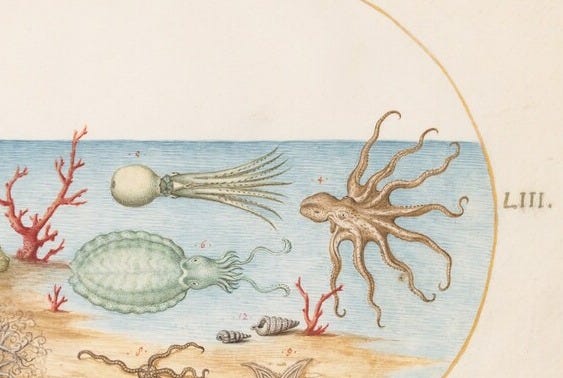
We must inhabit Pointsman to understand his state of being as Pointsman’s Agony, as Pynchon does in the paragraph below (“Both know…”), entering a land of binary numerals and tech analogy to characterize Pointsman relative to Roger Mexico. Of course, his literal agony is not the impossibility of escape from his extreme(ly mechanical) way of moving through the world but his hollowness, his sexual desire for children, his difficulty in finding stray dogs on which to experiment: “Yet for all his agonizing all Pointsman will score, presently, is an octopus—yes a gigantic, horror-movie devilfish name of Grigori: gray, slimy, never still, shivering slow-motion in his makeshift pen…”1
Such soulless eight-legged criminal perversion swims downstream from Pointsman’s perceptive capacity, which is more or less a machine’s:2
Both know how strange their liaison must look. If ever the anti-Pointsman existed, Roger Mexico is the man. Not so much, the doctor admits, for the psychical research. The young statistician is devoted to number and to method, not table-rapping or wishful thinking. But in the domain of zero to one, not-something to something, Pointsman can only possess the zero and the one. He cannot, like Mexico, survive anyplace in between. Like his master I.P. Pavlov before him, he imagines the cortex of the brain as a mosaic of tiny off/on elements. Some are always in bright excitation, others darkly inhibited. The contours, bright and dark, keep changing. But each point is only allowed the two states: waking or sleep. One or zero. “Summation,” “transition,” irradiation,” “concentration,” “reciprocal induction,”—all Pavlovian brain mechanics—assumes the presence of these bi-stable points. But to Mexico belongs the domain between zero and one—the middle Pointsman has excluded from his persuasion—the probabilities. A chance of 0.37 that, by the time he stops his count, a given square on his map will have suffered only only one hit, 0.17 that it will suffer two…
Yet it’s not as if Mexico’s a humanist; he’s still mathematizing. If you can conceive of 0.17 and 0.37 as descriptors of life, you can conceive of one and zero. This narrator’s claim that Mexico is the anti-Poinstman undermines his authority, is itself a Poinstmannish framing that reveals that not only Pointsman, not only Mexico, but the narrator as well suffers from Pointsman’s Agony. Not only the narrator but all of us readers who might buy in to the idea “of the brain as a mosaic of tiny off/on elements.”
Mexico’s map is a grid of London which marks the places German bombs have dropped. Coordinates of death. Legible (quantifiable) tragedy.
Pointsman’s Agony is our creeping inability to conceive of the motion of our bodies and our world without a technological analogue.
Pointsman’s Agonist Peter Thiel’s book is called Zero to One, and he reportedly injects the blood of young people into his arms! (At the very least—he may do worse). Here is your irregular reminder that AI was born from “the conjecture that every aspect of learning or any other feature of intelligence can in principle be so precisely described that a machine can be made to simulate it.”
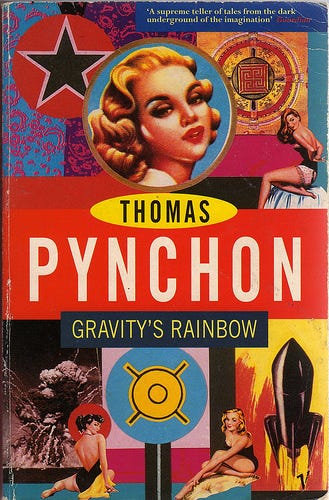
Pointsman’s Agony is the new indelibility of the connection between high technology and old words (like process and compute).
In a novel full of sick characters milling illy about at the tail end of two sick wars, Pointsman stands out as especially sick, yet Pynchon seems to think that in the time period between 1944 and 1973 (when modern computing was invented, mind you) we became even sicker in that Pointsman way—ever more zero-or-one—and there can be no doubt that the period since Gravity’s Rainbow was published has been one of intense Pointsmanization. The special sickness has gone mainstream.
Gravity’s Rainbow 56-57
Works Cited or Referenced
Friend, T. (2025, August 4). How to live forever and get rich doing it. The New Yorker.
Pynchon, T. (2006 [1973]). Gravity’s rainbow. Penguin Books.
All art used under Fair Use Doctrine and/or in accordance with licenses.
No posts
Comments
Nothing yet. Say the first thing.
Sign in to join the conversation.