
My twin daughters were born in August, and as a result, these past two months have been unlike any other time period in my life. Intense and beautiful, impossibly fragmented, magical, exhausting…it is impossible to express just what this feels like.
And Myth, Man, Machine is not the place I want to try. I wrote in one of my introductory posts that “I don’t plan on putting my own identity/story front and center” in this Substack and that’s still how I feel. When I do get personal in MMM, I want it to be within the context of myself as a reader and writer. That may change, but not yet.
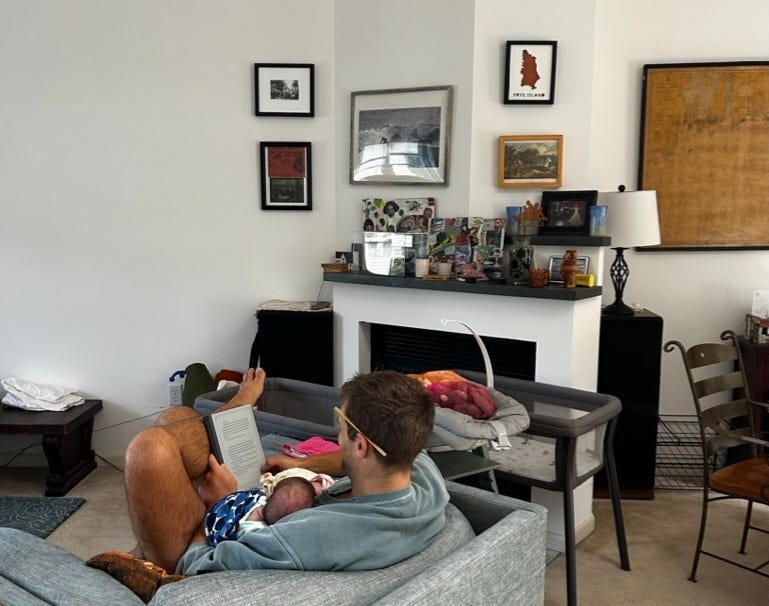
But my writing and reading self is not completely separable from my other elements of self, either, and my writing and reading has been no less profoundly impacted by fatherhood than anything else I do. I’ve never appreciated workshop—a chance to focus on writing with seven incredibly talented peers for two and a half concentrated hours—more than during this semester. It was a great thrill for my first published story to appear in The Adroit Journal just days before my daughters were born. Last month, one of my thesis advisors and a member of my MFA cohort read the most recent draft of my novel; in a small way, the book feels like it has taken its first step into the world just as these girls are developing the ability to see it. And of course there are the eleven posts I’ve written so far for Myth, Man, Machine, often late at night while I keep one leery eye on the baby monitor.
Thanks for reading Myth, Man, Machine. This post is public, so feel free to share it.
Tomorrow I will publish the thirteenth Myth, Man, Machine post. It will be the final installment of the Artificial Infinitude series and my last post for a while. I’m going to call these posts Season One. I need to focus on revising my novel; I am also writing a critical essay that uses Kazuo Ishiguro’s Klara and the Sun to ask if narrative possesses something uniquely human and therefore inaccessible to machines. I’m applying to fellowships and two PhD programs. My parental leave ends this week, and I’ve got a lot of work to do in order to prepare for the TAship I’ll hold through the end of the semester. And my daughters haven’t quite figured out how to survive on their own yet.
As I wrote before, “I frankly do not understand how Miranda July and Junot Diaz and George Saunders and so many other writers of high-quality fiction (and nonfiction) are producing a regular Substack and also continuing to write well beyond it.” True to my prediction, I can’t keep it up. I don’t know when Season Two will begin, but in between I should manage a post here and there. I will definitely be reading other people’s Substacks and interacting via Notes. Judging by the low bar set by social media overall, I remain a pretty big fan of the Substack ecosystem.
I’m pretty happy with and excited by Season One. When I began it, I wrote:
My hope is that people who find writing of mine elsewhere, or find me in real life, or have some other reason to Google me, will come across MMM and be able to get a better sense of who I am and my interests.
Season One of MMM did largely remain focused on “human narrative and its symbiotic, reflexive relationship with technology.” Anyone cross-referencing my fiction with this Substack will not have any trouble collating the ideas present in each.
I also wrote:
Ideally, this Substack will be a place for me to get rather experimental from time to time with my nonfiction, where I need not exert the kind of discipline required for academic writing (and I do mean kind, not amount). Perhaps it can be something of a lab or testing ground for eventual narrative (non)fiction forms.
I think I’ve been true to that; especially if you interpret “experimental” as “barely coherent” (but still hopefully interesting) my recent post Pointsman’s Agony emblemizes my expression of unacademic discipline.
Other highlights of Season One:
Faith in Mortal Life, a a humble effort at making my favorite living philosopher, Martin Hägglund, my interlocutor;
Biblical Freight, in which I dip into archaeology to inquire into the purpose and power of literary allusion; and
We’re Having Digital Twins, which asks us to consider the many virtual versions of ourselves that currently exist—and what that means for the future.
Despite saying that “I don’t anticipate ever charging for MMM, and if I do, it will have become something far bigger and more involved,” I managed to collect five paying subscribers. To those five folks, thank you so much! I hope you won’t be displeased by this imminent hiatus; then again, the point of making it free was to allow me to do such a thing.
I do think that Season Two, when it comes, will be a little more focused and straightforward. Maybe. But I don’t think I’ll be any less obsessed with myth, machines, and how humans interact with them through narrative. Nor, given the latest velocity of the world’s frenzied revolutions, will those three things be any less important.
If you’ve made it this far, thanks for reading!
Sincerely,
Miklos
No posts
Comments
Nothing yet. Say the first thing.
Sign in to join the conversation.