
Your Trauma Therapist by Lauren Auer, LCPC is a reader-supported publication. To receive new posts and support my work, consider becoming a free or paid subscriber. For more content follow me on Instagram.
I am not, historically, a big sports fan. My family wasn’t either, so I never really grew up around it. My high school was notoriously bad at most sports, my college didn’t even have a football team. I enjoy attending a baseball game for the hot dogs and the general experience of going somewhere, but I’ve never really been invested in a team.
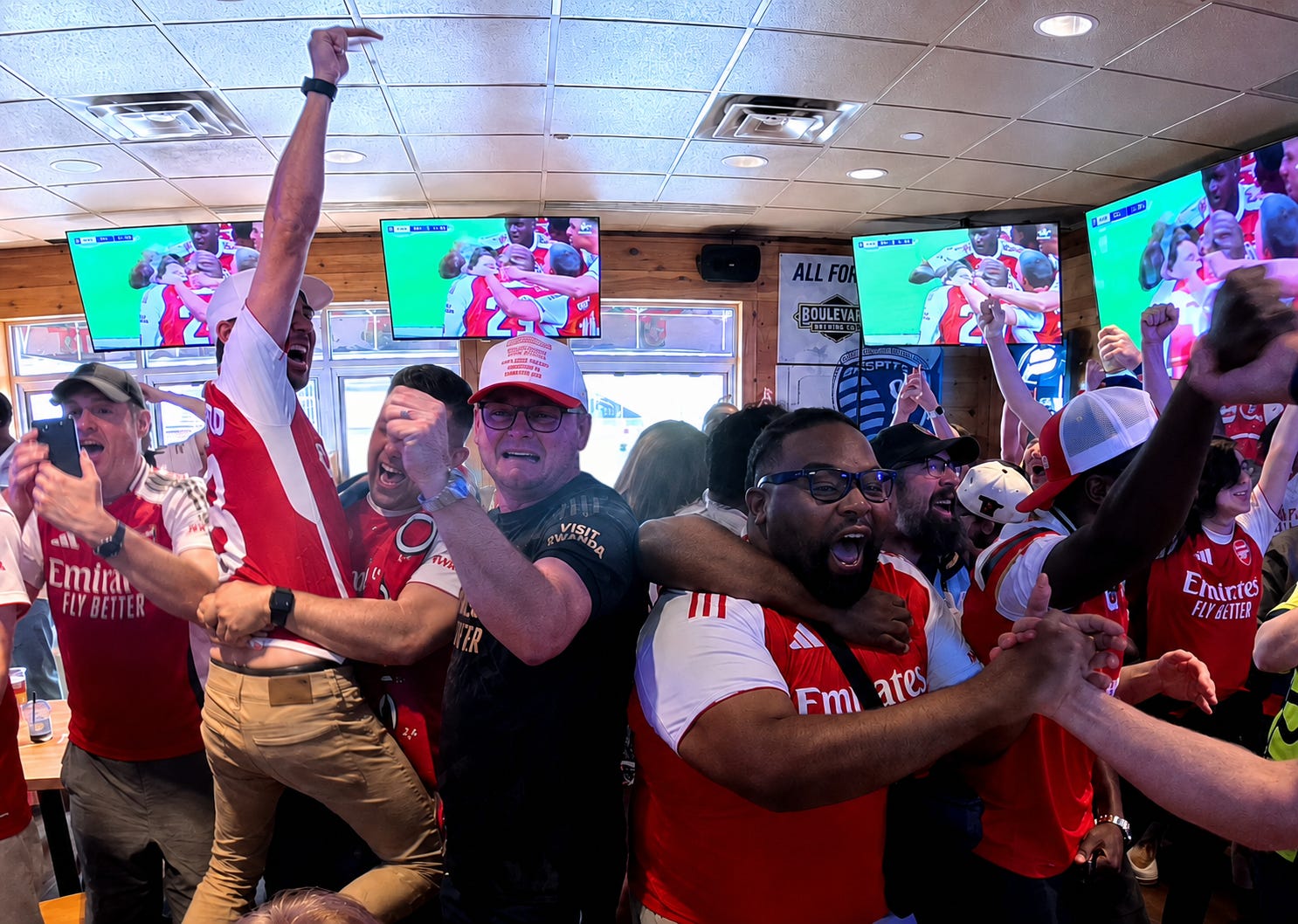
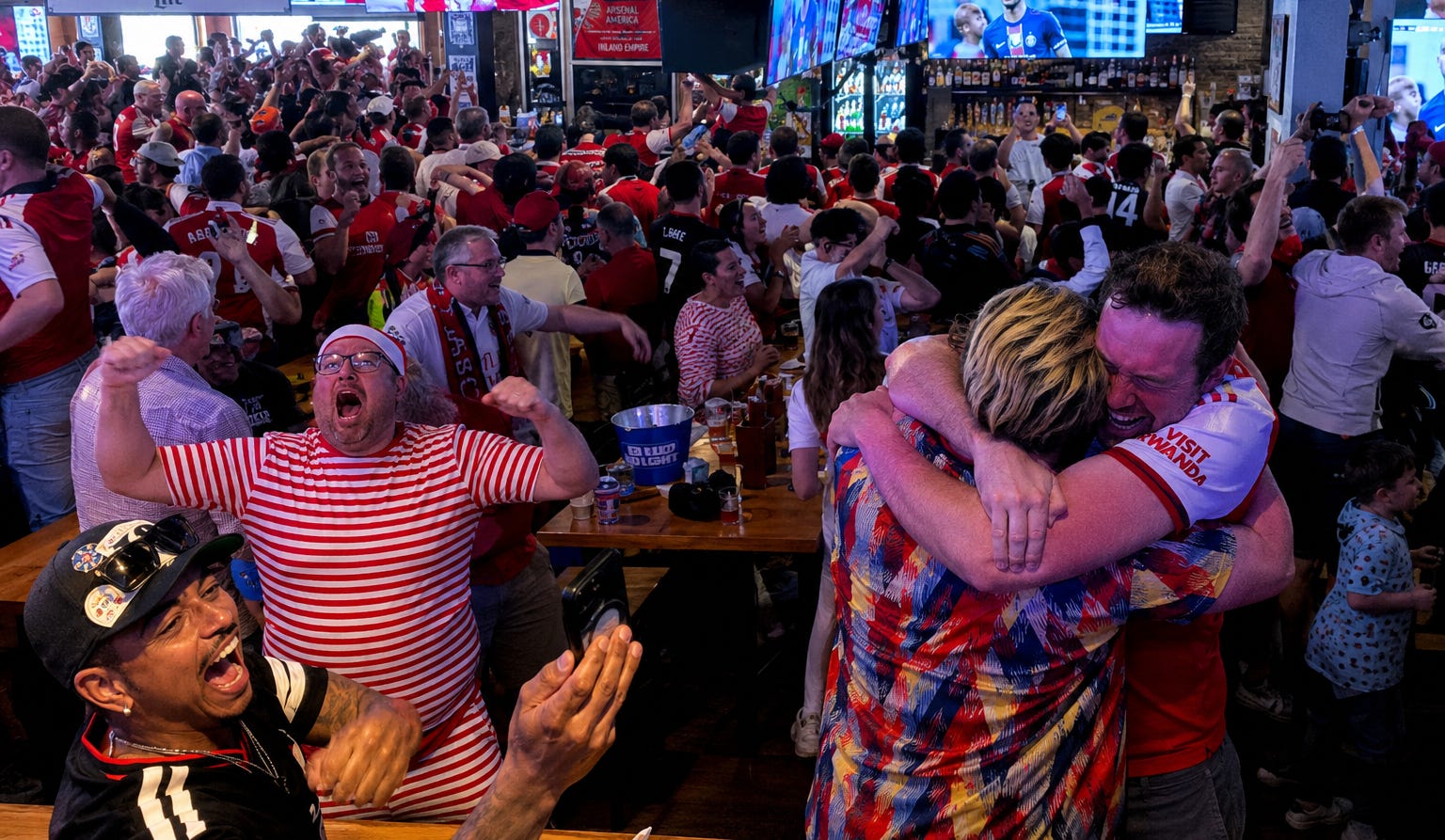
But on a Saturday afternoon recently, I found myself crammed into a sports bar in Kansas City with over 400 die-hard Arsenal fans watching a UEFA Champions League match happening an ocean away. I don’t think I fully appreciated how remarkable that was until I was standing in the middle of it.
Talking to the fans around me, I started to piece together the context. This wasn’t just any match. Arsenal has one of the more painful trophy droughts in English football, something in the range of two decades without a major title, and this Champions League run had felt to their fans like a genuine shot at something historic. The hope, the near-miss over months of matches, the grief of how it ultimately ended. All of that was still sitting in the room.
I left thinking about nervous systems. That’s the occupational hazard of being a trauma therapist. You go somewhere to watch a game and end up having a clinical epiphany over your beer.
What I watched that day wasn’t just fandom. It was something more primal. Strangers turning to each other mid-play, grabbing arms, making eye contact with people they’d never met. Grown adults covering their faces. The collective inhale before a penalty kick. The kind of screaming that doesn’t feel performative at all, it just comes out of you. And then, in the aftermath, something I can only describe as people being held by the room itself, regardless of the outcome.
I kept thinking that this is exactly what we're starving for.
We are, by most measures, profoundly lonely. In 2023, the U.S. Surgeon General issued an advisory declaring loneliness a public health crisis, noting that roughly half of American adults report measurable levels of social isolation. The health consequences are significant enough that researchers have compared chronic loneliness, in terms of mortality risk, to smoking 15 cigarettes a day. We know this. We talk about it. And we keep designing lives that make togetherness harder to find.
And the strange thing is that most of us aren’t lonely in the way we picture loneliness. We’re not isolated in a cabin somewhere with no human contact. We’re busy. We’re in meetings and grocery stores and school pickup lines. We’re technically around people constantly. But there’s a difference between being around people and actually being met by them. A lot of modern life is proximity without contact. We move through our days in adjacent bubbles, making small talk, performing fine, getting through it. The kind of moment where you feel genuinely seen or held by a group of people, where you’re not managing yourself at all, those moments have gotten rarer. And most of us have stopped expecting them.
What gets less attention is what we actually lose when that happens. Not connection in the abstract, but the actual embodied nervous system state that only happens when we’re physically present with other people who are feeling the same thing we are.
Our nervous systems are not built to regulate alone. The social engagement system is a set of neural pathways that come online in conditions of safety and allow us to connect, co-regulate, and settle. We’re continuously reading the faces, voices, and body language around us, running an unconscious scan for safety. When we find it, something in us relaxes in a way that no amount of solo deep breathing fully replicates.
A bar full of people collectively losing their minds over a goal is, neurologically speaking, a co-regulation event.
I watched this happen in real time. The room was loud and chaotic by most standards. But there was something underneath the noise that felt like safety. The guy next to me spent a good portion of the match with his face buried in his hands, barely able to watch. He wasn’t managing how he came across. Even as an unknown face in this environment, I had strangers hugging me and high fiving me. The feelings came and people just let them, together. That’s actually hard for a lot of people. And it happened organically because the container made it feel safe enough.
While we waited for the match to start, I struck up conversation with a few of the long-time Arsenal fans in the room. I asked how they got into it. I expected to hear about a dad who never missed a match, or some formative childhood memory at a first live game. Both of them more or less said they’d just decided to jump on the train.
One said he’d attended a game years ago and the energy of the crowd was contagious enough that he wanted to be part of something like that again. The other said he simply chose a team one day and went all in. Neither story was really about Arsenal. Both were about wanting to belong to something, and Arsenal happened to be the vehicle.
That stuck with me. Because a lot of people who feel like outsiders to community, myself included, carry an assumption that belonging is something that happens to other people. That you need the right backstory, the inherited loyalty, the family connection. These two guys just decided. And then they showed up, repeatedly, until the room felt like theirs.
That’s a therapeutic concept dressed up as soccer fandom.
Many of my clients have a truly complicated relationship with feeling things in front of other people. We learn, in various ways, that big feelings are inconvenient or too much. We get skilled at waiting until we’re alone to fall apart, or not falling apart at all. The feelings get managed, minimized, held at a careful distance from anyone who might witness them.
What collective fandom offers is almost countercultural in that context. A room full of people all feeling the same thing, at the same time, with no social penalty for showing it. Nobody in that bar was performing their feelings for social credit. Nobody was doing the internal calculus about whether their reaction was proportionate. The stakes were shared and the container held it, and people just responded.
For someone who has spent years learning to keep emotional experience small and internal, being part of something like that is not trivial. It’s actually practicing something.
Fandom isn’t a substitute for therapy, close relationships, or the slower work of building real community. Collective joy at a sporting event is not going to process stored trauma or repair attachment wounds. But it doesn’t have to do all of that to matter.
And this applies well beyond sports. The nervous system doesn’t care whether you’re in a packed sports bar or a living room full of people who all read the same book and have strong opinions about the ending. What it’s responding to is the shared stakes, the common language, the sense that everyone in the room already has some reason to be there together.
I think about clients who have built some of their most meaningful adult friendships through Harry Potter fan communities, or through a book club where one novel cracked something open and suddenly there were six people sitting around a table who actually knew each other. What fandom provides in all of those contexts is structure. A built-in reason to reach out, a shared reference point, something to talk about before you know each other well enough to talk about the real things. For anyone who finds meeting people as an adult somewhere between awkward and legitimately hard, that scaffolding matters more than we give it credit for.
Social anxiety in particular makes unstructured social situations exhausting. Walking into a room where you know nobody and are expected to generate connection from scratch is a lot to ask of a nervous system that’s already scanning for threat. Walking into a room where everyone is there because they love the same thing you love is a different experience entirely. The commonality does some of the work before you even open your mouth.
That’s not a shallow way to make friends. That’s actually a pretty wise one.
The Arsenal fans I talked to that day didn’t wait for belonging to find them. They picked something, showed up, and kept going until the room felt like theirs. In whatever form that takes for you, that option is available. You just have to decide.
Your Trauma Therapist by Lauren Auer, LCPC is a reader-supported publication. To receive new posts and support my work, consider becoming a free or paid subscriber. For more content follow me on Instagram.
Comments
Nothing yet. Say the first thing.
Sign in to join the conversation.