
Welcome to The Soft System where I help business owners break free from bloated, performative structures that look successful but are actually chaotic and unsustainable.
Here, you’ll learn how to build streamlined, aligned systems that support both your business growth and the life you want to live.
Your Software Addiction Is Sabotaging Everything: Each "Solution" Creates Three New Problems
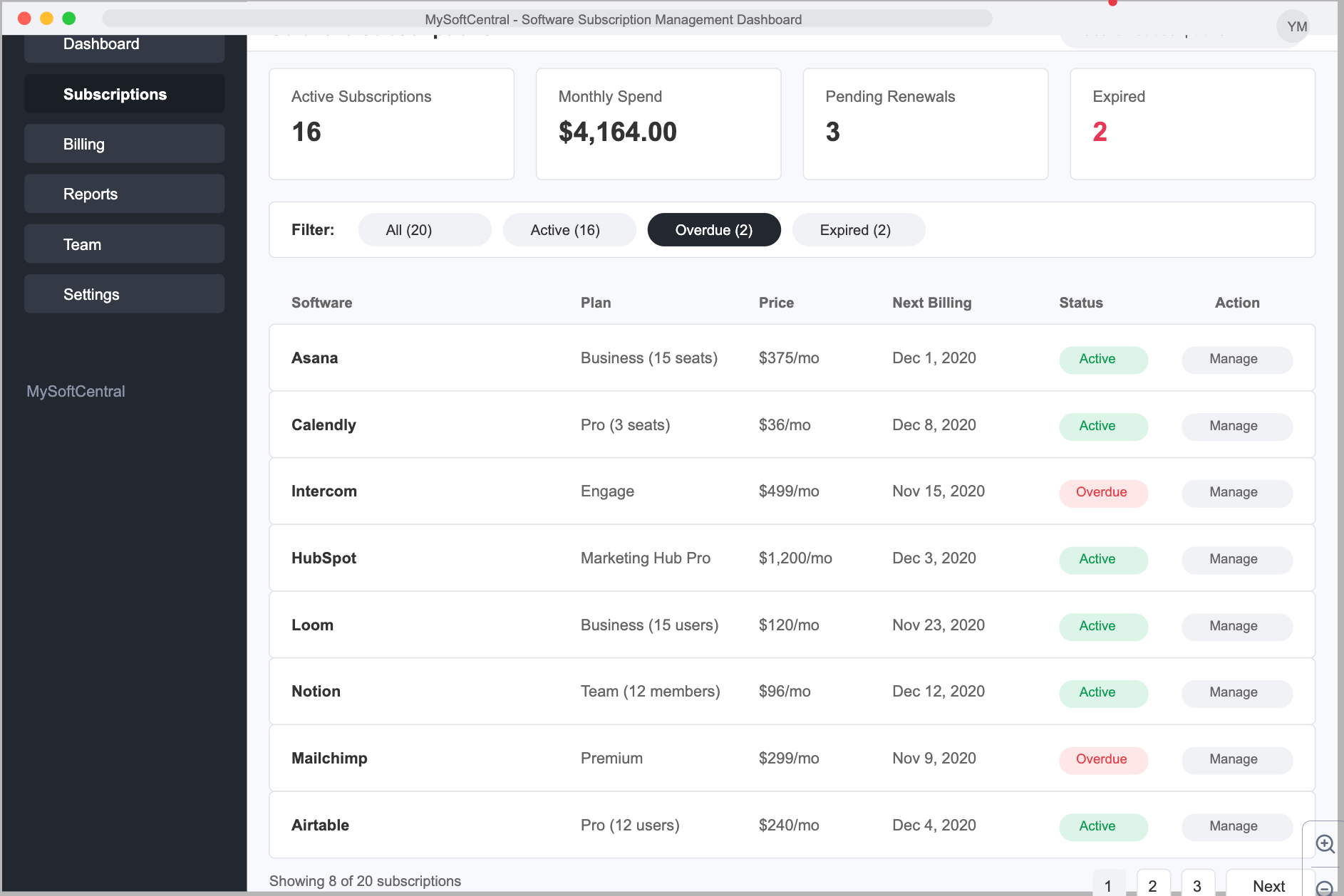
November 2020. 3:42 AM. Couldn't sleep so I decided to organize my bank statement. Bad idea.
Over $4,893 in monthly software subscriptions. Just sitting there. Staring back at me.
Asana ($375/mo for 15 seats we barely use).
Calendly ($36/mo for 3 seats with Zoom integration).
Intercom ($499/mo that we originally justified for "customer experience").
Hubspot ($1,200/mo for their marketing suite that only two people on the team understand).
Loom ($120/mo that we swore would improve team communication).
Notion ($96/mo for "documentation" that nobody updates). Mailchimp ($299/mo for email campaigns we send once a month).
Airtable ($240/mo for custom databases we could've built in Google Sheets). Zapier ($299/mo to connect all these things that somehow still don't actually connect).
And I'm not even counting the tools I forgot we had until the charges hit my card.
It was a long list.
I started taking screenshots of all the admin panels. The dozens of half-configured settings. The abandoned automations. The empty team member profiles of people who quit six months ago.
God, what a mess.
Remember when we all thought getting the right tech stack would solve everything? When we'd read those "How I Built My 7-Figure Business With These 10 Tools" articles and think, "That's what I'm missing!"
We literally overwhelmed ourselves.
Real talk: I audited 16 clients last year and found the average business wastes $2,100 monthly on unused or underutilized software. That's $25,200 annually going straight into the trash.
I work with these client who runs a luxury concierge service in Miami with her husband. They help wealthy people get impossible restaurant reservations, VIP concert tickets, last-minute yacht charters—you get the idea.
Their business looked incredible from the outside. But internally? Well….that’s a subject for another tale.
When I first got access to their systems, I found:
Dubsado for client onboarding (setup fee paid, then abandoned)
17Hats for contract management (also abandoned mid-setup)
HoneyBook for invoicing (set up but missing crucial payment integrations)
Freshbooks for accounting (because their bookkeeper preferred it)
Trello for team tasks
Asana for client projects (yes, two project management tools)
Google Sheets for tracking VIP requests
Zoho CRM (barely used)
Streak for Gmail (competing with their CRM)
WhatsApp for client communication
Slack for team communication
TextExpander for canned responses
Later for Instagram scheduling
Buffer for other social scheduling
Flodesk for their newsletter
Acuity for scheduling
Quickbooks (which duplicated Freshbooks' function)
Expensify for receipt tracking
DocuSign for contracts (despite HoneyBook having this feature)
Google Drive, organized by... nothing comprehensible
Twenty tools. Twenty monthly subscriptions. Almost none of them talking to each other.
Their team spent more time copying and pasting information between platforms than actually delivering for clients. They were manually entering the same client data into five different systems. Their "system" was a digital version of those people who collect newspapers until they're buried alive.
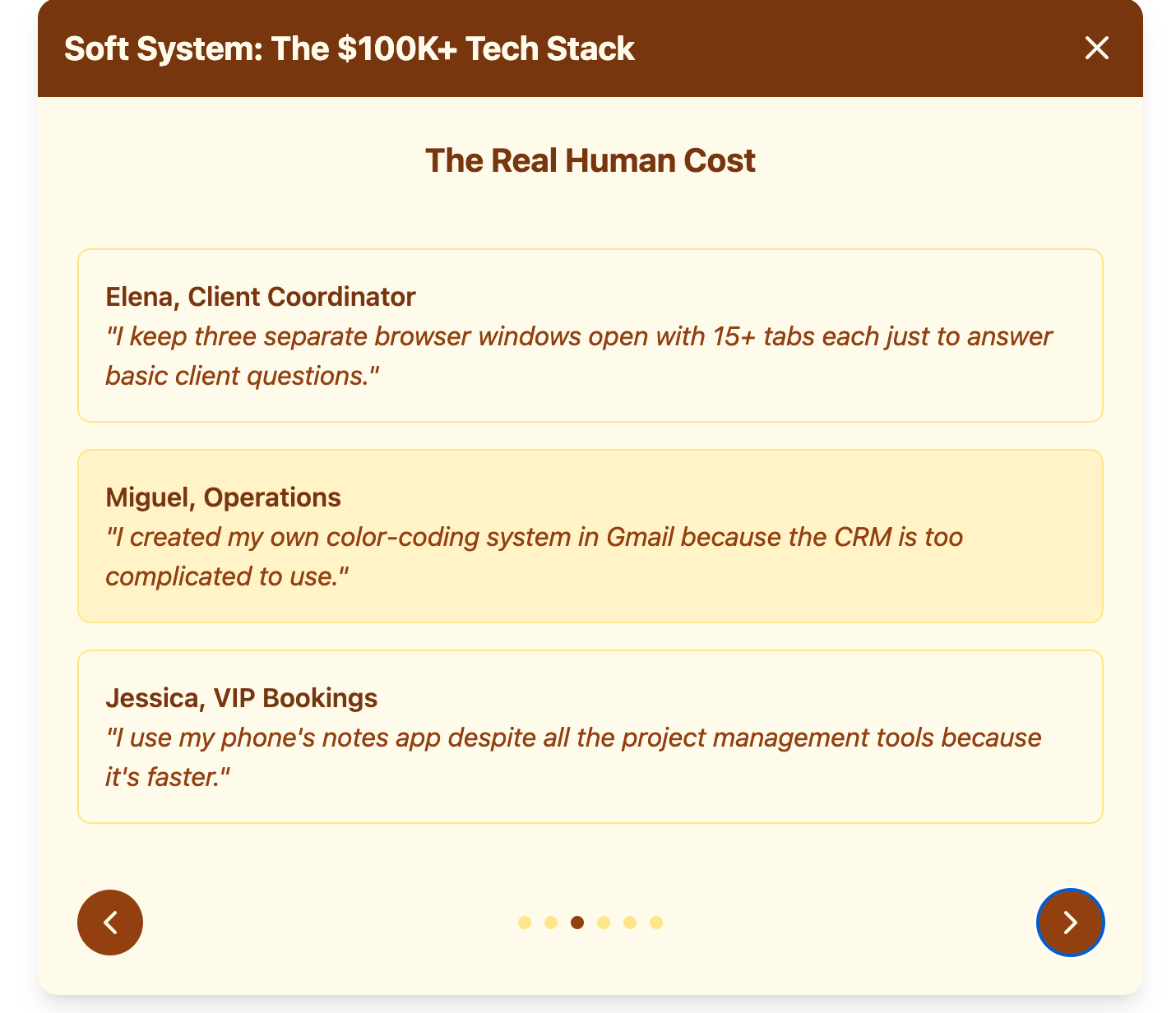
Behind every disconnected tool is a real human being forced to compensate for your technology decisions:
Elena, their client coordinator, keeps three separate browser windows open with 15+ tabs each because she has to constantly jump between systems to answer basic client questions.
Their operations guy, Miguel, created an elaborate color-coding system in Gmail because the CRM is so complicated that he gave up using it after two weeks.
Jessica, who handles their VIP bookings, exclusively uses her phone's notes app despite all the project management tools because "it's faster than waiting for Asana to load."
This isn't just inefficient—it's soul-crushing. Your team isn't excited about your business vision anymore; they're just trying to survive your fragmented tools.
This whole mess started innocently enough:
In 2017, you bought ClickFunnels ($297/mo) because Russell Brunson convinced you it was the magic solution for lead generation.
In 2018, you added Kajabi ($199/mo) because you were launching an online course, and everyone in that mastermind you joined swore by it.
In 2019, you got Kartra ($99/mo) because it promised to consolidate everything... but you didn't actually migrate off the other platforms.
By early 2020, you'd added Monday.com ($120/mo) after watching a podcast interview with a founder who credited it for their 8-figure exit.
None of these purchases came with a plan for:
Migrating data from existing tools
Training team members properly
Updating your SOPs to reflect the new tool
Deciding which old tools to sunset
You just kept adding. And adding. And adding.
It's like someone who buys a new outfit instead of doing laundry. Eventually, you run out of closet space, money, and sanity.
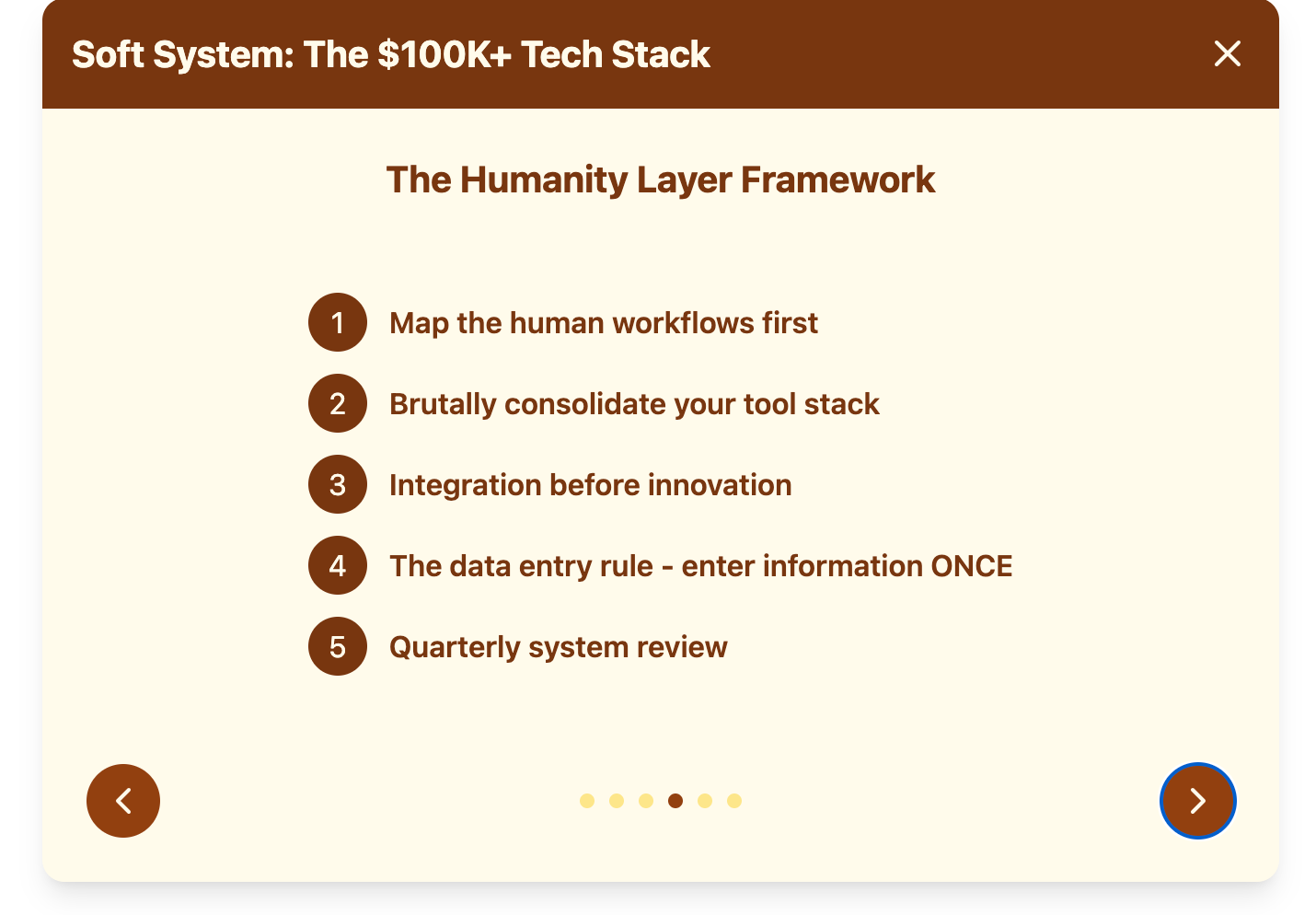
After helping dozens of businesses untangle their tech disasters, I've developed what I call The Humanity Layer framework. It's embarrassingly simple but nobody does it:
1. Map the human workflows first Before touching any software, document exactly how information flows through your business. Who needs what information, when, and for what purpose? I literally use sticky notes and a whiteboard for this. Old school, but it works.
2. Brutally consolidate your tool stack Most businesses need 5-7 core tools, not 20+. Your non-negotiables are typically:
One CRM/client management system
One project/task management tool
One communication hub
One financial system
One content/marketing platform
Everything else is probably expendable.
3. Integration before innovation No new tool enters your business unless it directly integrates with your core stack. No exceptions, no matter how cool the sales demo looked.
4. The data entry rule Information should be entered ONCE and flow automatically to all places it's needed. If someone's copying and pasting between tools, your system is broken.
5. Quarterly system review Every 90 days, pull usage reports for all tools. If you're using less than 60% of the features you're paying for, it's time to downgrade or eliminate.
When I implemented this with the luxury concierge business:
We cut their monthly software costs from $3,200 to $840
Their client response time dropped from 4.2 hours to 36 minutes
They reclaimed 22+ hours of team time per week previously spent on data entry
Their cancellation rate decreased 35% because clients stopped falling through the cracks
They actually got visibility into their business for the first time
All by doing less, not more.
I'm opening up five spots for my Lean System Detox program next month.
Over 8 weeks, we:
Document your current information ecosystem (the good, bad, and ugly)
Identify which tools are actually critical vs. which ones you've been emotionally attached to
Create your simplified integration blueprint
Build proper SOPs for your streamlined systems
Train your team on the consolidated workflow
Implement your quarterly system audit process
You shouldn’t be adding more tools, you should be creating a system that actually works for the humans using it.
If you're tired of digital bloat and ready for clarity, consider becoming a paying subscriber to get it straight in your inbox.
Back to my 3:42 AM bank statement moment in 2020—I made a list of every subscription we had. Then I organized them by last login date. Some of them hadn't been touched in 6+ months.
I canceled eleven subscriptions before the sun came up.
The next day, nobody even noticed they were gone. Not one person on my team asked, "Hey, where did [tool] go?"
That's when I knew we had a problem bigger than just wasted money. We had a system that existed on paper but not in reality.
Did this bring you a level of clarity?
P.S. Tell me one thing you're embarrassed to admit about your current tech stack. I like to think that (I've seen it all but I’m ready to be surprised). Hit reply, I promise not to judge.
No posts
Comments
Nothing yet. Say the first thing.
Sign in to join the conversation.