
“I’ve been playing with this concept of differentiating between bravery and courage.
I think when you get hit with something big that you don’t see coming, at first you’re in survival mode and you’re dealing with all these intense feelings. Bravery in that moment is choosing to keep moving, to get out of bed, and to feed yourself and hydrate. That takes bravery in the face of something really hard and life-changing that you weren’t expecting.
Then at a certain point there’s this shift that happens where you start to realize, ‘Okay, I’m working through my grief steps and I have some more acceptance now that this thing has happened.’ And you get to this point where you say, ‘What can I choose now? Where can I be proactive now? Where can I have some agency over ultimately how much power this thing is going to have over me?’ That is courage.
Whether it’s piecemealing lots of different side jobs so that you can make an income and have that flexibility of parenting or it’s going back to an office job. Choosing that in a field that feels good for you so that even if you do still have to sacrifice some time with your kids, you feel better about it because you feel better about the work that you’re doing when you’re not with them.
I think it’s a different path for every person. But I think the root for everybody who has that experience [of career disruption] is to ultimately get to where they are choosing instead of feeling like things are being chosen for them.”
-Mike Swartz
A few weeks ago Career Pivot put out a call to parents and caregivers who were navigating career transitions. Thanks to the many of you who reached out to share your insights and stories. I dove into their stories to better understand their perspectives on how career disruption affected their parenting, the challenges they faced as professionals and parents, and the elements of their success in navigating disruption.
One common trend emerged: successful transitions take many forms. The transition occurs through an iterative process of rebuilding one’s identity, family, and career marked by a clear sense of moving forward. Parents who successfully transitioned from career disruption often created portfolios of self-employment and/or salaried work.
Janina Acevedo-Yates has always found herself drawn to work that helps people learn, connect, and grow. After years in international development supporting USAID- and UN-funded learning programs, she founded Kitso Learning Solutions and now also serves as an instructional designer for the State of Colorado. We published about her journey back in October.
Jude Leitten moved on from her role with USAID to a leadership role in higher education combined with leading operations in Satori Sounds - her family’s audiovisual and live events business.
Mike Swartz left management roles in landscaping and property management to start Empowerment Consulting as a coach.
Yosi Echeverry Burckhardt left a career with UNICEF to start Sacred Resilience, embodied as a life coach and breathwork guide for women and mothers who find themselves at a life & career threshold.
I myself transitioned from education research as a USAID contractor into an independent education research consultant and part-time substitute teacher in elementary school.
Our post today centers around five themes I uncovered when comparing these transition stories:
The themes are illustrated by parents’ own words in order to remain authentic and honor their experiences. In addition to the people highlighted in this post, we also want to thank the other parents who graciously shared their experiences but wish to remain anonymous.
Career Disruption took a heavy toll on parents but also provided unexpected opportunities for them to be more present with their children and model healthy behaviors for navigating difficult emotions.
“Emotional collapse. I’m a single parent, so I’m all there is. I was terrified about what was going to happen if I couldn’t find a job.”
“Right after I was laid off, it was incredibly impactful in the sense that I didn’t leave my bedroom. I was incredibly depressed.”
“We did not receive a lot of support from our community when I was initially let go. Most people in our community didn’t think it was that big of a deal that I had lost my job. That was one of the things that was hardest for me - people didn’t really understand that I had lost not just a job, but an entire career and an entire group of people that had been like family to me for many years.”
“Not only was I navigating the transition of being laid off and watching everything crumble, but I was also trying to explain that and explain the severity of that to those who are in my immediate vicinity. It felt very isolating. I didn’t know where to go or what to do from there.”
“It was difficult. For the first couple of weeks, we didn’t tell our daughter. When I told her, she handled it well. I assured her that we would be fine…With my son, it was difficult in a different way because he was so little that he didn’t know what was going on. I remember one night sitting with him as he was going to sleep and wondering when or if things in our lives would ever be okay again.”
“A lot of my work now is self-employed. When I choose not to work I’m not working. I can be present with my kids, making dinner, helping with homework, and giving baths. If I want to bill six hours in a day and not work, that’s fine. It’s not like when I had salaried work where I had to find the other hours in the evening to complete eight hours of billable work.”
“I think for me as a parent, it’s helped me get so much more clear on what is truly important. The time with them, teaching them emotional intelligence that I believe is really what is going to make them strong humans.”
“Although being a parent took me away from time to apply for jobs it was the kids that kept me sane. I couldn’t wallow in my grief and feel sorry for myself because I had to take care of them. Being there for them and spending time with them in a way I couldn’t when I was working was one of the things that actually helped me the most through my transition. I feel very grateful for that time we had together, even though at times it was really difficult.”
“I started seeing a therapist; she was the one who encouraged me to model what I want them to do. I was thinking I had to hide it [grief]. And she said, ‘No, regardless of the age of your kids, they’re looking up to you and seeing how you handle a hard time.’ Instead of trying to hide it, I finally started carrying that grief and modeling it in a way that I would want them to navigate grief. I would say, ‘Mommy’s feeling really sad right now and I need a hug.’ That helped my relationship with them, but it also helped me navigate grief because I had never been in this situation before. I felt very absent for a very long time for them and for myself.”
“My opportunity with the kids was on emotional intelligence and vulnerability. It was helping them understand how to create safe spaces for each other, how to express emotion, and how to explore emotion. Also on the emotional side, having a lot of conversations around mental health and normalizing that it’s okay to not be okay and that therapy is healthy.”
“We started having different kinds of conversations about what was important for our home. How do we want to take care of it? What are the values we want to honor? I sat the kids down before we moved into the place we live in now and I said, ‘What are the values you guys want to honor in our house?’ And they just stared at me like deers in the headlights. And I said, ‘Okay. I’ll go first. I want bubbles in the house.’ So bubbles are my number one core value. And that is really about creating joy and living in the moment. Then I said, ‘What do you guys want?’ And that just opened the floodgates and they came up with this amazing list of values. And I had my cousin who’s a graphic designer make a poster with graphics that was our list of values and that is hanging up on the wall in our kitchen. We use it when there’s conflict, no matter who it’s between in the house, we’ll walk over to the poster and we’ll say, ‘What is the value on this list that’s being stepped on for you right now?’ We have these really interesting conversations around the values.and it steers it away from pointing the finger at somebody for doing something and it’s more about feeling like something is off. It’s a totally different conversation.”
Parents reported that caretaking limited the time they could dedicate to job search activities, constrained choices about when to work because of school schedules and care needs, and made them feel isolated from other parents.
“Parenting constrains my time on days when I have to pick up my kids at school in the afternoon and then be with them in the evening or the weekends. In general, I avoid doing work or looking for work on the weekends because I need to be present for my kids and I also need a break. I think that parenting limits my energy for work and job searching primarily to regular working hours. While I have done things in the evening or on weekends, I usually do not have the energy to devote to work or job searching because I’m tired or need to devote my energy to parenting or other things.”
“I have less time to apply, network, and attend events.”
“I had to choose between looking for full-time work that would engage me and keep me earning in the same ballpark as what I had been in my 20-year career versus finding a part-time position that isn’t as interesting or anywhere near my established rate or salary history, but that allows me the flexibility to care for my child.”
“Our current setup has our elementary school-aged son at a school that doesn’t provide student transportation and would make going back to full-time office work extremely logistically challenging.”
“I cannot move to a new city where the job prospects might be more favorable. The threshold for moving is much higher if the kids /are in great schools with spectacular networks and friends.”
“There was no way I was going to move because I have two young children and my family’s all here.”
“The constraint of having a hard time relating to some of the other parents at the school that my son started at and navigating what that was like. My son started pre-K amidst all of this and we were now in this new environment and it was a bit of a struggle to relate and to understand some of those other parents.”
“It’s interesting being here in DC. People get it, but then also lots of people have been missed by this [career disruption]. So they get it, but they don’t really get it.”
Parents experienced significant professional challenges like identity loss, lost confidence in their skills, anxiety tied to their job search, and burnout..
“Loss of identity and income were key for me. I was proud of the work that I did with USAID and the relationships and trust that I’d built over the years that allowed me the flexibility to work outside of the D.C. area and a flexible schedule. Having an interesting, challenging job with that kind of flexibility is extremely rare and I haven’t been able to replicate it.”
“I’ve been working since I was 16 years old so for me to suddenly not have a job really threw me upside down.”
“A big piece of my identity died. I tried to get a job immediately as if that would resolve all the challenges, but grief was this big rock. I tried to put the rock aside and get over it. I recognized that I have to carry that rock with me and integrate that into this new identity that I’m trying to forge. It was incredibly challenging because I was still trying to figure out what aspect of my identity incorporated mother because I loved so much of what we did.”
“The hardest mental challenge was convincing myself that I was still employable and that I would get another job. There were times when I felt like this is it, that was the culmination of my career. My self-esteem dropped.”
“When I got into this new job, I was carrying that [loss of confidence] with me. I thought, ‘I don’t know if I’m good at this or not.’”
“I get interviews, but I can’t convert them to offers. I think it’s just so competitive. There’s nothing about the interviews that are going bad. It can be really challenging to not let that impact your search. I experienced a lot of loss of confidence.”
“I was still in my full-time job when I was building all of this. When you have a little child, you also want to be present with them. So most of the things for my own business planning and working, I was doing it at night and after my baby was asleep. Basically, this was just my side hustle in the beginning.”
“Professionally it has been the hardest to maintain my motivation to find work or complete work. The process of competing for and finding work feels like an endless hamster wheel where people simply decide you are not the person for the role without meaningful feedback. This makes it hard to learn from any one experience (e.g., did I make a mistake or was the decision based on something out of my control). It also makes it difficult to motivate myself for any job interview process because I have done so many now (successful and unsuccessful) and companies do not understand the amount of time it takes to prepare for these conversations or job tasks.”
Parents also faced many caregiving challenges including trouble being present for caregiving after the initial career disruption and periods of intense solo caregiving.
“I have less patience for the kids but also more time to attend their soccer games and recitals. I feel guilty because every moment I spend with them is time I could be perfecting another version of my resume or applying to yet another job.”
“For the first three months, I was so depressed and just trying to figure out which end was up that I didn’t parent. I was physically present, but my parents had taken over the day-to-day duties while I just sort of adjusted my bearings.”
“My energy was totally drained. I relied a lot on friends to get my daughter to playdates, because I did not have the emotional reserve to deal with anything.”
“When I lost my job in February 2025 we immediately moved so my husband could work more during the busy season. We had to take my daughter out of her school and homeschool her. We no longer could afford childcare for my 1 year old and he was at home with me. Between my 1 year old at home and homeschooling my daughter, I had very little time to look for work or really do anything else. My energy and patience took a huge hit. I pretty much gave up looking for work in the first couple of months after I was let go. It was just too much.”
“I was completely alone. When I was at my duty station, I still had support. I had a nanny. We had some play dates on where she would go with the baby. And as I left [my duty station], I was just by myself. It was even more of a responsibility of being with her the whole day. I moved to a new country. I didn’t have childcare in the beginning. I couldn’t do anything at the beginning. I just had to be present and also heal myself a little bit from this whole mess. I think a month and a half ago did I actually start kind of putting myself out there and working with clients. It’s just overwhelming because the parental responsibilities are so intense. And then you can multiply it when you’re a single parent.”
Ultimately, parents cited numerous sources of support that helped them manage career disruption and make a successful transition including empathetic partners and families, supportive school communities, networking with former colleagues and new communities, and finding the time to develop an intentional, strategic approach to their job search
“I really leaned on my partner. My partner was my saving grace.”
“When I relocated us back to the mountains, it was a place where we had built community. My parents live up here. I have some other family and friends up here. We were able to relocate to a place that had support ready for us. We lived in my parents’ basement for the first six months of last year.”
“My wife has been endlessly supportive of professional and parenting needs. Professionally, she has been the largest source of emotional support and she is always telling me that she is proud of me and that we will get through this situation together. For parenting needs, our teamwork and balance has not changed since all this started. We continue to work together and balance the parenting load based on our strengths.”
“My family has been a big support, although I’m not in the same location as them. My mom has really been a great support. I have a few friends who have been giving extra support as well, more from remote than in person, but moral support and being there.”
“As a parent there was financial support early on. There was the physical driving the kids all over the place. I had friends who would reach out who had known my older two [kids] when we first lived in this town saying ‘Hey, can I take your kids out for the afternoon’ or friends of ours with other kids were arranging playdates and sleepovers.”
“My daughter’s school gave us a grant that eliminated the tuition balance for the rest of the school year which was a huge help…I substitute teach part-time at my daughter’s school because it’s a lot of fun to interact with the kids and play a larger role within that school community.”
“The school network is great, and willing to provide financial assistance in things like show tickets. They are very cognizant of the needs of all families.”
“I’ve had to expand my network through Never Search Alone, Career Pivot, and consulting opportunities. Ultimately, my network provided leads or direct referrals for all of my successful consulting contracts. My network has also been instrumental in securing interviews and positions on bids.”
“My network was great at suggesting opportunities and meeting with me, helping me with applications, and providing emotional support--as long as I asked.”
“Once we moved, we became involved in the arts community through the exhibit and my husband’s job. That was where we started really building a community and that was where we had a bit more support.”
“There was a sad hour at the Posner Center for International Development in Denver. Many of us who had been impacted or were about to be impacted gathered. That was the first time that I ever met others who touched international relations or international development in Colorado. We started forming a community through shared grief and it has grown.There were three of us and now I think the listserv touches over 200 people in the state of Colorado and we have affectionately named it the Tuesday Group. Through mutual aid, we’ve formed sessions, we’ve done workshops, we’ve had social gatherings to touch on the fact that many of us felt very isolated when this happened. Now, we’ve got this whole branch of parents who’ve gathered because we’ve found that that’s a whole other niche. I think it’s been immensely helpful for the job search, but more for the social emotional vastness that was missing after our jobs were taken. As a parent too, it has reminded me that so many people have been impacted by this.”
“[Friends] really wanted to support what I was trying to build. Tapping into them to help get into their networks to talk more about coaching and what I offer was huge. It’s definitely a big piece of how the back half of last year was successful for me.”
“I think the biggest piece is getting past that internal voice that wants you to not ask for help. I think most of us have that innate piece within us that wants to help when somebody else is struggling through something. Then when we’re struggling through something somehow we tell ourselves that it’s not okay to ask for help... Getting past that fear or even shame involved in that ask is huge because it’s amazing how many people really want to show up and provide support.”
“It’s been an overwhelming few months. Giving myself the time to decompress and not rush into the next thing has been such a huge learning for me because we’re so indoctrinated to constantly deliver and have outputs and results…I’ve been leaning into giving myself time to rest and going at my own pace. And that’s been quite helpful.”
“I didn’t push myself and ultimately only applied for 24 positions over the 15 months that I was unemployed. Plus, between caring for my one year old, homeschooling my daughter, and curating the USAID exhibit, I just didn’t have the damn time to apply for hundreds of jobs. I curated the USAID art exhibit as a way of grieving and paying tribute to what had been lost. Ultimately, it was that exhibit that put me out ahead of other candidates for the job I’m currently in. And somewhere deep inside me I knew that, by trusting my instincts and organizing this exhibit, good things would come from it.”
Looking for more stories shedding light on what it’s like to balance caregiving duties with a job search? Well you’re in luck. This post is the first of several we’re planning for our Parenting Through the Reset series, so stay tuned for those.
If you’re a parent or caregiver who’s navigated (or are currently navigating) as career disruption and would like to share your insights with the wider community, we’d love to hear from you about any topic. Here’s a few ways you can reach out.
You can fill out either (or both) of these forms to share insights on the following topics:
Childcare: Features six (6) questions covering your current professional situation, childcare setups, challenges, creative solutions, support systems, and direct advice.
Caregiving for Parents: Includes six (6) questions covering your current professional situation, caregiving setups, challenges, creative solutions, support systems, and direct advice.
Don’t want to type it all out? Let’s talk. You can schedule time to chat with me to share your experience.
Send me a direct message on LinkedIn, and I will provide you with a number to send over a quick WhatsApp voice note while you’re making dinner or running errands.
Have you been thinking about sharing your story on a wider scale?
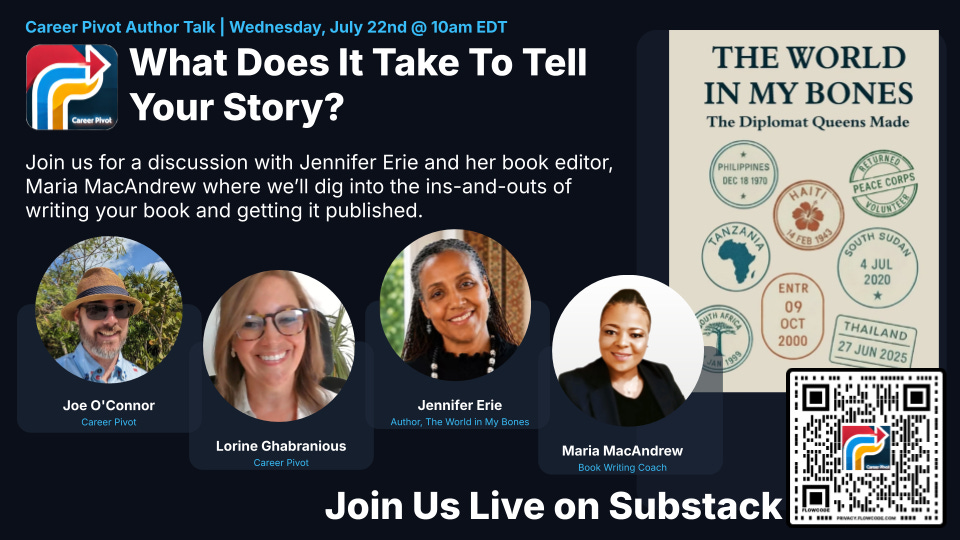
Then be sure to join us tomorrow (July 22nd) at 10am for our Live Discussion with Jennifer Erie and Maria MacAndrew. Together they’ll pull back the curtain on what it takes to write your story and get your book published.
Comments
Nothing yet. Say the first thing.
Sign in to join the conversation.