
I’ve been spending the past few weeks trying to stress test the newest part of the Batteries Included Fund thesis: relocatability. Not just whether a battery can move, but whether that movement actually creates value.
Part of the reason I got pulled into this question is because I’ve already spent a lot of time thinking about batteries in pretty fixed ways. Last summer at Vrinda Inc, I modeled long-duration energy storage systems in New York and analyzed how different storage technologies monetize through NYISO energy, capacity, and ancillary service markets. A lot of that work revolved around the “value stack” idea: How many revenue streams can a battery access? Which layers matter most? When do the economics actually work?
At first, the story felt pretty straightforward. Batteries go somewhere, they plug in, they either make money or save it, and that’s basically it. But the more I looked at the companies we’ve invested in, the less that explanation really held up. None of these batteries are actually staying where they started, and once I noticed that, it became hard to stop thinking about.
Our investment thesis frames things in terms of right place, right time. A battery might sit next to solar, next to machines, or maybe inside them. Wherever it lands, that placement gives it access to a specific set of value streams.
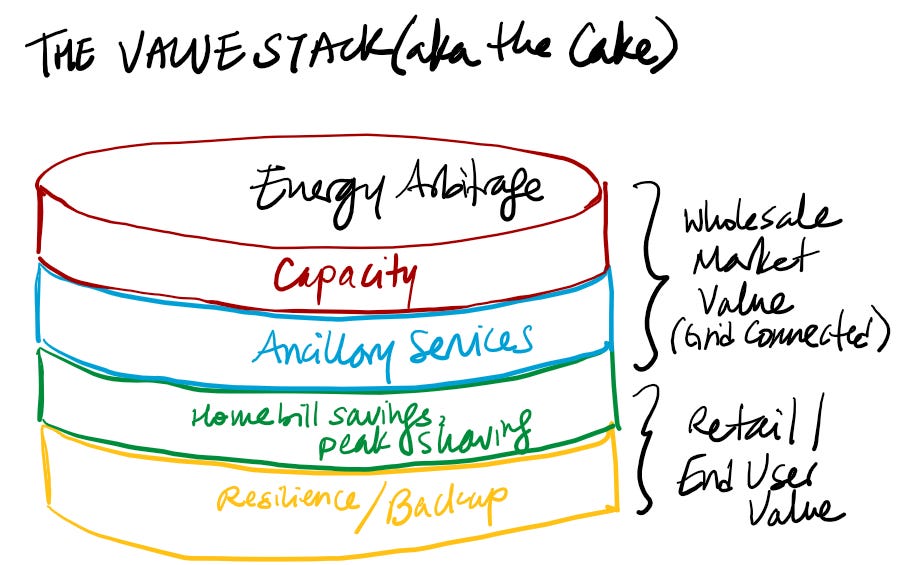
While researching NYISO markets, I spent a lot of time looking at how storage systems stack wholesale revenue through:
arbitrage,
capacity payments,
spinning reserves, and
regulation services.
Some technologies looked feasible only when multiple layers were combined together. Others depended heavily on timing, geography, or grid conditions.
In homes, the stack looks different. Instead of wholesale market revenue, retail value might come from:
bill savings,
backup power, or
avoiding expensive electrical upgrades.
This is the magic of batteries in an increasingly electrified world; the exact same battery can create value very differently depending on where it lives.
It’s helpful to think of a stack (cake?) where each layer represents a different type of value a battery can capture. Most batteries today are designed to optimize within one of two very different stacks: wholesale, or retail. They pick one stack and dedicate a battery’s entire life to that one stack.
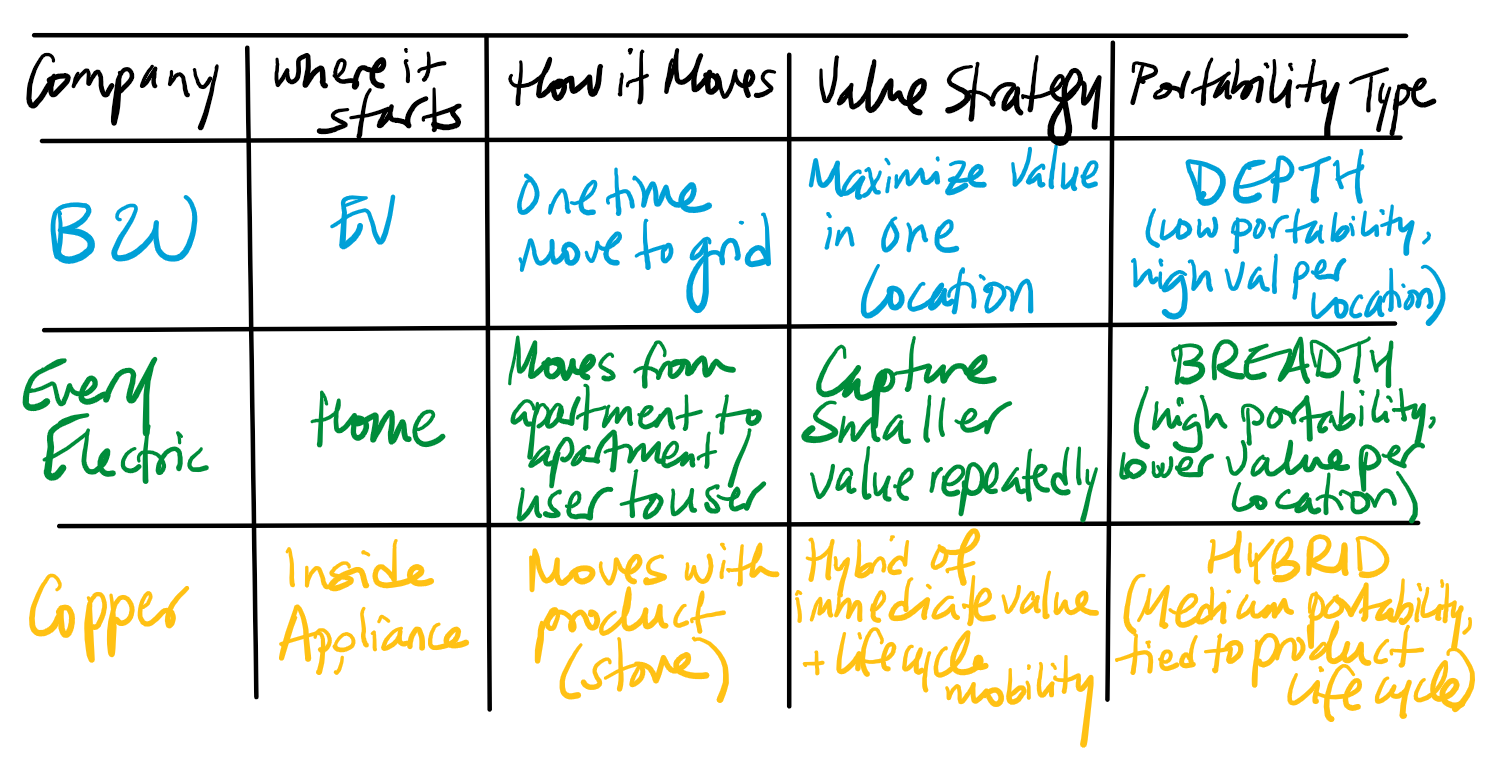
When I mapped out B2U, Every Electric, and Copper side by side, I saw three very different approaches to placement and movement.
B2U starts with EV batteries and moves them into the grid. That’s a one time, impactful relocation from an EV to the grid, where the battery enters a mature value stack with pretty established revenue streams. From there, it mostly stays put and maximizes value within that environment; it’s a model built around depth.
Every Electric feels completely different. The battery starts in the home, but it doesn’t stay tied to one apartment or one user. It moves from apartment to apartment while continuing to participate in roughly the same type of value stack. The individual value captured at each stop may be smaller, but the repetition starts to matter more over time.
Copper sits somewhere in between. The battery is embedded directly inside the stove, immediately creating value by avoiding wiring upgrades and adding backup capability. At first glance, it doesn’t feel relocatable at all. But the more I thought about it, the more I realized the battery effectively travels with the user through the lifecycle of the appliance itself.
This is where things started to click for me. The difference between these companies isn’t just what their batteries do. It’s how their batteries move through the system over time (I have Matt to thank for changing my perspective on this).
A battery plugged into the grid accesses one set of value streams. That same battery plugged into a home accesses a different set. The physical asset hasn’t changed at all, but the surrounding system of machines and infrastructure it’s connected to has, and that changes the type of value the battery can create.
Once I started thinking about batteries this way, the idea of a single fixed value stack started to feel incomplete. Instead, it made more sense to think about a sequence of stacks that a battery moves through across its lifetime.
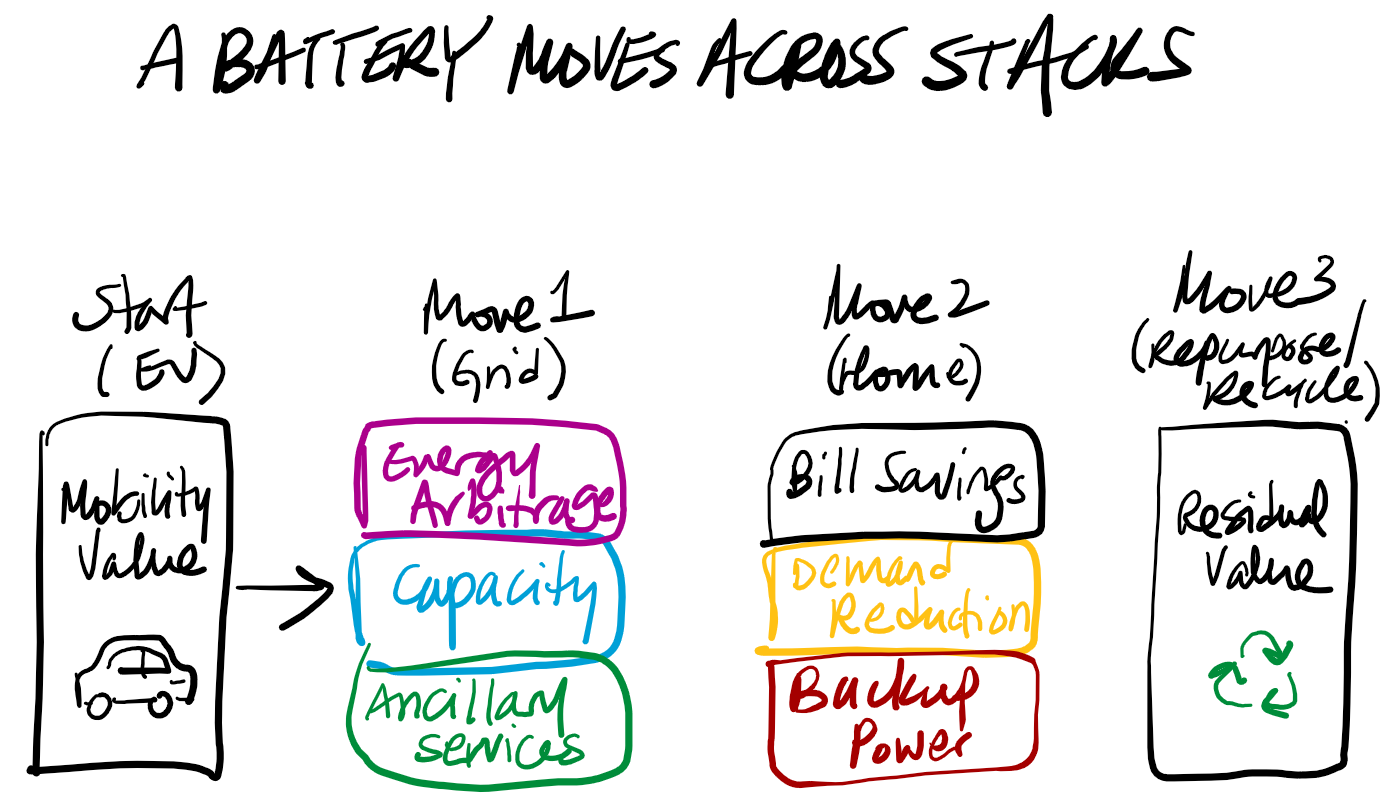
To make this more concrete, we started focusing on a new variable: relocatability.
Not just whether a battery can move, but whether extending the battery into a new location actually creates more value than keeping it where it is.
That distinction started to matter pretty quickly. A battery does not relocate for free; there are physical moving costs, integration costs, permitting constraints, and degradation from continued cycling over time. In some cases, the next stack may not justify those costs at all. In others, relocating the battery can unlock an entirely different set of value streams that outweigh the costs of moving and operating it further.
Looking at the portfolio through this lens, a few patterns emerged:
B2U has relatively low relocatability, but captures a large amount of value in one location through participation in grid markets.
Every Electric has much higher relocatability and lower value per location, but repeated across multiple users and apartments over the battery’s lifetime.
Copper sits somewhere in the middle, with relocatability tied to the lifecycle of the appliance itself and the movement of the user.
That’s what eventually pushed me toward building a rough comparison framework. Instead of evaluating battery companies only through market size or hardware costs, we wanted a way to think about battery lifetime opportunity more holistically, focusing on:
Depth of stack
Timing of monetization
Ability to relocate
Value after first deployment
We aren’t comparing batteries anymore; we’re comparing paths. B2U, Every Electric, and Copper are all battery companies, but each company’s batteries follow a different path. One goes deep into a single stack. One moves repeatedly across similar environments. One embeds itself into a machine and moves indirectly through the product lifecycle.
So I started sketching out a rough framework for thinking about battery lifetime opportunity beyond just hardware specs or market size.

Right now, the model has five parts, with a score from 1-5 for each:
How much value can the battery capture in one location? A grid battery participating in arbitrage, capacity, and ancillary service markets has much deeper economic potential than a battery only providing backup power in a home.
How many different value stacks can the battery access over its lifetime? Some batteries stay in one environment forever. Others move between EVs, homes, appliances, or grid systems and unlock entirely different forms of value along the way.
How easy is it for the battery to move between those stacks? Physical movement matters, but so does proper integration. A battery within a product that naturally moves with the user behaves very differently from a utility-scale system that becomes fixed infrastructure.
How quickly does the battery begin generating value? Some systems monetize almost immediately through avoided infrastructure costs or consumer savings. Others spend years stuck in permitting or interconnection queues before producing meaningful returns.
What useful life remains after the battery’s first deployment? This includes second-life applications, redeployment opportunities, recycling/salvage value, or continued operation in less intense environments.
The framework and summations are still rough, but it’s been useful because it shifts the question from:
“Is this a good battery company?”
to one that just might change everything about The Batteries Included Fund:
“How many opportunities does this battery have to create value over its lifetime, and how efficiently can it move between them?”
No posts
Comments
Nothing yet. Say the first thing.
Sign in to join the conversation.