
Lynette Woodard was been in the headlines a lot during the 2023-24 college basketball season.
It was about time.
Woodard was the all-time leading scorer in women’s major college basketball history for more than 40 years. But when Iowa’s Caitlin Clark pursued and passed the NCAA record, the only name mentioned was Kelsey Plum, who scored 3,397 points for the Washington Huskies between 2013-17.
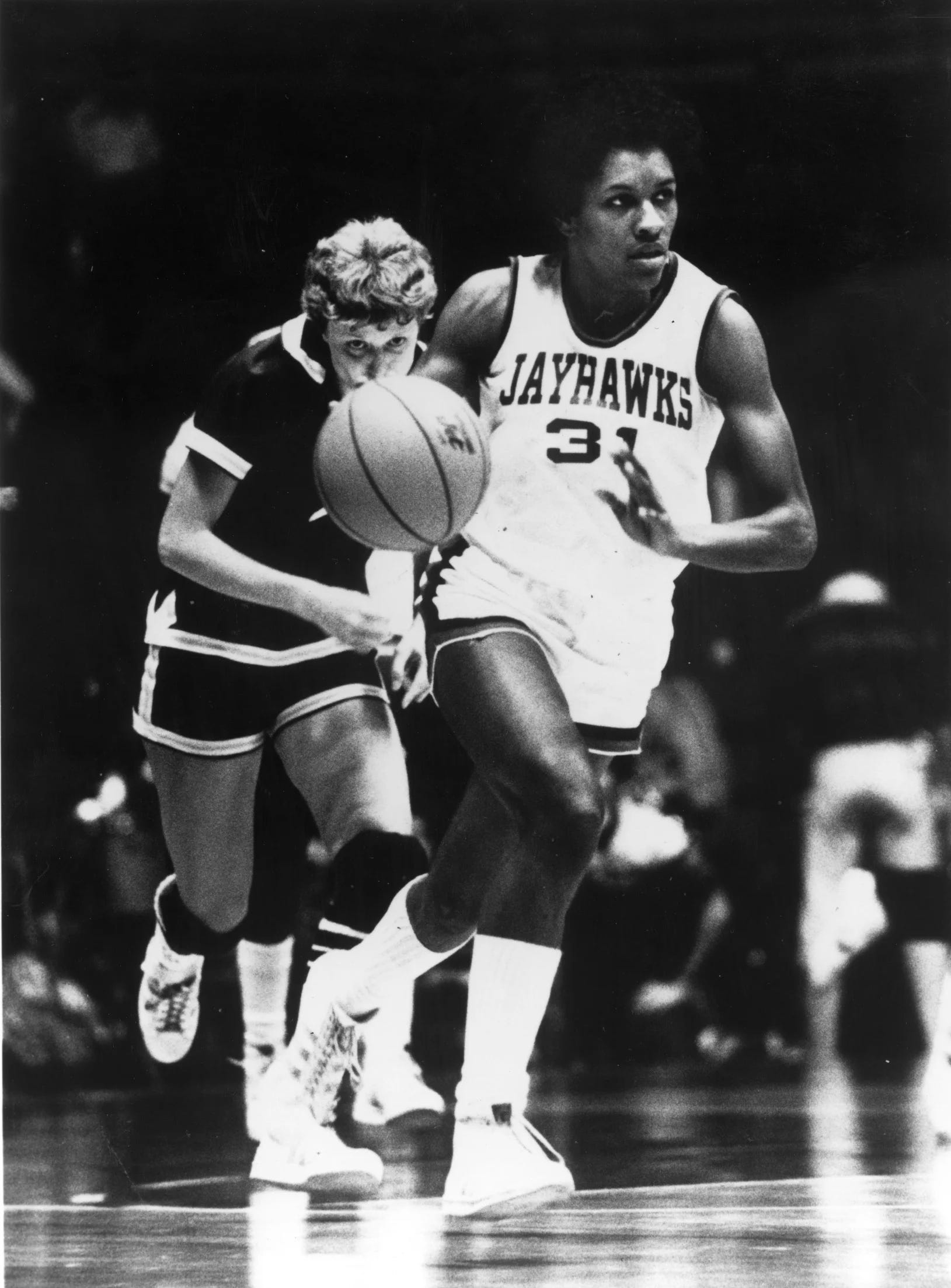
Woodard scored 3,649 points in her four seasons at Kansas (1977-81). Why wasn’t she mentioned? Because women’s sports were not governed by the NCAA until 1982. So Plum was listed as the NCAA Division I women’s scoring record holder until Clark passed her in February.
Maybe the NCAA is messed up (that’s never been said before), but that can’t take away from Woodard’s achievements, which are legendary.
Woodard was a two-time state champion in basketball at Wichita (Kan.) North High School prior to enrolling at Kansas. All she did at Kansas was average a double-double every season. She averaged 26.3 points and 12.5 rebounds per game over her four-year career. She was a four-time Kodak All-American.
She was amazingly consistent at Kansas, establishing career highs in at least one statistic in each of her four seasons. She had a career-best 14.8 rebounds per game as a freshman. In her sophomore year, she had her best season in games played (38), points (1,177, 31.0 per game), field-goal percentage (56.2), steals per game (5.1) and blocks per game (1.5). As a junior, she had her career best with 71.4 percent. She had her career best in assists (5.5) in her senior season.
She was named the winner of the 1981 Broderick and Wade Trophy awards, and was the first female to have her jersey retired at KU. But as far as the NCAA was concerned, it didn’t happen.
She represented the USA in multiple international events. Her first opportunity was at the 1979 World University Games in Mexico City. She averaged 14.1 points per game during the tournament when the USA won the gold medal.
She was named to the 1980 USA Olympic team, but that team did not participate in the Olympics because of the United States’ boycott. That certainly would have been a great opportunity to gain much-deserved fame.
Woodard averaged 19.0 points per game and 4.0 rebounds per game, both second best on the team, as the United States won the gold medal at the 1983 Pan Am Games.
She also won gold medals in the 1984 Olympics and the 1990 World Cup.
Since the WNBA didn’t exist, Woodard’s professional options were outside the United States. She played in Italy and Japan.
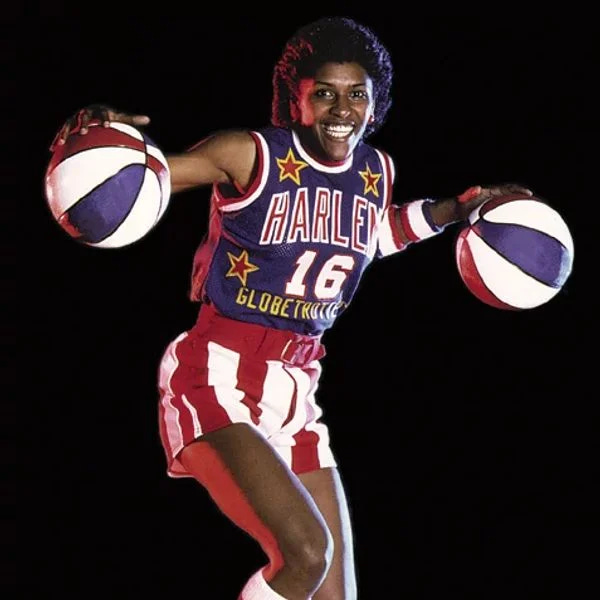
She did sign one other professional contract of note. In 1985, she played for the Harlem Globetrotters, becoming the first woman to do so. Her cousin, Hubert “Geese” Ausbie, played for the Globetrotters from 1961-85. Woodard played for the Trotters for two seasons.
Her last two seasons as a player were in the WNBA, which started in 1997. She turned 38 during that season, so her best years were behind her. But she was a name the new league could build around. But had the WNBA existed 15 or 20 years earlier, she would have been one of the early stars.
She hasn’t been completely ignored. She’s in multiple halls of fame. In 1989, she was inducted into the National High School Hall of Fame. In 1990, she was inducted into the Kansas Sports Hall of Fame. Finally, in 2004, she was inducted into the Naismith Memorial Basketball Hall of Fame in Springfield, Mass., and the Women’s Basketball Hall of Fame in Knoxville, Tenn., the following year.
She’s been a champion for women’s sports for a long time. So when Clark surged up the all-time scoring list, Woodard was supportive.
“The excitement surrounding (the record) it’s so beautiful for me,” Woodard told USA TODAY Sports. “Records are made to be broken. One day, it’s going to happen again, (and) I’m glad to be a part of it.
“(Clark is) drawing in so many different people from different walks of life. Not just the sporting world. I guarantee you every household out here knows Caitlin Clark’s name.
“I stepped outside my door (and) I had to smile. There was a young girl across the street dribbling with two hands, just bent over the ball. To see her with the basketball in her hands… those are the seeds that are being planted right now, and it’s a beautiful thing.”
It takes a true champion to recognize the accomplishments of others when she didn’t get her due praise. But that’s Lynette Woodard.
“(The attention is) bringing everyone to the game,” she said. “To see such an exciting game, and to embrace women’s basketball like it’s never ever been embraced, with this one player carrying it, God, it’s beautiful.
“It’s not just the basketball world, it’s the world. “The whole world will be watching.”
Too bad that world didn’t get to appreciate Woodard in her prime.
No posts
Comments
Nothing yet. Say the first thing.
Sign in to join the conversation.