
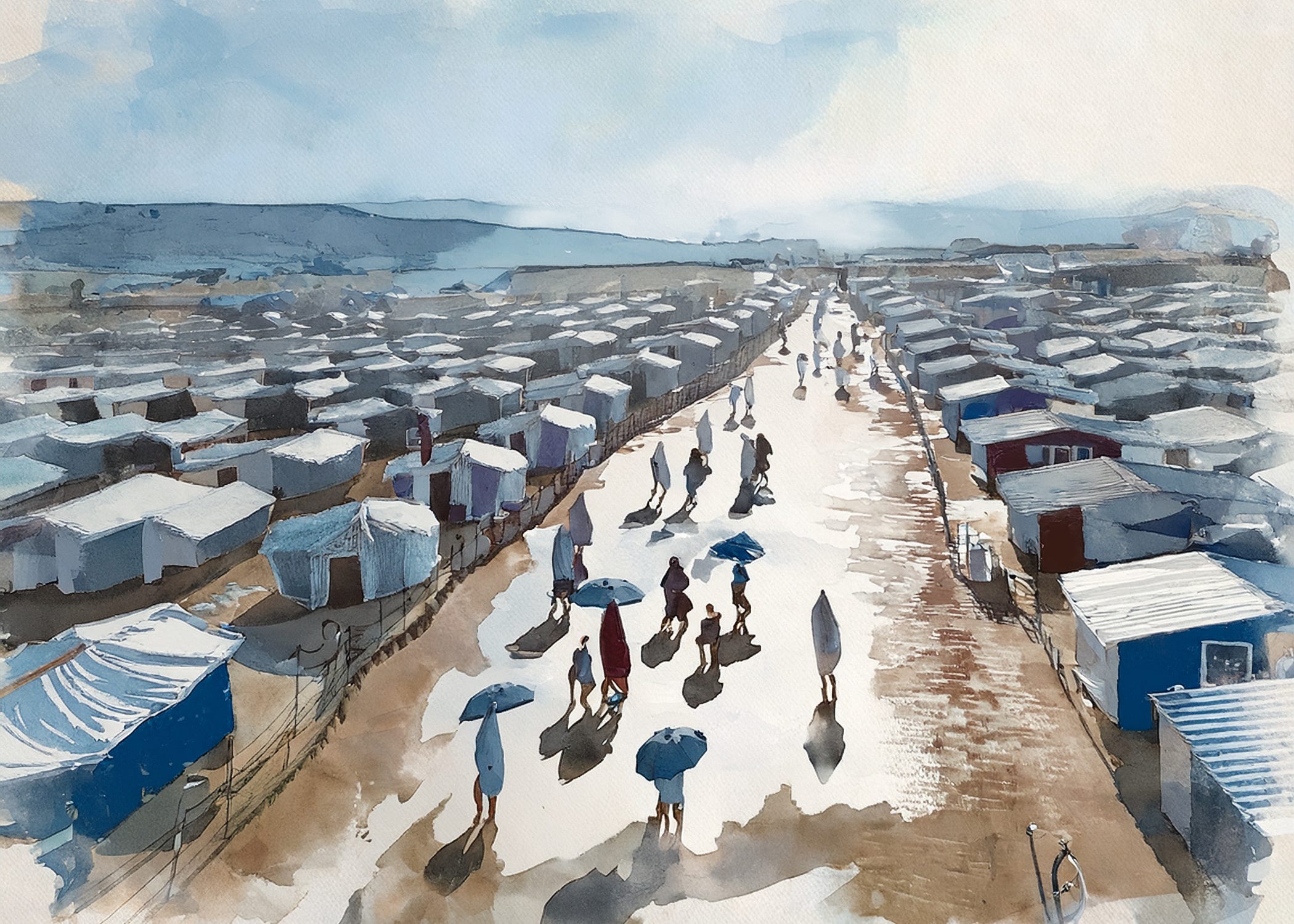
In January 2026, the International Court of Justice opened full hearings in The Hague on a genocide case against Myanmar, brought by The Gambia. On the opening day, Gambian Justice Minister Dawda Jallow told the court that the Rohingya, a predominantly Sunni Muslim population from Myanmar’s Rakhine State, “have been targeted for destruction.” Myanmar’s military government, which seized power in a 2021 coup, rejected the case as “flawed and unfounded in fact and law.” Its Foreign Ministry statement on the proceedings did not use the word “Rohingya” at all, referring instead to “persons from Rakhine state.”¹
That terminological refusal, performed in 2026 on the floor of an international court hearing a genocide case, is not incidental. It is the latest iteration of a strategy assembled over seven decades. The genocide charges before the ICJ are anchored in the events of August and September 2017, when Myanmar’s security forces and local militia conducted a clearance operation in Rakhine State that drove approximately 750,000 Rohingya across the border into Bangladesh within months. It is those operations, and the decades of deliberate legal construction that made them possible, that The Gambia has placed before the court as the evidentiary core of its genocide case. Survivors reported mass killings, rape, and the systematic burning of villages. On September 11, 2017, Zeid Ra’ad al-Hussein, then UN High Commissioner for Human Rights, addressed the UN Human Rights Council in Geneva stating “Because Myanmar has refused access to human rights investigators,” he told the council, “the current situation cannot yet be fully assessed, but the situation seems a textbook example of ethnic cleansing.”³
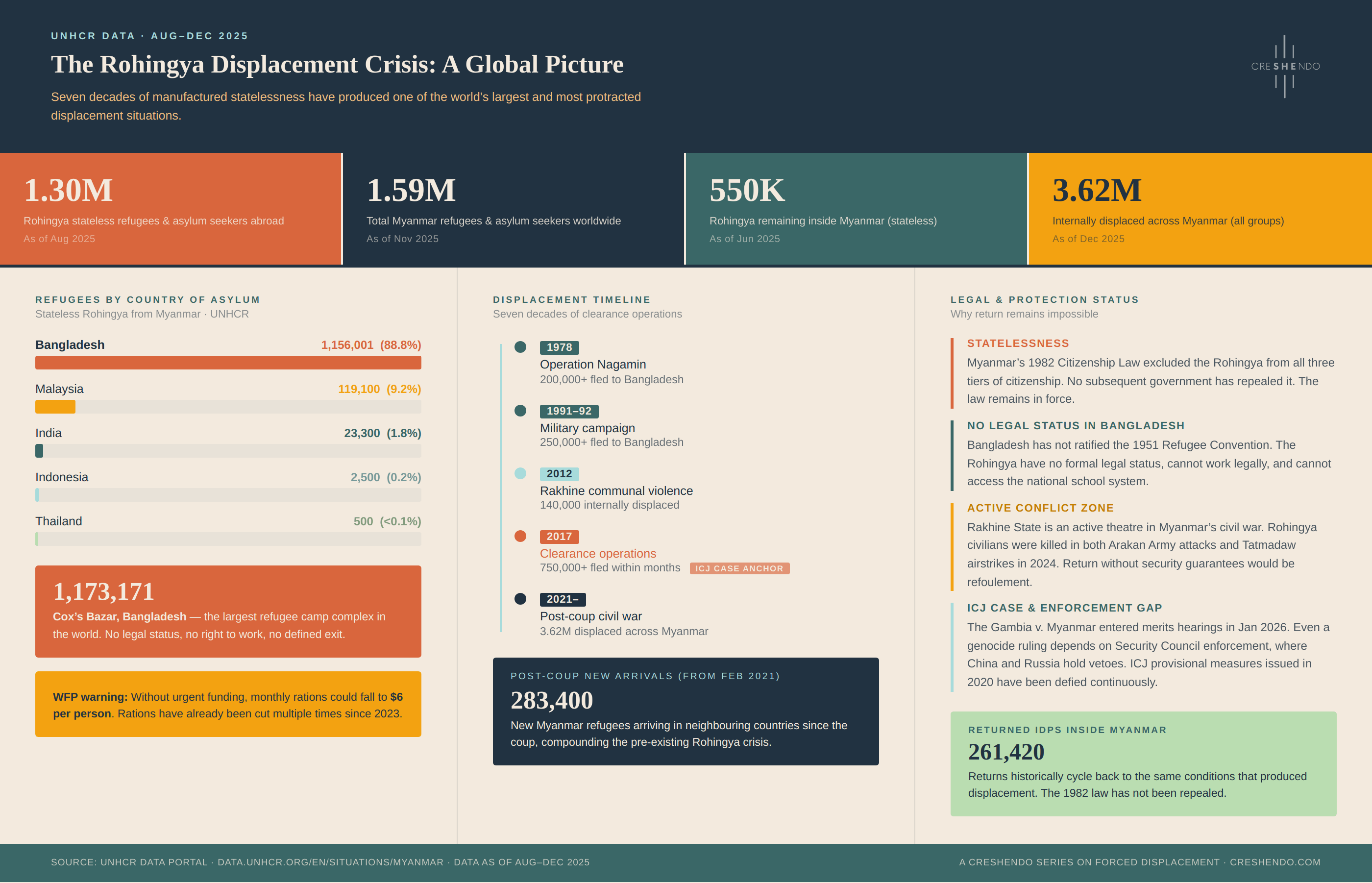
That statement did two things simultaneously: it named the crime and it named the strategy used to obscure it. More than eight years later, approximately 1.17 million Rohingya remain in overcrowded camps in Cox’s Bazar, Bangladesh, a figure that includes pre-2017 arrivals and births in the camps, in conditions the UN Secretary-General has described as a “stark reminder of the world’s collective failure to find solutions.”⁵ Without urgent new funding, the UN’s World Food Programme has warned that monthly rations could be halved to as little as six dollars per person. Meanwhile, there is no credible path of return.⁶
What the world witnessed in 2017 was not an eruption of spontaneous communal violence, nor simply a disproportionate military response to the attacks by Rohingya armed groups on police posts that preceded it. It was the terminal expression of a project constructed over seven decades: the deliberate, legally encoded effort to ensure that the Rohingya would possess no citizenship, no recognized identity, no land, and no legal standing from which to resist their own removal. It is precisely this terminal act, the 2017 clearance operations, that forms the evidentiary center of the case now before the ICJ. The Gambia’s legal argument rests on the premise that 2017 was not an isolated atrocity but the foreseeable culmination of a state policy spanning decades, and it is that argument this report is designed to examine. The ICJ hearings are not the beginning of that story. They are a late reckoning with a process that has been visible, documented, and largely unaddressed since Myanmar’s independence in 1948.
This report traces that process. It is a case study in how states manufacture the conditions for genocide and mass displacement: not through single acts of violence but through the patient accumulation of law, bureaucracy, propaganda, and institutional erasure. It is also a case study in the structural failure of the international legal framework designed to protect the forcibly displaced: a framework built for a different era, a different geography, and a different conception of how persecution operates.
The Rohingya are a distinct ethnic and religious community with a documented presence in the Arakan region (now Rakhine State), extending to at least the fifteenth century.⁷ Prior to the displacement crisis that accelerated after 2012, their population in Myanmar numbered approximately 800,000 to one million, concentrated in the townships of northern Rakhine State along the Bangladesh border. They speak their own dialect, practice Sunni Islam in a majority Theravada Buddhist country, and constitute one of over 100 ethno-linguistic groups within Myanmar’s heterogeneous population.⁸
What distinguishes the Rohingya from other ethnic minorities in Myanmar is not simply their religion or ethnicity but their legal position. From the earliest years of the independent Burmese state, the ethnically Burmese national government refused to recognize them as one of the country’s constituent peoples. The term “Rohingya,” which surfaced as a self-identifying political term in the 1950s, has been consistently rejected by successive governments as an invented identity. The preferred designation “Bengali” functions to pre-emptively classify the group as immigrants from Bangladesh rather than indigenous residents of Rakhine. That terminological dispute is not semantic. It is the foundational argument on which all subsequent legal exclusions rest, and the one still being deployed, without revision, before the ICJ in 2026.
Myanmar’s Union of Burma declared independence from British colonial rule in 1948. Within months it was mired in civil conflict. Competition between the ethnically Burmese national government, the Communist Party of Burma, and a range of ethno-nationalist armed groups produced what Ashley South has described as the longest-running internal conflict of its type in the twentieth century.⁹ It was against this backdrop of contested sovereignty and fractured national identity that the legal infrastructure of Rohingya exclusion began to take shape.
The British colonial system had organized the populations of Burma according to racial and ethnic taxonomies that distinguished “sons of the soil” (taingyintha) from populations of Chinese and South Asian origin. The latter had been favored under colonial administration and as a result, Elliott Prasse-Freeman has observed, rendered convenient objects of populist anger by the post-colonial state.¹⁰ The 1947 Constitution of independent Burma inaugurated a common citizenship but granted it automatically to members of specified indigenous races. As Amanda R. Cheong has documented in her ethnographic study of the crisis, the 1948 Union Citizenship Act named eight groups as automatically qualifying, among them the Arakanese, Burmese, Chin, Kachin, Karen, Kayah, Mon, and Shan, as well as any group settled permanently prior to 1823. The Rohingya were not named.¹¹ They were, from the moment of independence, vulnerable to discrimination through policy, persecution, limitation of movement, land appropriation, and denial of citizenship rights.¹²
It is worth pausing to note what was happening simultaneously in international law. In 1948, the United Nations adopted the Universal Declaration of Human Rights. Three years later, the UN convened at a high-level conference in Geneva that produced the Convention Relating to the Status of Refugees: the foundational legal instrument of the international protection regime.¹³ The convention defined a refugee as any person with a well-founded fear of persecution on grounds of race, religion, nationality, membership of a particular social group, or political opinion, who is outside their country of nationality and unable or unwilling to seek its protection.
The convention was geographically and temporally circumscribed in ways that reflected its origins rather than the scale of the problem it claimed to address. It applied only to persons displaced by events before January 1, 1951, and initial application was largely European. The convention’s drafting was dominated by the most powerful states in the early postwar UN: states that were simultaneously colonial empires with limited interest in extending protection obligations to non-European populations.¹⁴ India’s delegate objected explicitly during drafting, pointing to millions displaced by the 1947 partition. Those objections were set aside.¹⁵
The result was a framework that formally recognized the principle of non-refoulement and the right not to be returned to persecution, though the framework had been constructed with no regard for the conditions of manufactured statelessness already being imposed on populations in Southeast Asia. When the Burmese state began assembling the legal architecture of Rohingya exclusion, the international system designed to protect such populations was written for a different geography and a different crisis. The two systems developed in parallel, and the gap between them was, from the outset, structural.
The 1962 military coup brought General Ne Win and the Tatmadaw to power and marks the beginning of what Mary Patricia Callahan has described as a state “predicated on, constructed around, and ultimately held hostage to organized violence.”¹⁸ The Tatmadaw, in Callahan’s analysis, must be understood as war fighters first: an institution that perceives any organized expression of political difference as a threat to a historically fragile state that has never fully monopolized violence, and that therefore employs it as the primary instrument of authority.
Within this structure, the Rohingya occupied a particularly exposed position. Niloy Ranjan Biswas characterizes Myanmar as a “garrison state,” one “compulsively concerned about constructed existential threats to itself.”¹⁹ The Rohingya served as ideal targets for exactly these manufactured threats. As Kevin Bi has argued, ethnic armed organizations such as the Kachin and Kokang were met with a different military calculus precisely because both maintained significant armed capacity, controlled resource-rich territory, and shared a border with China.²⁰ The Rohingya shared a border with Bangladesh, posed no comparable geopolitical deterrent, and lacked both the resource base and armed strength that might have afforded protection. Their vulnerability was not incidental. It was structural, and the state’s targeting of them was deliberate.
The constitutional crystallization of this exclusion came in 1982 with the Burma Citizenship Law. Ne Win framed the legislation as a solution to the problem of foreigners introduced by British colonization. The law disaggregated citizenship into a three-tier hierarchy and defined full citizenship as automatically available only to members of recognized national races. The Rohingya were excluded. Significantly, the Kaman, another Muslim minority in Rakhine State, were recognized as a national race, which, as Cheong notes, demonstrates that the exclusion was constructed specifically around the Rohingya rather than motivated purely by religious prejudice.¹⁶
The 1982 law was implemented through an expansion of documentary control. New citizenship scrutiny cards, unlike prior National Registration Cards, contained a space for the holder’s race and religion filled in by a Ministry official. As Rohingya communities in Rakhine State exchanged old cards for new ones through the 1980s and 1990s, they found themselves classified en masse as non-citizens. Cheong’s interviews with Rohingya activists document the disorientation of this process: many had possessed National Registration Cards that functioned as de facto proof of national belonging. The card exchange unfolded gradually and inconsistently across communities, but its effect on the Rohingya was systematic.¹⁷
The same decades that saw the Rohingya’s legal status systematically dismantled saw the Tatmadaw entrench an institutional posture of systematic resistance to international legal accountability. Myanmar has never ratified the 1951 Refugee Convention or its 1967 Protocol,²¹ leaving those displaced across its borders without formal protection obligations binding on the state from which they fled. Its non-ratification is not an oversight but a consistent pattern.
As David Steinberg has documented, Ne Win’s 1974 constitution institutionalized an isolationist foreign policy premised on non-interference and the rejection of external scrutiny as the foundational principle of military governance. Writing on Myanmar’s foreign policy, Renaud Egreteau and Larry Jagan coined the phrase “isolationism without isolation” to describe the Tatmadaw’s approach: the systematic rejection of participation in international institutions while cultivating bilateral relationships with China and Russia that provided diplomatic cover at the UN Security Council.³⁰ Even as Myanmar engaged selectively with international bodies when it served its interests, the military government refused access to UN human rights investigators for decades, denied the jurisdiction of the International Criminal Court, and characterized every international legal proceeding as a violation of sovereignty rather than an application of law.
Myanmar signed human rights treaties whose obligations it had no intention of translating into enforceable domestic law, accruing the diplomatic benefits of formal participation in the international system while systematically insulating itself from its enforcement mechanisms. This is not an anomalous strategy. It reflects what Jack Donnelly has described as the foundational paradox of the international human rights regime: states are simultaneously the primary violators of human rights and the primary entities identified as responsible for upholding them.³⁵ International human rights law is built on the consent of the states it is designed to constrain.
It is against this background of deliberate legal non-participation that the 2017 clearance operations must be understood: they were conducted by an institution that had, for decades, operated on the premise that no external legal framework could reach it.
Myanmar was not bound by these expanding frameworks, and the 1951 definition’s architecture created specific problems for the Rohingya case. The convention requires a nexus between feared harm and five enumerated grounds. The Rohingya could plausibly claim several simultaneously. But the 1982 Citizenship Law had constructed a legal argument that denied the very premise of such a claim: if the Rohingya were not citizens, not a recognized national group, and classified as foreign nationals, the state’s position was that they could not be persecuted as Rohingya by Myanmar, because Myanmar did not recognize them as belonging to Myanmar in the first place. Stateless persons can in principle invoke protection by reference to their country of former habitual residence, though neither Myanmar nor Bangladesh has ratified the 1951 Convention, leaving enforcement dependent entirely on political will that has consistently been absent. The deeper structural problem, as Donnelly identifies it, is that the very architecture of international human rights law reproduces this dependence at every level: rights are declared universal, but their implementation is returned to the states most likely to violate them.³⁵
The legal architecture described above was not simply discriminatory. It was operational. It created the conditions under which organized, state-directed violence against the Rohingya could be conducted at scale without triggering effective international legal response. The pattern of displacement that followed is consistent and extensively documented.
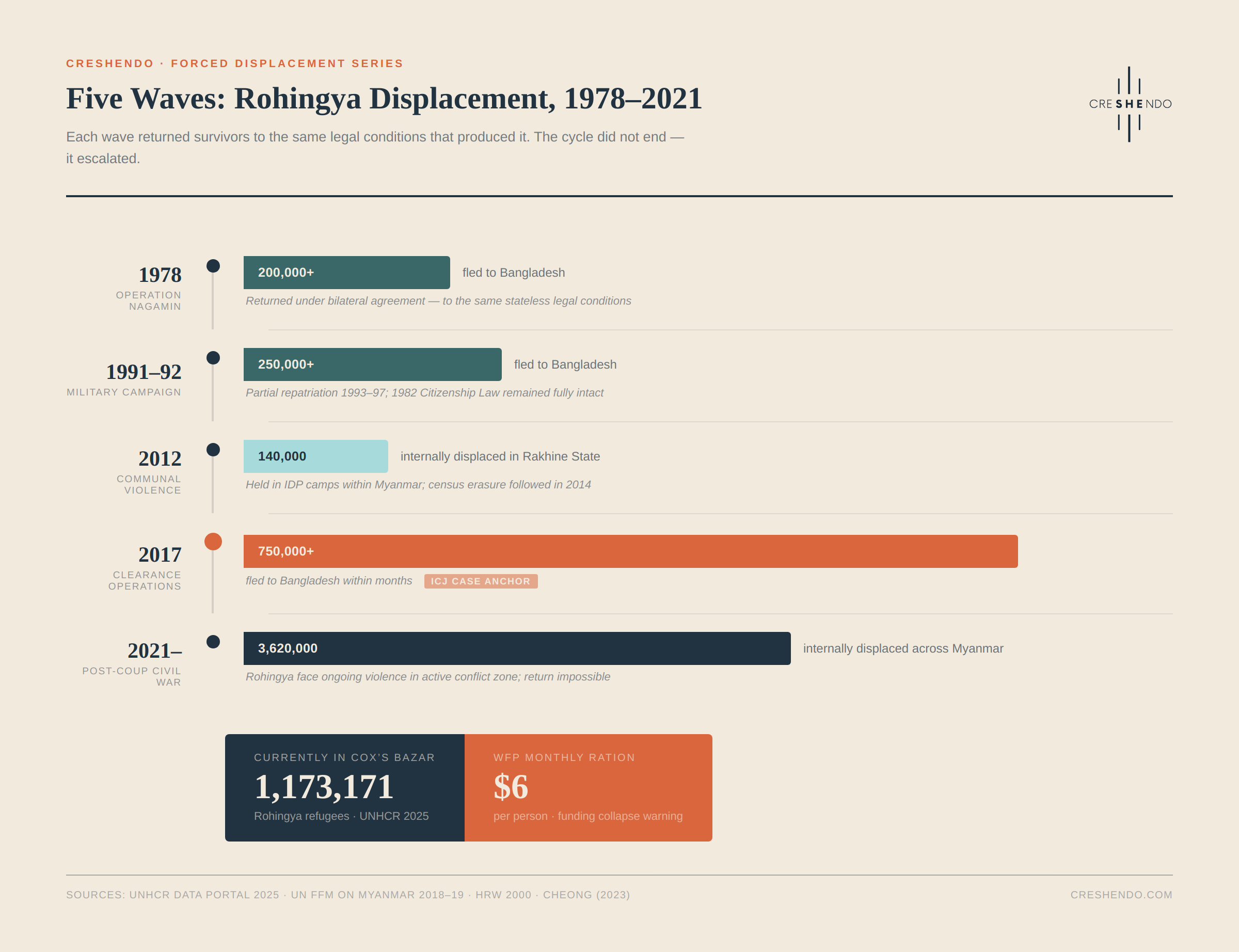
In 1978, Operation Nagamin drove over 200,000 Rohingya into Bangladesh. A further campaign in the early 1990s displaced approximately 250,000 more.²⁴ Both waves resulted in partial repatriation agreements. Those agreements returned displaced persons to the same conditions of legal exclusion that had produced displacement in the first place. Repatriation, in this context, was not resolution. It was the resetting of conditions for the next cycle.
Cheong’s archival and ethnographic research reveals the specific mechanics of what she terms “bureaucratic omission”: the strategy by which states pursue racial exclusion not through the institutionalization of racial categories but through the deliberate withdrawal of administrative recognition. Rather than classifying the Rohingya as a stigmatized group and persecuting that group — a strategy that generates documentary evidence and legal exposure — the Myanmar state pursued a strategy of making the population invisible to state systems, then using that invisibility as the basis for removal. This distinction matters enormously. Persecution leaves traces. Omission is designed not to.¹¹
Nowhere is this strategy more visible than in Myanmar’s 2014 census, the country’s first in over thirty years. In its formal agreement with the United Nations, the government, in the words of UNFPA (which co-funded the exercise), “explicitly and repeatedly agreed” that each person would be able to declare their own ethnicity, including those identifying as Rohingya. The day before enumeration began, the government reversed course. Anyone wishing to identify as Rohingya would be forbidden to do so and could instead identify as Bengali. Buddhist nationalist groups had threatened a boycott; the government capitulated.²⁵
UNFPA stated publicly that it was “deeply concerned about this departure from international census standards, human rights principles and agreed procedures.”²⁶ The result, documented in Myanmar’s own census report, was that approximately 1,090,000 people in Rakhine State went uncounted. The provisional government report described this as a “security measure to avoid the possibility of violence.” The full census report, published the following year, omitted the word “Rohingya” entirely, stating only that certain communities were not counted because they were “not allowed to self-identify using a name that is not recognized by the Government.”²⁷
The significance of this framing cannot be overstated. By not counting the Rohingya, the state did not simply fail to collect data. It actualized, through the legitimizing power of official census figures, a demographic reality that supported its foundational narrative: that this population does not exist as a recognized group within Myanmar. To obliquely acknowledge but deliberately not count a people communicates a precise symbolic declaration: that persons who attempt to identify as Rohingya do not qualify as persons to be recognized. Documentation of a population’s non-existence is, paradoxically, one of the most effective instruments of erasure.
The census erasure was compounded in the months that followed. In February 2015, ahead of Myanmar’s first general elections since 1990, President Thein Sein issued an executive order invalidating the Temporary Registration Cards held by Rohingya communities in Rakhine State, effective March 31. For most Rohingya, these cards had been their only form of official identification since the 1982 Citizenship Law’s implementation. An estimated 390,000 surrendered their cards; what they received in exchange were documents the government itself acknowledged were not proof of citizenship.²⁸
Cheong’s fieldwork documents the political calculus: the military-backed Union Solidarity and Democratic Party moved to disenfranchise the Rohingya to appease Buddhist nationalist factions ahead of a competitive election. What transpired was more fundamental than disenfranchisement. A population that had been stripped of citizenship, denied census recognition, and now deprived of its last documentary identity found itself holding papers that explicitly stated they proved nothing, in the months immediately preceding the 2017 clearance operations that form the evidentiary core of the genocide case now before the ICJ. The sequence was not coincidental. It was preparatory. Each step in the documentary dispossession contributes to The Gambia’s legal argument that what followed in 2017 was not spontaneous violence but the deliberate execution of a policy made possible by decades of manufactured legal exclusion.
The August 2017 attacks by the Arakan Rohingya Salvation Army on police posts provided a pretext for the military campaign that followed. Zeid Ra’ad al-Hussein, addressing the Human Rights Council three weeks into the operation, described the response as “clearly disproportionate” and conducted “without regard for basic principles of international law.” He called on the government to “stop claiming that the Rohingyas are setting fire to their own homes and laying waste to their own villages,” characterizing this as a “complete denial of reality.” He also cited the fact that successive Myanmar governments had, since 1962, been progressively stripping the Rohingya of their political and civil rights, including citizenship. The 2017 crisis was not a rupture. It was the product of a system.³
A UN fact-finding mission subsequently concluded that the 2017 offensive had included genocidal acts and that there was sufficient basis to warrant investigation and prosecution for genocide. The Minority Rights Group has documented how persecution operates simultaneously on ethnic and religious dimensions, with community members routinely vilified as “Bengalis” while the targeting of Muslim religious practice compounds the ethnic dimensions of exclusion.²⁹ The democratic transition period, rather than relieving this pressure, intensified it. The years between 2012 and 2018 saw increasingly violent dispossession precisely as civilian rule threatened to undermine the Tatmadaw’s dominance. The clearance operations drove approximately 750,000 Rohingya across the border into Bangladesh within months. These individuals were not fleeing a sudden catastrophe. They were fleeing the terminal expression of policies assembled over seven decades.
Renaud Egreteau and Larry Jagan have characterized Myanmar’s foreign policy orientation as “isolationism without isolation”: the systematic rejection of participation in international institutions while cultivating bilateral relationships, particularly with China and Russia, that provide diplomatic insulation from accountability.³⁰ The consequences of that posture are documented in the Special Advisory Council for Myanmar’s 2023 report, which found that the UN’s own internal review concluded the system was “relatively impotent” to work effectively with Myanmar’s authorities to reverse human rights trends, a product of “systemic and structural failures” within the UN itself.³¹ Myanmar’s government had constructed a diplomatic environment in which the international protection regime could observe displacement, document it, and express concern about it but tt could not stop it.
The January 2026 hearings in The Hague placed before the court a formal legal argument that the events of 2017 and the decades preceding them constitute the systematic destruction of a people. This is the first genocide case the ICJ has taken up in full in more than a decade, and its outcome will have implications beyond Myanmar, likely reshaping how the 1948 Genocide Convention is interpreted and applied for years to come. The case argues, correctly, that genocide is not a single act but a process, and that the process in Myanmar is documented, traceable, and constructed over seven decades. Whether the court ultimately finds in The Gambia’s favor matters enormously. But the framing alone — placing responsibility not on rogue commanders or a moment of communal violence but on the deliberate architecture of a state — represents a significant development in international legal thought.
A finding of genocide would also create binding legal obligations: to cease genocidal acts, to restore citizenship, to allow safe return, to provide reparations. Myanmar’s military government, which brought the same terminological strategy to The Hague that it deployed in the 1982 Citizenship Law, the 2014 census, and the 2015 card cancellations, has given no indication that it would comply. The court’s enforcement mechanism depends on Article 94(2) of the UN Charter, which allows the Security Council to act if a state defies an ICJ judgment. China and Russia, which have consistently shielded Myanmar at the Security Council, hold vetoes. The route from legal determination to political consequence runs directly through a wall that two permanent members have every incentive to maintain.
What the case has already accomplished — simply by existing and proceeding to full merits — is to enter into the permanent international record a legal argument that cannot be undone by Myanmar’s non-compliance. The ICJ’s provisional measures of January 2020, ordered while the full case was pending, were defied continuously. The court proceeded regardless. If a merits ruling follows, it will stand as a legal determination of state responsibility for genocide regardless of whether it produces immediate political change. That is not nothing. It is the basis on which future accountability claims, sanctions regimes, and diplomatic pressure can rest, and it forecloses the space for deniability that has for decades been the Tatmadaw’s primary diplomatic asset.
Myanmar’s response to the proceedings is itself instructive. Its government described the case as based on “biased reports” and “unreliable evidence” while simultaneously presenting itself as cooperating “in good faith” as a sign of respect for international law.³² The statement’s refusal to use the word “Rohingya,” deployed with consistency before an international court, confirms that the bureaucratic erasure strategy has not been abandoned. It has been brought to The Hague.
Cox’s Bazar is the largest refugee camp complex in the world. The Rohingya have been there in significant numbers since 1978 — before many of the people currently living in those camps were born. The settlements that expanded dramatically after 2017 were never intended to be permanent. They have become permanent by default, because no state has created the conditions under which they could be otherwise. The ICJ proceedings, whatever they produce, do not change this directly.
The Rohingya in Bangladesh have no formal legal status. Bangladesh has not ratified the 1951 Refugee Convention or its 1967 Protocol, meaning the country’s obligations are defined by political will rather than legal compulsion. The Rohingya cannot work legally, cannot move freely, and cannot access the national school system. They are held in a camp from which there is no defined exit: not integration, which Bangladesh has not offered and cannot sustain, and not return, which remains impossible.
Return is impossible not only because of the 2021 military coup and the civil war it produced. It was impossible before the coup. The legal conditions that generated displacement — the 1982 Citizenship Law, the documentary dispossession, the demographic denial — remained entirely intact through every period of Myanmar’s ostensible political transition. Repatriation without restored citizenship and legal recognition is not return. It is a different form of the same erasure, and the Rohingya who experienced forced returns in the 1990s can attest to what that cycle produces.
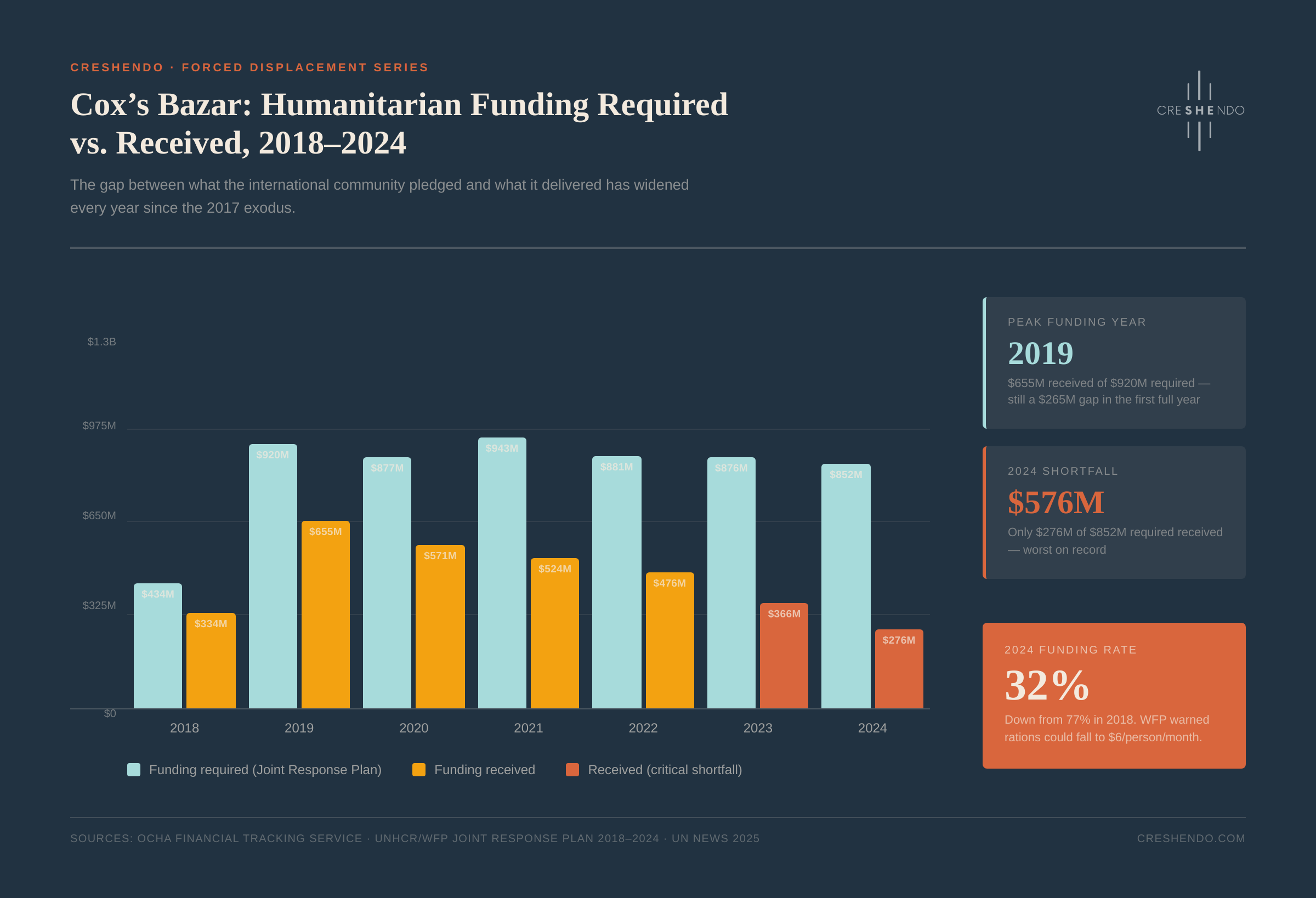
In principle, an ICJ ruling establishing state responsibility for genocide should create the legal architecture for demanding those conditions change. The compliance paradox runs deep: Myanmar’s generals are acutely aware that political transition means personal legal exposure. International accountability proceedings put those leaders on notice that stepping down does not mean safety. That notice can harden resistance rather than producing compliance that might ultimately mean prosecution for individual leaders. The conditions in Cox’s Bazar have been deteriorating regardless: WFP rations cut repeatedly since 2023, with warnings that monthly allocations could fall to as little as six dollars per person, while the UN Secretary-General has described the situation as “a stark reminder of the world’s collective failure to find solutions.”⁵ The Rohingya in those camps are not waiting for a legal argument to be won. They are living the consequence of arguments that were won on paper and then ignored.
The Rohingya were counted out of a census in 2014. They were rendered legally stateless in 1982. They were excluded from recognition as a national people in 1948. Each of these acts was deliberate, documented, and conducted in the presence of international institutions that lacked either the authority or the will to intervene. The 2017 clearance operations were not the beginning of this story. They were its culmination: the terminal act of a state policy assembled over decades, a policy of exclusion so methodically constructed that it produced, without ever requiring a single explicit order to commit genocide, the material and legal conditions in which genocide became possible. That, in substance, is The Gambia’s argument before the ICJ: that genocidal intent must be inferred from the pattern of conduct, and that the pattern is unambiguous. The court will determine whether the evidence meets the legal threshold. This report concludes that it does.
The 2026 hearings may well produce a ruling that matters to international law in ways that extend far beyond Myanmar. The case presses the court to determine whether the systematic, decades-long manufacture of statelessness, reinforced by state-sanctioned violence constitutes genocide under the 1948 Convention. If it finds that it does, the ruling will reshape how the convention is applied to future cases involving gradual state-directed exclusion rather than sudden mass killing. It will establish that the pattern of documentary dispossession, demographic denial, and manufactured legal non-existence is not merely discriminatory policy but a form of destruction recognizable in international law. That would be a genuine and significant development, with implications for populations facing analogous strategies of erasure in other contexts.
What it will not do, on its own, is change the conditions of Cox’s Bazar. The Rohingya have been in those camps, in some form, since 1978. The settlements that grew after 2017 represent not a temporary crisis awaiting resolution but the institutionalized consequence of a protection regime designed to observe displacement rather than reverse it. The 1.17 million people there are stateless. They have no legal status in the country hosting them, no right to work, no path to integration, and no viable route of return to a country that erased them in law before it expelled them in fact. WFP rations have been cut repeatedly; the UN Secretary-General has described their situation as a failure of collective responsibility; and the international community has, with considerable consistency, described the problem accurately and then declined to solve it.
The legal case has been made, and it is damning. The evidentiary record assembled over three decades of UN investigations, fact-finding missions, and legal proceedings leaves no serious doubt about what happened to the Rohingya or why. What remains is the oldest and most intractable problem in international affairs: the distance between a legal determination and a political consequence, between an institution that can name a crime and a world in which the states with the power to stop it have calculated reasons not to. Whether the January 2026 hearings represent a genuine reckoning or another entry in a long archive of documented failures will not be decided in The Hague. It will be decided in Beijing, in Dhaka, in ASEAN capitals, and in the foreign ministries of the states that intervened in this case to declare their commitment to the Genocide Convention and must now determine what that commitment costs.
The Rohingya have been waiting for that answer since 1948. They are still waiting.
Thanks for reading! This post is public so feel free to share it.
Adam Hancock, “Myanmar says Rohingya genocide case at The Hague is flawed, unfounded,” Al Jazeera, 14 January 2026, https://www.aljazeera.com/news/2026/1/14/myanmar-says-rohingya-genocide-case-at-the-hague-is-flawed-unfounded
Ibid.
Zeid Ra’ad al-Hussein, Statement to the UN Human Rights Council, 11 September 2017, UN News, https://news.un.org/en/story/2017/09/564622-un-human-rights-chief-points-textbook-example-ethnic-cleansing-myanmar
Ibid.
Vibhu Mishra, “After mass exodus, limbo: Rohingya refugees test international resolve,” UN News, 29 September 2025, https://news.un.org/en/story/2025/09/1162166
Ibid. The $6 figure was described by Muhammad Yunus, Chief Adviser of Bangladesh’s interim government, in his address to the UN General Assembly in September 2025, citing a World Food Programme warning.
Mehebub Sahana, Selim Jahangir, and Md. Anisujjaman, “Forced Migration and the Expatriation of the Rohingya: A Demographic Assessment of Their Historical Settlements,” Journal of Muslim Minority Affairs 38, no. 1 (2018): 39–56.
Michael Aung-Thwin and Maitrii Aung-Thwin, A History of Myanmar Since Ancient Times: Traditions and Transformations (London: Reaktion Books, 2012).
Ashley South, Mon Nationalism and Civil War in Burma (London: Routledge, 2013), https://doi.org/10.4324/9780203037478.
Elliott Prasse-Freeman, “The Rohingya Crisis,” Anthropology Today 33, no. 6 (December 2017): 1–2, https://doi.org/10.1111/1467-8322.12389.
Amanda R. Cheong, “Racial Exclusion by Bureaucratic Omission: Non-Enumeration, Documentary Dispossession, and the Rohingya Crisis in Myanmar,” Social Problems 70, no. 2 (2023): 340–359, https://doi.org/10.1093/socpro/spab054.
Sahana et al., “Forced Migration and the Expatriation of the Rohingya,” 46.
Convention Relating to the Status of Refugees, July 28, 1951, 189 U.N.T.S. 137, art. 1(A)(2). Entered into force April 22, 1954.
The National Archives (UK), “The 1951 Refugee Convention,” https://www.nationalarchives.gov.uk/explore-the-collection/stories/the-1951-refugee-convention/
Ibid.
Cheong, “Racial Exclusion by Bureaucratic Omission,” 345. The 1982 law disaggregated citizenship into full, associate, and naturalized tiers. The Kaman’s recognition as a national race is documented in the official list of 135 recognized national races published by Myanmar’s government.
Cheong, “Racial Exclusion by Bureaucratic Omission,” 345–346. The new citizenship scrutiny cards introduced in the 1980s, unlike prior National Registration Cards, contained a space for the holder’s race and religion filled in by a Ministry official, enabling the administrative reclassification of Rohingya as non-citizens.
Mary Patricia Callahan, Making Enemies: War and State Building in Burma (Ithaca: Cornell University Press, 2003), 2–3.
Niloy Ranjan Biswas, “Myanmar’s Military and the Garrison State,” Asian Journal of Comparative Politics 5, no. 2 (December 2019): 158–173, https://doi.org/10.1177/2057891119843842.
Kevin Bi, “The Politics of Slaughter: Why Myanmar’s Military Targets the Rohingya,” Harvard International Review 39, no. 4 (2018): 14–15.
Protocol Relating to the Status of Refugees, January 31, 1967, 606 U.N.T.S. 267. Entered into force October 4, 1967.
OAU Convention Governing the Specific Aspects of Refugee Problems in Africa, September 10, 1969, 1001 U.N.T.S. 45, art. I(2).
Marina Sharpe, “The 1969 African Refugee Convention: Innovations, Misconceptions, and Omissions,” McGill Law Journal 58, no. 1 (January 2013): 95–147.
Human Rights Watch, “Burma/Bangladesh: Burmese Refugees in Bangladesh — Historical Background,” Human Rights Watch, 2000, https://www.hrw.org/reports/2000/burma/burm009.htm
Cheong, “Racial Exclusion by Bureaucratic Omission,” 347–348. The figure of approximately 1,090,000 not enumerated in Rakhine State is drawn from the Department of Population’s own provisional census report.
UNFPA, “Making Sense of Myanmar’s Census,” 31 March 2014, https://www.unfpa.org/news/making-sense-myanmars-census.
Cheong, “Racial Exclusion by Bureaucratic Omission,” 348. The full census report’s language — that communities were not counted because they were “not allowed to self-identify using a name that is not recognized by the Government” — appears in the Myanmar Population and Housing Census 2014, Volume 2C, Rakhine State report.
Cheong, “Racial Exclusion by Bureaucratic Omission,” 349–350. The figure of approximately 390,000 TRC-holders surrendering cards in 2015 is cited from UNHCR documentation.
Minority Rights Group International, “Muslims and Rohingya in Myanmar,” January 29, 2024, https://minorityrights.org/communities/muslims-and-rohingya/
Renaud Egreteau and Larry Jagan, Back to the Old Habits: Isolationism or the Self-Preservation of Burma’s Military Regime (Bangkok: IRASEC, 2008).
Special Advisory Council for Myanmar (SAC-M), “How the UN Is Failing Myanmar,” October 2023, https://specialadvisorycouncil.org/wp-content/uploads/2023/10/SAC-M-How-the-UN-is-Failing-Myanmar-Oct2023-ENG.pdf
Hancock, “Myanmar says Rohingya genocide case at The Hague is flawed, unfounded.”
UNHCR, “The 1951 Refugee Convention,” https://www.unhcr.org/us/about-unhcr/overview/1951-refugee-convention.
Arthur C. Helton, The Price of Indifference: Refugees and Humanitarian Action in the New Century (Oxford: Oxford University Press, 2002).
Jack Donnelly, Universal Human Rights in Theory and Practice, 3rd ed. (Ithaca: Cornell University Press, 2013), 33.
Comments
Nothing yet. Say the first thing.
Sign in to join the conversation.