
On February 23, 2026, delegates from more than 120 countries gathered in Geneva to mark both the opening of the 61st session of the UN Human Rights Council and the Council's 20th anniversary. The occasion was marked not by celebration but by alarm. UN Secretary-General António Guterres warned that human rights are under a "full-scale attack, often led by those who hold the greatest power." The Council itself opened having absorbed a 15% cut to the Office of the High Commissioner for Human Rights under the UN80 reform initiative — its deliberations shortened from six to five and a half weeks. It is in this moment of institutional contraction that we must ask: what becomes of the right to education for the world's 47 million displaced children?

The scale of forced displacement has reached unprecedented levels. According to the UNHCR, at the end of 2023 there were at least 117.3 million forcibly displaced people worldwide — 40 percent of whom are children, approximately 47 million young people.1 The average length of displacement ranges from 10 to 26 years, meaning that millions of children will spend their entire childhood, and some their entire lives, without returning home.2
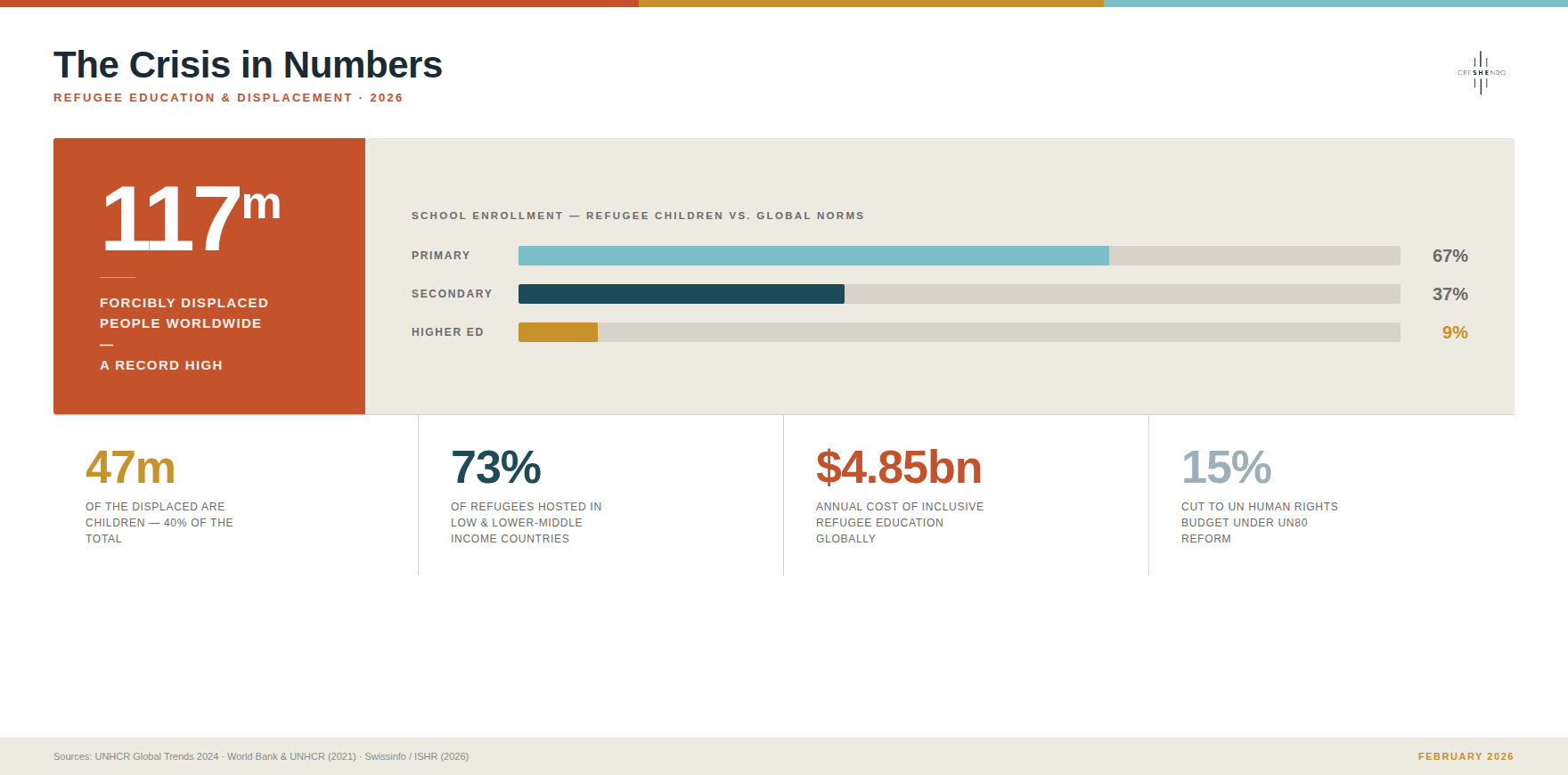
Compare those figures to global averages: 102% gross enrollment at the primary level, 77% at secondary, 42% in higher education.3 The gap is not incidental. It reflects cumulative failures of policy, funding, and political will.
The situation for internally displaced children — those who have fled danger without crossing an international border — is even more opaque. A chronic lack of data on internally displaced persons (IDPs) makes comprehensive assessment nearly impossible. What evidence does exist confirms that “most internally displaced children live in countries with some of the largest disparities in access to education and lowest outcomes in the world.”4
Despite these realities, the financial architecture built to respond to displacement is now contracting. As of early 2026, only 69 of 193 UN member states had paid their budgetary contributions for the year. The United States and China — the two largest donors — were not among them. The UN’s human rights machinery is now, in the words of High Commissioner Volker Türk, operating in “survival mode.”5
The right to education is not aspirational — it is legally codified. Article 26 of the 1948 Universal Declaration of Human Rights states plainly that “everyone has the right to education.” The 1951 Convention Relating to the Status of Refugees reinforces this right for displaced persons specifically. In 1993, the Vienna Declaration elevated Human Rights Education as a mechanism for bridging rights theory and rights practice.6 More recently, the 2024 INEE Minimum Standards, the Education Cannot Wait initiative (2016), and the Global Compact for Refugees (2018) each reasserted the international community’s commitment to educating displaced populations.
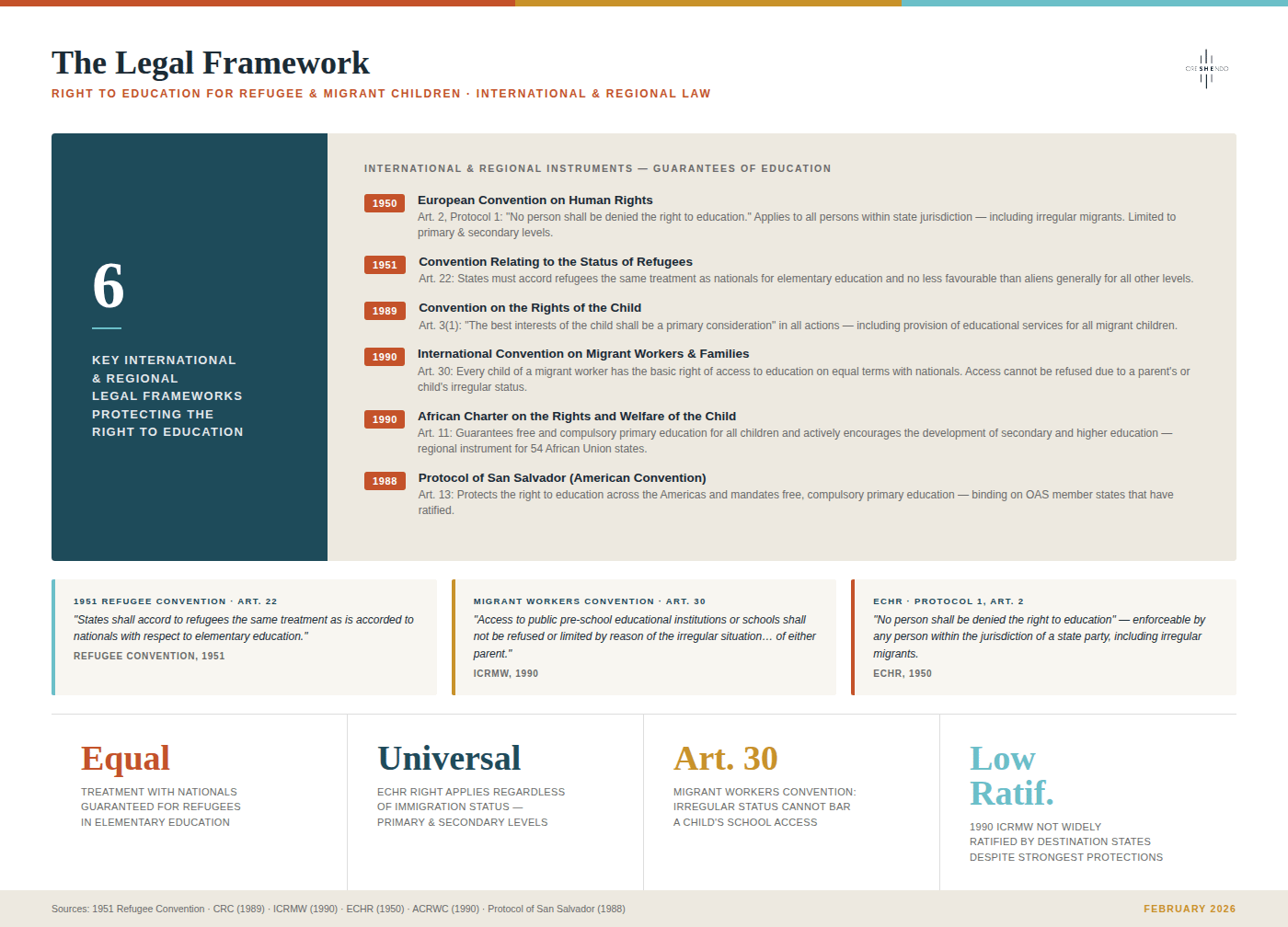
Yet as Dr. Tristan McCowan has argued, the UNDHR’s foundational framing contains critical shortcomings that persist today. The document identifies education too narrowly with formal schooling, restricts absolute rights to elementary level, and says too little about what education should achieve. McCowan proposes reframing the right to education to encompass both intrinsically valuable processes that embody respect for human rights, and access to institutions and experiences that confer genuine positional advantage — the ability to compete and participate in global society.7
If human rights are only accessible to the wealthy and privileged, they are meaningless.— Tristan McCowan, Reframing the Universal Right to Education (2010)
Joel Spring articulated the deeper purpose of education for marginalized groups: to give people “the power to mediate the relation between their own cultures and the current world system.”8 Stripped of this power through lack of education, displaced children navigate an increasingly complex international legal landscape without tools for self-advocacy or economic participation.
Katarina Tomaševski’s influential 4A framework — Availability, Accessibility, Acceptability, Adaptability — identifies governments as the primary agents obligated to deliver education rights. In theory, international refugee law creates a uniform distribution of responsibility: all states must admit refugees and uphold their rights. In practice, as Betts and Collier have documented, this uniform responsibility is unevenly met.9
This distributional problem is compounded by geography. Seventy-three percent of the world’s displaced persons are hosted in low and lower-middle-income countries.10 The World Bank and UNHCR estimate the annual cost of providing quality, inclusive education to refugee students in these countries at approximately US$4.85 billion. The gap between need and available resources is vast — and growing wider as donor states reduce their UN contributions.
Bullard and Jalbout argue persuasively that inclusion in national education systems — not parallel refugee-only programs — is the most effective and sustainable model for delivering education rights. This means not merely ensuring attendance, but adapting classroom content, pedagogies, and school culture so that displaced children “feel supported, included, and connected to their identity, communities, and school culture.”11 State-led inclusion remains the gold standard; but where states fail, the role of non-state humanitarian actors and IGOs becomes essential, provided these interventions aim at eventual reintegration rather than permanent parallel schooling.
One of the most underutilized resources in delivering quality education to displaced children is the refugee teacher. Ericka Richardson establishes that the teacher is the most important in-school factor affecting educational quality. Refugee teachers bring irreplaceable assets: language skills, cultural knowledge, and first-hand experience of displacement that positions them uniquely to support displaced learners from their communities of origin.12
Yet host country policies frequently prevent refugee teachers from working legally or earning salaries in public education systems. This reflects what Bullard and Jalbout characterize as a “deficit perspective” — a framework that views refugees as a burden rather than contributors. An asset perspective, by contrast, recognizes that when refugees are empowered to teach, work, and participate, they become net contributors to host societies while restoring their own autonomy and dignity.
Refugees can access opportunities not only to learn and teach, but also to heal, see themselves reflected in the systems around them, feel included in their communities, and imagine a future for themselves.— Bullard & Jalbout, Key Tensions in Refugee Education (2022)
As the 61st session of the Human Rights Council convenes this week, it does so under conditions that would have been difficult to imagine when the Council was founded two decades ago. Wars in Sudan, Ukraine, Gaza, and Myanmar generate displacement at industrial scale. Climate change induces its own category of mass dislocation. And the institutional architecture built to respond faces acute financial strain.
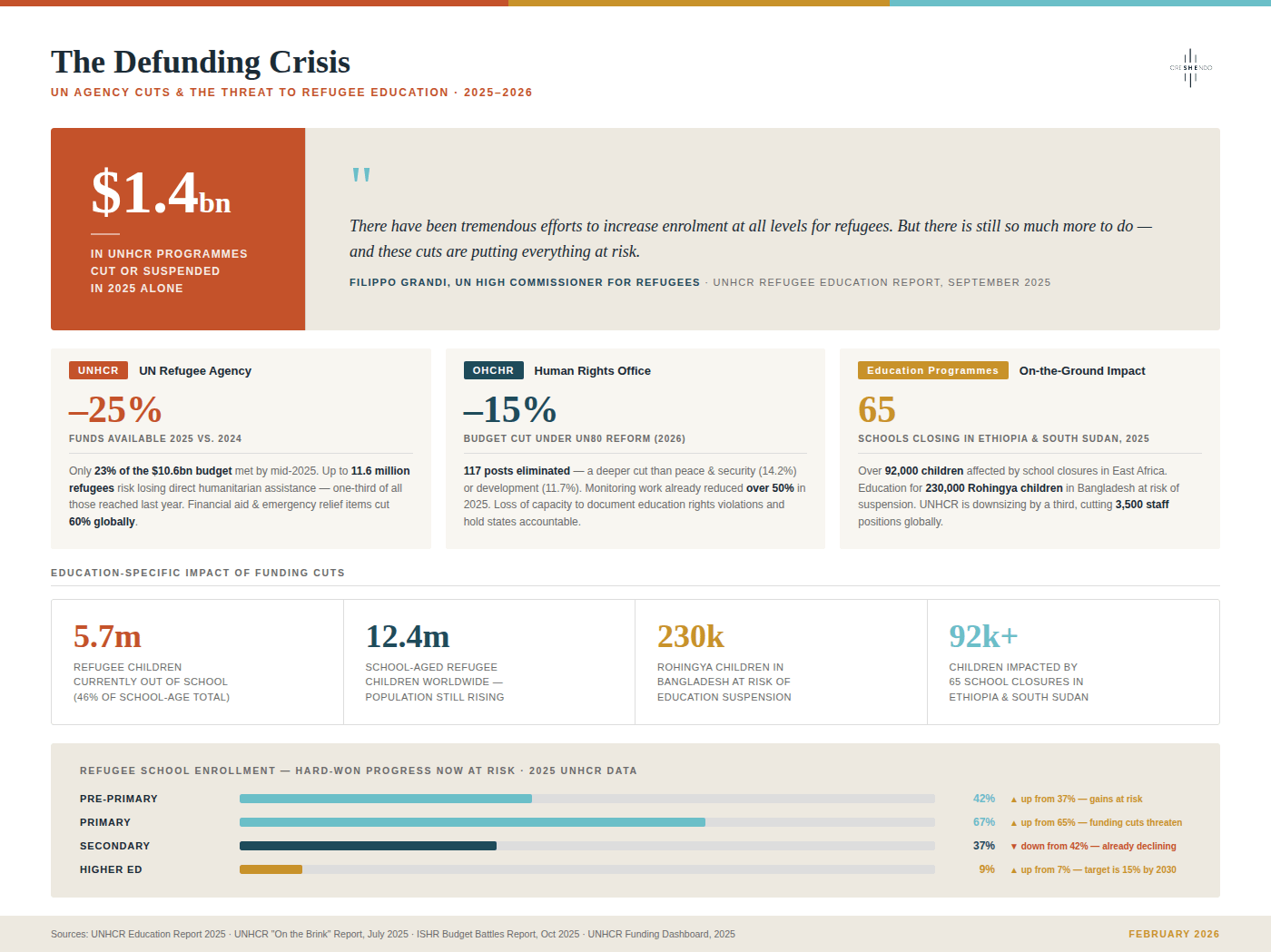
The 15% budget reduction to the Office of the High Commissioner for Human Rights is not merely an administrative adjustment. When the bodies responsible for monitoring, reporting on, and advocating for human rights are defunded, violations become harder to document, harder to address, and easier to perpetrate. In 2025, OHCHR monitoring work was already reduced by over 50 percent. The narrowing of the Council’s session by half a week means fewer days to scrutinize education crises in Sudan, fewer opportunities to hold states accountable for their commitments under the Global Compact for Refugees.13
The 9% higher education enrollment rate for refugees does not represent a policy failure awaiting a technical fix. It represents a choice. A collective, ongoing choice by the international community about who among the world’s youth deserve a future.
The literature surveyed here converges on several urgent conclusions as the Human Rights Council convenes its 61st session:
Member states must fulfill financial obligations to the UN system. The liquidity crisis undermining the Human Rights Council, UNHCR, and related bodies directly compromises the delivery of education rights to displaced children.
Host states must move toward inclusive national education models. Parallel refugee education systems are neither sustainable nor equitable. Meaningful inclusion requires adaptation of curriculum, pedagogy, and school culture.
Refugee teachers must be granted the right to work. Restricting qualified educators from employment is both a human rights violation and an act of institutional self-harm that deprives displaced communities of their most valuable educational resource.
Data collection on internally displaced children must be urgently improved. The absence of reliable IDP education data renders millions of displaced children invisible to policy and accountability mechanisms.
Education for displaced persons must be reframed as investment, not charity. The estimated US$4.85 billion annual cost of inclusive refugee education is a fraction of the long-term costs of a generation educated in exclusion — or not educated at all.
The displaced children of today are the adults of a world we are already building. What kind of world that will be depends, in no small part, on whether we choose to educate them.
Thanks for reading! This post is public so feel free to share it.
Notes
1.UNHCR, Global Trends: Forced Displacement in 2023 (Geneva: UNHCR, June 2024). The 117.3 million figure represents all categories of forced displacement. Children represent approximately 40% of this total, yielding an estimated 47 million.
2.Elizabeth Ferris, “When Refugee Displacement Drags On, Is Self-Reliance the Answer?” Brookings Institution, June 19, 2018, https://www.brookings.edu/articles/when-refugee-displacement-drags-on-is-self-reliance-the-answer/.
3.UNHCR, Refugee Education Report 2023 (Geneva: UNHCR, September 2023); INEE, “Refugee Education,” https://inee.org/collections/refugee-education. Global averages from UNHCR Global Report 2023, Outcome Areas: Education. Enrollment rates reflect 2022 reporting-country data.
4.Christelle Cazabat and Laura Yasukawa, Informing Better Access to Education for IDPs (Geneva: Internal Displacement Monitoring Centre, 2022), https://www.internal-displacement.org/publications/informing-better-access-to-education-for-idps/.
5.Swissinfo.ch, “Twenty Years After Its Creation, the Human Rights Council Is Under Pressure,” February 2026, https://www.swissinfo.ch/eng/international-geneva/twenty-years-after-its-creation-the-human-rights-council-is-under-pressure/90982470; Geneva Solutions, “UN Human Rights Branch ‘In Survival Mode’ as Funding Dries Up,” December 23, 2025, https://genevasolutions.news/human-rights/un-human-rights-branch-in-survival-mode-as-funding-dries-up.
6.Monisha Bajaj and Nadia Mabona, “Theories of Human Rights Education in Comparative and International Education,” in The Bloomsbury Handbook of Theory in Comparative and International Education (London: Bloomsbury, 2021), 361.
7.Tristan McCowan, “Reframing the Universal Right to Education,” Comparative Education 46, no. 4 (2010): 509–525, https://doi.org/10.1080/03050068.2010.519482.
8.Joel H. Spring, The Universal Right to Education: Justification, Definition, and Guidelines (Mahwah, NJ: Lawrence Erlbaum, 2000), 18.
9.Katarina Tomaševski, Human Rights Obligations: Making Education Available, Accessible, Acceptable and Adaptable (Stockholm: Swedish International Development Cooperation Agency, 2001), 8; Alexander Betts and Paul Collier, Refuge: Rethinking Refugee Policy in a Changing World (Oxford: Oxford University Press, 2017), 208.
10.UNHCR, Global Trends: Forced Displacement in 2024 (Geneva: UNHCR, June 2025); UNHCR, Mid-Year Trends 2025 (Geneva: UNHCR, November 4, 2025), https://www.unhcr.org/media/mid-year-trends-2025.
11.Katy Bullard and Maysa Jalbout, “Key Tensions in Refugee Education,” Brookings Institution, November 16, 2022, 4, https://www.brookings.edu/articles/key-tensions-in-refugee-education/.
12.Ericka Richardson, Teachers of Refugees: A Review of the Literature (Washington, DC: ERIC Clearinghouse, 2018), 27–32.
13.International Service for Human Rights (ISHR), “UN80 Reform: States Endorse Slashing of Human Rights Budget,” January 2026, https://ishr.ch/latest-updates/un80-reform-states-endorse-slashing-of-human-rights-budget/; fundsforNGOs News, “Funding Shortfall at UN Puts Human Rights Programs at Risk,” February 16, 2026, https://news.fundsforngos.org/2026/02/16/funding-shortfall-at-un-puts-human-rights-programs-at-risk/.
Comments
Nothing yet. Say the first thing.
Sign in to join the conversation.