
Hi there,
The final session of our 3-part mock interview series tackled the exact format that trips up even seasoned PMs: the live case study.
Session 1 was product sense.
Session 2 was technical chops.
Session 3 was the pressure cooker - the one that exposes whether you can actually think on your feet.
The setup? A real case study. A 30-minute prep window. A panel of three interviewers. No slides - just raw notes.
Here is everything worth taking from that session to ensure you land your next role.
Start with a framework before proposing solutions. A 2x2 beats a list every time - it shows structure, not just knowledge.
Separate AI automation from AI assistance. Not everything should be fully automated. Knowing where to draw that line is the real skill.
Think in phases, not final-state visions. Show what you’d build first and why. Phased thinking signals PM maturity.
Build trust differently for users and buyers. End users need transparency and speed. Buyers need benchmarks and boundaries. Same product, two completely different trust journeys.
Define your North Star metric before discussing features. If you can’t name one clean, defensible number, your feature list has no anchor.
Interviewers are tired of practiced answers. Case studies exist to defeat muscle memory.
When a company gives you a case, especially one you get 30 minutes or an hour before the interview - they’ve usually designed it around a real problem they’re currently solving. They have deep context. They can tell instantly if you’re pattern-matching versus actually thinking.
There are two formats you’ll encounter:
Take-home style: case study given a week in advance, submit written answers, then defend them
Live style: case arrives at interview time, you get 60 minutes to prep, then present cold
The live format is growing fast. And it rewards one thing above all: structured, confident thinking under pressure.
The mock session used a real case study: an AI maintenance agent for property managers. Residents report issues via text or voice. The question - what should AI own, and what should traditional software handle?
Most people dive straight into “AI should do X.” That’s the wrong move.
Mahesh’s approach: build a 2x2 first.
Axes:
Cost of error (low → high)
Complexity / available information (explicit → technical)
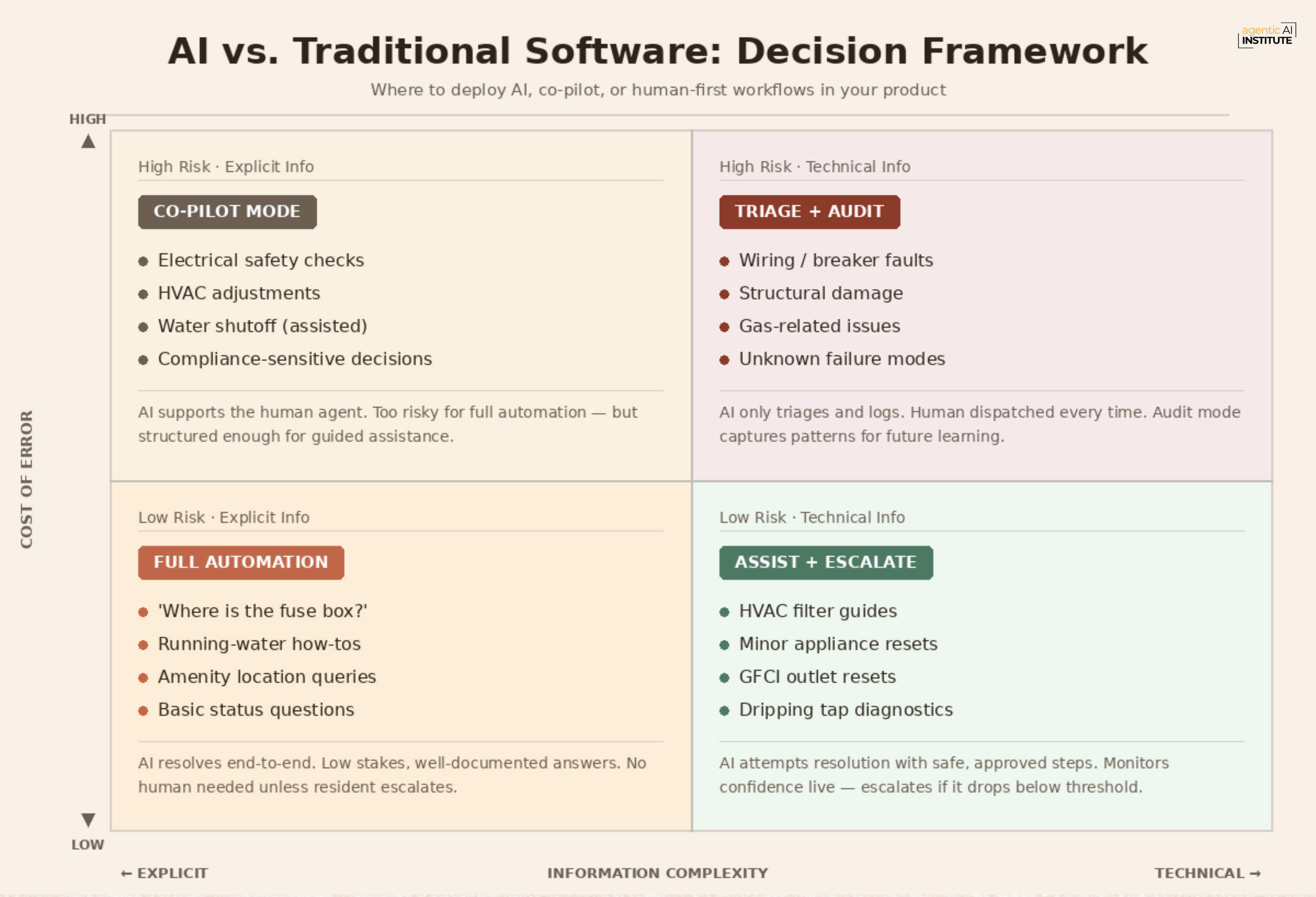
This framework forces clarity before commitment. Once you’ve plotted problem types on that grid:
Quadrant 1 (low cost, explicit info): Full AI automation. How-to questions, basic troubleshooting, location queries - let the AI handle these end-to-end.
Quadrant 2 & 3 (moderate complexity): AI + co-pilot. The agent assists, a human stays in the loop for sensitive decisions.
Quadrant 4 (high cost, technical): Triage only. No troubleshooting. Audit mode - observe, learn, escalate.
The insight: start where you can win clearly, then expand. Phase 1 is Quadrant 1 only. The rest follows over 6–12 months as confidence builds.
When the panel asked what data would make the system effective, the answer wasn’t just “training data.” It was a three-layer framework:
Data to build the system: historical issues, resolution playbooks, unit details, building-level seasonal patterns, resident profiles
Data to evaluate the system: top 10 issue types with known resolutions, competitive benchmarks, expert-reviewed test runs
Data to improve the system: real interaction logs, flagged failures, human-agent corrections
Most PMs stop at layer one. The panel noticed the distinction immediately. Contextual, structured data beats volume every time.
A question that surfaces in nearly every AI product interview: how do you build user trust?
Comments
Nothing yet. Say the first thing.
Sign in to join the conversation.