
Last week, during our community session, I asked the room a question that a billion-dollar data company had actually asked in a staff PM interview:
“We built a tool for lawyers that extracts key terms from M&A contracts using AI. It works well. But lawyers don’t trust it. What would you do?”
The answers I got were good. Citations. Human-in-the-loop. Evals. Time savings.
But none of them told the full story. And in a real interview, that incomplete answer costs you the offer.
Let me explain what’s actually happening in AI PM interviews right now, and what interviewers are really looking for.
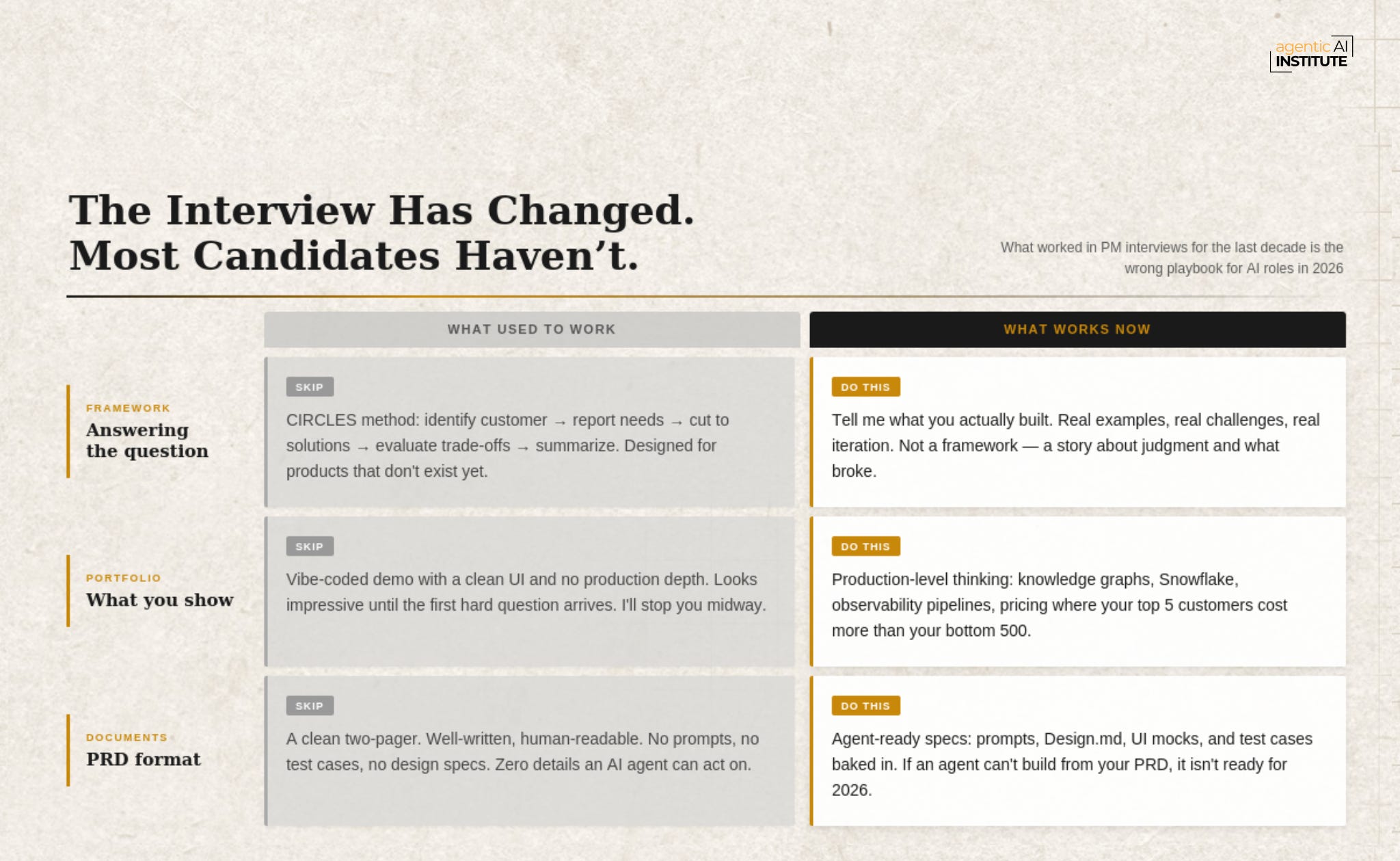
For the last decade, PM interview prep has been built on the same playbook: identify the customer, surface the needs, prioritize, propose solutions, evaluate tradeoffs, summarize your recommendation.
That framework was designed for a world where the product doesn’t exist yet - where the job is to find white space and fill it.
AI is different.
When a company is building an AI product for lawyers, or doctors, or compliance teams, the need is not in question. Paralegals already process M&A contracts today. The job is already being done by humans. The challenge isn’t discovering what to build. The challenge is earning the right to replace a deeply trusted human workflow with a machine.
If you walk into an AI PM interview with the old framework, I will stop you inside the first two minutes. Because you’re solving the wrong problem.
What I’m actually testing for is simpler and harder: Do you understand what it takes for a skeptical professional to trust AI enough to depend on it?
The data storage company that asked the lawyer question wasn’t looking for a product sense framework. They had tried building the product. It worked technically. But it couldn’t break through.
Here’s why this keeps happening across AI products: the people who are hardest to sell aren’t irrational. Lawyers, radiologists, compliance officers, financial auditors - they’re experts who’ve spent years building judgment. When an AI tool gives them an answer without showing its work, they don’t see a time-saver. They see a liability.
What I have shipped in products like this, and what I now test for in interviews - comes down to five things I call the TRUST framework:
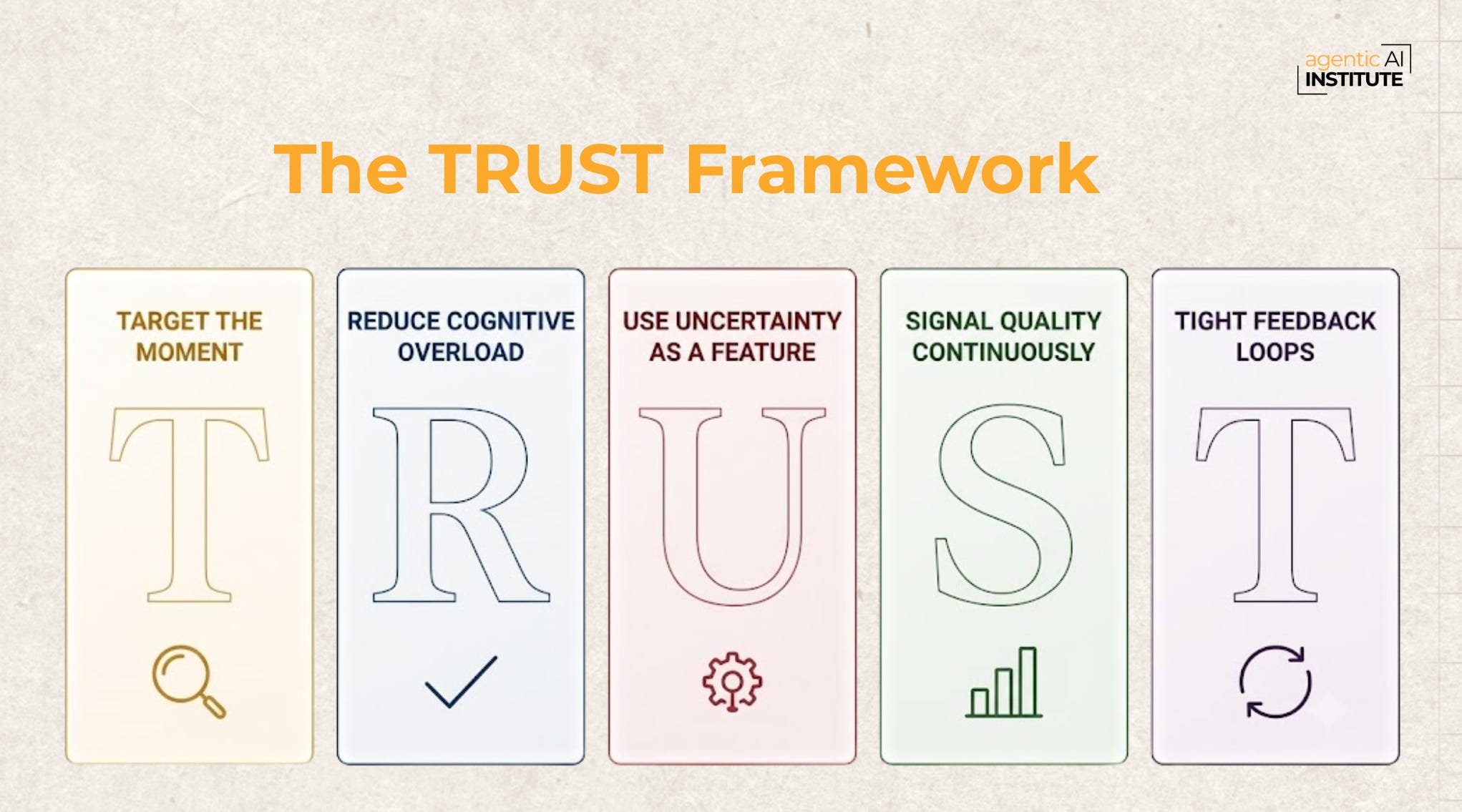
Target the moment. Trust isn’t lost all at once. There are specific moments where users first doubt the output. Identify those moments and design for them. For the lawyer tool, it was the moment the AI surfaced a contract risk with no explanation of why.
Reduce cognitive overload. The instinct is to show everything - full citations, all sources, complete reasoning chains. But more information doesn’t mean more trust. It means more work. We layered the answer: a clean output first, a citation button second, and a “Reasoning” button third. Users could go as deep as they wanted, but they didn’t have to.
Use uncertainty as a feature. AI reasoning is generic. A law firm has spent decades building its own playbook for M&A risk. We gave lawyers the ability to edit the reasoning to encode their firm’s specific logic into the product. Now the AI doesn’t just show its work. It learns their style. Uncertainty, reframed, becomes institutional memory.
Signal quality continuously. We ran domain-specific evals - M&A contracts reviewed by expert lawyers, and showed users exactly how the tool performed versus humans and versus out-of-the-box models like Copilot. This is not a feature. It’s a promise. Without it, “trust us” is just a sales pitch.
Tight feedback loops. Every time a lawyer edited the reasoning, the product learned. This is the moat that generic tools like Copilot cannot replicate. They can’t be configured. They can’t be taught your firm’s style. We could.
When I ask you a product sense question in an AI interview, I’m not checking whether you know the TRUST framework. I’m checking whether you’ve lived something like it.
I want to hear the iteration. The thing you tried that didn’t work. The feedback that surprised you. The reason you added a feature you initially thought was unnecessary.
One of the patterns I see too often in 2026 is candidates who show me their vibe-coded demo and stop there. The demo is impressive. But my production systems have knowledge graphs, Snowflake integrations, observability pipelines, and pricing models where the top five customers cost more than the bottom five hundred combined. A demo that skips all of that is not a PM story. It’s a weekend project.
The other gap I see: PRDs that aren’t agent-ready. In 2026, a product requirement document needs to contain the prompts your agents will use, the design specifications an agent can act on, and the test cases that define success. If your PRD doesn’t have those, you are not writing for the world we’re actually building in.
Judgment is what I’m paying for. Knowledge is free. Show me what you tried, what failed, and what you learned from the failure.
Q: Can you explain observability? What does it actually mean in practice?
Your agent is calling tools, sub-agents, and APIs to solve a problem, and unlike traditional software, the cost of answering a query isn’t fixed. Observability is how you track what happened: how many tool calls were made, how many were correct, and what it cost to solve that specific customer problem. Without observability, you cannot price your product. Your top five customers might cost you more than your bottom 500 combined. You need to see that before you can segment users, set pricing tiers, or make model routing decisions. Observability is the broader umbrella. Evals sit inside it, focused specifically on quality. Observability covers pricing, planning, cost attribution, and operationalizing your agents end to end.
Q: What’s the difference between observability and evals? They sound similar.
Evals are one stream within observability. You run evals to improve quality - to know if your model is performing better or worse than a human on a specific task. Observability is broader. It tells you how your agent behaves in production over time: which users are asking what, how complex their queries are, how much you’re spending to serve them. One is about improving the product. The other is about running the business.
Q: I’ve been building internal tools and client-facing products by vibe coding. How do I transition into AI PM without years of traditional PM experience?
You already have the technical depth. What I’d look for next is product taste - real stories about where you chose not to build something with AI, and why. That judgment is hard to fake. I’d also want to see that you can take an idea and turn it into a roadmap: who does what, how do you sequence it, how do you actually land it. If you walk into an interview and you can show me a product that’s in production - even with five users, and walk me through the architecture, the trade-offs you made, and what you’d do differently, you’re ahead of most candidates.
Q: If I haven’t worked on AI products at a company, what should I be building to prepare?
Build something real. It doesn’t need to scale to millions of users - it needs to be production-grade enough that someone can actually try it. Go from vibe coding to spec-based development: write a PRD, document the architecture, show the evaluation setup and observability hooks. Publish the architecture somewhere public. In the interview, walk me through the real decisions - not the demo, the decisions. If you understand what it took to get something to production on Azure, AWS, or GCP, you’re already better than the majority of people in the room.
A friend reached out to me recently. He’s been searching for a senior AI PM for three months, willing to pay $750K to $850K. He cannot find the right person.
This is not a contradiction. AI PM job postings have grown roughly 33% in the last six months. Companies that never hired PMs before - AI-native startups that shipped their first products with just engineers are now facing the hardest problems: they got users, but they can’t keep them. They have products that work, but users don’t trust them enough to pay. They need people who have shipped AI into the hands of skeptical professionals and know what it actually takes.
That is the job. And that is the interview.
If you want to prepare for it, start by asking yourself honestly: have you shipped something? Not built - shipped. Have real users depended on it? Have you had the conversation where a user told you, “I tried it, but I didn’t trust it enough to keep using it?” Have you iterated from that?
If not, go build something. It doesn’t need to scale to a million users. It needs to be real enough that you have genuine stories - about what worked, what didn’t, and what you would do differently.
That’s the signal I’m looking for. And based on what I’m hearing from hiring managers across the industry, it’s the signal most candidates aren’t giving.
Keep building.
Mahesh Yadav runs the AI PM Community, a free weekly learning session for product managers and builders navigating the age of AI. This article is based on Last Lightning Session. Join us at substack.com/@myaicommunity. Watch past sessions on YouTube. Connect on LinkedIn.
No posts
Comments
Nothing yet. Say the first thing.
Sign in to join the conversation.