
There is a specific kind of energy that happens on Pitch Day.
It’s 6 AM somewhere. Someone’s screen is frozen. The timer is counting down. And a person who six weeks ago had never shipped an AI product is now showing a live demo - a real, working, agentic system - to 75+ people who stayed up or woke up early to watch.
That’s Pitch Day.
In june 2026, we ran Cohort 9’s Pitch Day. Three sessions. An entire weekend. 75+ builders presenting live AI products across healthcare, fintech, legal tech, sales automation, mental wellness, sustainability, logistics, and more.
After giving feedback on every single presentation, the thing I kept coming back to wasn’t the tech. It was the pattern.
What separated the products that landed from the ones that didn’t wasn’t the model, the architecture, or the stack. It was something older than all of that.
But we’ll get to that.
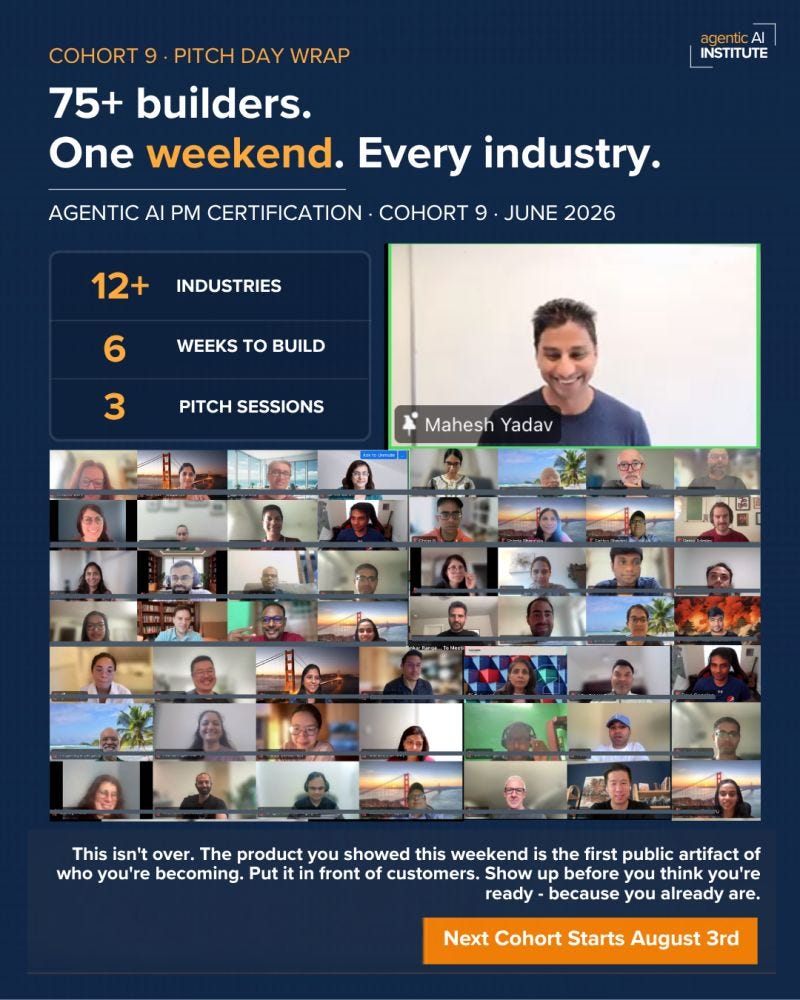
The range was staggering, and it matters, because one of the biggest myths in AI right now is that the interesting problems are all in the same two or three verticals.
They’re not.
Across three sessions, builders shipped:
AI agents for healthcare coaching, diabetic reversal protocols, and clinical decision-making
Revenue cycle automation that catches insurance underpayments doctors never knew they were owed
Fintech tools that give retail investors a morning portfolio brief before their first coffee
Sales automation that qualifies and routes leads in real time using voice AI
Social media planning agents for D2C founders who can’t afford a content team
Legal tech that teaches junior associates to think like lawyers, not just draft like them
Family planning and activity discovery tools that get smarter with every choice you make
Enterprise ERP and supply chain agents that handle the parts humans hate most
Sustainability platforms that give brand managers an environmental footprint in minutes, not months
Grant discovery tools for nonprofits that cut hours of research down to a single workflow
AI pricing engines that help founders go from “what should we charge” to “here’s the number we can defend”
Across 75+ pitches, certain patterns showed up repeatedly. Here’s what I kept coming back to.
1. The moat is the learning loop, not the capability.
Personal AI capability is no longer a differentiator. Every serious model can do the basics. What separates the products that stick is compounding - tools that integrate with what people already use (their calendar, WhatsApp, their daily workflow), learn their patterns over time, and get measurably better with every rep.
If your product is as good on day one as it is on day ninety, you don’t have a moat. You have a feature.
2. The most interesting whitespace is in agent gaps, not human gaps.
Most builders start by asking: where are humans struggling, and how can AI help? That’s a reasonable question. But the products that stood out were asking a different one: what problems are agents creating?
Coding assistants, for example, are now so capable that they’ve created a new failure mode - developers who can use AI to generate code but can’t build durable systems, debug meaningfully, or understand what they’ve shipped. That’s a real problem. And it’s a gap that didn’t exist three years ago.
Build for the world AI is creating, not just the world it’s fixing.
3. Ownership beats assistance - every time.
There is a version of every AI product that assists. Surfaces information. Drafts a response. Suggests an action. And there is a version that owns the outcome — that takes the work end-to-end, figures out where a human needs to be in the loop, and delivers a result.
The second version is harder to build. It’s also significantly easier to sell. When you own the outcome, pricing becomes a conversation about value, not cost. When you only assist, you’re competing with tools that start at $20 a month.
4. Domain knowledge is now the primary differentiator.
This one showed up in every session, without fail - When you know the domain, you know the problems. The builders who presented the sharpest products weren’t the ones with the most impressive tech stacks. They were the ones who had lived the problem - as a practitioner, a patient, a parent, someone who had sat in that exact meeting and felt the exact friction.
That intimacy shows up in the product. In the edge cases they’d already solved. In the language they used to describe the problem. In the trust the product immediately signals to anyone who’s been in that room.
You can’t fake domain depth. And in an era where anyone can build a prototype in a weekend, it might be the last real differentiator.
Good feedback isn’t only praise, it requires honesty about failure patterns too. Here’s what I flagged consistently.
Low-frequency problems.
Real problems - but frequency drives data, and data drives improvement. If your product only activates once a year, you can’t build the feedback loop that makes agents genuinely better. You also can’t run a GTM motion that compounds. Think carefully about how often your product earns a rep.
Multi-agent complexity without domain expertise or evals.
Stacking agents doesn’t substitute for understanding your domain deeply. If you don’t know when your agent is right and when it’s wrong - if there are no evaluations, no ground truth, no way to measure quality - more architecture won’t save you. Build the eval layer before you build the next agent.
Pricing without observability.
If you don’t know what your agent costs per run, when it succeeds, and when it fails -you’re flying blind. Flat pricing on top of variable agent performance is a unit economics problem waiting to happen. Observability isn’t a nice-to-have. It’s a precondition for sustainable pricing.
There is a version of the AI PM conversation that is almost entirely about tools, models, and frameworks. And that conversation is useful.
But the thing that I kept returning to and the thing that the data from three full sessions kept confirming - is something that has nothing to do with AI.
The best products were built by people who cared about the problem before they ever heard of an agent.
Not people who found a market gap and looked for a problem to fit it. People who had been inside the problem - as a revenue cycle manager who knew exactly how insurance underpayments happen, as a mental wellness founder with 70,000 organic followers because the pain was personal, as a wealth management practitioner who watched high-value advisors leave because their feedback was never prioritized.
These people didn’t need to be convinced the problem was real. They already knew. And that conviction - that intimate, personal, lived conviction - is what made the product credible, specific, and hard to replicate.
In 2026, anyone can build a prototype. The question is whether you understand the problem well enough to build the right one.
Whether you’re a product manager, a builder, someone thinking about making the leap into AI - here’s what’s actually transferable from the sessions.
Start with a problem you’ve lived, not a problem you’ve researched. Research tells you a problem exists. Experience tells you what it actually feels like, where the real friction is, and what a solution would need to do to earn trust.
Think about frequency before you think about features. How often does your product get a rep? That answer shapes everything - your data strategy, your improvement loop, your GTM motion.
Build for ownership, not assistance. Ask yourself: is my product doing something for the user, or doing something instead of the user? The latter is a harder build and a much better business.
Observe before you optimize. Know what your agent costs. Know when it works. Know when it doesn’t. Pricing, trust, and scale all depend on it.
Don’t wait until it’s ready. The product you have today is your first public artifact. Put it in front of real people. Learn faster than you build. The builders who win aren’t the ones who launch perfectly - they’re the ones who learn the fastest.
And if this is the kind of room you want to be in - Cohort 10 of the Agentic AI PM Certification starts August 29th.

Real products. Real problems. Real feedback. The bar is only going up.
No posts
Comments
Nothing yet. Say the first thing.
Sign in to join the conversation.