
Today, Nebius released its Q2 results.
In my preview, I wrote that given this team’s track record, it wouldn’t make much sense to approach this report without being optimistic. Even so, they managed to surprise me again. Not so much on the headline numbers, which were quite good, but mostly on the economics behind them.
Arkady opened his shareholders’ letter by saying this was the quarter the market validated the company’s strategy, and I think that’s a fair way to frame it.
In this article, I’ll break down everything you need to know.
Let’s dive in.
Revenue of $582.3M vs. $573.9M est. (+454% YoY and +46% QoQ)
Core Business Revenue of $574.9M (+514% YoY and +47% QoQ)
Adj. EBITDA of $236.2M vs. $172.6M est.
Group Adj. EBITDA margin of 41%, up from 32% in Q1
Core Business Adj. EBITDA of $285.7M at a 49.7% margin, up from 45% in Q1 and 24% in Q4
ARR of $3.0B at the end of June (+598% YoY and +56% QoQ)
Gross margin of 77% vs. 74% in Q1
Operating Cash Flow of $2.2B, once again driven by customer prepayments
Q2 CapEx of ~$5.7B (vs. ~$2.5B in Q1), bringing H1 to $8.1B
$8B in cash at quarter-end, plus another ~$1.1B in restricted cash
GAAP Net Loss of $190.4M, or $(0.68) per share
Non-GAAP Net Loss of $33.2M, narrowing 64% from a $91.5M loss a year ago
The revenue beat was modest relative to consensus, which was broadly in line with what I expected in my preview given the timing of capacity deployments. Capacity that came online late in Q2 only begins contributing meaningfully to revenue in Q3, so this quarter was never going to be the one where top-line growth really accelerated.
The Adj. EBITDA line is a different story. Nebius delivered a 37% beat, way better than I expected. The core AI cloud business is now running at a ~50% margin, and the steepness of this ramp is worth noting: 24% in Q4 2025, 45% in Q1, and 50% now. Keep in mind, though, that EBITDA is a long way from the bottom line in a business this capital intensive. D&A alone was 45% of revenue this quarter (down from 72% YoY), so the metric I ultimately anchor my model to remains management’s medium-term profile of a 20-30% EBIT margin. What this quarter shows is that the path toward that profile is tracking ahead of schedule. Management attributed the improvement to higher revenue, the early contribution of the asset-light model, Token Factory, and the recent acquisitions. The delta between the group margin (41%) and the core business margin reflects the ongoing investments in Avride and TripleTen.
On the GAAP net loss, three things explain the swing from last year’s $502.5M net income. First, Q2 2025 included a one-off $597.4M non-cash gain from the revaluation of equity stakes, and this quarter had no equivalent (Q1 2026 had the $781M ClickHouse gain). Second, interest expense has scaled to $119.1M as the convertibles and debt raised over the past year flow through the P&L. Third, the quarter absorbed $102.5M of SBC and $49.9M of acquisition-related costs (product development alone carried $115.9M of non-recurring expense tied to SBC and post-combination compensation from the Eigen AI acquisition). Strip out all of that, and the non-GAAP net loss of $33.2M is shrinking toward breakeven much faster than I expected.
2026 Outlook
Revenue guidance of $3-3.4B reiterated
YE2026 ARR guidance of $7-9B reiterated
Group Adj. EBITDA margin guidance of ~40% reiterated
YE2026 connected power guidance of 800MW-1GW reiterated
YE2026 contracted power guidance RAISED from >4GW to 5GW
2026 CapEx guidance of $20-25B reiterated
Over $9B in customer prepayments expected in 2026
Reaffirming the $7-9B ARR range was one of the most important things this print needed to deliver, especially given the amount of FUD circulating in recent weeks.
With ARR at $3B at the end of June and most of this year’s capacity still set to come online in H2, the path to the guidance range was always going to run through the second half of the year.
The contracted power target was raised again. Three months ago, management increased the year-end target from >3GW to >4GW. Today, they raised it once more to 5GW. I’ll cover the capacity details in a separate section below, but the broader takeaway is clear: Nebius continues to secure power faster than its own guidance can keep up with.
On 2027, we didn’t get formal guidance yet, but we did get something arguably more useful: a pricing baseline.
“You should expect the deals we closed in this quarter with more than $20M per MW and less than two-year payback period to start coming online from late Q4 and onwards. This can serve as the baseline for pricing early next year, as we could have sold out our planned capacity already today. However, we are choosing not to do so, reflecting our confidence with respect to future pricing dynamics.”
Dado also mentioned that Nebius will deploy “significantly more capacity in 2027” than in all of 2026, that formal 2027 guidance comes later this year, and that the asset-light model plus high-value services (agentic and inference solutions) should contribute an increasing share of revenue at even higher margins.
Let’s do some simple math.
Andrey Korolenko mentioned that the 800MW-1GW of connected power guided for year-end should become fully active during the first half of 2027.
If we use a blended average of ~$20M per MW (accounting for the significant capacity tied to Microsoft and Meta at lower rates, while more recent contracts carry substantially better economics), that 800MW-1GW of active power would imply roughly $16-20B in ARR by the end of June 2027.
As I said before, YE2027 ARR guidance might be the single biggest catalyst ahead.
This was, in my view, the highlight of the quarter.
Nebius closed four landmark deals for the AI cloud business: Reflection, Cohere, another (unnamed) US-based AI neolab pursuing frontier model development, and a large US-based quantitative trading firm (one of the first large-scale customer wins in financial services). The average total contract value across the four was more than $1B each, with annual contract value of $20-25M per MW.
To put that pricing in context, take a look at the chart below.
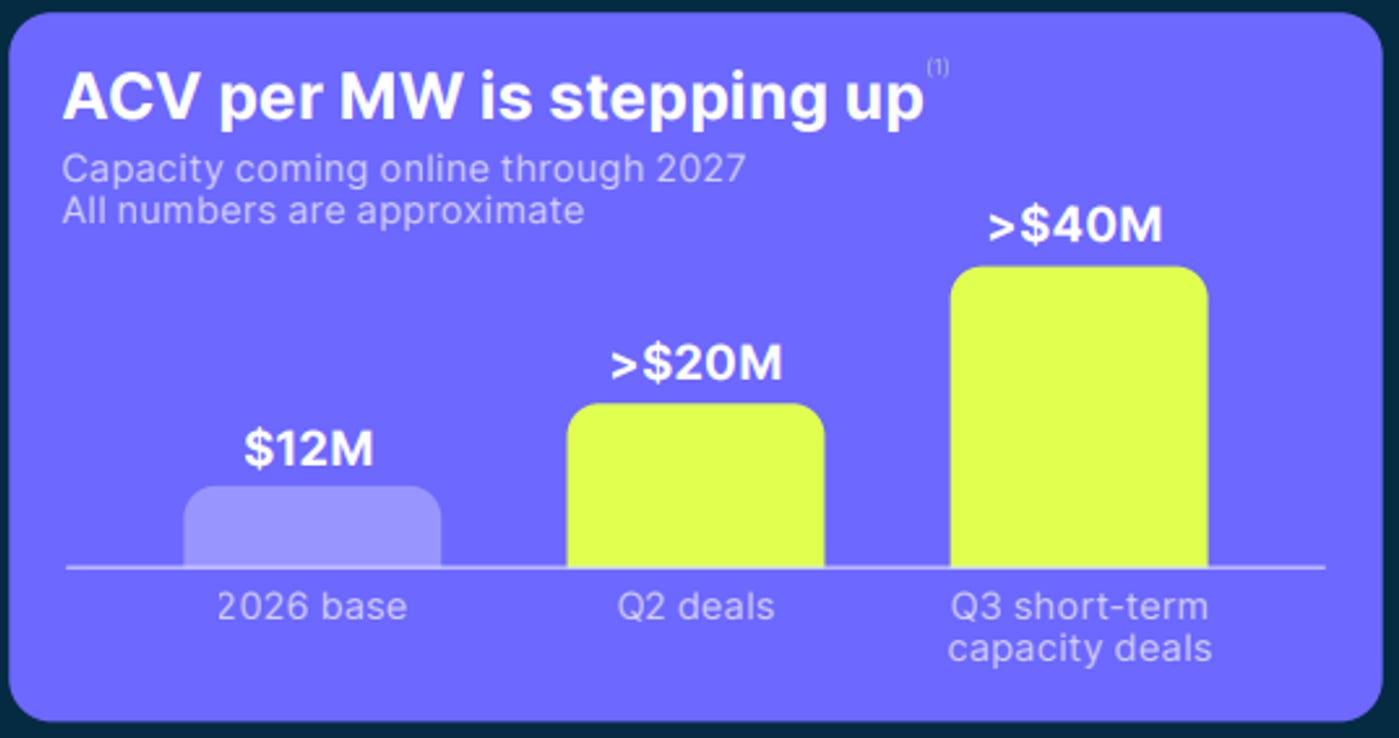
What a trend… The 2026 base of the business is priced at ~$12M per MW, the Q2 deals came in above $20M per MW, driven by higher pricing for new-generation GPUs and more than 30% higher pricing on older-generation GPUs compared to Q1, and the short-term capacity deals now being signed in Q3 are pricing above $40M per MW.
The aggregate figures are just as impressive.
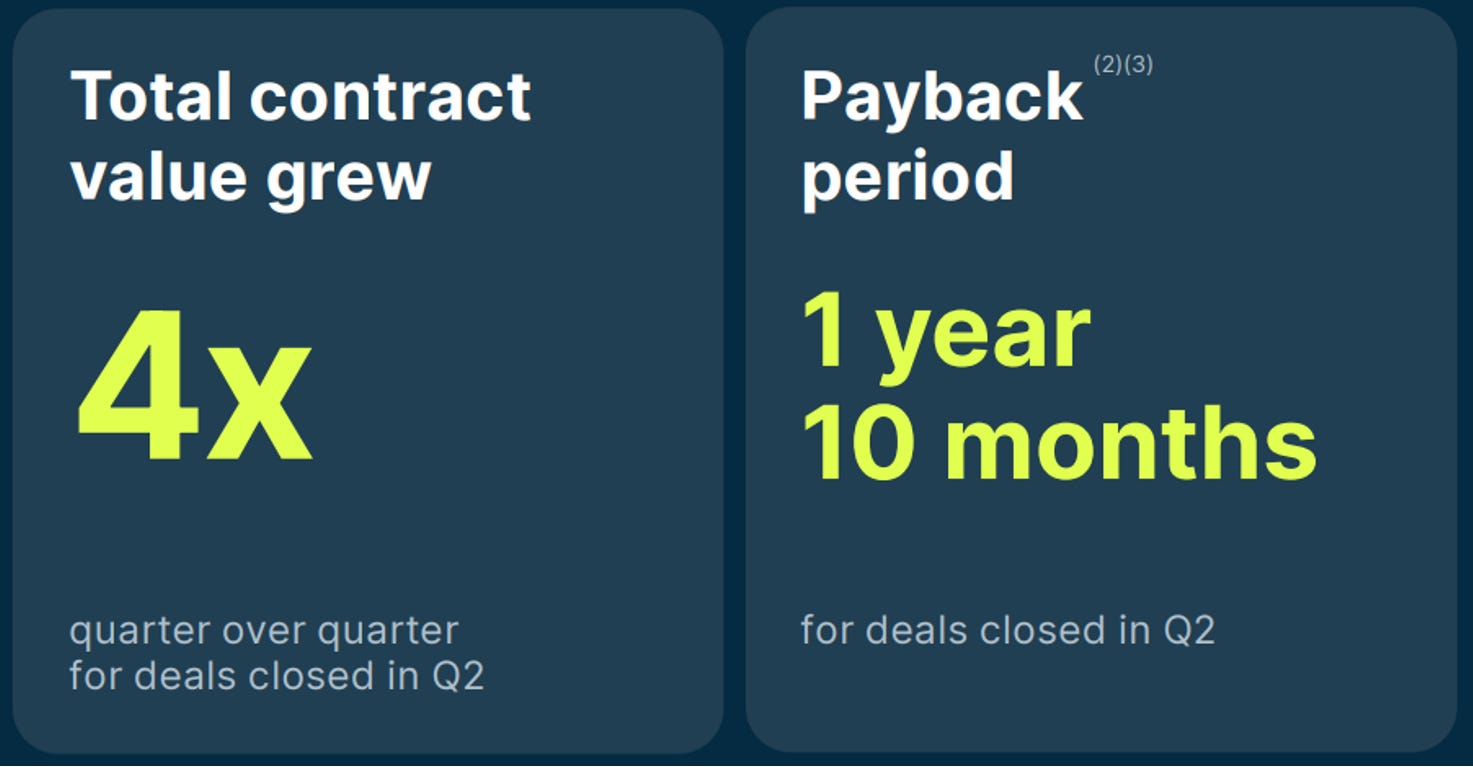
Total contract value (TCV) of deals closed in Q2 grew nearly 4x QoQ, with TCV from new customers growing more than 9x.
Roughly 70% of deals closed included customer prepayments, an all-time high, covering 50-60% of the associated CapEx.
The expected payback period for the CapEx and operating costs associated with Q2 deals compressed to 1 year and 10 months, down from the historical two-to-three-year range.
The impact these changes have on the company’s ROIC is extremely important.
For a business whose bear case has always been capital intensity and unproven unit economics, a sub-two-year payback on billion-dollar contracts is about as direct an answer as you can get.
Management also formalized how they think about the contract mix, with three deal types serving different purposes:
Mid-term contracts (one to three years) with the world’s most ambitious AI companies remain the core AI cloud business. That’s where the four landmark deals sit.
Long-term contracts with investment-grade customers (Microsoft, Meta) exist primarily to finance the buildout faster and more efficiently. The $775M secured facility raised in July was backed by one of these agreements, and with $40B in customer commitments, they’ll do more of this.
Shorter-duration contracts, typically three to six months, for customers with an acute, time-bound need. Think time-boxed large-scale training runs ahead of a model release, or reinforcement learning post-training sprints, priced at a significant premium. Nebius sees a price opportunity in the $40-50M per MW range here, sometimes above, and signed the first such deal in Q3.
Then there’s also this: Nebius ran its first capacity auction pilot. Marc Boroditsky framed it as pure price discovery in a market where reference points (competitor pricing, analyst opinions, even prediction markets) are all over the place:
“In a market where we have several buyers for every GPU, we let the market tell us directly. The auction result was a price 15% higher than we have ever seen before, and 20% higher than our pipeline for Blackwells.”
The winning bidder said they plan to participate in future rounds. Management was clear that these initiatives use a small portion of overall capacity and are primarily about learning and validating pricing within what remains a take-or-pay business. But this is basically real-time market evidence that Nebius has been underpricing its capacity.
All of this culminates in this statement:
Nebius could sell its entire 2027 capacity on these terms today ($20-25M per MW, with upfront payments that cover 50-60% of the associated CapEx), and is deliberately choosing not to, because retaining capacity for shorter-term and immediate customer needs generates higher value.
Marc explained that they’ve tactically shortened how far in advance they sell capacity because selling closer to deployment improves pricing while preserving agility. Priorities in deal-making are existing customers first, then new logos, then terms (in order: price, then upfront prepayment, then duration). In an environment where compute prices keep rising, holding inventory back is exactly what you want them to do. The current demand environment is essentially giving the company significant pricing power.
On the demand quality behind the headline deals:
All four landmark wins came through competitive processes. “Earned wins, not inbound walk-ins.” In every case, the customer already had an existing supplier, sometimes even a hyperscaler, and was looking to expand with next-generation capacity and a stronger platform.
Each deal was validated through hands-on proofs of concept (POCs), with one customer describing Nebius’ POC as “quite literally the best they have ever had.”
The quant firm, introduced by a key strategic partner late in Q1, was looking for a large-scale contiguous GB300 cluster and signed in May. Management said the customer highlighted Nebius’ responsiveness, transparency, white glove support, and ability to serve both its current US deployment needs and future sovereign expansion. They’re already discussing additional capacity and exploring Token Factory.
Marc also said the pipeline stepped up again in Q2 and now includes multiple opportunities worth more than $1B, spanning AI-native companies, neolabs, and enterprises. Several of the new customers are already in discussions for additional capacity and next-generation chips, including Vera Rubin.
The key takeaway is that these wins appear to be the beginning of much broader customer relationships rather than one-off transactions. Customers are validating the platform, signing meaningful initial deployments, and then coming back to discuss expansion.
Beyond the landmark deals, the vertical wins this quarter reinforce the diversification of customers in the pipeline.
AMI, co-founded by Yann LeCun, is developing world models using Nebius’ compute and storage. Basecamp Research trained EDEN, a 28 billion parameter biological foundation model, on 9.7 trillion tokens from more than one million newly discovered species, entirely on Nebius’ infrastructure, while achieving training speeds 20x faster than in its previous environments. Prima Mente scaled its Alzheimer’s and Parkinson’s epigenetic foundation model from 1 billion to 68 billion parameters on a dedicated Nebius’ cluster, achieving 89% to 97% diagnostic accuracy from blood samples.
Higgsfield, meanwhile, is a great example of what customer expansion can look like. One of Nebius’ earliest AI cloud customers (some of my long-time readers might remember me analyzing interviews with its founder more than a year ago), it has increased usage by more than 20x since its initial contract and premiered a 95-minute feature film made entirely with AI on Nebius’ infrastructure this summer.
Healthcare, science, robotics, financial services, and media. The customer base continues to broaden well beyond AI labs, adding another layer of diversification to the growth story.
As mentioned, Nebius raised its year-end contracted power target to 5GW, up from the >4GW indicated last quarter. The pace of these raises has been relentless. For anyone keeping score, the YE2026 contracted power guidance has gone from >1GW (August 2025) to >2.5GW (November) to >3GW (February) to >4GW (May) to 5GW now. Andrey said almost all of that contracted power will come online over roughly the next three years, and they’re not stopping there.
Even more important: Nebius plans to bring more than 1GW of new capacity to market per year, starting in 2027, making it one of just a few companies in the world able to build at that pace.
On the footprint, the number of data centers in the pipeline expanded again in Q2, with two additional sites in the UK, one in Estonia, and one in Finland.
In my preview, I specifically listed Estonia and additional UK capacity among the announcements I expected, so it’s good to see those materialize. I’ll keep watching for India, Singapore, and the other locations I mentioned.
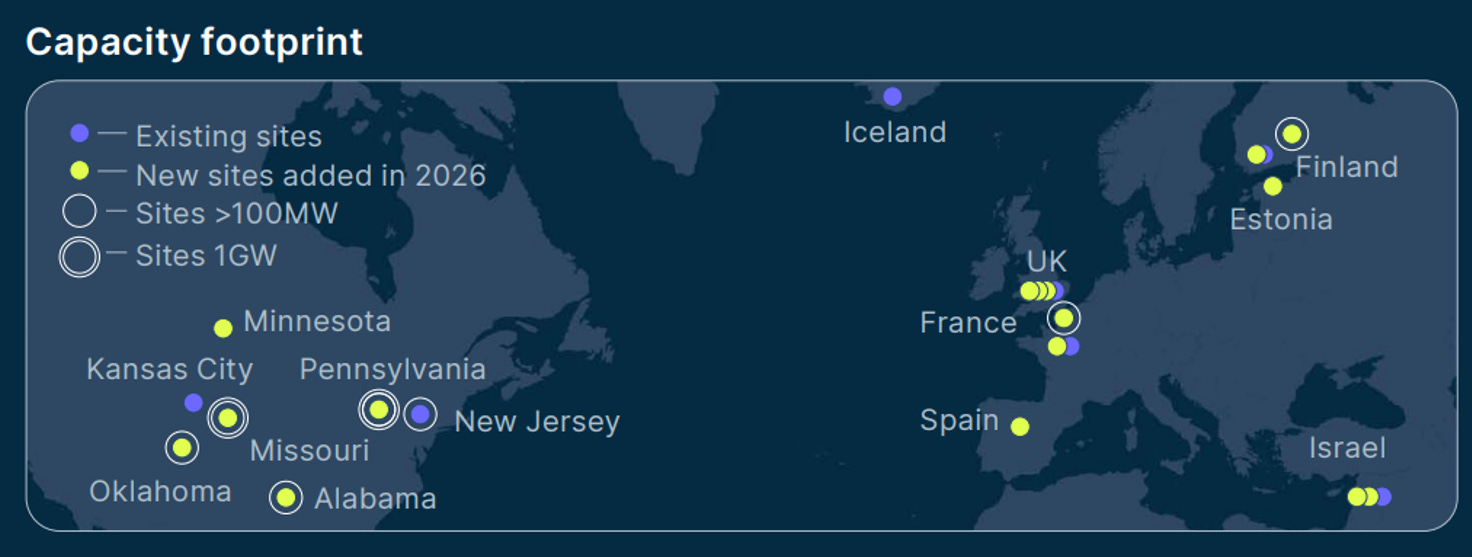
Construction is also underway at Nebius’ owned AI factories in the US, and the footprint now spans Minnesota, Kansas City, Pennsylvania, New Jersey, Missouri, Oklahoma, and Alabama, alongside Iceland, Finland, Estonia, the UK, France, Spain, and Israel.
On the large commitments with hyperscalers:
Meta: the buildout supporting the second agreement continues to progress, with capacity on track to come online in early 2027.
Microsoft: Nebius has delivered all capacity tranches required under the contract to date, including two in the past month.
Specifically on Vineland, the data center tied to the Microsoft contract and the source of much of the FUD of the past few weeks, management provided an update during the earnings call:
“We’re confident that the layout complies with all the applicable local, state and federal laws and regulations. We’re optimistic that once the public has been heard, this will move quickly to approval. We’ll definitely keep you updated as we have more news.
We delivered all the tranches that we were required to deliver under the contract up to date, and we have all the reasons to believe that we’ll continue to deliver the remaining tranches as required by the contract.
To add color, construction of the building itself finished earlier this summer. Engineering fit out is progressing fairly well, and Bloom fuel cells deployment should be fast. Overall, the switch to Bloom has been a valuable and a good pivot for the project, with no significant impact expected on the project timeline.”
Importantly, Andrey reiterated that the vast majority of contracts are cloud contracts with regional delivery flexibility, reducing dependency on any single location, and that overprovisioning capacity remains one of the company’s highest priorities, both today and going forward.
This goes exactly in line with what I explained recently when discussing all the frenzy around a potential Vineland delay. Not only can Nebius deliver equivalent capacity from a different data center to offset delays at a particular location, but the combination of regional flexibility, overprovisioned capacity, and a diversified portfolio of sites significantly reduces the risk that delays at any single site have a meaningful impact on the company’s overall targets.
On the hardware side, Nebius received its first NVIDIA Vera Rubin NVL72 systems and is using the early units to validate compute, networking, and orchestration as a single system. Andrey said the step from Grace Blackwell to Vera Rubin is technically easier than the step from previous generations to Grace Blackwell, with deployment expected to start late this year or early next year and continue throughout 2027. Customers are already engaging for Vera Rubin access.
Nebius is also complementing its GPU fleet with more general-purpose CPU compute, including early adoption of NVIDIA Vera CPUs. This is important because AI workloads are becoming more complex. GPUs handle the heavy AI processing, while CPUs increasingly take care of tasks like coordinating agents, calling tools, preparing data, and running application logic. The practical implication is that Nebius can support more of the AI workload end-to-end, rather than simply selling GPU capacity. As agentic AI grows, that should expand the amount of infrastructure spend Nebius can capture from each customer.
After announcing the model, Nebius received “dozens of inquiries from potential partners who have significant capacity and enough capital, but don’t know how to build and how to sell.”
Arkady’s logic here was straightforward: with GPUs increasingly becoming an investable asset class, more capital wants exposure to this market than there’s operating capability to deploy it, and Nebius can rent out exactly that capability.
The model is still early stage, but management is “very much encouraged by early signs.” This has the potential to unlock new capacity in 2027 and beyond, on top of the company’s portfolio.
If this scales meaningfully, it could eventually reshape the margin profile of the business. Generating software-like revenue without having to carry the underlying infrastructure on Nebius’ own balance sheet is a fundamentally different economic model.
This quarter brought several important catalysts around the unit economics of the business, which I think was one of the main reasons behind the stock’s more than 30% move following the results.
As mentioned, customer prepayments reached an all-time high in the quarter, with ~70% of closed deals including upfront payments covering 50-60% of associated CapEx (something they intend to push even higher). Total deferred revenue on the balance sheet now stands at ~$6B, up from ~$4.8B at the end of Q1, and management expects customer prepayments to bring in more than $9B of upfront funding in 2026, directly reducing the capital needed from debt and equity.
The $775M asset-backed facility closed in July at attractive terms, SOFR + 250bps, a mid-single-digit all-in rate, secured against deployed GPU infrastructure and contracted cash flows from an investment-grade customer. When an analyst asked whether volatile debt markets change the funding calculus, Dado answered that this facility demonstrated that even in a more volatile market, there’s strong demand to finance these contracted cash flows on attractive terms. With more than $40B of committed backlog to borrow against, this is a highly scalable and repeatable financing model. The shareholders’ letter explicitly labels it a “repeatable framework.” Additional asset-backed financings are progressing, and corporate-level debt, which Nebius has almost none of today, remains an untapped pool.
On the equity side, Nebius tapped the ATM program for the first time during this quarter. Through June 30, the company sold 12.7M Class A shares at a weighted-average price of $223.6 per share, generating gross proceeds of ~$2.8B, with 12.3M shares remaining available under the program. In the preview, I wrote that I’d be watching whether the ATM remained untouched, and it didn’t, but I don’t see anything dramatic here. I’ve said several times that touching it was inevitable in an industry this capital intensive, and I’ve always expected the full program to be used eventually. That’s precisely why all my valuation models have accounted for significantly more shares outstanding than the current count. I don’t like dilution, nobody does, but some of it was always going to be part of funding this buildout, and if anything, everything this quarter told us about the unit economics only reinforced my view that it’s worth it. If I’m being honest, I think they handled it in a perfect way.
Here’s how Dado framed the overall capital philosophy: match the right instrument to the right asset while staying disciplined on cost of capital, dilution, and balance sheet strength. That’s the other reason I’m far from concerned. Dilution continues to be minimized by a genuinely diversified funding toolkit: prepayments, asset-backed debt, untapped corporate debt, and equity/equity-linked options. She even flagged emerging opportunities around GPUs as a standalone investable asset class, a potential additional source over time.
I continue to believe Nebius has one of the strongest funding strategies in the sector, and over time, that should translate into a meaningful advantage in the company’s bottom-line.
The software layer keeps compounding, and this quarter the numbers started showing up in the P&L (management credited Token Factory and the acquisitions as contributors to the margin expansion).
Token Factory production inference workloads more than tripled in Q2, increasingly running on open models. A growing share of these workloads are agentic (search, coding, customer-facing agents), where a single task drives many model calls, meaning consumption scales with the complexity of automated work rather than with user count. That’s a structurally better demand curve.
Roman’s examples on the call reinforced how broad this is getting: long-horizon agentic workflows in financial services at Revolut and Mastercard, e-commerce applications at Shopify, Sword Health in healthcare, marketing automation, among several other verticals.
He also touched on another important point: training and inference are converging. Those training models require production inference, while those inferencing open-weight models evolve toward fine-tuning and post-training. A growing share of inference demand is generated by training itself (RL rollouts, evaluations, synthetic data generation). Unlike standalone inference providers, Nebius supports the full workload lifecycle on a single platform, which should translate into better total cost of ownership and higher compute utilization.
On models, Token Factory shipped day-one support for the most advanced open models: Kimi K3, GLM-5.2, MiniMax 3, NVIDIA Nemotron 3 Ultra, DeepSeek V4 Flash, and Nemotron 3.5 Lightning in just the last four weeks. The velocity has been very impressive, and so has the quality validation: in the most recent Endpoint Accuracy Index from Artificial Analysis, Nebius achieved full accuracy parity on GLM-5.2 (a model some called “DeepSeek Moment 2”) while delivering among the fastest output speeds of any provider.
The Eigen AI and Clarifai teams, which joined this quarter, are now fully integrated into the Token Factory effort and already shipping inside the roadmap, deepening model optimization, inference systems and deployment capabilities in-house.
Tavily also had its first full quarter inside Nebius. The developer community grew to more than 2.5M developers, from 1M in February. It launched keyless pay-per-search built for autonomous agent consumption, achieved ISO 27001 certification for enterprise deployments, and now pairs Token Factory’s inference with real-time web access for factual grounding, reasoning and retrieval on one platform.
On the core platform, Nebius shipped AI cloud “Aether 3.6”, and the headline feature was Nebius Echo (announced at Inflection), an in-house AI agent for natural-language infrastructure control, built into the cloud and running on open-source models served by Token Factory. Echo lets customers manage their environment in plain language, with automated diagnostics and complex multi-step deployments planned. The release also added security and governance controls for regulated workloads (Key Management Service with customer-managed encryption keys, Workload Identity Federation, FinOps budgets, Bring Your Own Image), and storage improvements (object storage read speeds up 30%, Shared Filesystem 3x faster on small-file operations).
This isn’t something many investors pay close attention to, and it’s not new information from this earnings release, but it’s a good example of what “enterprise-grade” actually means in practice and one of the things that separates Nebius from more commoditized neocloud offerings.
Also at the Inflection event, Nebius launched its Customer Advisory Board (AMI, Black Forest Labs, Cloudflare, Cognition, Cohere, Core Automation, Higgsfield, Recraft, Revolut and Rhoda) plus the Nebius Builder Program (early preview, with credits across AI Cloud, Token Factory, Tavily and Nebius Academy) and Nebius Certifications.
In July, Lindsey Irvine joined as Chief Marketing Officer, a multi-time CMO from Square, Benchling and MuleSoft with prior leadership roles at Salesforce.
The GTM buildout continues in parallel with everything else.
Avride
The AV-capable fleet has nearly tripled since year-end 2025, exceeding 200 vehicles in May, with more than one million autonomous miles completed this year;
Completed over 60k commercial rides on Uber in Dallas, and the Dallas operating map has doubled since launch, with further expansion expected;
The R&D fleet keeps collecting the mileage and data needed to advance the transition to No-Vehicle-Operator operations;
Robot deliveries more than tripled YoY and exceeded 600k since inception;
Q2 brought robot delivery launches in Arlington, VA and Miami through UberEats;
July brought a Master Services Agreement with Chartwells Higher Education, one of the largest on-campus food service providers in the US (Bowling Green State University among the first campuses, with more joining this fall, and operations already live at Indiana University Bloomington);
Momentum is building with vendor partners following a competitor’s exit from campus deliveries.
TripleTen
Added AI Systems Engineering as a new program;
Tested new products in the US;
Expanded its enterprise-focused B2B offering with emphasis on enterprise AI capabilities and synergies across the Nebius ecosystem;
Efficiency improvements and cost reductions have improved segment-level financial performance.
Toloka (equity stake, backed by Bezos Expeditions)
Executed several platform expansions:
Toloka Arena, an independent benchmark suite evaluating agentic intelligence on private, non-contaminated tasks with over 40 models evaluated;
A major self-service platform upgrade with API automation and synthetic data generation;
An expanded expert-validated dataset catalog across coding, STEM, reasoning and RL Gyms;
Accelerated investment in physical AI and robotics data, expanding beyond egocentric video to UMI-style data and teleoperation.
ClickHouse
The letter reiterates the January 2026 $400M Series D at a valuation of ~$15B, with Nebius continuing to own a significant minority stake (25% last updated). Nothing new this quarter, but as I mentioned before, this stake remains a meaningful piece of the sum-of-the-parts valuation, and the trajectory continues to be very promising.
I feel like a broken record at this point, but this was another exceptional quarter and, in several ways, perhaps the most important one yet.
Deal economics repriced significantly higher across every dimension. Payback periods compressed below two years. The auction told us the market is willing to pay significantly more than Nebius has been charging. Prepayments hit an all-time high. Contracted power keeps outrunning guidance. The funding toolkit added another instrument at attractive terms. And management is now deliberately holding some capacity back because they expect prices to keep rising, even from the incredibly attractive levels we’re seeing today.
I know I’m probably biased, since Nebius is still my largest position by a wide margin, but I’ve never been more bullish. And the thing is, I end up saying that after every single quarter, which in itself speaks volumes about the level of execution. As I wrote in the preview, I’ve repeatedly gone into earnings with what I thought were already ambitious expectations, and this team has somehow continued to surpass them.
To me, the next two major catalysts remain the same:
First, formal 2027 guidance, coming later this year. I think there’s a reasonable chance Nebius shocks the market with its year-end 2027 ARR projections.
Second, another large contract. Personally, I’d almost prefer not to see this, and I suspect management may feel similarly, because the economics of other deal types are way more attractive. That said, if Nebius wants to deploy 1GW per year, it will need access to hundreds of billions of dollars in capital over time. Large contracts can be an important funding lever to support that scale of expansion.
Regarding valuation, next week I’ll publish an update to my Valuation Model incorporating everything we learned this quarter.
My confidence has only been reinforced, and I couldn’t be happier as a shareholder.
That’s it. Thanks a lot for reading and for your continued support!
Disclaimer: The views expressed in this article are solely my own and are based on my personal research and analysis. This content is for informational purposes only and should not be considered financial, investment, or legal advice. Always conduct your own research before making investment decisions.
Disclaimer: As of this writing, M. V. Cunha holds a position in Nebius Group (NBIS) at an average cost of $25.67/share.
No posts
Comments
Nothing yet. Say the first thing.
Sign in to join the conversation.