
On Monday, HROW reported its Q2 results.
Management slightly missed its own Q2 revenue guidance, again, which is disappointing. However, expectations were already low enough that, unlike the past two quarters, there was no shock this time: consensus sat well below management’s midpoint, and the stock barely moved.
Meanwhile, unit demand across every core product continues to hit all-time highs, but the real test is still ahead. The second half is when a few important catalysts should finally start to materialize.
Here’s everything you need to know about the Earnings Report.
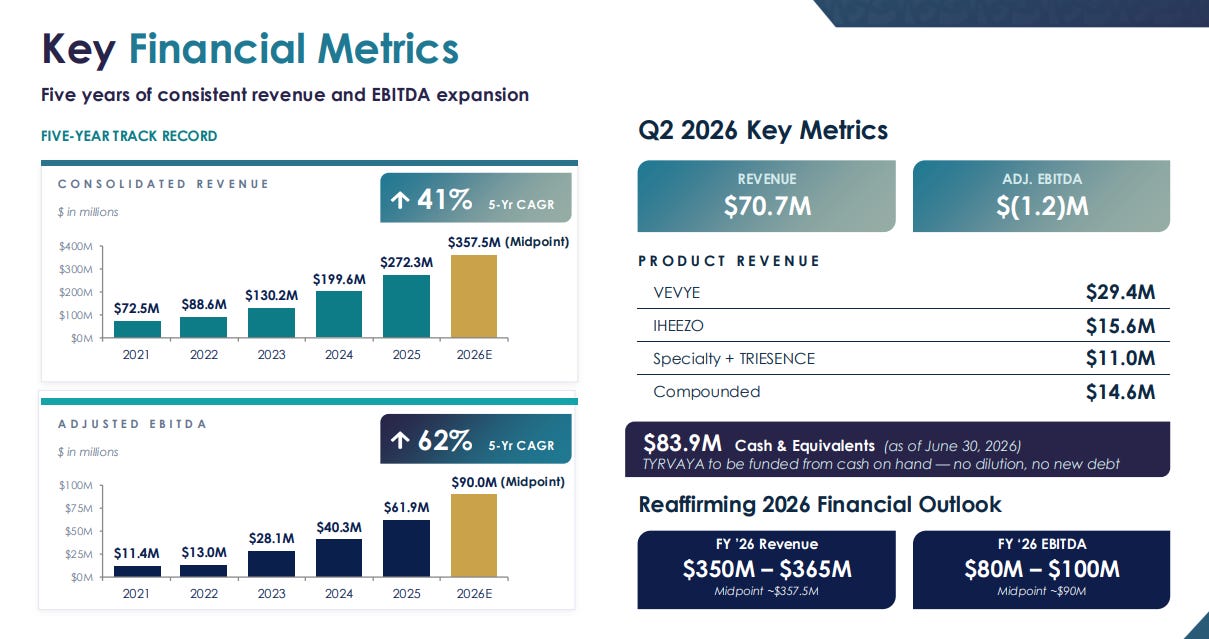
Revenue of $70.7M vs. $70.4M est. (+11% YoY, +60% QoQ)
Adj. EBITDA of $(1.2)M vs. $3.5M est.
GAAP EPS of $(0.46) vs. $(0.18) est.
Gross Margin of 71% vs. 75% YoY and 61% QoQ
Cash of $83.9M as of June 30
Debt of $300M in 8.625% senior notes, maturing September 2030
2026 Guidance:
Revenue of $350-365M (reiterated) vs. $348.5M est.
Adj. EBITDA of $80-100M (reiterated) vs. $77.4M est.
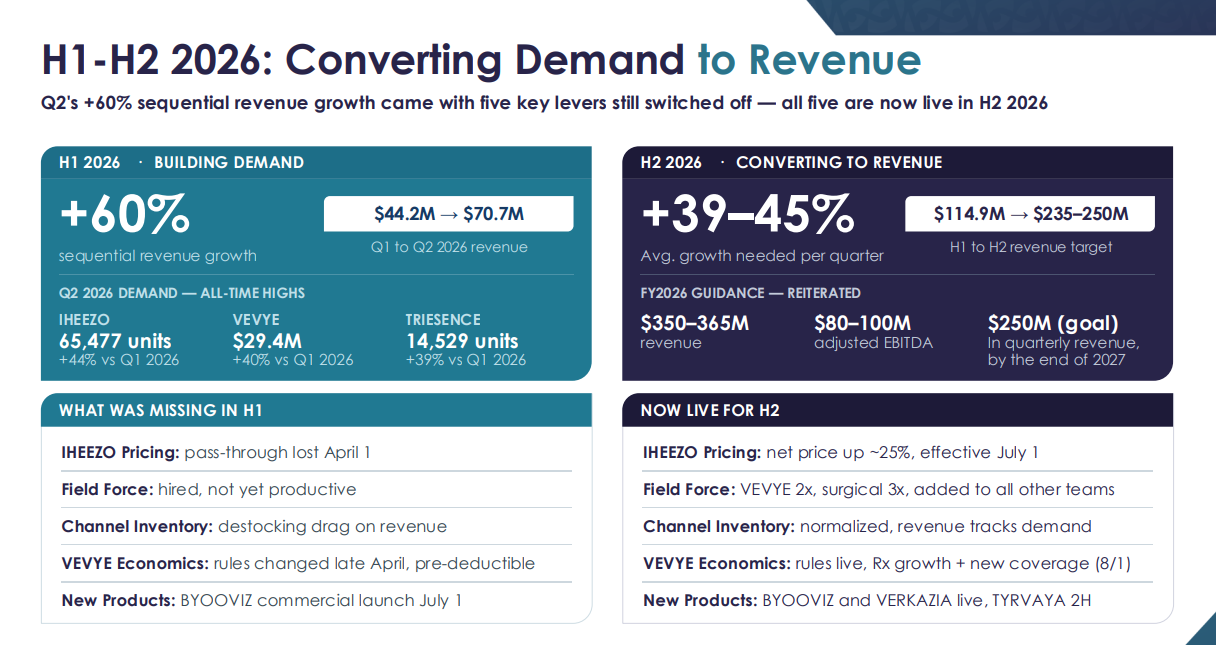
With H1 revenue at ~$115M, the reiterated full-year guidance implies $235-250M in revenue in the second half, more than double what Harrow delivered in the first half. Management expects sequential growth in both Q3 and Q4, with a larger step-up occurring in Q4.
Let’s start with the scorecard on guidance, because I said last quarter I’d treat management’s numbers as a reference point to be stress-tested, not as a credible commitment (and this quarter proved that point again).
Three months ago, management guided Q2 revenue to $71-81M. They delivered $70.7M, about $0.3M below the bottom end of a range they issued with six weeks of the quarter already behind them. The miss is trivial in dollars, but as a data point on guidance reliability, it extends the pattern. Consensus, notably, had already stopped believing them: analysts modeled $70.4M against a $76M guidance midpoint, and they were right. So yes, Harrow beat estimates, but only because the market had already discounted the guide. In a way, the muted stock reaction is the market confirming the conclusion I reached in May: nobody is pricing management’s words anymore, only their execution.
The EBITDA and EPS misses deserve context, though. SG&A jumped to $53.3M (from $33.2M a year ago) as Harrow doubled the VEVYE sales force, tripled the surgical team, and expanded every other commercial organization. R&D nearly tripled to $8.1M, driven by the NDA-enabling G-MELT work and the IHEEZO and TRIESENCE clinical trials. Andrew Boll said base SG&A should stay roughly flat at Q2 levels for the balance of the year (excluding the TYRVAYA headcount coming with the close), and gross margins should trend back toward the high 70s in H2 on IHEEZO’s normalized revenue cycle, higher pricing, and better mix. In other words: the cost structure for the second-half ramp is now fully in place, and the whole question is whether revenue shows up on top of it.
One structural note underneath the headline number: branded revenue, the core driver of my thesis, grew 33% YoY to $56.1M and now represents 79% of total revenue (VEVYE alone is 42%), while compounding fell to 21%. Part of the compounding decline is revenue moving by design into the branded portfolio (more on that in the ImprimisRx section).
Since I know the debt worries a lot of shareholders, let’s address it directly again.
Harrow carries $300M of 8.625% senior notes following the $50M add-on completed in March, against $83.9M of cash (before the $30M TYRVAYA payment leaves at closing) and an undrawn $40M revolver. Two facts frame the actual risk here. First, there are no maturities until September 2030. Nothing needs to be repaid or refinanced for more than four years. Second, the leverage question resolves itself with execution: if Harrow comes anywhere close to the second-half guidance, there’s no problem at all, even a slight miss of the $80-100M EBITDA range puts net leverage in entirely comfortable territory, and the trajectory into 2027 improves from there. With maturities that far out and the major product catalysts landing in 2027 and beyond, I’m pretty confident in their financial position.
What I’m less relaxed about is the cost of carrying it. Net interest expense was $6.3M in Q2 alone, roughly $26M annually at the 8.625% coupon, and it’s a significant drag on the bottom line (a big part of the gap between operating performance and GAAP results). The debt did its job funding the build-out, but once the business turns cash generative in the second half and into 2027, I’d like to see management start paying some of it down beginning next year rather than letting a near-9% coupon keep taxing earnings that should be flowing to shareholders.
Mark Baum’s framing in the letter was in line with what we already knew: “the first half of 2026 was about driving demand and fine-tuning business rules, the second half is about converting growing demand into revenue and profits.”
That’s the setup. Every positive operational data point from this quarter, and there were several, now needs to be translated into execution during H2.
Now, let’s assess every part of the business separately.
VEVYE delivered what it needed to: record revenue with improving economics and continued demand.
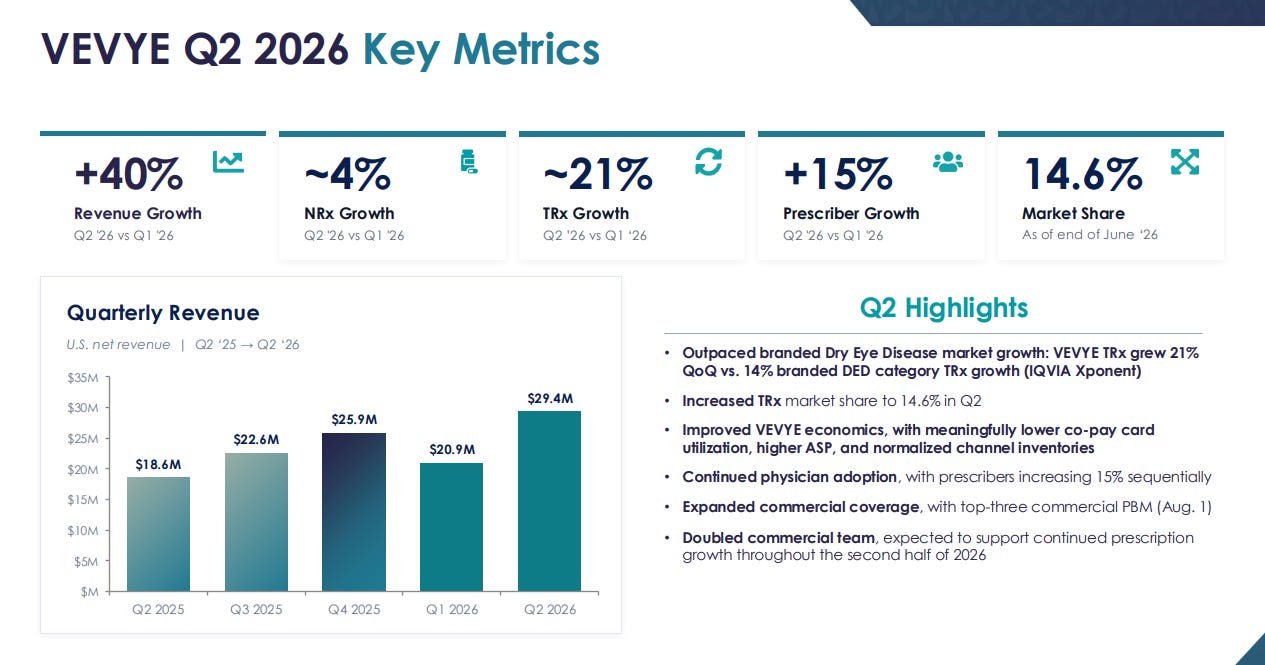
Revenue came in at $29.4M, up ~40% QoQ and ~58% YoY.
Recall the context from last quarter: Q1 was distorted by the ~$8M gross-to-net issue, and normalizing for it, VEVYE was tracking toward $28-29M.
The demand data kept moving in the right direction:
Total prescriptions grew ~21% QoQ, vs. 14% for the branded dry eye market.
New prescriptions grew ~4% QoQ, despite the significant business rule changes implemented at the end of April.
The prescriber base expanded ~15% QoQ, validating management’s view that a significant pool of potential VEVYE prescribers remains untapped and can now be reached by the expanded field force.
VEVYE exited June at 14.6% branded dry eye market share, up from 14% QoQ and 7.8% YoY, further extending its TRx share gains and continuing to make progress toward its primary goal of becoming the market leader.
This is one of the most important parts: the April business rule changes were the big operational test of the quarter. The expectation among some was that tightening the rules would constrict prescribing and dispensing. However, ASP improved sequentially, co-pay card utilization declined meaningfully, and both NRx and TRx still grew. As Mark said, they strengthened the economics of the business without sacrificing demand or patient access. After the Q1 disaster, this was precisely what needed to be proven. Demand growth is important, but demand that doesn’t translate into healthy unit economics ultimately has limited value.
On top of that, there was another meaningful development: effective August 1, VEVYE gained expanded formulary coverage with another top-three national commercial PBM. Management wouldn’t name the payer or the formulary positioning but gave a few data points: it’s a top-three PBM, it covers commercial lives (these were lives that were formerly blocked), and the newly accessible lives number “in the many millions.” Notably, this came earlier than management expected. They didn’t think it would land until early 2027. Last quarter I highlighted that Harrow was actively bidding on additional VEVYE coverage, so this is that promise being delivered, ahead of time, and under the same business rules implemented in late April.
Two commercial initiatives were also rolled out. First, the $0 first-fill program was replaced with physician sampling. The first-fill program carried COGS, processing fees, pharmacy fees, and distribution costs with no corresponding revenue, and relied on refills to earn it back. Sampling achieves the same access goal at far lower cost. Second, the PrioritEYEs initiative, which directly challenges ophthalmologists and optometrists to position VEVYE earlier in the treatment paradigm as the anti-inflammatory foundation of dry eye treatment.
One data caveat worth flagging if you track this name through third-party sources, as I used to: management explicitly said Symphony and IQVIA data are becoming increasingly unrepresentative of VEVYE demand, since a growing share of prescriptions is fulfilled through Harrow’s specialty pharmacy partners that those services don’t fully capture. If you’re following VEVYE through Symphony alone, you’re seeing an increasingly incomplete subset of the product.
Looking ahead, ASP should keep improving: Q2 only captured a partial benefit from the new business rules, more patients will clear their deductibles through H2, and the new coverage should improve unit revenue. Add the doubled sales force (~100 territories) just entering productivity and the “higher highs and higher lows“ in daily volumes continuing into Q3, and VEVYE enters the second half in its strongest commercial position since launch.
If I had to pick the single most impressive part of the quarter, it’s this one.
Again, remember the setup: IHEEZO lost pass-through reimbursement status in the ASC setting on April 1, a headwind that eliminated essentially all ASC volume, roughly 30% of 2025 units, virtually overnight. This was supposed to be the quarter IHEEZO absorbed its hardest structural hit.
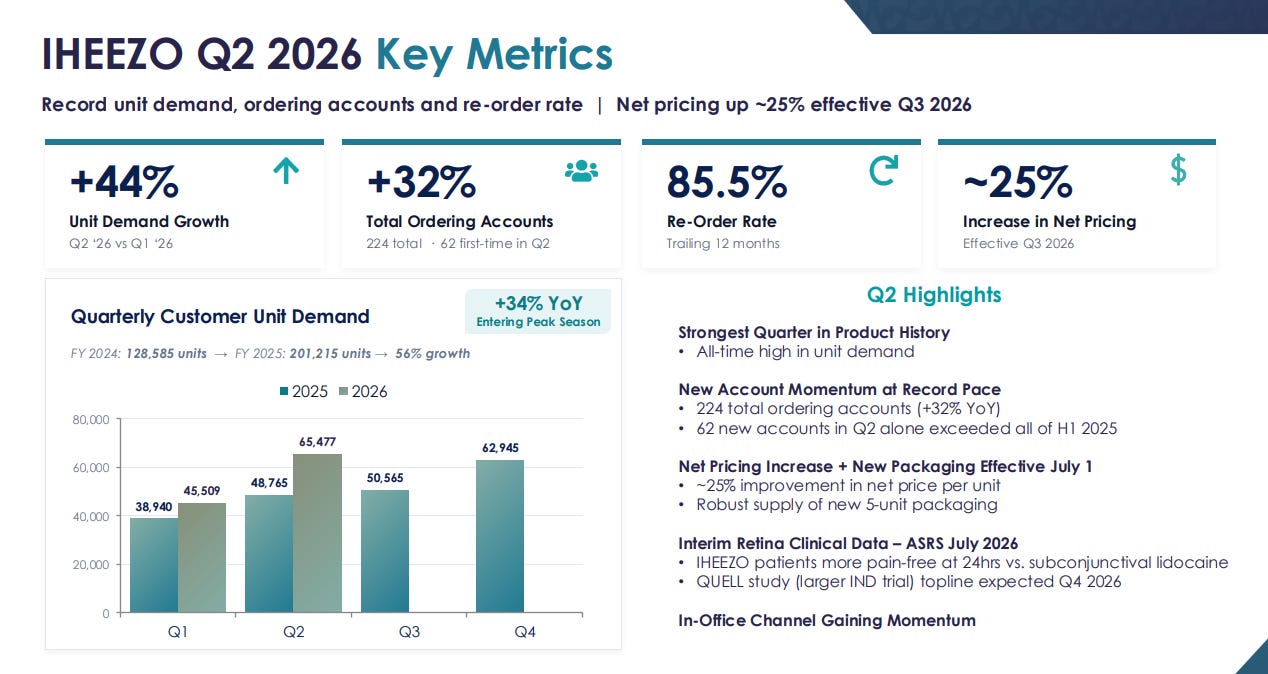
Instead, unit demand reached 65,477 units, an all-time record, up 44% QoQ and 34% YoY, driven entirely by retina and in-office procedures. The product posted its best demand ever during the exact period it lost a third of its addressable reimbursement.
The account data tells the same story. Harrow exited Q2 with 224 total ordering accounts, up 32% YoY, with 62 accounts placing their first-ever IHEEZO order during the quarter, the strongest new-account quarter since launch, and more new accounts in a single quarter than in all of H1 2025 combined. The TTM reorder rate held at ~85.5%. Once practices adopt IHEEZO, they keep ordering it.
Reported revenue was $15.6M, above management’s internal expectations (primarily wholesaler stocking of the new 5-unit packaging), but still below the $18.3M of the prior-year quarter. We’ve known since the Q4 report that roughly 1.5 quarters of channel inventory built up in late 2025 had to be absorbed before Harrow could recognize meaningful new revenue, and management explicitly guided for muted IHEEZO revenue across the first half. Q1’s $1.9M and Q2’s below-prior-year results are exactly that dynamic playing out. The important update: channel inventories are now fully normalized, meaning reported revenue should finally start mirroring the strength of the underlying business from Q3 onward.
And Q3 comes with another important catalyst: IHEEZO’s net price improved by ~25%, effective July 1. Combine record unit demand, normalized inventory, a 25% net price increase, and gross margins exceeding 90%, and it’s easy to understand why Andrew Boll identified IHEEZO as the largest incremental contributor to the second-half revenue bridge. Mark said the acceleration is already visible in Q3 numbers.
On the clinical side, Dr. Dang presented encouraging interim data at ASRS evaluating IHEEZO in intravitreal injections: compared with subconjunctival lidocaine, IHEEZO showed promising trends toward reduced post-procedure pain, improved patient experience, and fewer ocular symptoms through 24 hours post-injection. It’s a small early dataset, but it reinforces the setup for QUELL (the prospective, randomized, multi-center trial being run under an IND), with topline data expected in Q4 2026. Favorable QUELL data would hand the sales force an evidence-based message for the retina market, and the IND designation could deliver additional advantages depending on the outcome.
One note from the Q&A: an analyst asked whether the surgical/ASC market is gone forever. Mark said they’re leaving the surgical market alone for now and focusing where they’re winning: retina and the in-office procedure market, where IHEEZO has a permanent product-specific J-code with better than 95% reimbursement and a sub-5% prior authorization rate, and where the addressable market exceeds 14M annual procedures. Current penetration is below 2%, so there’s a lot of room to grow there.
Overall, IHEEZO is one of the most important catalysts for H2, if not the most important one.
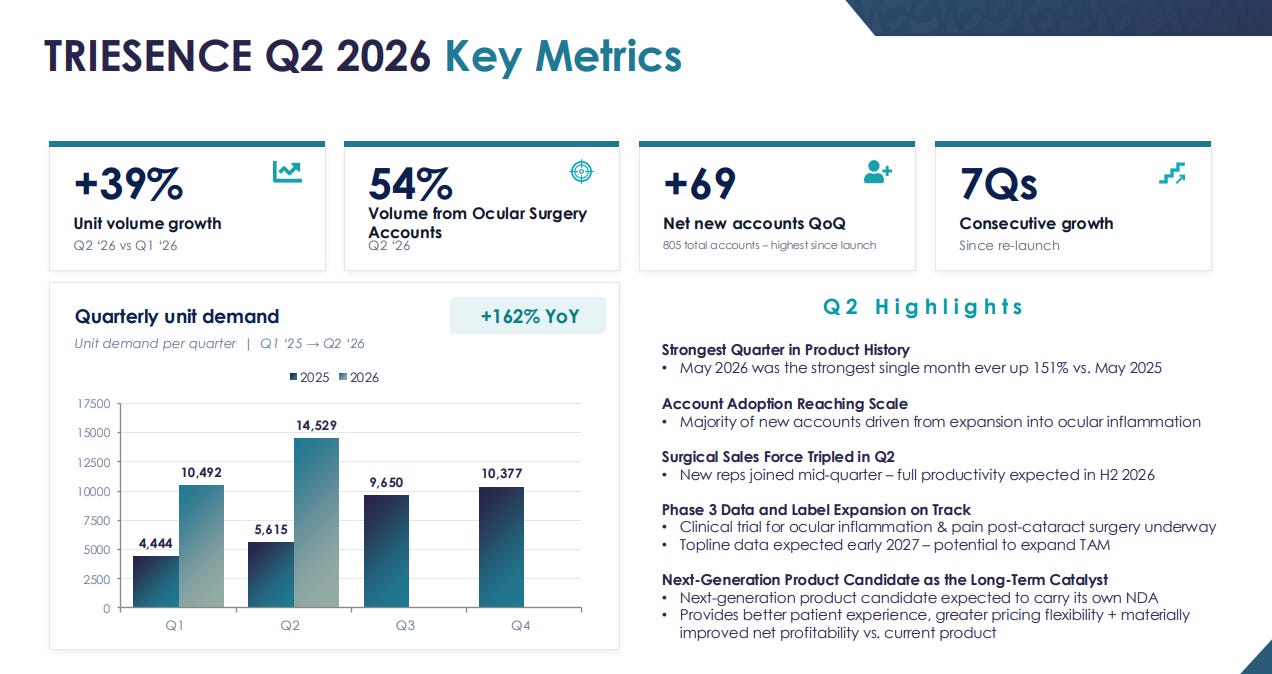
TRIESENCE keeps compounding.
Unit demand reached 14,529 units, the strongest quarter in the product’s history, up 39% QoQ and 162% YoY. May 2026 was the strongest single month ever, up 151% YoY. That makes seven consecutive quarters of unit demand growth since relaunch.
The composition remains encouraging: 54% of Q2 unit volume came from ocular surgery accounts, confirming the product is expanding well beyond its historical retina base into the larger long-term opportunity. Total ordering accounts reached 805, the highest since launch, with a net addition of 69 accounts in the quarter.
Harrow tripled its dedicated surgical sales organization during Q2. Most of those reps joined mid-quarter, so the productivity benefit hasn’t shown up yet, which adds another catalyst for H2. This is the same team expected to sell G-MELT if approved, so the investment is doing double duty.
The two catalysts I flagged last quarter remain on track.
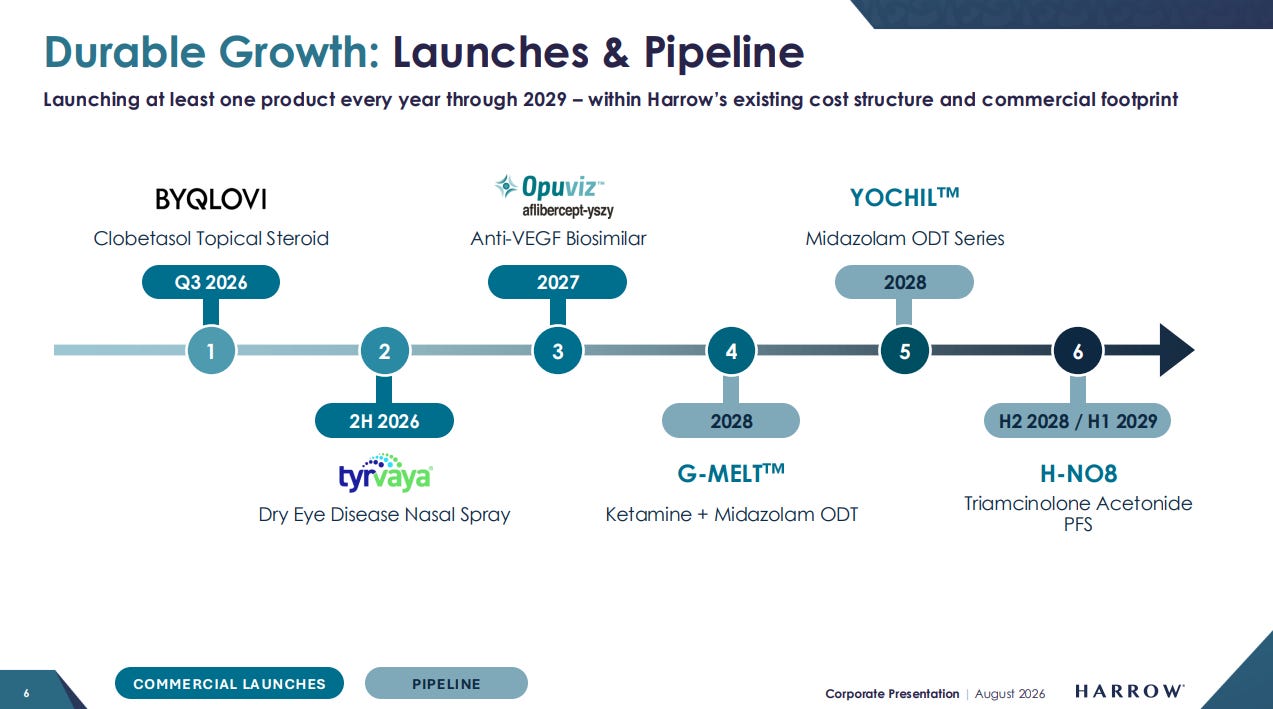
First, the Phase 3 label-expansion study for ocular inflammation and pain following cataract surgery is on track to fully enroll this year, with topline data in early 2027. Success here would materially broaden the on-label commercial opportunity. Second, the next-generation preservative-free pre-filled syringe (now dubbed H-NO8 on the pipeline slide) is targeted for an H2 2028 / H1 2029 launch with its own NDA, promising better patient experience, greater pricing flexibility, and materially improved net profitability (conveniently ahead of the current Orange Book patents expiring in 2029).
For context on financials, the Specialty portfolio plus TRIESENCE generated ~$11M of revenue in the quarter (Harrow doesn’t break TRIESENCE out individually), up from ~$7.8M in Q1 and $5.2M YoY. Importantly, Q2 2026 also includes modest initial BYOOVIZ stocking revenue.
Still the weakest part of the business.
I’ve always viewed the branded portfolio as the core of my investment thesis, and that remains the case. Excluding ImprimisRx, which has always been strategically important because of the relationships it provides with thousands of doctors, the underlying numbers would look considerably stronger.
Net Revenue was $14.6M, down from $21.5M in the prior-year quarter (-32% YoY). Management attributes the decline to three specific factors: (i) the inventory shortfalls we’ve been tracking since Q4, (ii) exiting the California market, and (iii) the deliberate transition of certain compounded units to branded products, most notably moving Klarity-C patients to VEVYE, which is revenue shifting by design into the higher-value branded portfolio.
The inventory rebuild was 100% completed during the second quarter. Backorders cleared, safety stock increased, and with full formulary availability, compounded sales are recovering. If that sounds familiar, it should. On the Q4 call, management said inventory would return to normal by the end of Q1, and on the Q1 call, they told us backorders had been cleared and key SKUs rebuilt. This is now the third time we’ve been told some version of “the inventory issue is behind us.” I remain skeptical until I see a recovery in the numbers.
Management’s stated goal is for ImprimisRx to be almost fully recovered, from a financial perspective, by the end of 2026. Andrew Boll confirmed the $60-65M full-year compounded revenue guide from March is still in place, implying continued sequential growth through H2. Gross margins in the segment (52.8% in Q2, down from 65.1% YoY on lower volumes and unfavorable absorption) should also improve as revenue comes back on top of the fixed cost base.
My view is unchanged: I’m not underwriting Harrow on the compounding business. Its value is the small but recurring cash-pay revenue and, more importantly, the decade-plus of ophthalmology relationships that power Harrow’s distribution model. Management’s history here is that when they have inventory, they grow. Now they have inventory. This segment just needs to stop being a drag, and Q2 should be the trough.
The biggest strategic news of the quarter deserves its own section.
Harrow announced the acquisition of global rights to TYRVAYA (varenicline solution nasal spray) from Viatris, the first and only FDA-approved nasal spray for dry eye disease.
The deal terms, from the 10-Q: $30M in cash at closing, plus up to $70M in contingent milestone payments tied to specified annual net sales thresholds.
The upfront is funded entirely from cash on hand (though the company recently raised $50M, which I told you I expected would be used for M&A), with no dilution. Management also emphasized that the milestones are structured so that, if they’re triggered, the deal should already be generating a high ROI.
Mark Baum called it possibly the best deal they have ever struck, but we already know how much of a salesman he can be.
Closing is expected in the second half of 2026, with only a modest 2026 revenue contribution assumed in guidance.
The strategic logic is straightforward and, I think, sound. VEVYE remains the cornerstone as the chronic anti-inflammatory anchor therapy. TYRVAYA is complementary rather than competitive: it offers a differentiated, drop-free mechanism that stimulates natural tear production through the trigeminal pathway, along with a clean label (zero contraindications, zero ocular adverse events, and zero label warnings), with transient sneezing as the most common side effect. It also uniquely serves the ~45M U.S. contact lens wearers who don’t need to remove their lenses, as well as drop-fatigued patients and those with aqueous-deficient DED. Critically, the two products can be prescribed together, meaning every TYRVAYA call can create a VEVYE opportunity, and vice versa.
A detail worth noting: Harrow acquired the global rights. TYRVAYA is approved in the U.S. and China, with marketing authorizations under regulatory review in five additional countries. That said, Mark was explicit that Harrow will stay laser-focused on the U.S. market and seek competent partners for rights outside it, so any ex-U.S. value would be found money.
It’s also fair to say the product has been neglected: he acknowledged TYRVAYA “hasn’t gotten a lot of attention over the last couple of years” under Viatris despite generating significant revenue historically, and Harrow’s bet is that they can restore and grow that revenue base. His conversion story from skeptic to believer was classic Mark Baum. He admitted he always wondered why anyone would want a nasal spray for dry eye until diligence conversations with committed prescribers changed his mind, including one dry eye specialist who told him his patients “would much rather have someone say ‘God bless you’ after a sneeze than endure the stinging and burning or dysgeusia after applying eye drops multiple times a day.”
Harrow expects TYRVAYA to contribute more than $30M in revenue during 2027, exceeding the incremental operating costs required to support it, and assumes exclusivity through 2034 (twelve Orange Book patents run to 2035).
The deal also brings Viatris’ experienced dry eye sales representatives, whose territories are largely complementary to Harrow’s, adding roughly $20M in annualized SG&A once fully integrated during Q4, with those reps now selling both TYRVAYA and VEVYE. Andrew said there may be some integration costs in the first few months, but the product shouldn’t pull down 2026 earnings and should be accretive from day one in 2027.
Paying $30M upfront (roughly 1x forward revenue, assuming they deliver) for an FDA-approved, on-market product with a unique mechanism that simultaneously expands the sales force in Harrow’s most important franchise is hard to argue with on price. That said, while the synergy story is compelling, the company still needs to execute to justify the additional debt costs, which will weigh on profitability.
Overall, it looks like a good acquisition that fits Harrow’s typical playbook, the same one I laid out in my Deep Dive a long time ago, but I’ll be watching closely to see how it performs in 2027.
The pipeline had a productive quarter, and the near-term catalysts keep coming.
G-MELT took the most important step: the FDA granted Harrow its pre-NDA meeting, scheduled for early in the fourth quarter. The dossier is in preparation, remaining ancillary studies are initiated, and the company remains on track to submit the NDA in H1 2027, with a potential FDA approval in H1 2028 and a commercial launch later that year. Mark shared a telling anecdote from ASRS: retina practices are struggling to secure reliable anesthesia coverage for procedures, with many now paying “stipends” out of their own facility fees just to keep anesthesia services available, a structural problem he believes will persist for years, and one G-MELT could directly address. In nearly 15 years running the company, he has never seen as consistently positive a reaction to a Harrow product candidate. The initial target market is 5M+ annual U.S. cataract surgeries, with 100M+ short-duration procedures behind it. Commercial foundation-laying has already begun.
YOCHIL (think “G-MELT for children”) completed its End-of-Phase 2 meeting with the FDA and is refining its Phase 3 protocol per the agency’s feedback, advancing via a 505(b)(2) path with a PK bridge to midazolam syrup and likely four dose strengths to fit the existing weight-based dosing paradigm. Harrow is also considering a pediatric usability study using a matching placebo to make sure the tablet’s size, thickness, color, and taste work for children. NDA targeted for 2027, potential 2028 launch, against 7M+ annual pediatric procedures.
BYOOVIZ formally launched July 1, following modest initial stocking revenue in Q2, marking Harrow’s entry into the retinal biologics market. Early physician engagement has been encouraging. The strategy is relationship-led rather than price-led: years of trusted service to retina practices, extended payment terms for creditworthy accounts, and an integrated procedure-through-recovery portfolio (IHEEZO for anesthesia, BYOOVIZ for anti-VEGF, TRIESENCE for inflammation) that single-product competitors can’t match. The market is large: the U.S. anti-VEGF market runs ~8.5M units annually with over $4.2B of Medicare Part B spend. OPUVIZ, the EYLEA-referenced biosimilar, remains on track for 2027.
IOPIDINE’s permanent J-code went into effect July 1, removing the reimbursement barrier that left it a cost center paid out of capitated fees. Physicians can now bill at WAC +3-6% at launch, moving to ASP +6%. The on-label market exceeds 1.5M annual laser procedures, IOPIDINE cuts severe post-procedure IOP spikes from ~23% to ~2% (a ~91% relative risk reduction), and physician reception at ASRS was reportedly strong and unprompted. The call point overlaps directly with IHEEZO’s in-office infrastructure.
BYQLOVI still shows a Q3 2026 launch on the deck’s pipeline timeline, but curiously, that timeline slide is the only place it appears. No mention in the letter, the press release, or anywhere on the call, in the very quarter it’s supposed to launch. After last quarter’s slip from Q2 to Q3, I’d like to see the launch actually confirmed soon.
VERKAZIA has been successfully relaunched with rising prescription volumes, and NATACYN enrolled its first patients in the investigator-initiated clinical study during Q2 (targeting fungal blepharitis / keratitis), with topline data expected in Q4 2026.
The company plans to launch at least one new product every year through 2029 within its existing cost structure.
Finally, Harrow announced its Investor Day for March 22, 2027, where it will lay out the 2027-2031 Five-Year Strategic Vision and its most comprehensive MELT platform update yet. Mark Baum reaffirmed the $250M quarterly revenue goal by the end of 2027, clarifying in the Q&A that the goal was always built on the existing portfolio at the time, meaning TYRVAYA is additive to the path.
You already know that management’s credibility record made me stop taking this kind of ambitious guidance at face value, so I don’t underwrite the thesis with it. But honestly, that’s why I like the current setup. The stock doesn’t need to come anywhere close to that to deliver solid returns from today’s valuation, and if they actually get there, the upside is enormous.
Let me go straight to the point…
Does this quarter change the thesis? No.
Am I disappointed they missed their own guidance yet again? Yes.
But the news flow continues to move in the right direction, and the groundwork is now set for what will ultimately determine whether this investment works: the materialization of the important catalysts.
That’s why H2 2026 and 2027 matter far more to this thesis than H1 2026 ever did. Even though the first half was guided terribly, it delivered most of the operational milestones that long-term execution depends on. All the pieces are in place. Now they have to convert them into accelerating revenue growth and operating leverage.
Will I remain skeptical of management’s guidance? Absolutely, nothing about this quarter earned that trust back. But so is everyone else: analysts model below the guided range, and the market clearly stopped paying for management’s words a while ago. That’s precisely why the stock trades at current levels. It’s already pricing in a miss. When skepticism is this universal, you don’t need perfection to be rewarded. You just need the business to keep doing what the demand data says it’s already doing.
On valuation, I continue to find the setup very attractive. I still see a credible path for the stock to reach $100 by 2028, even if management doesn’t hit its targets. They don’t need to. What the thesis needs is for growth to accelerate meaningfully from here, and there’s a long list of catalysts built to do exactly that.
So, what am I doing?
I’m holding my entire position.
It wouldn’t make any sense to sell right before what’s coming. If you zoom out and look at how this business has evolved over the past several years, the pattern is clear: consistently terrible management of investor expectations, paired with consistently strong execution on the product side, even with many difficult variables working against them. The first part costs volatility. The second part is where the returns should come from. I’ll be watching for execution, but for now, my thesis remains on track.
Best regards,
M. V. Cunha
Disclaimer: The views expressed in this article are solely my own and are based on my personal research and analysis. This content is for informational purposes only and should not be considered financial, investment, or legal advice. Always conduct your own research before making investment decisions.
No posts
Comments
Nothing yet. Say the first thing.
Sign in to join the conversation.