

Much like the Superbowl of 2026, the India telecast of the 2026 T20 cricket world Cup has been laden with AI ads. These campaigns reveal a broader story about positioning, adoption, and the future of AI usage in India. This piece examines the state of AI advertising in India and how each company, in fact, appears to be targeting very different audiences.
With its ads for fixing guitar strings and visualising haircuts, Gemini (by Google) appears to be targeting an affluent, urban audience — a segment that already lives and breathes technology, and is most susceptible to expanding its arsenal of tools. The Gemini ads demonstrate how the LLM is only a tap away, and can help you with problems big, small, vague or silly. With advertisements that suggest the use of AI to gauge how a new hairstyle might look on you, the Gemini ads are geared towards encouraging the inclusion of AI in everyday usage.
In contrast, with advertisements in Hindi, ChatGPT (by OpenAI) is taking a more local, regional approach to amassing users. Leaning into ambition and upward mobility, these ads target an audience that is aspiring to grow — an audience that is keen to build a business from the ground up or cultivate a new income stream. It is positioned not as a trivial, everyday app, but as a companion that can help you move to the next stage in life.
In a surprising, stark contrast, Claude (by Anthropic) did not run any ads in the World Cup at all. In the SuperBowl, Claude took a dig at ChatGPT and emphasized the importance of upholding and guarding privacy in LLMs. However, in the T20 world cup where ChatGPT and Gemini ran a steady stream of ads, Claude was notably absent. Although Anthropic recently opened an office in India signalling an interest and investment in Indian markets, the absence of Claude in the World Cup advertisements is intriguing. On one hand, it may suggest that Anthropic does not yet view India as a priority market. Claude is often touted as the “Apple of LLMs,” with relatively aggressive pricing and limits; perhaps a price- and value-sensitive market like India is not its immediate focus. On the other hand, this absence can also be explained away by Anthropic’s extensive focus on selling to enterprises instead of end users, in contrast with OpenAI and Google that have had a keen B2C focus.
Zooming out, it is also interesting that these companies feel the need to advertise so heavily at all. Generative AI has seen one of the steepest technology adoption curves. As the KPMG report on AI adoption notes —
39.5% of US adults aged 18-64 had adopted generative AI within two years of its release, compared to 20% adoption for the internet within the same 2-year timeframe.
Despite AI’s capabilities, and despite the LLMs witnessing rapid, explosive growth, the AI companies certainly observe significant room for growth, and are running aggressive campaigns to acquire and grow their user base. It is also worth noting that while LLMs have exploded, they have exploded in niches. As the Anthropic Economic Index notes:
The tasks and occupations with by far the largest adoption of AI in our dataset were those in the “computer and mathematical” category, which in large part covers software engineering roles. 37.2% of queries sent to Claude were in this category, covering tasks like software modification, code debugging, and network troubleshooting.
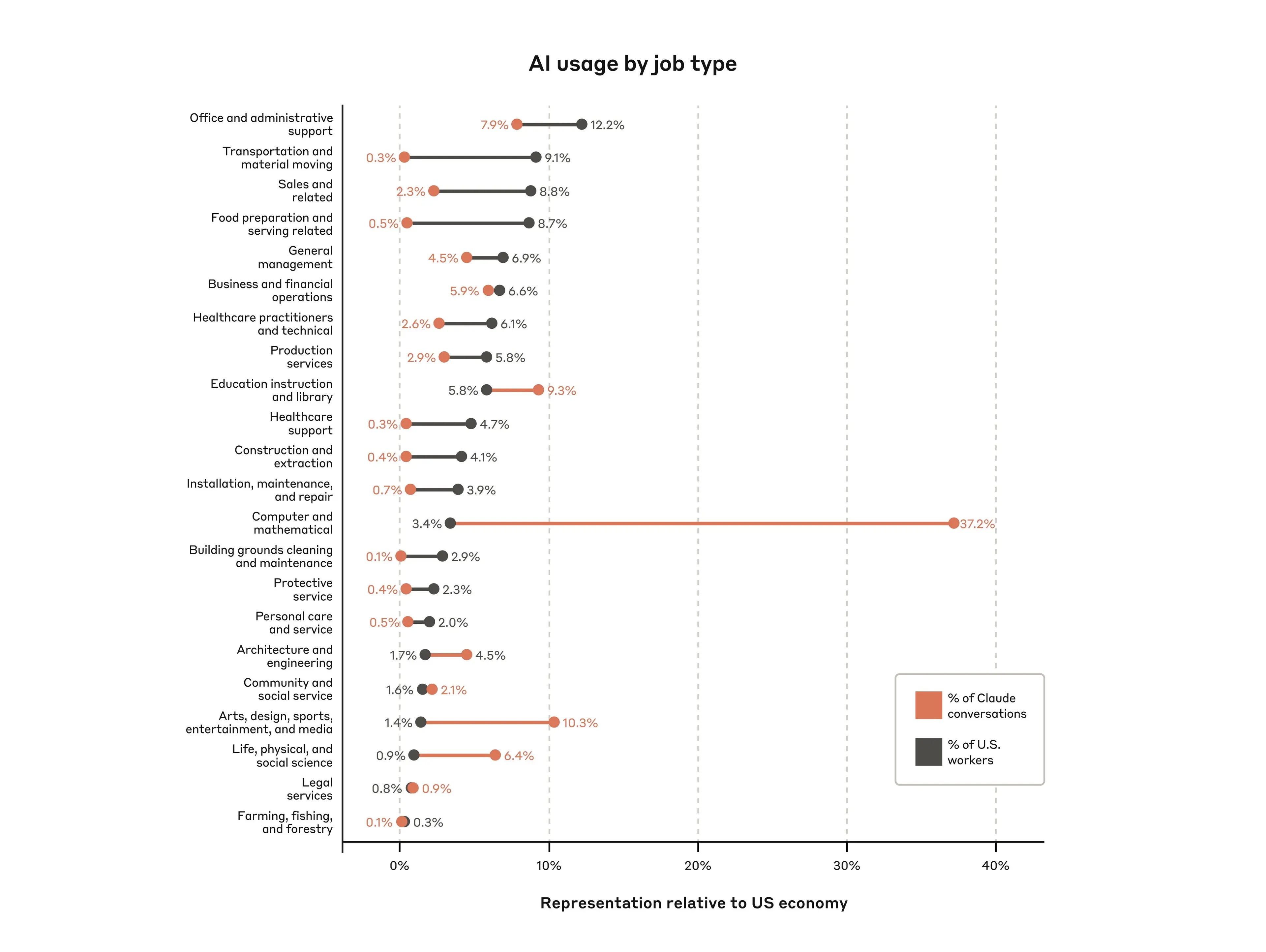
Outside of the software industry where AI adoption has been rapid and massive, LLMs have not yet become the default for most people across age groups. They have not replaced search. For most people, fingers are not yet twitching between ChatGPT and Google – they are still landing straight on Google.
The AI companies have considerable work to do to bring a layperson into the folds of LLMs and to bring LLMs into the folds of everyday usage. These advertisements will play a huge role not only in user acquisition, but also in building behaviour.
It will be interesting to see what happens next: how pricing tiers evolve once a larger user base is established, how users are nudged beyond chat interfaces into agents and skills, and how these companies will ultimately choose to monetize and rate-limit the very users they are now investing incredibly heavily to acquire.
No posts
Comments
Nothing yet. Say the first thing.
Sign in to join the conversation.