
In 1906 the composer John Philip Sousa went to the United States Congress to warn them about a machine. The threat was the player piano, and Sousa did not hide his hatred for it. He foresaw
“a marked deterioration in American music and musical taste, an interruption in the musical development of the country, and a host of other injuries to music in its artistic manifestations, by virtue, or rather by vice, of the multiplication of the various music-reproducing machines.”
Read this quote now and it could be a tweet, Substack Note or LinkedIn post about Suno. Every reproducing machine since this pianola has arrived to the same funeral music: gramophone, radio, cassette, MP3, and now the generative models. The panic surrounding these is a ritual which we seem to perform on schedule. But the music industry has never buried any of these machines. It has, instead, licensed all of them.
More interesting than panicking composers or triumphant engineers and entrepreneurs are the rightsholders in the middle. They watch a new machine arrive and then work out how to own whatever it creates. What’s different this time is that it’s not about owning the final recorded product, but the capacity to make more songs from them.
Panic is a ritual. The plot is the licence.
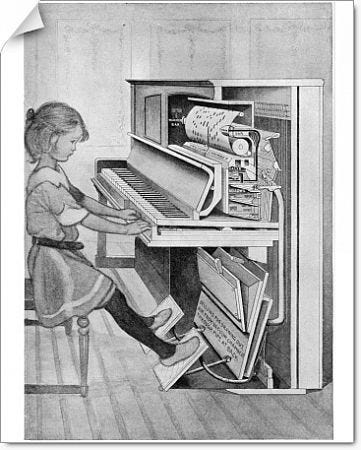
Just stepping back to that machine that scared Sousa so, because it is where the playbook finds it infancy. The player piano launched in the United States in 1901 and sold enormously. It used perforated paper rolls to reproduce a composition without a performer, and composers, reasonably so, cried infringement. Their music was being copied and sold, and they saw no remuneration. When this fight reached the US Supreme Court, the composers lost. A piano roll, the court decided, was not a copy of the sheet music. It was a “mechanical part” of the machine.
That initially looked like defeat for the people who owned the music. But within a couple of years Congress had written an entirely new right into copyright law, the “mechanical right,” which captured exactly the reproduction the court had just said fell outside the old rules. By 1911 the United Kingdom’s Copyright Act adopted it, extending protection to “any recorded, perforated roll, cinematographic film or other contrivance.” The machine that was thought to end composers’ income became the reason for a brand new stream of it.
Radio and the gramophone repeated the lesson a generation later, splitting music into a public performance right and a mechanical right, and giving rise to the collecting societies, PRS and ASCAP in 1914, PPL in 1934, that turned a recording into a standing income you could collect on forever. This pattern thus set itself and it has never really changed.
Every new machine gets metabolised into a new right, and the right outlives the machine.
Fast forward. When Napster arrived in 1999 it looked like an extinction event, and for a few years it kind of behaved like one. What followed was a large-scale reinvention of recorded music revenue models. Sometimes, the rhetoric of rescue hides the actual mechanism here so let’s be explicit. The record companies remade themselves as licensing models, and the economics of that reinvention were extraordinary.
Under the old analogue settlement, a regulated and independent body set the rate for playing music on the radio, and it came to something like three per cent of advertising revenue to the publishing side and three per cent to the recorded side, with no guaranteed minimum. The on-demand streaming model that replaced it runs unregulated, at roughly sixty-five per cent of gross revenue to the labels and fifteen per cent to the publishers, underpinned by advances and minimum guarantees. Those who owned the copyrights wrote themselves a far better deal on their way through the change in consumption.
And they did one more thing. The majors took equity in the streaming services themselves, Spotify above all of course. For years they were not only the suppliers to the platform, they were among its owners, so that when Spotify’s valuation rose the labels won twice over. Those stakes have been steadily sold down, and in April this year Universal halved what remained of its holding, roughly 3.1 per cent of Spotify, for around 1.4 billion dollars, passing a slice to artists on a non-recoupable basis and directing the rest into its own share buyback. I wrote previously about how the real value in music increasingly gets made in the financial packaging rather than the music. The Spotify equity story works along those same lines, but from another angle: streaming did not just give the majors a licence, it gave them a shareholding, and they have cashed it in.
Streaming economics was a reinvention, and the majors wrote themselves the best seat in the house.
Which brings us to the machine of the moment. For two years the major labels fought the GenAI companies in court. Their vocubulary sounded like principle: this is theft; our catalogue was taken without consent; the models were built on stolen work. Then, one by one, the fights turned into deals. Warner settled with Suno and agreed to build “next-generation licensed AI music,” with the current models phased out, free-tier songs made non-downloadable, and, in a lovely detail, Suno buying Warner’s own Songkick as part of the settlement. Universal settled with Udio and built a walled garden where the outputs cannot be exported, running on opt-in catalogue participation and per-output royalties calibrated to how closely a given generation resembles the training data. Merlin brought thirty thousand independent labels into the frame in January. Kobalt covered the publishing side in April. Most recently, Suno signed BMG as it prepares its label-backed models. Sony is the one still holding out, but this remaining fight is as much about the size of the number as the existence of a deal.
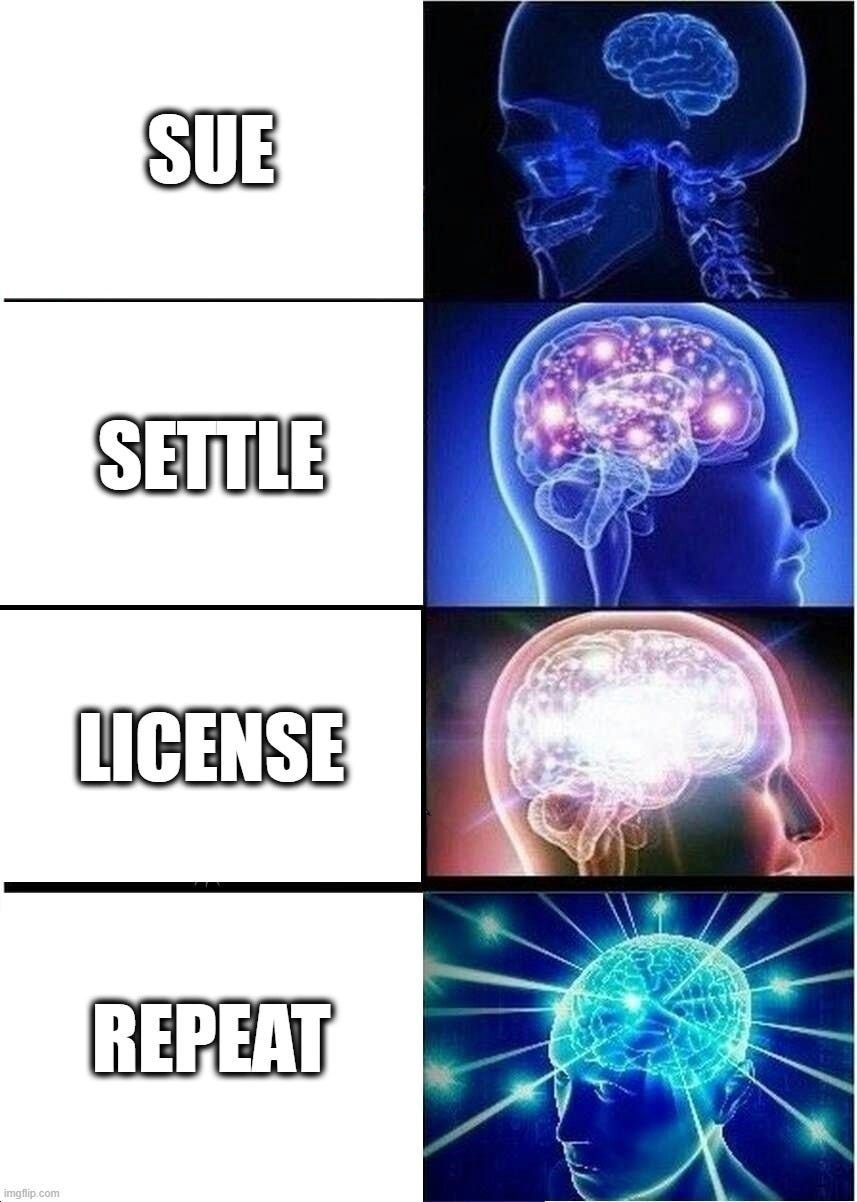
Virginie Berger named the pattern with her signature precision: launch, train, settle. Build the model on the catalogue, get sued, and convert the lawsuit into a licence. It is the pianola trick in a mature industry. The machine that was supposed to end the value of recorded music becomes the reason for a new stream of income from it, and the artists and composers, once again, are told the system has been arranged in their favour.
This is the same thing the industry has always done, and it works because panic distracts from paperwork.
Let’s make clear the big shift with the current GenAI systems. With streaming, everything the majors licensed was still a finished human recording. A catalogue is a library of specific works made by specific people, and its value rests on a kind of scarcity: the recordings. That scarcity is the source of whatever leverage the artists inside the catalogue had.
What the AI deals license is different in kind. The asset is no longer just the catalogue. It is the capacity to generate, then sold per output, metered like water (right, Sam?). From a finite - but already humongous - library of human work to an infinite faucet of synthetic supply. The labels holding the tap and taking a cut of every swig. Brodie Conley has argued that the question isn’t whether to engage with AI but who ends up holding the controls once everyone has. The settlements are an answer, and the controls are currently landing exactly where they landed after the peer-to-peer download shift.
When supply cannot be exhausted and the person who owns the faucet also owns your recording contract, the risk is that the artist slides from someone the label has to bargain with into something the label has already priced into its training set. Watch, too, for whether this reinvention becomes an equity play like the last one. So far the disclosed AI deals are licences and per-output royalties, not shareholdings. But the majors have done the ownership move, and there is no reason to assume they have forgotten how it works.
None of this is fixed. The same machinery that captured the pianola also, eventually, built equitable remuneration for the session musicians who used to get nothing. There are models being built transparently (Voice-Swap, Datamind Audio, pollinations.ai are a few examples), with artists as beneficiaries rather than just raw material. While the public argument seems stuck on whether the robot is frightening, it’s important to be in the room where the deals get made.
The majors are shifting from owning a catalogue to licensing a capacity.
So don’t watch the machine, and don’t join the funeral march, because both are the ritual and the ritual is a mere decoy. Watch the industry rebuild itself, the way it has after every new shiny machine for more than a century. Watch which new right gets written, watch whether there’s equity stakes, and watch whether the people who made the training data end up as owners or as inputs. The industry never fought the future. It licensed it.
“The program would be akin to how explicit music is currently labeled on services, that little “E” box listed beside a track. The groups suggested two different labels for AI: one “AI-generated” logo to disclose a song was created wholly or mostly with AI, and a separate “AI-assisted” logo for if a recording was substantially human-created but AI was used for some “expressive elements.””
✘ Part of what I describe above, the trade bodies are making their mark, too.
“Both Soulless Music and SlopTracker use AI and other automated tools to detect AI music. As we’ve written previously, using AI detectors to detect AI content is an inherently flawed process that can lead to false positives. When I asked him how he handles cases of false positives, Fulton said “it's not ideal when that happens, but it's going to happen because it's still quite tricky to check what's AI and what’s not.””
✘ Let’s see what Spotify’s AI Persona tagging system does for this. It does all feel like a long road that we’re walking here.
“The case exposes the limits of treating licensing, attribution, and compensation as purely technical problems, while also underscoring the need for artists to build and deploy collective power. Even a system capable of identifying every recording used in training or generation—a technically ‘perfect’ attribution algorithm—would not, by itself, determine who can authorize the use of a recording, how revenue should be divided, or whether the musicians who performed on it have any meaningful say. Those are questions of bargaining power and governance. This is why collective leverage-building is so important.”
✘ If you didn’t read Brodie’s last Notes on Financialization, please do so. We’re arguing along similar lines but Brodie is perhaps even stronger in his call for artists to make sure they influence the incoming political economy.
“Community is an obligation. Community is getting laid off, running out of unemployment, throwing a rent party, and having the people around you show up to help you cover it. Community is finding out a member is struggling with groceries and bringing over some bags from Morton Williams to put in their fridge. Six Instagram posts a month for brand partners who don’t truly care about your people doesn’t meet that criteria, and neither does a brand partnership that serves the few instead of the whole.”
✘ Well, if you read MUSIC x, you know all about community. Another reminder from another voice cannot hurt anyone. Keep preaching the community gospel, please.
“World-Building vs Cultural Identity: Let’s start by understanding the difference between the two.
World-building is the aesthetic universe; the visuals, the sonic palette. It’s a place, not a person. It gives them something to admire.
Cultural Identity, however, is the interior. It’s the artist’s core DNA; their values, their perspective, and the throughline that defines them as a human and comes up time and time again, album after album. It’s not just a place to visit; it’s an identity for fans to align with.”
✘ Another message that bears repeating over and over again. Love the way that Lucie does this here with real examples.
Is it metal? Is it bass music? Does it matter? Probably not when it’s this good. Noer the Boy’s new album Precipice is a mountain filled with lava, covered with rough bushes and tall trees, strewn rocks are about. While that lava bubbles deep within, the rumbling bass vibrates under your feet as you make your way through the thicket of nature’s spikiest climb.
Comments
Nothing yet. Say the first thing.
Sign in to join the conversation.