
All the news that’s fit to be tied
Subscribe via RSS feed musicwire.substack.com/feed
August 13, 2026
By David Gross
Previously in Part Two…
San Francisco didn’t simply create remarkable bands. It created an environment where experimentation became the norm. At the Fillmore, the Avalon Ballroom and Ken Kesey’s Acid Tests, musicians discovered they could take creative risks because audiences encouraged them to do exactly that.
Now the question became inevitable.
Could the rest of America be persuaded to listen?
Creative revolutions don’t remain hidden forever.
Eventually someone carries the news home.
By 1966, visitors arriving in San Francisco sensed they had stumbled onto something entirely new. The bands sounded different. The concerts felt different. Even the audiences seemed to understand an unwritten language that outsiders were only beginning to decipher.
Word spread the old-fashioned way.
One concert at a time.
One conversation at a time.
One astonished visitor at a time.
Before long, musicians from across America were making pilgrimages west.
Some came searching for opportunity.
Others came searching for answers.
Most left with ideas they never expected to find.
The remarkable thing wasn’t that everyone copied San Francisco.
It’s that everyone borrowed something.
No single development carried San Francisco’s musical philosophy farther than FM radio.
For years, AM radio had been built around brevity.
Three-minute singles.
Tight playlists.
Minimal risk.
FM offered something radically different.
Time.
Longer songs.
Album tracks.
Entire musical journeys that would have been impossible within AM’s rigid format.
One of the movement’s most influential champions was Tom Donahue.
Having grown increasingly frustrated with the limitations of conventional radio, Donahue helped pioneer a freer, album-oriented approach that trusted listeners instead of programming them.
The philosophy was remarkably similar to what had already been happening inside San Francisco’s ballrooms.
Stop telling artists what they should create.
Stop telling audiences what they should enjoy.
Create the conditions for discovery.
The audience will do the rest.
That simple idea transformed radio.
Instead of hearing only carefully selected hit singles, listeners suddenly encountered deep album cuts, extended improvisations and emerging artists who might otherwise never have reached a national audience.
FM didn’t merely broadcast music.
It broadcast curiosity.
Rock music quietly underwent another revolution.
For years, the single had been the industry’s ultimate prize.
Albums often served as little more than containers surrounding a hit.
San Francisco helped reverse that relationship.
Bands increasingly viewed albums as complete artistic statements rather than collections of potential singles.
Listeners responded in kind.
They stopped asking, “What’s the hit?”
They began asking, “Have you heard the album?”
That subtle shift permanently altered the relationship between musicians and audiences.
The listening experience became more intentional.
More immersive.
More adventurous.
In many ways, the album became the modern equivalent of a novel.
Something to be experienced from beginning to end.
Another unexpected force amplified San Francisco’s influence.
Music journalism.
Publications such as Rolling Stone, founded in San Francisco in 1967, treated rock music with a seriousness that had once been reserved almost exclusively for literature, film and jazz.
Critics weren’t merely reviewing concerts.
They were interpreting a rapidly evolving culture.
Writers such as Ralph J. Gleason had long argued that popular music deserved thoughtful criticism rather than casual dismissal.
That philosophy found fertile ground in San Francisco, where musicians, journalists and audiences often occupied the same neighborhoods and attended the same performances.
Ideas flowed in every direction.
The conversation surrounding rock music became nearly as influential as the music itself.
As San Francisco’s reputation grew, guitarists found themselves listening differently.
Technique still mattered.
So did speed.
But expression increasingly outweighed precision.
Players learned that a sustained note could carry as much emotional weight as a rapid cascade of scales.
Improvisation became less about showing off than about telling a story.
The city’s musicians drew inspiration from blues, folk, jazz, modal music and countless other traditions, blending influences into something that felt remarkably open-ended.
No one style dominated.
Curiosity did.
That openness became one of San Francisco’s greatest exports.
Ironically, the city’s greatest triumph also introduced its greatest problem.
National attention brought record executives.
Television cameras.
Tourists.
Curious newcomers.
The same affordability that had nurtured creativity slowly began to disappear.
Neighborhoods changed.
Rents climbed.
Crowds swelled.
The intimate creative community that had developed almost accidentally became increasingly difficult to sustain.
Success, as it often does, altered the very conditions that had made success possible.
San Francisco had created an ecosystem.
America had discovered it.
And discovery changed everything.
Looking back, perhaps the city’s greatest export wasn’t any single band.
It wasn’t a guitar sound.
It wasn’t a fashion trend.
It wasn’t psychedelic music itself.
It was permission.
Permission to experiment.
Permission to ignore formulas.
Permission to trust audiences with ambitious ideas.
That philosophy spread remarkably fast.
Within only a few years, echoes of San Francisco could be heard in concert halls, recording studios and FM radio stations across America.
The city had become less a place than an idea.
Ideas, unlike neighborhoods, have no boundaries.
Millions of visitors would arrive searching for the city they imagined.
Some would find it.
Many wouldn’t.
Because the real San Francisco story was never about flowers tucked into guitar cases or colorful clothing hanging in Haight-Ashbury shop windows.
Those were symbols.
The revolution itself had already happened.
It had taken place quietly, through thousands of conversations, countless creative risks and a community willing to reward curiosity instead of conformity.
Once that spirit escaped the Bay, there was no putting it back.
Was the Summer of Love the beginning of San Francisco’s musical revolution—or the moment it began slipping away?
In the concluding installment, we’ll examine the paradox of success, the “Death of the Hippie,” and why San Francisco’s greatest legacy isn’t a sound, a band or even an era. It’s a blueprint for how creativity itself flourishes.
⸻
David Gross is the publisher of Punmaster MusicWire and host of Rockabilly Roadhouse on KRSH 95.9 The Krush in Sonoma County, California. His work explores the history, personalities and unexpected stories that continue to shape popular music.
By David Gross
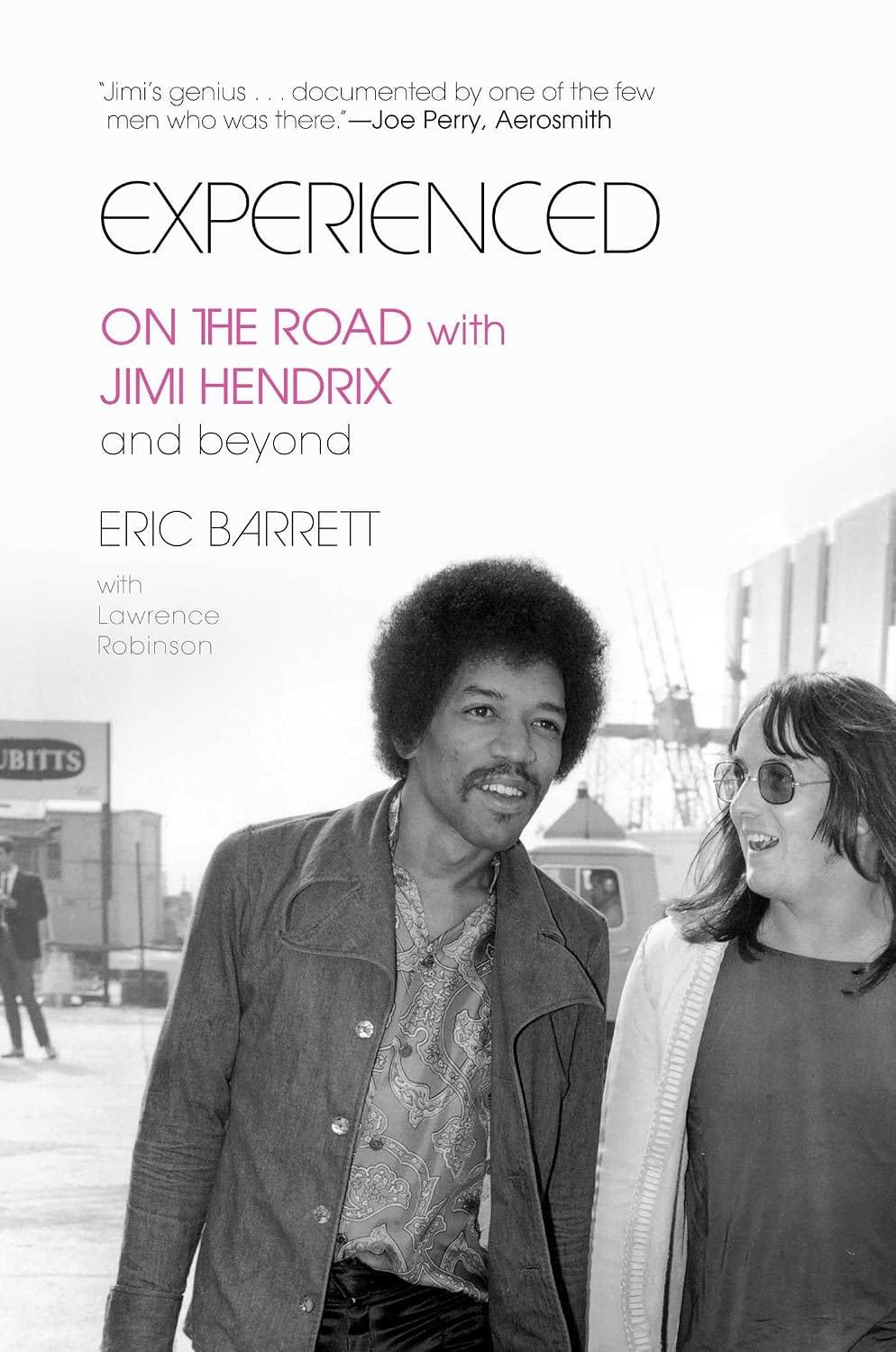
There may be no rock musician more thoroughly examined than Jimi Hendrix.
The records have been remastered, remixed, expanded and excavated. The concerts have been reconstructed night by night. Every surviving reel of tape seems to have acquired its own mythology. Hendrix’s three astonishing years at the center of popular music have produced enough biographies, documentaries and eyewitness accounts to make you wonder whether there could possibly be another worthwhile story left to tell.
Then along comes Experienced: On the Road with Jimi Hendrix and Beyond.
What makes the book interesting isn’t another attempt to explain how Hendrix made a Stratocaster sound like something that had fallen to Earth from another planet. Nor does it try to solve Jimi Hendrix as though the man were an unfinished historical puzzle.
Its value is proximity.
Eric Barrett was Hendrix’s road manager, which put him in one of the most revealing positions imaginable. Not across a desk conducting an interview. Not in the audience marveling at what Hendrix could do. Barrett was inside the machinery that had to keep moving after the amplifiers were switched off.
And that gives Experienced its pulse.
The mythology of rock tends to live in photographs: Hendrix kneeling over a burning guitar at Monterey, standing in front of those enormous Marshall stacks, playing “The Star-Spangled Banner” at Woodstock, dressed in colors and scarves that made almost everybody else in rock suddenly look conventional.
But nobody actually lives inside a photograph.
There were airports to make, hotels to find, equipment to move, promoters to deal with, schedules that changed, people who wanted something, people who wanted everything, and a young musician at the center of it all whose career had accelerated at a speed the music business itself could barely comprehend.
That is the Hendrix world Barrett knew.
And it’s one of the reasons road-crew memoirs can sometimes reveal more about rock history than conventional biographies. The road manager occupies a peculiar position. He isn’t supposed to be the story. He’s the person making sure the story gets to the next town.
He sees what happens before the curtain opens and after everybody else has gone home.
With Hendrix, those in-between moments matter.
By the end of the 1960s, Jimi had gone from relative obscurity to international phenomenon with almost no middle ground. Think about the compressed timeline. In 1966, most American record buyers had never heard of him. Within a year he had made Are You Experienced, stunned Monterey, and become one of the most talked-about musicians alive.
Then came Axis: Bold as Love. Then Electric Ladyland. Then bigger venues, bigger expectations, more touring, management complications, changing musicians, unfinished musical ideas and the increasingly impossible job of being Jimi Hendrix.
The distance between discovery and legend was breathtakingly short.
Barrett’s perspective allows us to look at that period not simply as a sequence of historic performances but as an existence.
That distinction is important.
Hendrix has sometimes suffered the peculiar fate reserved for artists who die young: eventually the icon threatens to swallow the person. We remember the hair, the clothes, the upside-down Stratocaster, the feedback, the lighter fluid.
We forget that the man carrying all of it was only 27 when he died.
One of the strengths of Experienced is the way Hendrix gradually becomes human-sized again.
Not smaller.
Human.
The guitarist who changed rock music could also be funny, generous, distracted, exhausted, uncertain and surrounded by the strange gravitational field that develops around extraordinary fame. By the time Hendrix reached the enormous festival stages of his final period, his image had almost become public property. Everybody seemed to have an idea of what Jimi Hendrix was supposed to be.
Meanwhile, Hendrix himself was trying to figure out where he wanted the music to go next.
That may be the most fascinating Hendrix story of all.
Listen past the familiar mythology and you hear an artist who was still moving. Hendrix wasn’t interested in endlessly reproducing Are You Experienced. His music was absorbing blues, soul, jazz, funk, studio experimentation and increasingly expansive ideas about arrangement and rhythm. The finished catalog is remarkable, but the unfinished direction may be even more tantalizing.
You can hear someone searching.
And while Experienced is not primarily a musical analysis, Barrett’s recollections provide something equally useful: the atmosphere surrounding that search.
The book also benefits from Barrett not having built his public identity around Hendrix.
That’s significant.
Rock history has an abundance of professional reminiscers—people who have spent decades retelling their proximity to famous musicians until the anecdotes become polished little performances of their own. Barrett largely stayed out of that industry.
So when someone who occupied a genuine seat inside Hendrix’s traveling world finally tells his story, you pay attention.
There is another layer here as well.
Barrett’s life on the road did not end with Jimi Hendrix. His subsequent career crossed paths with other major artists and later generations of touring, giving Experienced a wider perspective than its title character alone. What begins inside the wonderfully improvised chaos of late-’60s rock eventually points toward the increasingly sophisticated international touring business that followed.
That transition is fascinating in itself.
The rock tour of the Hendrix era was still being invented as it happened. There were no established templates for moving what was quickly becoming arena-scale entertainment around the world. Production, security, transportation, artist management and the entire backstage infrastructure were evolving practically in real time.
People like Barrett weren’t merely participating in rock history.
They were helping invent the logistics of it.
And perhaps that is what separates Experienced from another routine addition to the Hendrix library.
The big moments are already ours.
We know Monterey.
We know Woodstock.
We know the Isle of Wight.
We know the records.
What we haven’t always known is what it felt like to stand a few feet away while all of it was happening—to watch an extraordinarily gifted young musician become a cultural symbol almost faster than anyone could understand what was taking place.
There is an intimacy to that perspective that discographies and session logs cannot provide.
For serious Hendrix followers, Experienced doesn’t replace the major biographies, nor should it. It does something more useful than attempting to rewrite them. It adds another camera angle.
And sometimes one camera placed in exactly the right location changes the entire scene.
More than half a century after Hendrix’s death, the temptation is still to talk about him primarily in superlatives: greatest, loudest, most innovative, most influential.
All may be defensible.
But perhaps the most revealing thing a new Hendrix book can do at this point is strip away the adjectives.
Behind the Marshall stacks, the psychedelic clothes, the photographers, the entourages and one of the most recognizable silhouettes in rock history was a working musician trying to get through another night, another city and another performance while hearing sounds in his head that the rest of the world hadn’t quite caught up with yet.
Eric Barrett happened to be standing nearby.
Thankfully, he remembered.
What’s the connection with these artists?
The Beatles, Roy Clark, Chad & Jeremy, Rolling Stones, Spiral Starecase, Willie Nelson, Carpenters, Stevie Wonder, Four Tops, Guns N’ Roses
The answer will appear in the next MusicWire...
What’s the connection?
Johnny Ramone, Kurt Cobain, The Ventures, Larry Collins, and Love
Answer: They all played or featured Mosrite Guitars
Thanks to this week’s winners, George Michalski, Cap’n Mike Hiebert, Dean Williams
Two turbo-charged hours of high-octane roots, rockabilly & revved-up classics!
Rebroadcast Saturday nights at 7 p.m.
Kickstart your weekend—guaranteed.
Listen live at KRSH.com
Download the free KRUSH mobile app
Or tune in to 95.9 The Krush in Sonoma County, CA
Tell 40 or 50 of your closest friends!
Check out the web site at rockabillyroadhouse.com
It's time to get down to the Main Gazane with Big Dave!

BREAK OUT THE HEADPHONES!
Hosted by Big Dave, the Saturday Night Album Trax features some of the greatest albums ever recorded. Deep cuts, live albums, extended tracks, rarities and themes. Plus get the background and inside stories on these classic albums.
These are the good old days!
STREAM IT LIVE at KRSH.com
“I’m as country as a dozen eggs.” - Elvin Bishop
“Elvis may be the King of Rock and Roll, but I am the Queen.” - Little Richard
“If you think you are too old to rock ‘n roll, then you are.” - Lemmy Kilmister
"If you tried to give rock and roll another name, you might call it 'Chuck Berry’.” - John Lennon
“David Gross (Punmaster MusicWire) is the Arianna Huffington of music news!” - Barry “The Fish” Melton
“Rock and roll is here to stay.” - Neil Young
“The old-timers schooled me good. They brainwashed me to respect music, whether we were playing rockabilly or blues or rock and roll.” - Dr. John
“It’s much too late to do anything about rock & roll now ...” - Jerry Garcia
“Hippies? Why, I’m the original.” - Jerry Lee Lewis
“I’m a part of the I like ice cream watermelon soup generation.” ~ Allen Ginsberg
“Rock journalism is people who can’t write interviewing people who can’t talk in order to provide articles for people who can’t read.” - Frank Zappa
“The older you get, the better you were!” - Leslie West
“I opened the door for a lot of people, and they just ran through and left me holding the knob.” - Bo Diddley
“The reason kids like rock ‘n roll is their parents don’t.” - Mitch Miller
“Rock ’n roll is really swing with a modern name. It began on the levees and plantations, took in folk songs, and features blues and rhythm. It’s the rhythm that gets to the kids – they’re starved of music they can dance to, after all those years of crooners.” - Alan Freed
“If I were not a physicist, I would probably be a musician. I often think in music. I live my daydreams in music. I see my life in terms of music.” - Albert Einstein
“The music business is a cruel and shallow money trench, a long plastic hallway where thieves and pimps run free, and good men die like dogs. There’s also a negative side.” - Hunter S. Thompson
"Mike Love, not war." - Scott Mathews
"I have outlived my dick" - Willie Nelson (2008)
Visit the archive: https://musicwire.substack.com/archive
Subscribe via RSS feed musicwire.substack.com/feed
No posts
Comments
Nothing yet. Say the first thing.
Sign in to join the conversation.