
All the news that’s fit to be tied
Subscribe via RSS feed musicwire.substack.com/feed
August 27, 2026
By David Gross
The songwriter, show-business original and country music giant has died at 80
Dolly Parton, who died Tuesday in Nashville at 80, spent a lifetime pairing one of the sharpest minds in American music with rhinestones, laughter and a towering blond wig. She understood that image could open the door—but only talent, discipline and extraordinary instincts could keep you in the room.
The voice was instantly recognizable, but the songs were the real engine. “Jolene,” “Coat of Many Colors,” “9 to 5” and “I Will Always Love You” weren’t simply country standards—they were compact emotional screenplays, written with a songwriter’s economy and a novelist’s eye for the revealing detail.
She survived Nashville’s machinery, walked away from Porter Wagoner with grace and a farewell song, crossed into pop without abandoning country, conquered Hollywood and built an empire without ever pretending success had happened by accident. She could gently send up her own glamorous image, then turn around and make the smartest business decision in the room.
When Whitney Houston carried “I Will Always Love You” into another musical universe, Dolly didn’t compete with the record—she celebrated it and cashed the publishing checks. That was Dolly: generous enough to share the spotlight and savvy enough to keep ownership of the bulb.
Even her philanthropy had a practical purpose. The Imagination Library put books into the hands of children, Dollywood put people to work, and her charitable giving helped communities without turning compassion into spectacle.
Perhaps that was her greatest crossover achievement. Dolly belonged to country music, but country music could never quite contain her. Grandparents adored her, rock stars wanted to sing with her, children received books from her, and people who agreed on almost nothing agreed on Dolly.
Country music has lost one of its greatest writers. America has lost something rarer: a star who became universally beloved without ever becoming bland. Dolly Parton knew exactly who she was—and made the rest of the world feel a little better about being themselves.
By David Gross
Jeff Beck has always presented a problem for biographers.
How do you explain an artist who never seemed interested in winning the race everyone else was running?
While many of his contemporaries were building brands, chasing chart positions, or becoming larger-than-life rock icons, Beck appeared content to follow nothing more than his own curiosity. That’s what makes Blow by Blow: The Jeff Beck Story so refreshing. Rather than trying to force his life into the familiar arc of rock stardom, it embraces the contradictions that made him one of the most admired—and least predictable—musicians of the rock era.
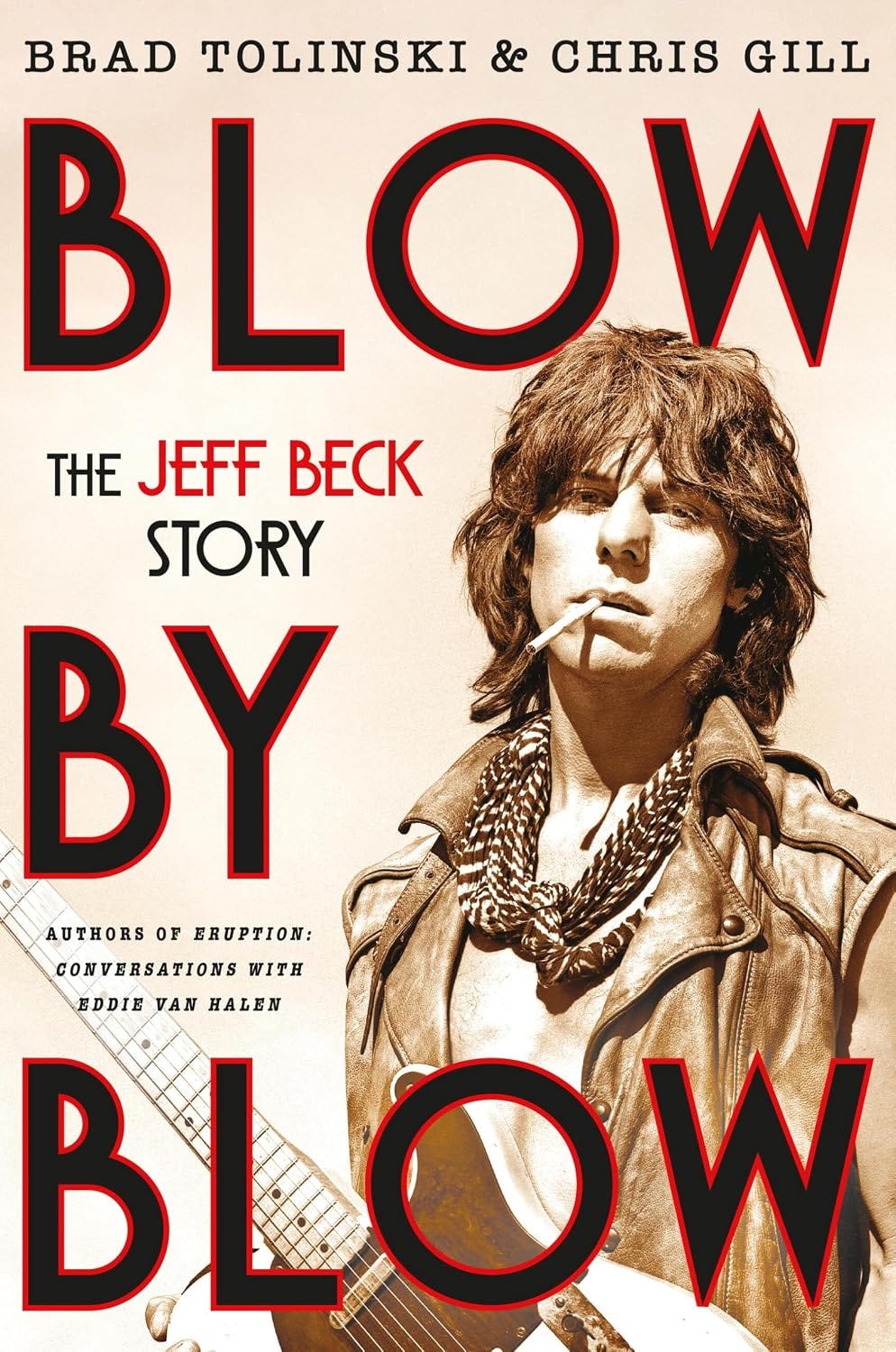
The biography traces Beck from his early fascination with building and modifying guitars through his brief but pivotal tenure with the Yardbirds, where he helped redefine what lead guitar could be. From there, readers follow the rise of the Jeff Beck Group, his groundbreaking instrumental recordings, his fearless explorations of blues, rock, and jazz fusion, and the remarkable late-career collaborations that introduced him to entirely new audiences. Along the way are revealing stories about the musicians, producers, friends, and fellow artists who crossed his path, creating a portrait that feels intimate rather than simply chronological.
The real story, however, isn’t about a guitarist climbing to the top. It’s about an artist who repeatedly walked away from the obvious next step. Every time success seemed ready to define him, Beck found another musical road to explore. Blues gave way to jazz fusion. Heavy rock evolved into atmospheric instrumentals. Technical mastery became emotional expression. He never seemed interested in repeating himself simply because audiences expected it.
What emerges from Blow by Blow: The Jeff Beck Story is a portrait of a musician who treated the electric guitar less like a weapon and more like a paintbrush. Beck wasn’t obsessed with playing faster or louder than everyone else. He was searching for sounds that hadn’t yet been imagined. That restless creativity became his true signature.
The biography also captures something many books miss: Jeff Beck’s quiet confidence. He never needed to tell the world he was one of the greatest guitarists of all time because the musicians around him were already saying it. His reputation wasn’t built through self-promotion. It was earned one unforgettable performance at a time.
Perhaps that’s why Beck’s influence has always exceeded his record sales. His fingerprints are scattered across decades of rock music, even when his name isn’t. He became the guitarist other guitarists listened to when they wanted to be surprised.
One of the book’s greatest strengths is that it doesn’t attempt to solve the mystery of Jeff Beck. Instead, it celebrates it. Readers come away with a deeper appreciation not only for his astonishing musicianship but also for the relentless curiosity that drove him to keep experimenting long after many of his peers had settled into comfortable routines.
The lasting impression isn’t simply that Jeff Beck was an extraordinary musician.
It’s that he never stopped being a student of music itself.
In an industry built on formulas, Jeff Beck remained wonderfully unpredictable. Blow by Blow: The Jeff Beck Story succeeds because it understands that his greatest achievement wasn’t becoming a guitar hero.
It was refusing to become only that.
For longtime fans, the book fills in the spaces between the albums and the performances, revealing the man behind the music without diminishing the mystique that made him so compelling. For newcomers, it’s an ideal introduction to an artist who continually expanded the vocabulary of the electric guitar and inspired generations of musicians to think beyond technique and toward imagination.
Jeff Beck never chased greatness.
He chased possibility.
That’s why his music—and this biography—continue to resonate.
Actress and singer starred on The Donna Reed Show and appeared opposite Elvis Presley in three films
Shelley Fabares, the actress and singer whose sweetly innocent “Johnny Angel” became one of the defining pop records of the early 1960s, died Saturday in Los Angeles at age 82.
Fabares first won over America as Mary Stone, Donna Reed’s teenage daughter on The Donna Reed Show. Her television popularity unexpectedly carried her onto the record charts when “Johnny Angel” reached No. 1 on the Billboard Hot 100 in 1962. With its dreamy vocal and lovestruck teenage longing, the song remained inseparable from Fabares for the rest of her life.
She later became one of Elvis Presley’s favorite leading ladies, appearing with him in three musical comedies: Girl Happy, Spinout and Clambake. Their easy chemistry placed Fabares squarely inside the colorful world of Elvis cinema at its mid-’60s peak.
Although her long acting career would eventually include acclaimed roles in Brian’s Song, One Day at a Time and Coach, music fans will always hear Shelley Fabares as the young woman forever waiting for her “Johnny Angel”—a three-minute pop performance that never lost its glow.
Tim Curry, who has just passed away at 80 years old, didn’t merely play Dr. Frank-N-Furter in The Rocky Horror Show and its immortal film adaptation, The Rocky Horror Picture Show—he strutted into rock culture in fishnets, sang “Sweet Transvestite” with astonishing swagger and permanently rearranged the boundaries between theater, music and midnight-movie rebellion.
A three-time Tony Award nominee and Emmy-winning voice actor, Curry could move effortlessly from Shakespeare and Broadway to Clue, It and a recording career that produced three albums—including the wonderfully knowing “I Do the Rock.”
Curry understood something many technically superior singers never do: rock ’n’ roll is theater, theater requires nerve, and nobody ever had more nerve than Tim Curry. The curtain has fallen, but it will always be just a jump to the left.
By David Gross
The acclaimed documentary leaves theaters and heads to streaming August 21, with an expanded home-video edition following in October
There are people who witnessed rock history, people who participated in it, and a very small number who somehow kept turning up at precisely the moments when the music was about to change.
Peter Asher belongs in that last category.
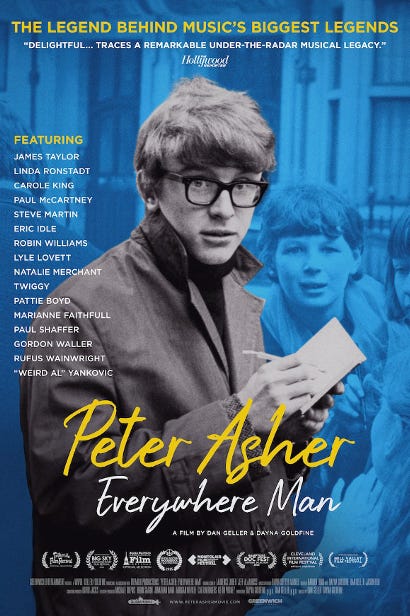
Following its U.S. theatrical run, Peter Asher: Everywhere Man arrives on American streaming platforms August 21, available to rent or purchase through the major digital movie services. For anyone who missed the film in theaters, that makes this remarkable musical life story considerably easier to find — appropriately enough for a documentary about a man who spent six decades seemingly impossible to avoid.
The film, directed by Dan Geller and Dayna Goldfine, understands something important about Asher: his story isn’t merely a parade of famous names. It’s a fascinating look at the connective tissue of rock and pop history.
Most casual fans first encounter Asher as the redheaded, bespectacled half of Peter & Gordon, one of the more distinctive duos to emerge from the British Invasion. Their 1964 recording of “A World Without Love,” written by Paul McCartney, became a transatlantic No. 1 smash.
But that was only Act One.
Asher’s friendship with McCartney placed him extraordinarily close to the Beatles’ inner circle during the period when British pop was exploding around the world. Yet instead of spending the rest of his life trading on his proximity to Beatlemania, Asher did something much more interesting.
He reinvented himself.
When the performing career of Peter & Gordon wound down, Asher moved behind the glass and behind the scenes — and proved that his musical instincts may have been even more formidable there.
At the Beatles’ Apple Records, he recognized something special in a young American singer-songwriter named James Taylor. Asher produced Taylor’s breakthrough work and became his manager, helping guide a career that would become one of the defining voices of the singer-songwriter era.
Then came Linda Ronstadt.
Asher’s production work with Ronstadt helped create a succession of records that didn’t merely sell millions; they helped establish the sonic vocabulary of sophisticated 1970s California rock. The records were polished without becoming sterile, commercial without losing their humanity. Asher understood that a producer didn’t need to dominate the artist. Sometimes the real skill was recognizing what was already there and finding the best possible frame for it.
That may be the thread running through his entire career.
Peter Asher has always seemed to know when to step forward — and when to get out of the way.
Everywhere Man uses archival material, interviews and Asher’s own recollections to connect those seemingly separate lives: British Invasion pop star, Beatles confidant, Apple Records executive, manager, Grammy-winning producer and lifelong student of the recording studio.
And unlike so many rock documentaries built around catastrophe, estrangement or excess, this one has another attraction: Asher is still here to tell the stories himself.
He’s an unusually good storyteller, too.
There is a dry intelligence to Asher that has always separated him from the standard rock-and-roll raconteur. He doesn’t need to inflate his place in history because his résumé is already almost absurd. Follow the trail long enough and you move from Peter & Gordon to McCartney, from Apple to James Taylor, from Taylor to Ronstadt and into an entire ecosystem of artists and records that defined successive generations.
The title Everywhere Man initially sounds like a clever Beatles-adjacent pun.
By the end, it feels more like a job description.
More Asher Is Coming
The August 21 digital release isn’t the end of the story. DVD and Blu-ray editions arrive October 6, with additional material that should be especially attractive to serious music fans. The physical release is slated to include bonus footage and additional scenes involving Asher, Carole King, Natalie Merchant and others.
The film then heads home in another sense.
Everywhere Man receives its UK theatrical premiere October 30, bringing Asher’s story back to the country where that improbable journey began more than six decades ago.
There is a wonderful symmetry to that.
Peter Asher started as the kid with the glasses standing beside Gordon Waller, singing beautifully crafted pop songs during one of the most competitive musical explosions in history. He could easily have become another fondly remembered face from a British Invasion photograph.
Instead, he kept moving.
From performer to producer. From London to Los Angeles. From the Beatles’ orbit to the singer-songwriter revolution. From one side of the studio glass to the other.
Rock history tends to celebrate the people standing in the spotlight.
Peter Asher: Everywhere Man reminds us that some of the people who changed the music most profoundly were standing just outside it — listening.
Twenty-two-year-old film student Albert Goodman slipped onstage and videotaped Hendrix’s historic Woodstock performance from just 15 feet away. Hendrix later watched the footage himself—but the tapes remained unseen by the public for three decades.


What’s the connection with these musicians?
Percy Sledge
Billy Preston
Ray Davies
Charley Pride
Frankie Lymon
Elton John
Ray Dorset
Elvis Costello
The answer will appear in the next MusicWire...
What’s the connection between these six legendary musicians?
Jimi Hendrix
Tony Iommi
Paul McCartney
Kurt Cobain
Albert King
Dick Dale
Answer: They are all left-handed
Thanks to this week’s winners, George Michalski, Michael Macaluso, Jonathan Bassil, Jack Pott, Steve Finnegan, Mark Cohen

Two turbo-charged hours of high-octane roots, rockabilly & revved-up classics!
Rebroadcast Saturday nights at 7 p.m.
Kickstart your weekend—guaranteed.
Listen live at KRSH.com
Download the free KRUSH mobile app
Or tune in to 95.9 The Krush in Sonoma County, CA
Tell 40 or 50 of your closest friends!
Check out the web site at rockabillyroadhouse.com
It's time to get down to the Main Gazane with Big Dave!

BREAK OUT THE HEADPHONES!
Hosted by Big Dave, the Saturday Night Album Trax features some of the greatest albums ever recorded. Deep cuts, live albums, extended tracks, rarities and themes. Plus get the background and inside stories on these classic albums.
These are the good old days!
STREAM IT LIVE at KRSH.com

“I’m as country as a dozen eggs.” - Elvin Bishop
“Elvis may be the King of Rock and Roll, but I am the Queen.” - Little Richard
“If you think you are too old to rock ‘n roll, then you are.” - Lemmy Kilmister
"If you tried to give rock and roll another name, you might call it 'Chuck Berry’.” - John Lennon
“David Gross (Punmaster MusicWire) is the Arianna Huffington of music news!” - Barry “The Fish” Melton
“Rock and roll is here to stay.” - Neil Young
“The old-timers schooled me good. They brainwashed me to respect music, whether we were playing rockabilly or blues or rock and roll.” - Dr. John
“It’s much too late to do anything about rock & roll now ...” - Jerry Garcia
“Hippies? Why, I’m the original.” - Jerry Lee Lewis
“I’m a part of the I like ice cream watermelon soup generation.” ~ Allen Ginsberg
“Rock journalism is people who can’t write interviewing people who can’t talk in order to provide articles for people who can’t read.” - Frank Zappa
“The older you get, the better you were!” - Leslie West
“I opened the door for a lot of people, and they just ran through and left me holding the knob.” - Bo Diddley
“The reason kids like rock ‘n roll is their parents don’t.” - Mitch Miller
“Rock ’n roll is really swing with a modern name. It began on the levees and plantations, took in folk songs, and features blues and rhythm. It’s the rhythm that gets to the kids – they’re starved of music they can dance to, after all those years of crooners.” - Alan Freed
“If I were not a physicist, I would probably be a musician. I often think in music. I live my daydreams in music. I see my life in terms of music.” - Albert Einstein
“The music business is a cruel and shallow money trench, a long plastic hallway where thieves and pimps run free, and good men die like dogs. There’s also a negative side.” - Hunter S. Thompson
"Mike Love, not war." - Scott Mathews
"I have outlived my dick" - Willie Nelson (2008)
Visit the archive: https://musicwire.substack.com/archive
Subscribe via RSS feed musicwire.substack.com/feed
No posts
Comments
Nothing yet. Say the first thing.
Sign in to join the conversation.