
Good evening, friends,
We got off trail last Wednesday at mile 1,186 in Pennsylvania and have been off the trail since. My mom is battling Alzheimer’s right now and our entire family has rallied together to support her. Ciara, in particular, has been incredibly helpful, compassionate, and nurturing.
Unfortunately, the trail seems insignificant and far away at the moment. Giving my mom all our love is the priority. We do have fantastic support and our family is trying to figure out a way where we can go back to the trail for two months to finish our hike. My mom is rooting for that, too. Until then, we will take each day as it comes and just control what we can control. Coincidentally, the uncertainty of each day on the trail has somewhat prepared us for the uncertainty of each day here at home.
If we’re able to get back out in the next week or two, we can continue to walk north, and if we don’t get back until later in the summer we can flip up to Katahdin and walk back down to Pennsylvania. And, if we don’t get back out at all, the trail will always be there in the future. Some of the most inspirational people we met were on their third attempt of a thru-hike —shoutout to Phantom and Pinch.
So that’s where we’re at right now. I also wrote a typical, Mushroom Monday profile for one of the last mushrooms we saw when we were out there. Additionally, I’m hoping to write another fun trail story from our time in Tennessee and share that later this week.
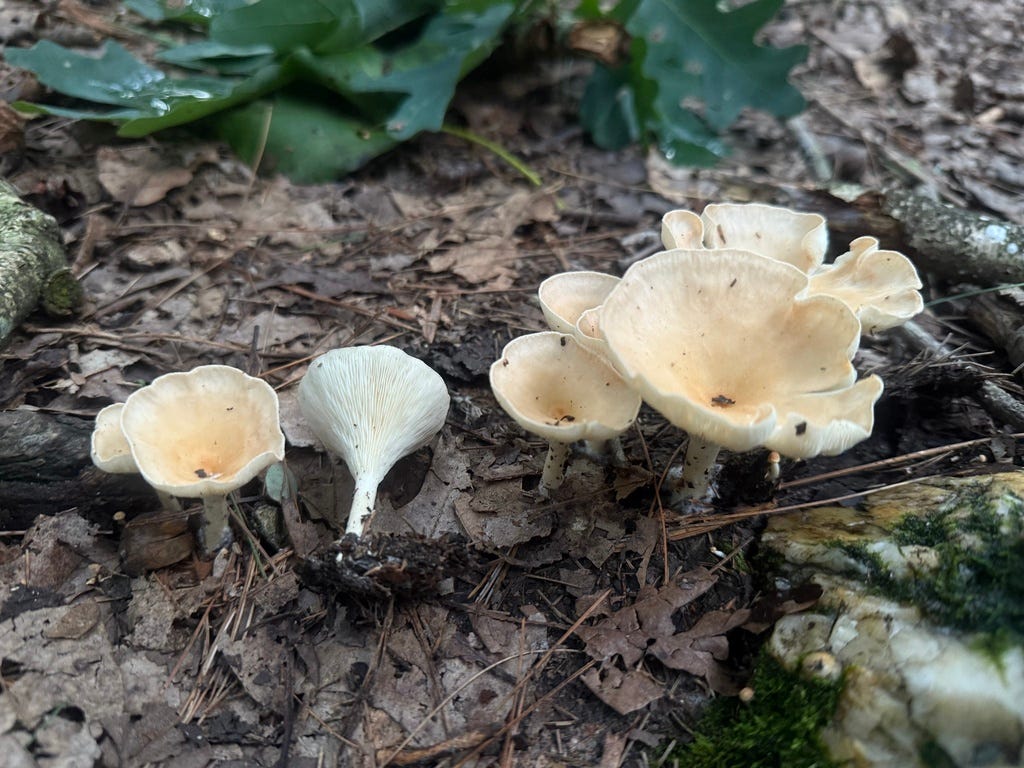
This is a mushroom that we saw each day during our last few days on the trail. The Latin name is a mouthful, and I’ve typed it wrong many more times than I’ve typed it right, but let’s see if we can’t learn a little about this martini-glass looking mushroom.
Fun Fact
A 2021 study out of Slovenia found that extracts of I. gibba not only completely inhibited the growth of the bacteria Salmonella infantis (a drug resistant form of Salmonella that originates in poultry), but actually killed some of the bacteria cells as well.
Etymology
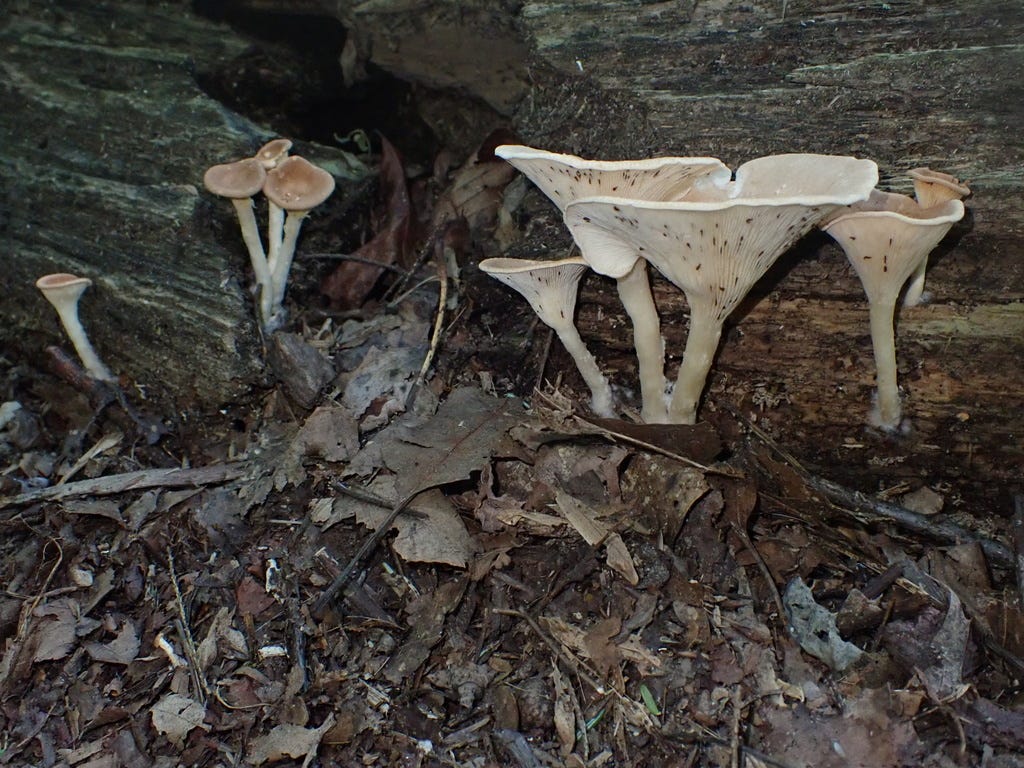
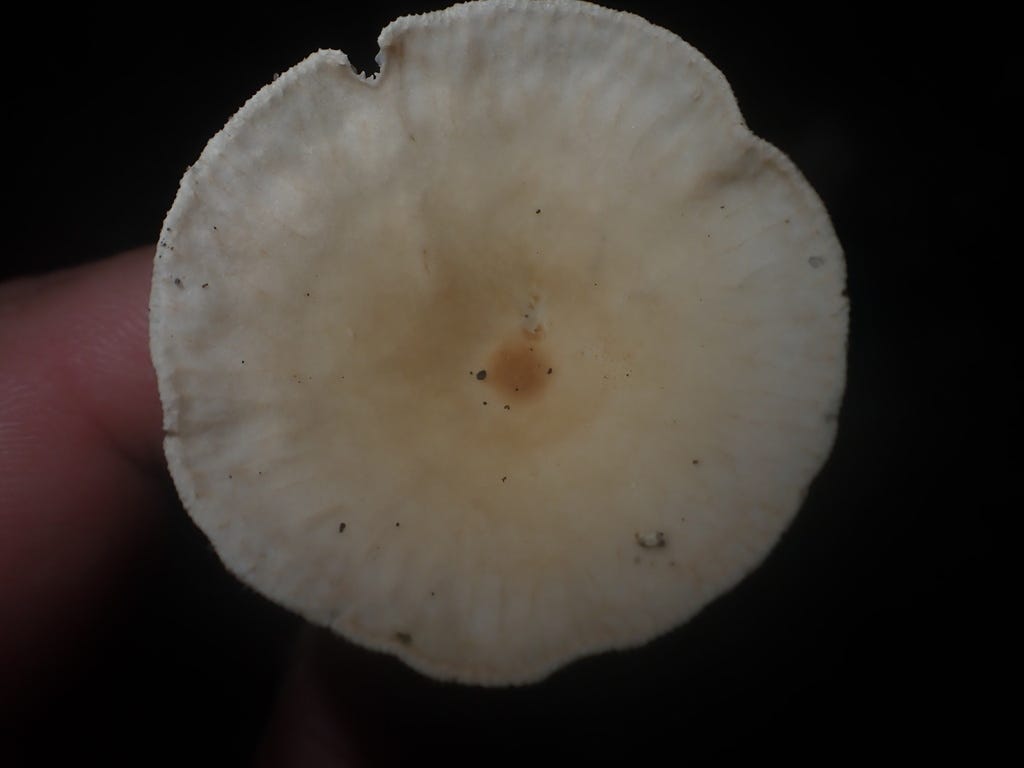
The fungus used to be named Clitocybe gibba, but in 2003 it was moved to the genus Infundibulicybe . A mouthful, sure, but the etymology breaks down to the Latin infundibulum, which means “funnel”, and the Greek kybos which means “head”. Funnel-head, that’s what they called me in college. The species epithet, gibba, comes from the Latin gibbus, and means “humped”, which refers to the bump in the center of the cap (prominent in young mushrooms like those on the left in the below photo).
Ecology
The fungus is saprobic and digests wood and/or decaying organic material on the forest floor. The species was originally described from Europe but can be found fruiting summer through fall across temperate forests of the Northern Hemisphere. The species comprises a “complex” with multiple, genetically distinct species all referred to as I. gibba. I’ve collected and dehydrated two different specimens so hopefully we’ll be able to get them sequenced and know a little more about the species we have in eastern North America.
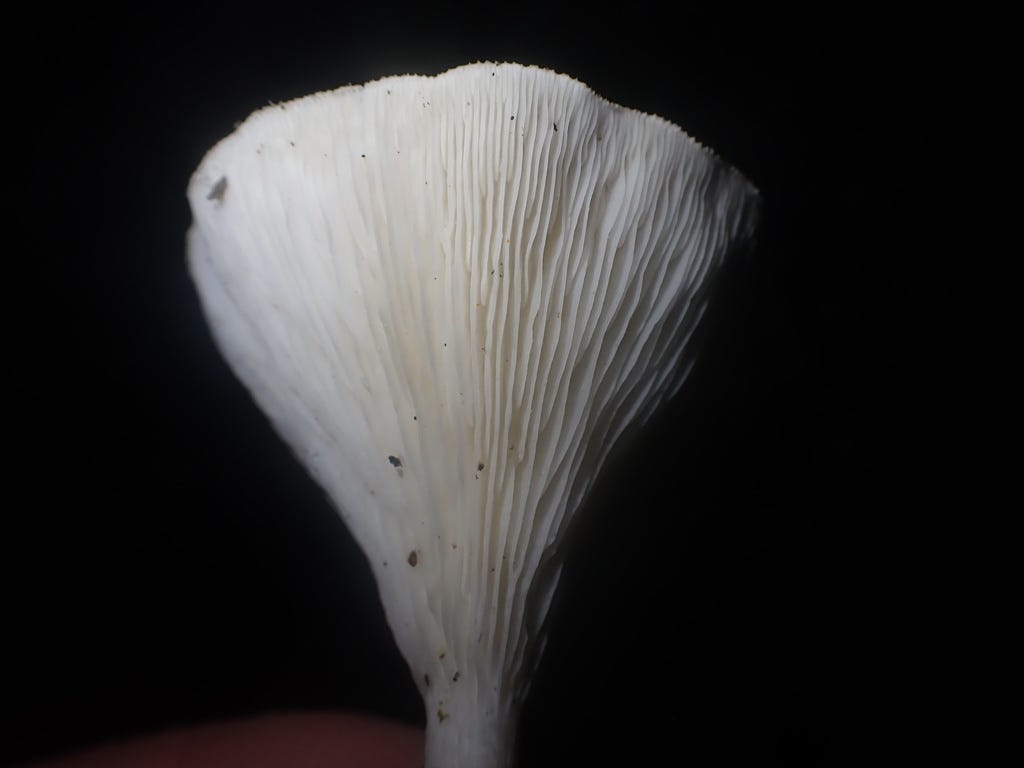
The mushroom has decurrent gills which means they run down the stipe to create that vase-like shape. The spores are white, the gills are white, and the cap is tan. Even when the cap becomes deeply concaved, you can still find the little “gibba” bump in the center of it. The largest mushrooms grew to about the size of my palm.
Thanks for bearing with me. I wanted to get this out so folks knew what was up on our end. We don’t know what will happen over the next few days, weeks, and months, but who does? I realized one thing early on while hiking the AT, and it’s that it doesn’t matter if you’re out there for a day or six months, 1 mile or 2,200 miles — what matters is that you’re out there. We were blessed and fortunate to have been able to hike 1,200 miles, and we’ll be even more blessed if we get to hike any more.
Hug your mom,
Aubrey
Thanks for reading Mushroom Monday! This post is public so feel free to share it.
References:
Kuo, M. (2022, April). Infundibulicybe gibba. Retrieved from the MushroomExpert.Com Web site: http://www.mushroomexpert.com/infundibulicybe_gibba.html
Sterniša M, Sabotič J, Klančnik A. A novel approach using growth curve analysis to distinguish between antimicrobial and anti-biofilm activities against Salmonella. Int J Food Microbiol. 2022 Mar 2;364:109520. doi: 10.1016/j.ijfoodmicro.2021.109520. Epub 2022 Jan 4. PMID: 35026447.
https://walklists.newyorkmyc.org/listall-nyc-public.php
https://www.jungledragon.com/specie/15496/common_funnel.html
https://www.inaturalist.org/taxa/921916-Infundibulicybe-gibba
Comments
Nothing yet. Say the first thing.
Sign in to join the conversation.