
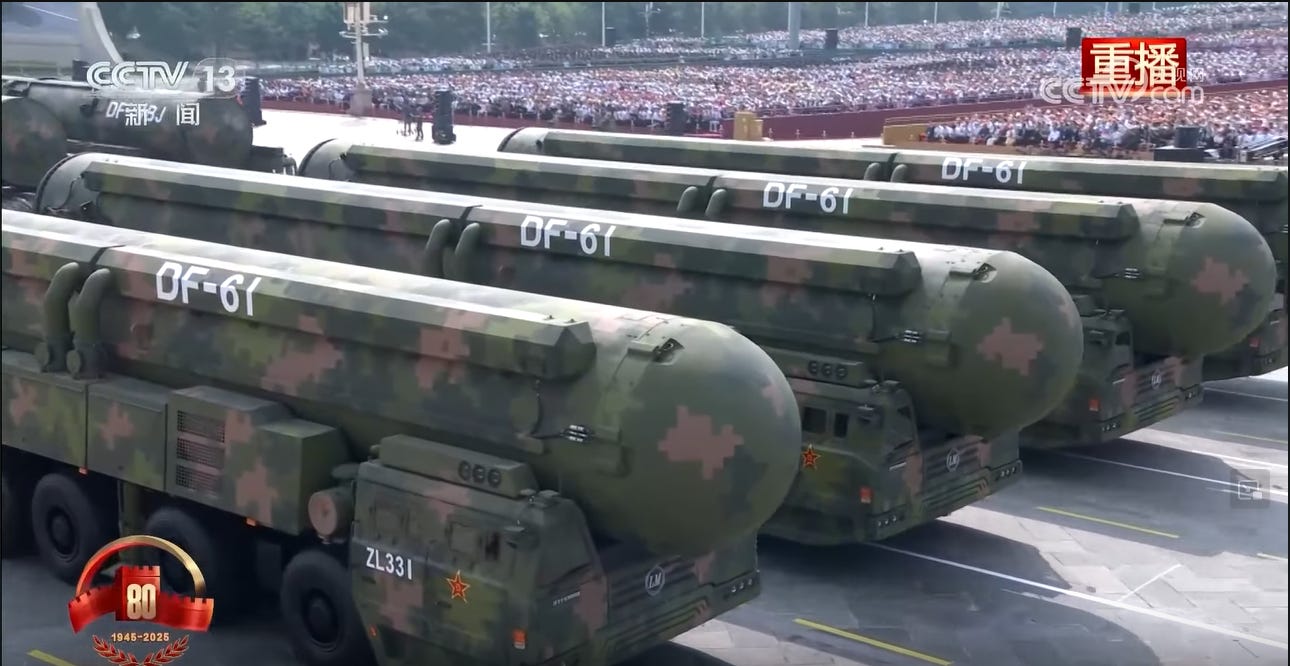
China’s nuclear arsenal, long kept at modest levels, is growing rapidly. The Pentagon estimates that the PRC will be near-parity with the United States and Russia, long the world’s leading nuclear powers, by 2030. Do Americans care?
I set out to answer one part of this question thanks to an unusual opportunity. Verasight, a survey research firm I have worked with previously, offered previous clients a chance to field one or two questions on a nationally representative omnibus survey. I was curious about how Americans viewed latent Chinese threats, and also pretty confident nobody else would ask about this, so I sent in a couple of questions. They chose them for the survey, which was fielded between March 6 and March 16, 2026, using Verasight’s proprietary pool of respondents (N = 1,000 U.S. citizens, weighted for national representativeness; margin of error +/- 3.5%).
Specifically, I asked:
Question 1: Currently, the United States has about 1,800 deployed nuclear weapons. Russia has about the same number and China has about 600. Do you support or oppose expanding the US nuclear arsenal?
Question 2: Many experts believe that China is rapidly expanding its nuclear arsenal and will have over 1,000 nuclear weapons by 2030, a few years from now. Given this, do you support or oppose expanding the US nuclear arsenal?
By asking these questions in order, I hoped to establish both a baseline level of concern about Chinese weapons and whether being provided with new information would change respondents’ views.
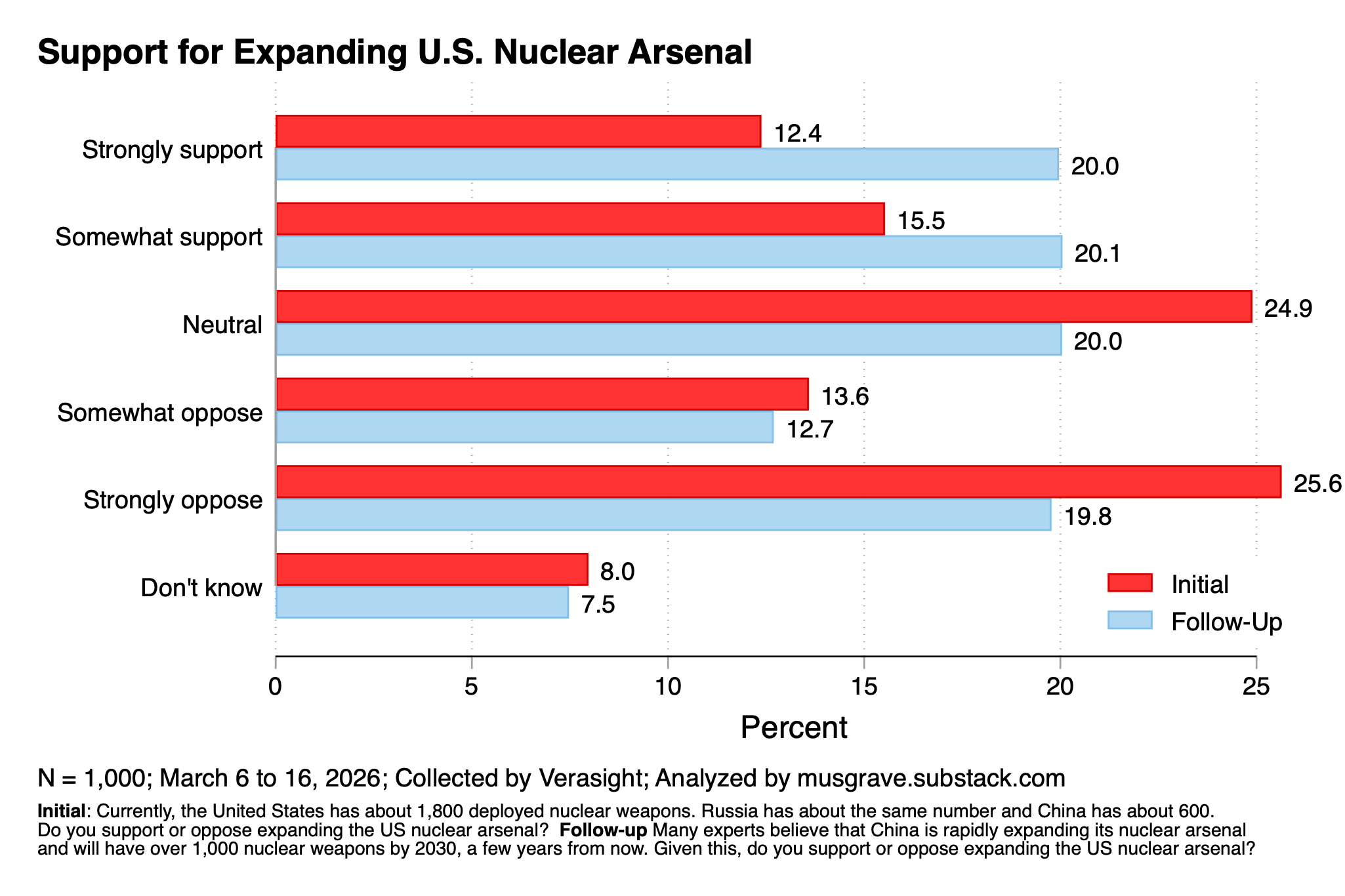
The answer is that, in isolation, Americans are not particularly predisposed to favor new nuclear weapons development: just shy of 28 percent of Americans favored such programs in isolation. The partisan cross-tabs on support for building nuclear weapons are stark: 44 percent of Democrats strongly oppose nuclear weapons, while only 9 percent of Republicans oppose them and 48 percent somewhat or strongly support building them.
As the figure above also shows, however, these levels are changeable. When told about growing Chinese arsenals, however, support jumped to a smidgen over 40 percent—a really substantial change!
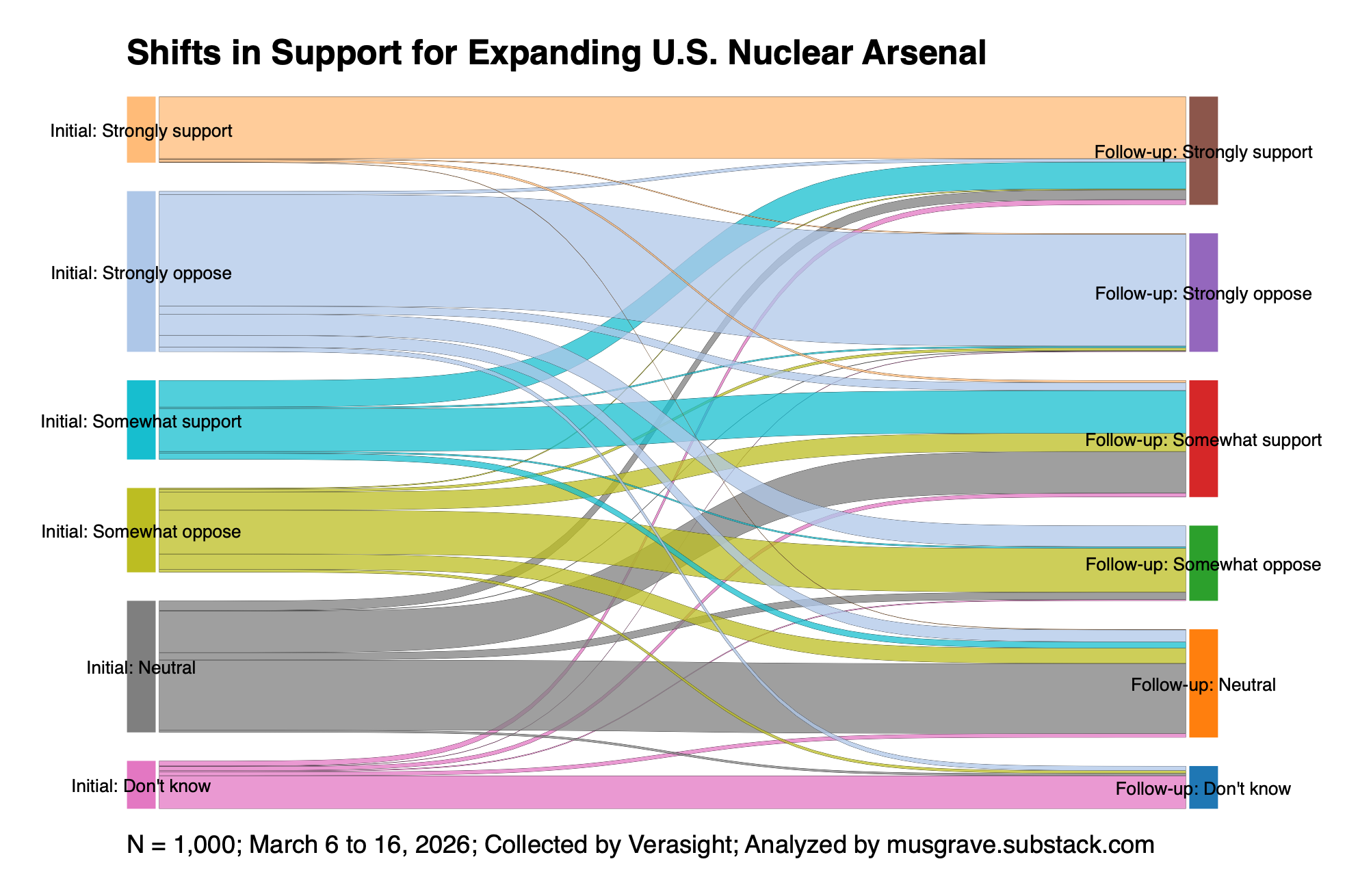
The direction of change in support was pretty consistent as well: very few people saw the growing Chinese arsenals and became convinced of nuclear restraint. Indeed, in general, those who changed their minds moved one notch toward supporting weapons on the five-point response scale (Strongly support to strongly oppose).
I used multinomial logistic regression analysis to evaluate what produced support for U.S. nuclear expansion in the abstract and changes in support after providing information. The most consistent predictors of support in general were between Republicans and Democrats, with Republicans hugely more favorable toward nuclear expansion and Democrats substantially more opposed. Similarly, Republicans were much more likely than Democrats to increase support for building weapons when told about China’s buildup; interestingly, older respondents also became more favorable. (All of these predictions hold education, race, ethnicity, and gender constant.)
The figure below illustrates the size of these changes from the first to the second question. Republicans became about 35% more likely to support building more weapons, while Democrats and Independents were only about 21 to 24 percent more likely respectively. (For this analysis, I have combined independents who lean D or lean R with their avowed partisans.) The youngest and oldest respondents also became markedly more likely to support building arsenals (again, keeping other factors constant).

What does this mean? Hawkish policies—even at the level of building more nuclear weapons—have more support than one might suspect (I certainly did not suspect this!), and Republican thirst for great-power competition is a strong latent force. Democrats, however, are much less interested in rearmament baseline and comparative terms, although they generally resemble Independents in this regard. Indeed, although the changes in relative support might look similar, overall support for nuclear armament among Democrats was comparatively low, with only 8 percent strongly supporting expanding U.S. arsenals and 17 percent somewhat supporting expansion when told of China’s trajectory. That’s compared to 50 percent somewhat or strongly (mostly strongly!) opposing a U.S. buildup in response. Meanwhile, 65 percent—nearly two-thirds—of Republicans surveyed favored a U.S. buildup in response, compared to just 16 percent opposed. And all of this, remember, was in response to a single data point, meaning that it’s plausible that a larger argument might sway more people. (Hey, if you give me money, I can research this for you!)
Arms control is, at the very least, a latently polarized issue. Overt Chinese displays of strength might provoke support for much stronger U.S. responses—and at the very least, there may be more of a lane for a hard China hawk than I would have suspected. The future may look more like the past than those of us who grew up in the post-Cold War assumed.
Thanks for reading Systematic Hatreds! This post is public so feel free to share it.
No posts
Comments
Nothing yet. Say the first thing.
Sign in to join the conversation.