
I have no position in this market, any Polymarket market, or any event market whatsoever. Neither I nor CIV are shareholders in Kalshi or Polymarket.
People are upset about the MicroStrategy selling Bitcoin by May 31 Polymarket market.
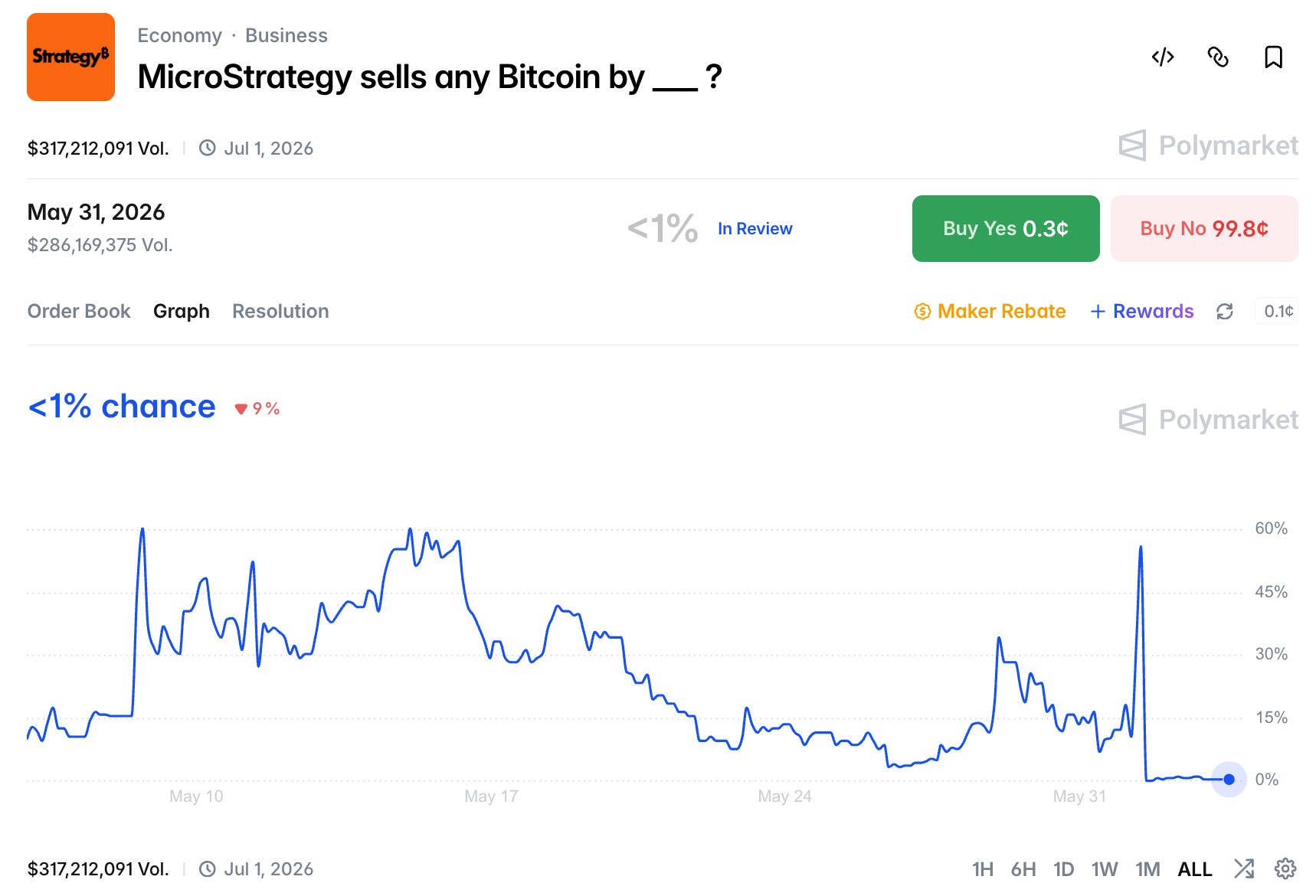
And I get it. MicroStrategy did sell Bitcoin by May 31. They sold 32 coins for $2.5m between May 26 and May 31. (Strategy is entering a bit of a tailspin on the news, but that’s a subject for another article).
This became somewhat apparent as early as mid May due to Saylor suggesting that he might do it as a test of how the market would react (badly). You can see that YES traded as high as 60% on May 15th.
The only problem is that after multiple rounds of disputes, the market settled to NO, due to the fact that MSTR only announced their sale on June 1st, after the market had closed.
Polymarket added a note on June 1st during the dispute period, saying
No information from MSTR, on-chain data, or consensus of credible reporting confirmed that MicroStrategy sold Bitcoin within the market’s timeframe. Confirmation achieved outside of the market’s time frame does not qualify.
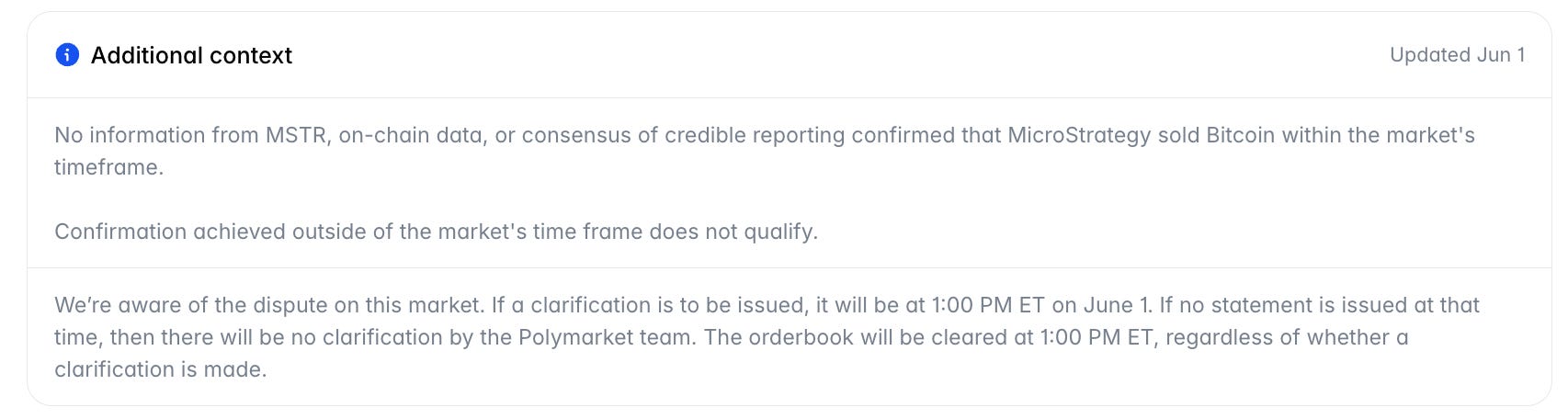
This belatedly transformed the market from an “occurrence” market to an “announcement” market. Effectively, Polymarket rewrote the market from “MicroStrategy sells Bitcoin by…” to “MicroStrategy announces a sale of Bitcoin by...”
The disgruntled YES buyers – and there are many of them – reasonably argue that the sale did in fact happen during the window, that the additional context changing the rules of the market was not present upfront, and that the spirit of the market resolved to YES. They also point out that on-chain data implied that MSTR was indeed selling the coins in late May.
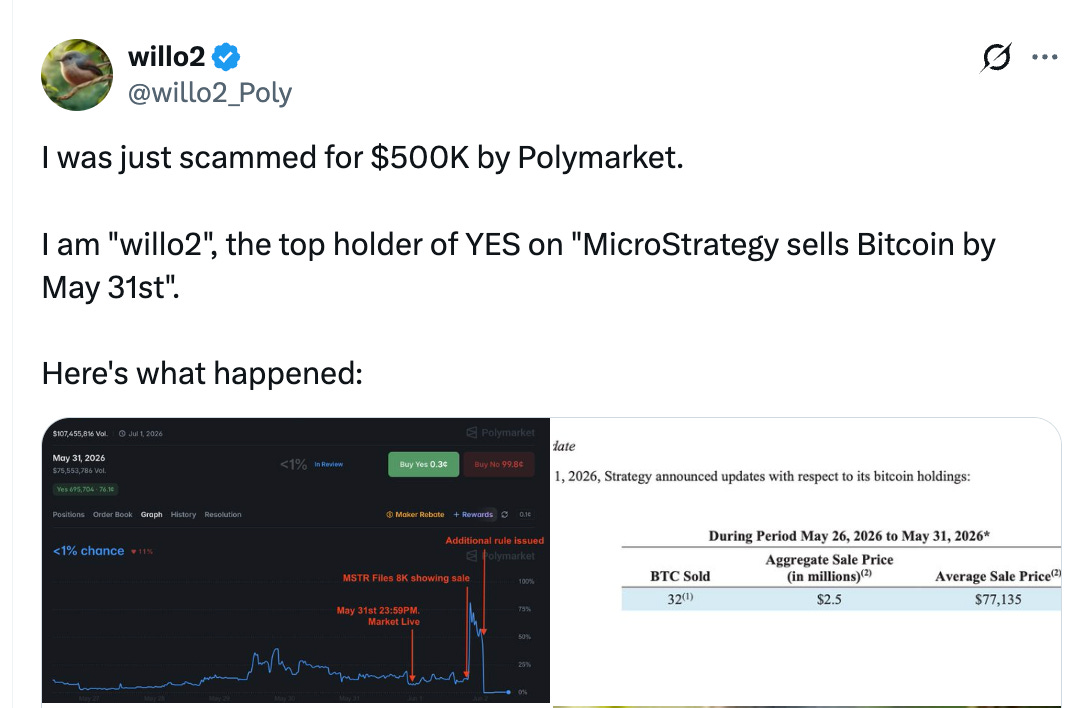
Some sophisticated participants agree that Polymarket is in the wrong here. Some of the FTX claims buyers are now buying YES claims for 20-25 cents on the dollar.
This is a gigantic mess that will test Polymarket’s resolve. In the past, they have outsourced contested markets to UMA, their designated resolution protocol, and stuck by it. This is deeply flawed, as voting power on UMA is determined by token ownership, which can be profitably exploited to swing resolution one way or another.
This isn’t the first time a market has resolved “wrongly” due to a poorly specified market and the whims of UMA whales. Polymarket should take this opportunity to completely overhaul their resolution system, and do the following:
Abandon UMA as a resolution oracle, and settle markets themselves
Fire the markets team and hire actual lawyers who know how to properly specify markets
Introduce deferred settlement, like other event betting platforms
Refund all participants in the Strategy by May 31 market
Introduce voided market outcomes rather than forcing all markets into a binary outcome
Universal MarketAccess, now UMA, is the outsourced protocol that handles Polymarket market resolution. It made sense in the early days when Polymarket was a fully crypto-native protocol and wanted to avoid the perception of being centralized. Outsourcing settlement was elegant back in those days because Polymarket could avoid allegations that they were running a centralized bookie, which might have caused their regulatory tightrope walk to fail.
It doesn’t make sense today.
Regulated prediction markets are now a thing, and Polymarket US is officially regulated by the CFTC as a DCM. The Strategy market happened on Polymarket international, where US users aren’t meant to trade. My understanding is that Polymarket US relies on its own market resolution mechanism whereas their offshore entity uses UMA. Polymarket should bite the bullet and move to the internal resolution model for the whole platform.
UMA is basically an anachronism. A callback to a time when the platform needed third-party resolution delivered on chain. But Poly is increasingly pursuing regulatory rapprochement rather than a rugged decentralized model. And UMA itself has a checkered track record. It is constantly the source of controversy for its difficulties settling contested markets.
And this isn’t strictly UMA’s fault, as the markets are often ambiguously written and hard to interpret, leading to constant fights.
But UMA itself is also a potential source of manipulation, unacceptably so in my opinion. The entire market cap of UMA is $37.4m, and tokenholders vote anonymously. To swing a market resolution, you might only need a fraction of supply or a few million tokens.
Disputed markets like the Microstrategy market have volumes in the hundreds of millions of dollars ($317m in that case).
For only a few million dollars, you could buy enough UMA to consistently swing disputed markets, harvesting way more than that in close markets where you swing the vote. Since UMA votes are anonymous, there’s nothing prohibiting an UMA holder from having a position in an underlying Polymarket market. This is obviously highly conflicted.
And you get to reuse your UMA indefinitely (and sell it when you are done), so you could profit many times from this strategy. The economic security of the UMA system fails once the supply of disputed market liquidity far exceeds the UMA market cap, which it does (by a large factor). In fact, I’d be very surprised if there wasn’t currently a fund running a systematic strategy which does exactly this.
Here are my estimates on some recent markets:
Flipping the Strategy Sells BTC market resolution would have required 15.7m UMA, or $6.52m, against a market with $293m in liquidity
Flipping the Zelenskyy suit market would have required $7.01m worth of UMA, against a market with $242m liquidity
These numbers are approximate because UMA penalizes voting against the ultimate winner, so all you have to do is represent an “emerging consensus” on one side or other, which you could in theory do cheaply. There are hundreds of disputed markets resolved by UMA each year.
UMA votes have resolved a lot of markets “wrongly”, in my opinion, notably the Zelenskyy suit market (it was obviously a suit). So there is plenty to reason to suspect UMA whales. Even absent any evidence of wrongdoing – and I’m sure it exists if you look closely enough – Polymarket should abandon UMA regardless. The stakes are simply too high to outsource resolution to anonymous token holders of a $37m protocol. As volumes on Polymarket keep growing, the divergence between the cost to maliciously swing a resolution and the profit to be extracted will only grow.
UMA was a nice idea initially, but Polymarket has outgrown UMA’s ability to provide reliable crypto-economic security.
Looking at Polymarket competitors or adjacent venues like Kalshi, CME, Nadex, or IBKR that offer similar markets, a pattern is clear. They clearly define the source upfront. They define the event time and the determination time. They allow deferred settlement if the source data lags the market close. And they settle centrally without passing the buck to some unaccountable third party. For instance, Kalshi explicitly says:
Most markets settle within a few hours after the outcome is known (often within about 3 hours). In some cases, it can take longer if we’re waiting on official data from source agencies.
And:
Why might settlement take longer than expected? Waiting on official data: We rely on a source agency (for example, official league statistics, government releases, or other event authorities) to publish finalized results. If their data is delayed or revised, we may wait before settling, depending on the market rules.
The CME has similar contingency language in its event contract rulebook:
If an Event does not occur, is delayed, is rescheduled, or is canceled prior to Termination of Trading, Final Settlement determination shall be deferred until the Contingency, as set forth in the Event Contract Swaps Table. If the Event has still not resolved and/or will not be resolved as of the Contingency Expiration, occurrence determination shall determine Final Settlement, as set forth in the Event Contract Swaps Table.
Nadex avoids this quagmire by only listing event contracts that can be settled by data releases by a specific reporting body:
The expiration value for an economic report contract is the figure released by the designated reporting body. For example, the weekly jobless claims number is reported by the US Bureau of Labor Statistics, and GDP is reported by the Department of Commerce.
ForecastEx (which IBKR relies on) also accommodates reporting delays, but again this depends on a specific predetermined reporting agency.
So how would Polymarket’s competitors have handled this market?
They would have specified it differently up front.
They would have made it clear up front whether it was an occurrence or an announcement market. If it was an occurrence market, they would have cleanly specified reporting sources up front. They would have closed trading at the specified time, and then waited through a predetermined evidence window, settling via predetermined admissible sources. Markets like these can’t close and settle at the same time.
First things first, Polymarket should refund participants in the Strategy market. The addendum changing the market rules was added after the fact (as far as I can tell), giving the YES buyers clear cause to bring a case should they choose to. Poly should nip this embarrassment in the bud by refunding and voiding the market. Second, Poly should ditch UMA. It is an anachronism and no longer useful. They should internalize market settlement and shoulder the responsibility for their resolutions. The stakes are too high to continue with business as usual.
Third, Poly should simply hire better people to write their contracts. The trouble with most of these markets is not that the real world is ambiguous, but so far they haven’t been able to write that ambiguity out of their contracts up front. But by being extremely pedantic and anticipating weird edge cases, it’s possible to take the risk of an ambiguously settling market to near zero. People that can do this exist – they are called lawyers, and they are exceptionally good at anticipating weird edge cases. (In fact, they’d probably be thrilled to do it, as AI is making a lot of them redundant). It seems to me from reading lots of Poly contracts that they are being written by “markets guys”, not “legal guys”. It appears that Poly is playing a scale game, trying to pump out as many markets as possible. They should invest more in a legal team to write these contracts. They certainly have the cash.
Fourth, Poly should introduce a deferred settlement mechanism, like all of their competitors do, and permit markets to be voided. Sometimes the real world really doesn’t settle one way or another, and in that case you simply give the bettors their cash back.
See my other pieces on prediction markets:
No posts
Comments
Nothing yet. Say the first thing.
Sign in to join the conversation.