
By Andrea Smith
Correspondent for Russia Today of Russian Federation, reporting for MUNFW World Press
RT is a Russian state funded international media network. RT presents perspectives aligned with Russian foreign policy and challenges Western narratives, often highlighting criticism of Western governments and institutions.
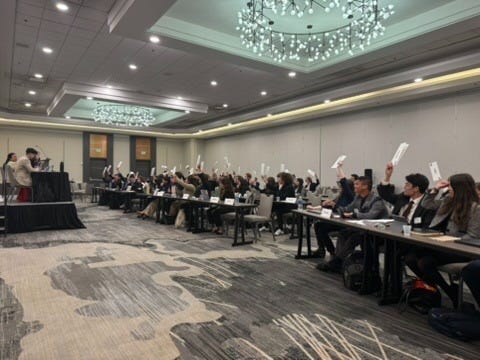
Delegates gathered Sunday, 19 April, in the Second Committee of the General Assembly at Model United Nations of the Far West (MUNFW) to begin discussions on the agenda topic “Artificial Intelligence for Sustainable Development,” where Member States decided to work together on one large resolution with many subtopics. In a setting where disagreement is often expected, this level of cooperation stands out.
Unlike previous sessions, delegates were not divided into separate resolutions, but instead worked collectively across six to seven subtopics in small groups around the committee room. Ranging from healthcare and education to military applications and funding of Artificial Intelligence (AI). This approach reflects a shared understanding that AI is no longer optional, but necessary in achieving the 2030 Sustainable Development Goals (SDG’s).
Russia Today spoke with several delegates, including the Russian Federation, to ask whether countries truly see eye to eye. Delegates largely agreed that while methods may differ, the end goal remains the same: using AI to enhance development and speed up global progress. One of the strongest areas of agreement came from the use of AI in healthcare. Delegates highlighted how AI can already detect early-stage cancers, including melanoma, allowing for faster and more accurate diagnosis. Expanding these systems globally was seen as a key step in making healthcare more accessible and efficient for people.
However, not all topics have reached the same level of consensus. The use of AI in the military remains more divided. The Russian Federation noted that AI could play a role in enhancing drone capabilities and overall defense systems, while other delegations expressed concern over how such technologies would be regulated.
To address these concerns, delegates proposed the creation of a UN body to oversee AI, ensuring it remains human centered while also guiding funding, development, and global access. This proposal shows the ongoing concerns about balancing innovation with responsibility between member bodies.
Despite different views on certain issues, the overall tone of the committee remains unusually mutual. Delegates continue to emphasize one shared priority: accelerating the progress toward the 2030 deadline through the use of AI. While this topic is still fresh it seems that the member bodies will be able to agree on this resolution for the better of all bodies, a rare occasion in MUN committees.
Do you have tips and information to share with The World Press writers and editors? Would you like to submit a letter to the editor? Email worldpress@munfw.org today.
No posts
Comments
Nothing yet. Say the first thing.
Sign in to join the conversation.