
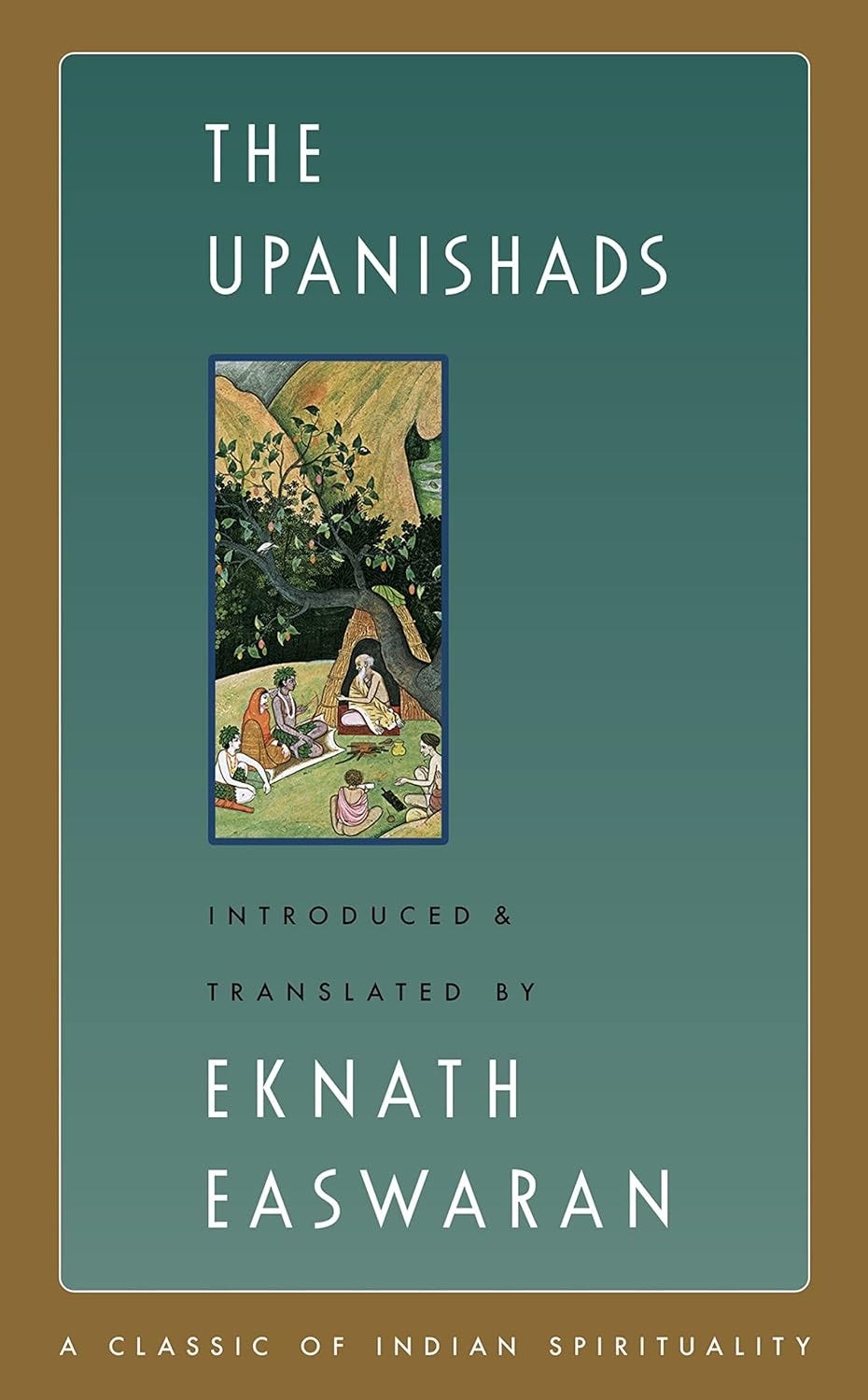
Eknath Easwaran’s translation of the Upanishads brings ancient India’s most profound philosophical texts to modern readers, revealing a body of wisdom that has shaped Hindu thought for over 3,000 years. These ancient dialogues between teachers and students—composed in forest retreats by unnamed sages—represent humanity’s earliest systematic exploration of consciousness, identity, and the nature of reality itself.
Easwaran begins by explaining what makes the Upanishads unique among religious texts. Unlike the Bible or Quran, which present divine commandments, the Upanishads record philosophical investigations—arguments, counter-arguments, and direct experiments in consciousness. Ancient sages treated the human mind as their laboratory, exploring questions that modern neuroscience and physics are only beginning to approach: What is consciousness? What persists after death? What is the relationship between the individual self and the universe?
The Kena Upanishad opens with a question that stops most readers cold: “By whom directed does the mind go toward its objects? Commanded by whom does life move? By whose will do people speak?” These aren’t rhetorical questions but genuine inquiries into what animates human experience beneath surface consciousness. The answers lead toward Brahman—the underlying reality that makes all experience possible but cannot itself be experienced as an object.
The Chandogya Upanishad contains perhaps the most famous phrase in Indian philosophy: “Tat tvam asi”—”That thou art.” Easwaran explains this through the dialogue between sage Uddalaka and his son Shvetaketu. The father asks his son to dissolve salt in water, then taste the water at different points. The salt is invisible yet present everywhere. Similarly, Brahman—the universal consciousness—is invisible yet present in every being. “That which is the subtle essence,” Uddalaka tells his son, “in that have all things their existence. That is the truth. That is the Self. And that, Shvetaketu, that art thou.”
The Katha Upanishad presents wisdom through a remarkable story: young Nachiketa visits Yama, the god of death, and demands to understand what happens after dying. Yama initially offers wealth, pleasure, and earthly power as substitutes, recognizing that most humans prefer comfort to truth. Nachiketa refuses everything, insisting on understanding death’s mystery. This exchange becomes one of literature’s greatest explorations of mortality, with Yama eventually revealing that the true Self—the Atman—was never born and can never die. “The Self is not born; it does not die. It was not produced from anyone; nor was anyone produced from it. Unborn, eternal, it is not slain, though the body is slain.”
Easwaran’s translation excels through his introductions to each Upanishad, providing cultural and philosophical context without oversimplifying. He explains the concept of maya—often mistranslated as “illusion”—as the tendency to mistake partial reality for complete reality. He uses the example of rope mistaken for a snake in dim light: the snake isn’t unreal, but mistaking rope for snake creates unnecessary fear. Similarly, mistaking the individual ego for ultimate reality creates suffering that understanding can dissolve.
The Mundaka Upanishad distinguishes between two kinds of knowledge: lower knowledge covering sciences, arts, and scriptures, and higher knowledge that reveals “that by which the changeless is known.” Easwaran explains how ancient Indians weren’t dismissing intellectual learning but recognizing its limitations. All conventional knowledge describes objects within consciousness, while higher knowledge investigates consciousness itself—the knower rather than the known.
The Mandukya Upanishad explores consciousness through the states of waking, dreaming, and deep sleep, identifying a fourth state—turiya—underlying all three. Easwaran explains this through an analogy: gold can be fashioned into rings, bracelets, and necklaces of different shapes, but gold remains unchanged throughout. Similarly, consciousness takes different forms during waking and dreaming while remaining fundamentally unchanged.
Easwaran presents these ancient insights with remarkable accessibility, connecting Upanishadic ideas to modern concerns about identity, meaning, and psychological wellbeing. He shows how the central teaching—that individual consciousness and universal consciousness are ultimately identical—provides not just philosophical satisfaction but practical liberation from anxiety, fear, and the sense of fundamental isolation that plagues modern life.
The Upanishads ultimately presents a vision of human existence far more expansive than modern materialism allows—one where consciousness isn’t produced by the brain but is the fundamental ground of reality itself, where individual identity is simultaneously real and limited, and where the deepest questions about existence point not toward despair but toward an inexhaustible source of peace and meaning available to anyone willing to investigate their own experience with sufficient depth and honesty.
Get it here : India | USA | UK
Did you read these?
Comments
Nothing yet. Say the first thing.
Sign in to join the conversation.