
This morning, I ran breakpoint unit root tests for the U.S. Real Gross Domestic Product (RGDP), Gross Private Domestic Investments (GPDI), and Loans and Leases in bank credit and could have found an error behind our (failed) U.S. real GDP forecasts.
The breakpoint tests indicate that the GPDI series might not be a unit root process at all. If so, this would have biased both the cointegration (Johansen Trace) test as well as our estimates (forecasts) for the U.S. real GDP. More research is naturally warranted, but this is one potential reason for the failure of our model.
Outside of the now-defunct forecasting model, the situation with the U.S. economy has been on our (GnS Economics) cross-hairs for some time. Another way to say this is that we have been negative on the prospects of the U.S. economy for some time.
I’ve been warning about the implosion of the U.S. economy for over two years. In the Private Sector Recession (free), I noted that “... the Great Depression-level fiscal stimulus is currently carrying the U.S. economy.” This was not all, though.
My analyses from two years ago missed the rapid ascent of the private credit sector and lending (money) flowing into the U.S. economy through it. Missing it led me to erroneously call for a U.S. private sector recession in May 2024. My warning was based on the credit recession, which never was. Business lending has just moved from banks to the credit funds, for a short while at least.
My error was another valuable lesson on forecasting uncertainty. When you miss a crucial data point, your forecast will, almost certainly, be erroneous.
That said, where do we stand with the U.S. economy? The mood among Americans is not good.
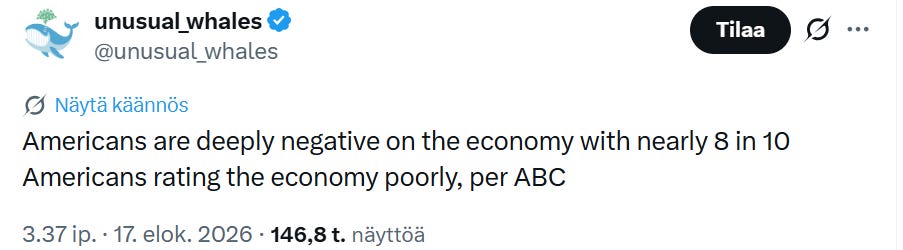
This is reflective of the 2022-2025 cost of living crisis, when around the same level of discontents was observed among the U.S. populace.1 Bankruptcies are also creeping up.
Comments
Nothing yet. Say the first thing.
Sign in to join the conversation.