
Let’s discuss a bit about the stimulus of China (Beijing) today. Yesterday, I noted (citing our Weekly Forecasts 27/2026) that
Secondly, it shows that the Chinese economy’s downturn has continued, but the decline has slowed in the past two to three months. This is indicative of an approaching increase in stimulus by Beijing and hence another upturn in the Chinese economy.
Such a ramping up of the credit machines in China (for the nth time) would be important to note, because it would foreshadow a likely upturn of the global and European business cycles.
We at GnS Economics discovered the dominant role China held in the global business cycle as early as 2017 (summarized here). In the Weekly Forecasts 22/2025, we ran extensive statistical analyses to discover whether this hypothesis would hold. Our impulse-response analyses indicated that A) from May 1992 (the earliest data point) to April 2008, both China and the U.S. would have driven the global business cycle, and B) that from 2009 until 2025, China led the global business cycle. We concluded:
A shock to the leading indicator series of China has a clear nonnegligible effect on leading indicators of Major-4 Europe and the U.S., while the shocks to Major-4 Europe and the U.S. have only a very small or nonnegligible effect on the series of each other and that of China. China leads the “pack”, statistically at least.
In other words, there’s quite a lot of both circumstantial (China has, e.g., created most of the new credit in the world since 2009) and statistical evidence that stimulus decisions of Beijing carry a long tail. That’s why the first statistical forecasts conducted by GnS Economics with our new team focused on China’s stimulus, and why we have invested significant (statistical) effort in building an accurate forecasting model. On this, we have been rather successful.
Figure 1 presents our August 2025 forecasts for the natural logarithmic aggregate financing to the real economy of China, or AFRE, alongside actualized values
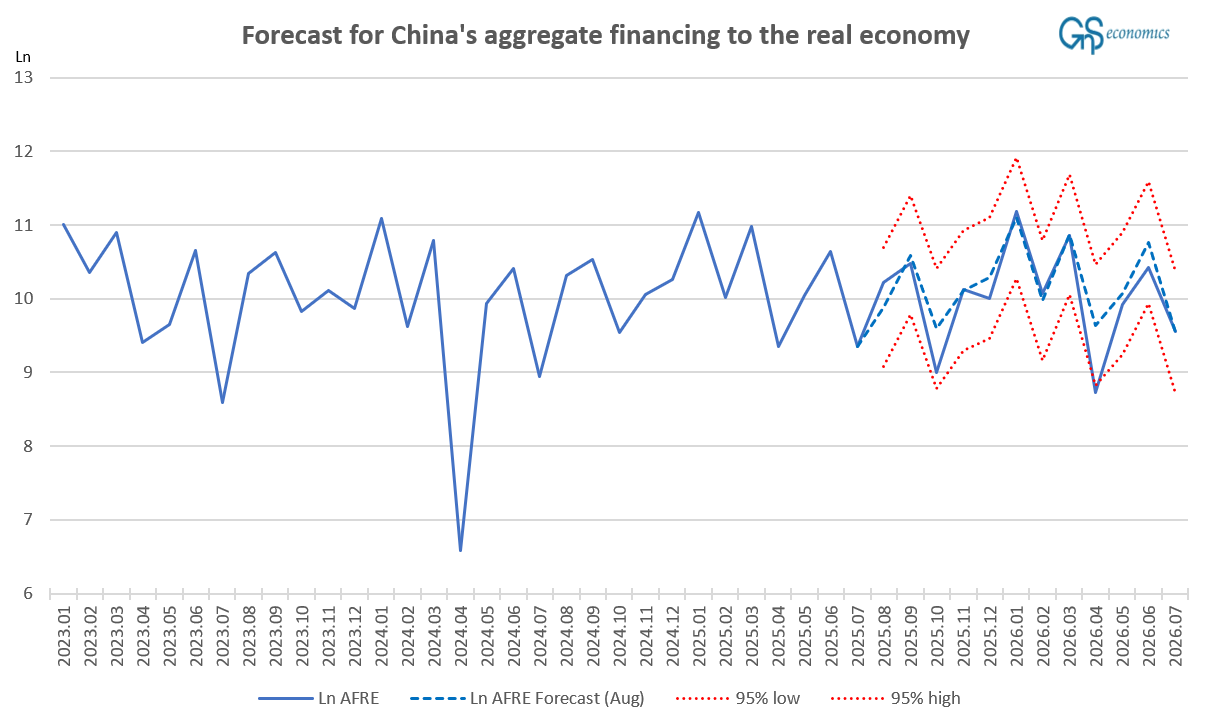
What Figure 1 depicts is an excellent forecast accuracy. Basically our forecasts missed only in April, when the drop in AFRE broke through the 95% lower confidence interval. The reason why our forecasts have been so accurate is the cyclicality of the financial flows, which source we do not yet fully understand but which has been the driving feature of AFRE at least since 2016. When you model those correctly, forecasts tend to be very accurate.
What interests me the most is the below-forecast trajectory of China’s Total Social Financing (another name for the AFRE) has remained after April. Is this indicative of slowing down of stimulus?
To get a clearer picture, let’s update our forecasts.1
Comments
Nothing yet. Say the first thing.
Sign in to join the conversation.