
Steven Major is a well respected Bond Analyst - I worked with him at HSBC, and he now worked for Tradition. Here is his take on the GPIF announcement, and its potential impact on Global and EM Bond Markets.
13th July 2026 | Steven Major, CFA - Global Macro Advisor
Japan’s Swing Factor
A nudge not a mandate: The slow-motion shift in Japanese flows
For over two decades, the global macro environment has been anchored by a singular, reliable asymmetric mechanism: the Japanese yen carry trade. While recent verbal interventions by Finance Minister Satsuki Katayama sparked intense market speculation about an imminent overhaul of the Government Pension Investment Fund’s (GPIF) asset allocation, subsequent reports confirming that no formal policy rewrite is planned have temporarily calmed the waters.
Yet, focusing purely on immediate bureaucratic shifts misses the broader structural transformation. The combination of policy normalisation by the Bank of Japan (BoJ) and multi-decade highs in domestic yields means that the mechanical assumptions underpinning global yen liquidity are quietly dissolving, driven by commercial reality rather than sudden political mandates.
The nudge – Japan’s Finance Minister steps in
At the end of last week, in a move that caught global capital markets completely off guard, Japan’s Finance Minister, Satsuki Katayama, issued a directive targeting the nation’s massive institutional wealth:
“One priority is to encourage households, as well as pension funds including the Government Pension Investment Fund (GPIF), to increase their investment in Japanese financial assets. We intend to pursue policies that support that objective.”
- Satsuki Katayama, Minister of Finance, 10 July 2026
Though any official change to the GPIF’s asset mix requires a lengthy formal review process, the political intent to anchor more wealth at home is clear. Rather than relying on standard, transient verbal interventions to deter yen short-sellers, Finance Minister Katayama explicitly stated that the government intends to pursue policies to encourage domestic households, insurance companies and public pension funds to aggressively scale up their allocations to Japanese financial assets.
It’s all about the signal
The implications of this statement cannot be overstated. Katayama is directly referencing the GPIF, which manages a staggering ¥293.6 trillion ($1.81 trillion) in assets. As of the close of the last fiscal quarter, approximately half of the GPIF’s entire portfolio was parked in foreign assets: 24.5% in foreign bonds and 24.8% in foreign equities (Bloomberg).
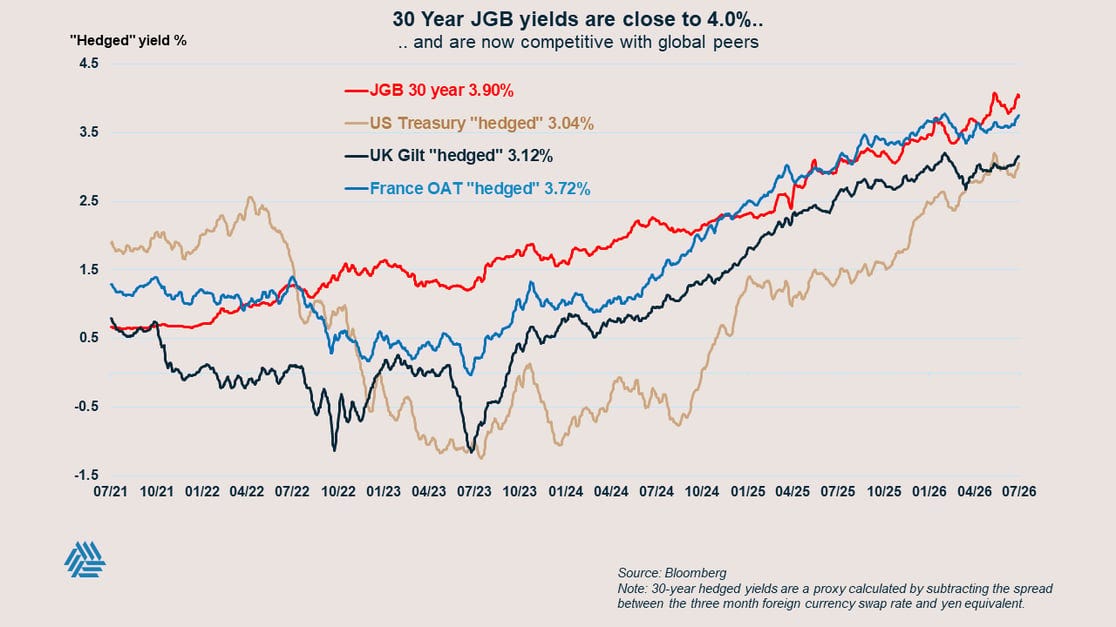
Even minor portfolio rebalancing by the world’s largest pension fund could disrupt global capital flows, especially if other Japanese institutions follow its lead. As our chart shows, JGB yields have been rising for five years and now stand competitive with global peers.
Our measure of the “hedged” yield shows that the return Japanese investors receive from overseas bonds has become unattractive. From a valuation perspective, it has long been the case that JGBs are more compelling to domestic investors. Katayama has effectively given the green light to the repatriation trade.
Whilst officials are quick to clarify that this is not an overnight, state-guided structural mandate, it highlights a powerful cyclical reality. The government is not requesting these funds to make a patriotic sacrifice by bringing money home; they are asking them to execute an obvious, higher-yielding trade. By liquidating an expensive, hedged US Treasury or UK Gilt portfolio and moving capital into local 30-year JGBs, institutional allocators immediately capture a decent risk-free yield pick-up while entirely shedding foreign currency, political, and rollover execution risks.
Isolating the hedged yield
We evaluate the shifting macro landscape through a clean metric: the proxy JPY-hedged yield. For a Japanese institutional investor looking abroad, the true return on a foreign bond is not its nominal headline rate, but what remains after accounting for short-term rolling currency protection. This relationship can be formalised and proxied as:
JPY “hedged” yield = 30-year foreign bond yield – (three-month foreign rate - three-month JPY rate).
By subtracting the short-term interest rate differential from the ultra-long 30-year foreign sovereign bond yield, this formula isolates the economic reality for a Japanese cross-border institutional investor. In practice investors will use cross-currency basis swaps but we use the proxy - which is not distorted by liquidity anomalies- for purposes of comparison.
The lines on the chart trace three distinct historical regimes:
2021 – 2022 (The great outflow): During this phase, exporting capital from Japan was entirely rational. The proxy hedged US Treasury yield peaked well above 2.5%, whilst 30-year JGBs were pinned beneath 1.0%. This massive yield advantage incentivised a structural migration of Japanese capital into Western fixed income.
2023 – 2024 (An inversion trap): As Western central banks aggressively hiked short-term rates to combat inflation, global yield curves deeply inverted. The cost of running short-term currency hedges skyrocketed, plummeting the proxy hedged US Treasury return below -1.0%. Japanese institutions either dropped currency protection or reduced foreign asset accumulation.
2025 – 2026 (Domestic gravitational pull): As foreign central banks execute rate cuts, short-term hedging costs have moderated, bringing proxy hedged yields back into positive territory. However, the structural steepening and cheapening of the domestic JGB curve has outpaced the offshore recovery.
Today, the 30-year JGB is close to 4.0%. Our chart shows the local yields standing significantly taller than a proxy hedged 30-year US Treasury or UK Gilt, while recently moving above French OATs. The domestic yield curve has effectively formed a “gravity well,” sucking institutional demand away from global markets.
Developed market repatriation trap
For developed markets, the hazard highlighted by our chart is an orderly but relentless drain of structural capital. Large institutional investors, like Japanese life insurance companies for example, do not gamble on currency fluctuations; they typically hedge their foreign bond purchases using rolling short-term forward contracts.
As foreign central banks don’t hike rates and the BoJ normalises, the cost of running these currency hedges drops, but the raw yield advantage of foreign debt falls even faster. The result is a slow-motion exit, removing a critical pillar of structural demand from Western debt markets just as domestic fiscal deficits in the US and Europe mean there is more issuance. The structural decompression of Western long-end curves has become an ongoing theme for global asset allocators this cycle.
Emerging market unwind risk
Whilst DM faces the risk of an institutional capital flight, the risk profile of EM operates in a different, rather speculative way. Because EM nominal yields are structurally much higher, macro hedge funds executing speculative trades funded in yen don’t buy currency insurance; they run their positions unhedged to harvest the raw interest rate gap.
This mechanism thrives in a low-volatility regime. However, when domestic repatriation drives the yen structurally higher, it short-circuits this speculative funding leg. Spikes in the spot JPY rate force macro desks into disorderly, simultaneous liquidations of local EM assets to close out their short currency positions before their gains are completely wiped out. This creates acute liquidity shocks in high-yielding markets like South Africa and Turkey, acting as an immediate sentiment drag on broader cross-asset risk assets.
Summary
Whilst official pushback confirms that the GPIF will not alter its strategic asset mix overnight without a formal review, our time-series of 30-year yields suggests that the organic economic incentives for capital migration are already in place. The red line tracking domestic 30-year JGB yields has crossed above the proxy hedged returns of the entire Western developed market complex.
The restoration of value in the JGB market means that domestic allocators no longer need a political directive to bring money home; they can now justify doing so based on valuations. The government’s “nudge” may be downplayed by official channels to prevent near-term market disorder, but the long-term trend points towards a slow, relentless repatriation.
Over-extended EM carry positions remain structurally vulnerable to any sudden shifts in yen volatility, whilst the long-ends of Western sovereign debt markets must prepare for a steady erosion of their most reliable source of cross-border institutional demand.
The information contained herein is distributed by Tradition (Dubai) Ltd under licence from the owners of the intellectual property rights or its licensors. This document is prepared for informational purposes only to Professional Clients and Market Counterparties . Any review, disclosure, dissemination, distribution or copying of the information, whether in full or in part, is strictly prohibited and only intended for confidential use by the designated recipient(s). All content is provided “as is”, without warranty of any kind, either express or implied, including without limitation, warranties of merchantability, fitness for a particular purpose, and non-infringement. Nothing herein constitutes investment advice or an offer, or solicitation of an offer to buy or sell any financial product. Any data consists of purely indicative prices and should not be relied upon to revalue any commercial positions held by any recipient. Tradition (Dubai) Limited specifically does not make any warranties or representations as to the appropriateness, quality, timeliness, accuracy or completeness of the information and shall not be liable to any user or anyone else for any inaccuracy, error, omission, interruption, timeliness, incompleteness, deletion, defect, failure of performance, alteration or use of any of the content displayed, regardless of cause, or for any damages resulting therefrom. Copyright © Tradition (Dubai) Ltd, 2026.
Commercial in Confidence.
Tradition (Dubai) Ltd, registered in Dubai at Unit 3 & 6, Level 2, Building 1, Currency House, DIFC, PO Box 506530, Dubai, UAE and is authorised and regulated by the Dubai Financial Services Authority (DFSA).
No posts
Comments
Nothing yet. Say the first thing.
Sign in to join the conversation.