
China’s rapid progress in developing fifth- and sixth-generation stealth aircraft reflects a defense strategy centered on speed, continuous prototyping, and mass production. Unlike the United States, which often prioritizes lengthy development and extensive testing, China rapidly refines multiple designs while dedicating significant national resources to modernization. The result is an increasingly capable aerospace industry that is narrowing the technological gap and challenging Western air superiority.
Lately, many articles have been discussing the progress and expediency of the Chinese in developing their 5th- and 6th-generation stealth fighters (J-20 and J-35).
The Chinese are, in fact, outpacing us in manufacturing, assembling more aircraft faster. They are also testing and fielding them faster than our own efforts.
So, apart from those facts, which are clear in satellite photography, as well as videos and sightings, it just shows you how a totalitarian regime can dedicate resources and funding to its modernization effort and catch up with the West.
It seems like we are now the ones who need to wake up and get back in the race to maintain the pace of deployment of our own aircraft.
But the R&D (research and development) on both sides is completely different. The United States will spend X amount of dollars on a project to develop a new aircraft and, in doing so, reach a point where it is determined not to move forward and scrap an entire program.
The Chinese, much like the Russians and the old Soviet Union, follow a different path. First, most of their aircraft are now pseudo-copies of our own. So, the years of designing and studying structural and engine designs are saved by means of industrial espionage, stealing intellectual property, and actual designs.
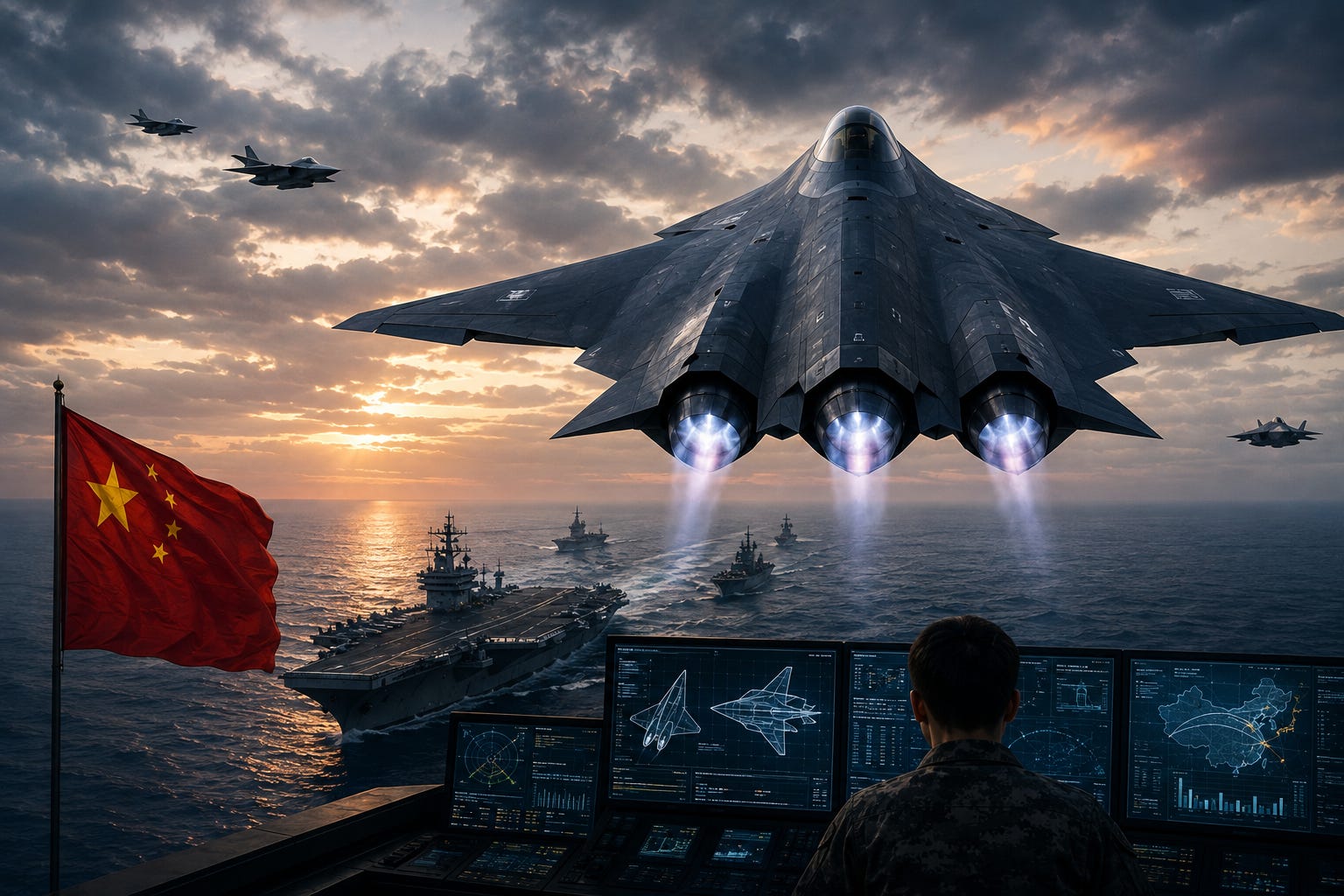
The Chinese and Russians will design a piece of equipment and keep working on it, creating several variants until they finally feel comfortable with a design and eventually move to it as the final candidate. That is above and beyond the fact that you may intentionally create variants for exclusive functions. Case in point, the J-35A, which has been adapted for the navy and the latest aircraft carrier, the Fujian. This model has folding wings, a catapult launch bar, and a reinforced structure so it can be catapulted and recovered. Needless to say, we also have a knockoff of the F-35, the F-35B, which has also been adapted for aircraft carrier operations.
So, let’s go over the latest news in July.
As of July 23 of this year, there was an official release of videos showing the test flight of the fifth variant (prototype) of what could be the follow-on successor to the J-20. This aircraft remains unnamed but would be part of the sixth generation of stealth aircraft. Some analysts are considering the possibility that this is a pre-production prototype.
Currently, the J-20 is being built at a faster rate than any other aircraft in the world, with an estimated production of 100 to 120 aircraft per year. It is also estimated that the current fleet has almost 500 aircraft in service.
The advent of this sixth-generation fighter and its progressive development only means that China is looking to fill the gap in its heavy, ultra-long-range fighters. Since 2024, three prototypes have flown: the first one flew in December 2024, the third prototype flew a year later in December 2025, and the fourth prototype flew 36 days later, in January 2026. So here we are, six months later, seeing the fifth, most improved version in flight. For some reason, there is no apparent test flight of version 2.
Design changes affect maneuverability, especially on delta-wing, tailless aircraft. So, you end up sacrificing one aspect for the other (maneuverability over radar cross-section reduction).
The real takeaway from the latest videos and articles is that this new aircraft may have integrated flight-control mechanisms in its wings, along with software that has permitted significant improvements in the maneuverability of this ultra-long-range fighter. The sheer size of this aircraft initially led analysts to believe it was a bomber rather than a fighter, but given the updated improvements, we can now assume it very well can be fielded as a fighter-bomber.
In this race toward sixth-generation stealth fighter-bombers, only two countries are envisioned to achieve the development of these aircraft before the middle of this century (2050). Europe and Russia are still in the early stages of planning, and since they still have prototypes that exhibit vertical stalls, it will limit the achievement of a completely stealth platform.
The highlights and significant impact of this latest prototype make the Chengdu sixth-generation fighter-bomber an innovator, as it will carry three engines, giving it a longer range as well as a larger radar system and higher capacity for weapons and ammunition. Based on current analysis, it could be expected to exceed a combat radius of 4,000 km.
These ranges and capacities make this aircraft a lone wolf capable of operations with little or no support over the South China Sea or the entire Pacific. This is something the U.S. must readjust to in the evaluation of a potential conflict in that part of the world.
Back to the timetables of development, they also provide a potentially expected delivery date, or fielding, in 2030, if not even sooner, given the guidance from Xi Jinping.
One of the greatest takeaways from all this has to do with China’s perception of this race toward stealth technology. The U.S. school of thought is mainly that stealth is only a component of total air warfare, giving an extra edge overall and not serving as the fulcrum of success. The Chinese, on the other hand, think that stealth technology is the fulcrum of success and, therefore, that more technology and more anti-stealth technology are the way to go.
Their quest to develop low-frequency radars, passive sensors, and other potential anti-stealth technologies may not be the way to solve the problem, since these systems have significant limitations and vulnerabilities.
China has a lot to worry about after Operation Sindoor (May 7, 2025) and Operation Absolute Resolve (Jan. 3, 2026). In both operations, serious deficiencies in the performance of radars made by China were detrimental to both Pakistan and the Maduro regime.
The U.S. raid in Caracas, which captured Nicolás Maduro, proved that the JY-227A mobile anti-stealth radars could not detect the F-22s and F-35s that pretty much controlled the skies. During Operation Sindoor, the HQ-9 and LY80 also had significant shortfalls. The PL-15E seeker also failed to achieve target lock, flew deep into Indian territory, and landed intact.
So, China is much more interested in getting it right with its sixth-generation fighter-bomber.
Regardless of the fact that little training, combined with inadequate maintenance support, could have caused the failures, this means that exporting equipment for sale without continuous Chinese support will not work to standard.
They are banking on time rather than quality review, and also on getting it fielded sooner and in large production numbers. They know the focus on the Middle East will go away one day and that their backyard (the South China Sea and the Pacific Rim) will be in the spotlight.
Needless to say, the continued enforcement of the Monroe Doctrine in the Western Hemisphere, where they have worked diligently for the last 50 years, makes force projection and long-range stealth capabilities crucial to defending their immediate area of interest and area of defense.
China’s sixth-generation fighter program demonstrates that Beijing is prioritizing rapid capability development over lengthy acquisition cycles. While recent operations suggest Chinese weapons systems still have important weaknesses, the pace of aircraft development remains strategically significant. The United States must continue leveraging its technological advantages while accelerating innovation and procurement to maintain air superiority in an increasingly competitive Indo-Pacific security environment.
Octavio Pérez, LTC, MI USA, Retired (AKA Deacon Octavio Michael Perez, St. Andrew Greek Orthodox Church). Pérez is a highly experienced U.S. Army intelligence officer with more than two decades of active-duty service and additional reserve assignments. He specialized in intelligence and Nuclear, Biological, and Chemical Warfare, commanding operations at Fort Leonard Wood and serving in the Republic of Korea. At the Defense Intelligence Agency, he focused on North Korean military analysis and responded to crises involving the Achille Lauro and TWA 847 incidents. Perez volunteered with the 1st Cavalry Division during Desert Shield/Storm and later served as Chief Intelligence Instructor at the U.S. Army School of the Americas, training Latin American officers in low-intensity conflict. His reserve career culminated at U.S. Southern Command as a strategic intelligence officer (J2 Ops).
The opinions expressed in this article are those of the author and do not necessarily reflect the views of the Miami Strategic Intelligence Institute (MSI²).
No posts
Comments
Nothing yet. Say the first thing.
Sign in to join the conversation.