
Right now, your 9-to-5 is asking you to do the work of 5 people while paying you as 1 emplouee. This generalization of skills is what happens when costs drop. But now, AI is accelerating that collapse faster than we’ve ever seen.
But, the market outside of your 9-to-5 didn’t get the memo. Out there, those same skills, when attached to a specific outcome, still command real money. We’re talking $20K–$48K/month for work you’re currently doing at $5K–$9K/month as a salaried generalist.
So, this post is going to cover 3 things:
Why your role is being compressed (and why your pay isn’t keeping up). Why the “safety” of your 9-to-5 is a lie you’re telling yourself. And what “weird jobs” are — the new wave of hybrid, outcome-based roles that are quietly replacing traditional job titles.
This shift is already happening right now and AI is only going to make it more obvious. I’d rather you understand it now, before it becomes mainstream and everyone’s competing for the same thing.
So let’s get into it!
The reason this feels so confusing is because all of these things are happening at the same time.
Costs are going down.
Coordination is cheaper
Execution is cheaper.
These 3 factors above are decreasing at an abnormally accelerated rate right now because of AI adoption and innovation. So companies have been responding by bundling roles together where one person does more. This is why your job feels like three jobs now. But your pay didn’t increase with that. Because you’re still being paid for a role, not for everything you actually do. This is also referred to today in pop culture as “quiet hiring”.
Here’s an example using a common job:
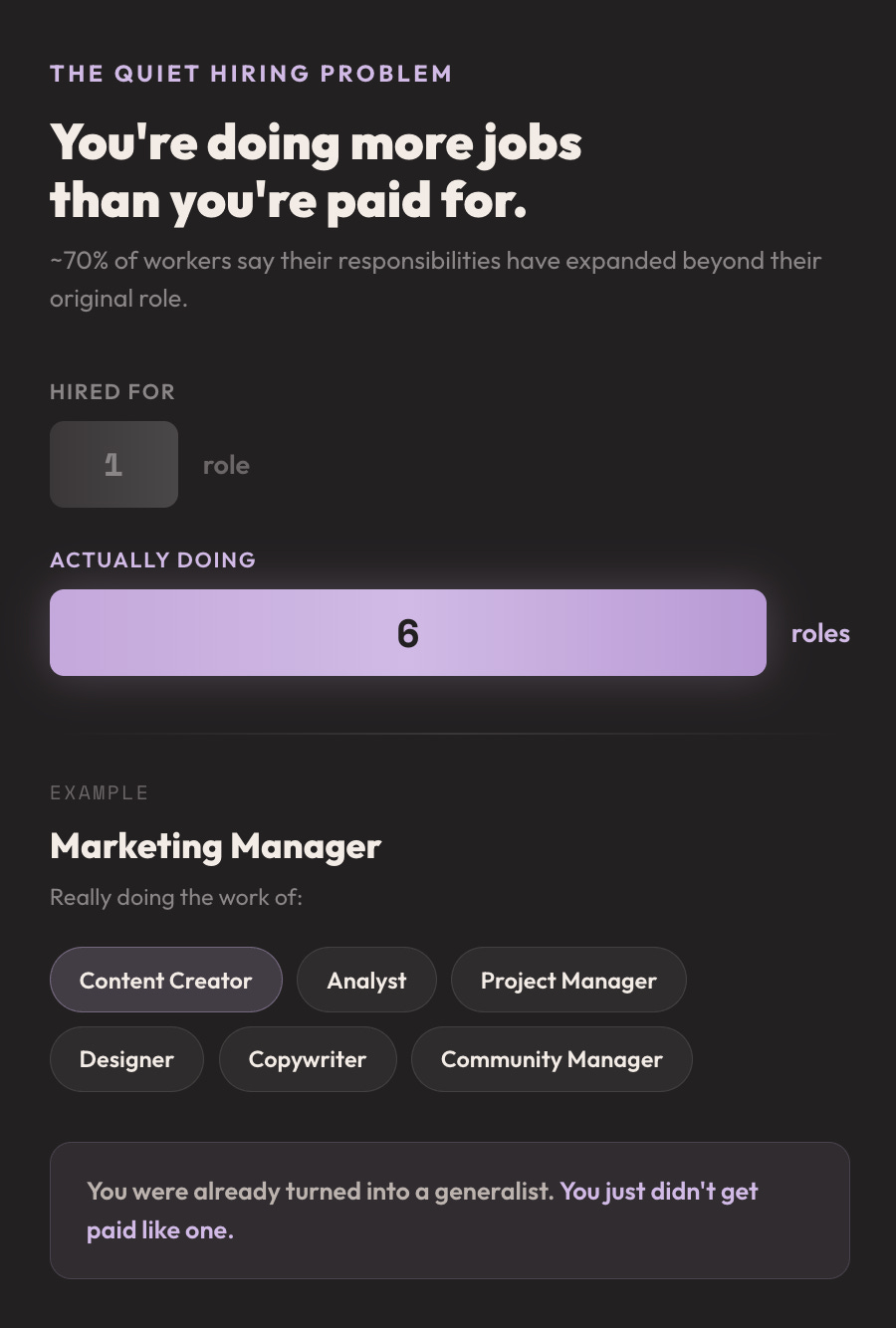
Here’s a breakdown of what you’d make if each function was paid separately:
Content Creator: $4,000 – $8,000/month
Analyst: $3,000 – $7,000/month
Project Manager: $4,000 – $9,000/month
Designer: $3,000 – $8,000/month
Copywriter: $4,000 – $10,000/month
Community Manager: $2,500 – $6,000/month
Total (if priced as projects/retainers):
→ $20,500 – $48,000/month
Here’s what you make as a Marketing Manager at a 9-5 instead:
→ $5,000 – $9,000/month
Therefore, at the same time, the market outside of 9-5 work didn’t change how it pays. This is because the market outside of 9-5s pays for outcomes rather than jobs.
TL;DR:
Inside your job, you’re a generalist and underpaid. Outside of the job, those same skills, when turned into a specific outcome, are valued more.
In my humble opinion, rooted in 3 years of commenting on work trends (and usually being right), this signals to me there is a huge new opportunity. But, it does require you to leave the 9-5 for good.
We’re going to start with objections right off the bat. In this moment, you’re probably thinking 2 things at the same time:
Staying in your 9–5 is safer than working for yourself
The job market has never been more unstable
And even though both of those feel true, they contradict each other.
Your 9-5 is not safer, and the traditional work market is unstable. We've even seen newer pop culture trends than the abovementioned “quiet hiring," such as “job hugging”. The entire point of “job hugging” is to label the new surge of employees clinging to their current roles, often despite dissatisfaction, due to fears of economic uncertainty, AI-driven layoffs, and a tougher hiring landscape. This definitely doesn’t signal safety at a traditional 40 hr/week salaried white-collar job.
This is because how you are expected to operate in your 9–5 today is extremely similar to someone who works for themselves… except you don’t get the financial upside or the autonomy that’s supposed to come with that.
At traditional crunchy 9-to-5s, you’re expected to:
jump between projects
figure things out without clear direction
pick up work outside your job description
adapt constantly
So observing these bullets above, I see most employees are already operating like a freelancer. While doing this generalization of work, still getting paid like an employee.
So, the TL;DR on this:
You were expected to become a generalist inside your 9-to-5, but you only got paid for one job.
You took on the risk profile of someone who works for themselves without getting the ROI of someone who works for themselves. While, at the same time, you’re staying in that structure because you were told it’s “safer.”
While also believing AI might wipe out your role, your industry, or your company entirely.
Additionally, due to the aggressive lowering of costs due to AI, we will see a rise in “weird jobs”. My aim is to get you to understand these new weird job opprtunities, before they become mainstream in the next few years. You do not want to wait to act until this becomes mainstream, because then your competition will be larger. What I am observing below, I predict will be adopted almost everywhere thanks to AI automation. So it’s important to act now.
To my first paragraph, when costs go down, employees tend to generalize more than specialize. This is an Adam Smith school of thought, but I’ll save the explanation on that here because I don’t want to bore you with the economics talk. I’d rather explain via your personal experience in corporate America rn. So we’ll start there and then the end of the Substack will be on what “weird jobs” are and where to find them.
By “weird” jobs, I mean new roles outside of the box we will continue to see as AI adoption creates new problems for humans to solve. Or, roles we will learn very quickly need to stay human and not be autamated. It’s a role that looks unconventional on paper, but is actually tied to a very real problem that needs to be solved. That’s why it doesn’t fit cleanly into something like marketing or operations. It usually sits in between multiple functions because the problem itself doesn’t belong to just one department.
Weird jobs are starting to show up more right now because the market is changing faster than job titles can keep up. AI is changing execution, competition online is increasing, and companies are running into new bottlenecks they didn’t have before. So instead of hiring a traditional role, they need someone who can move across domains and solve one very specific problem.
The difference is your current Bullshit job has you doing a little bit of everything with no clear output, while a weird job still uses multiple skills but is anchored to a specific outcome. AI can already do medocre work, so they won’t need a ton of Bullshits Jobs because if they wanted tasks or medocre work, they would just use AI. That’s why it translates outside the company. You can point to what you did, explain the result, and sell it again.
Weird jobs are manifestiong to the shift from
“What is your job?”
to:
“What have you built?”
This is where most people in corporate 9-to-5’s are still stuck and won’t understand nor identify this weird job opportunity.. Because they’re only asking:
What’s my next title?
What promotion should I aim for?
Which is the old way of thinking.
Additionally, I still see a lot of career media and career experts currently optimizing for the above questions. This is what grinds my personal gears in this career space. To stay ahead in the future, the goal is not the next job title or promotion to add to your LinkedIn profile.
Instead we should be optimizing for:
What can I create?
What can I show?
What problems can I solve repeatedly?
The overall shift I am describing is what turns your career into a portfolio to be able to get these weird jobs from AI disruption. The focus of a portfolio is not to quit your job overnight and become an entrepreneur tomorrow. It’s just the recalibration of how the new division of labor will play out.
We have to reverse engineer your career portfolio execution by examples like this:
A campaign you ran.
A system you built.
A client you helped.
A piece of content that performed.
So instead of wrungs on the laddder to aim for, it’s a acquiring more projects. This is because every project becomes a proof of skill. Which then helps in cultivating more projects because that proof of skill becomes something you can point to and sell again.
TL;DR:
Stop optimizing for job titles and instead start building projects you can show and sell for these new weird jobs. And yes, these projects will more than likely not be traditional 9-to-5’s.
First, I would not quit your job and go all in on something random. This is typically the biggest mistake people make as they go from one extreme to another. We do all not need to be Alex Hormozi’s to break out of the 9-to-5 strucutre. We don’t even need to be vibe coding for 120 hours a week for the hopes to get a VC firm’s attention. That jump has no nuance and most people don’t have the infrastructure for it.
I personally didn’t even do that. I just made content slowly on the side and then still to this day very slowly teach myself new content streams. Here’s what I would do:
Stop caring about my job title.
Completely.
Because outside of the 9-to-5 job listings, no one is reading your resume like that anymore. So, instead of anchoring on your title, I would start asking:
What am I actually good at across everything I’ve done?
Because you’re already operating as a generalist. Quiet hiring already did that to you as we already assesed. You’re doing multiple roles whether you realize it or not. Now, we just need to make that legible.
Research weird jobs
With the latter, I see a lot of roles still focused around creativity and strategy. These new weird jobs will be your skills and porjects you can repackage into freelancing/consulting/prodcut-based businesses for yourself.
hat I would do is start looking at roles that already reflect this shift. There’s a job board called Generalist Jobs. (This isn’t sponsored, I literally found it in a LinkedIn comment on one of my posts).
Here’s an example of post on there I find interesting:
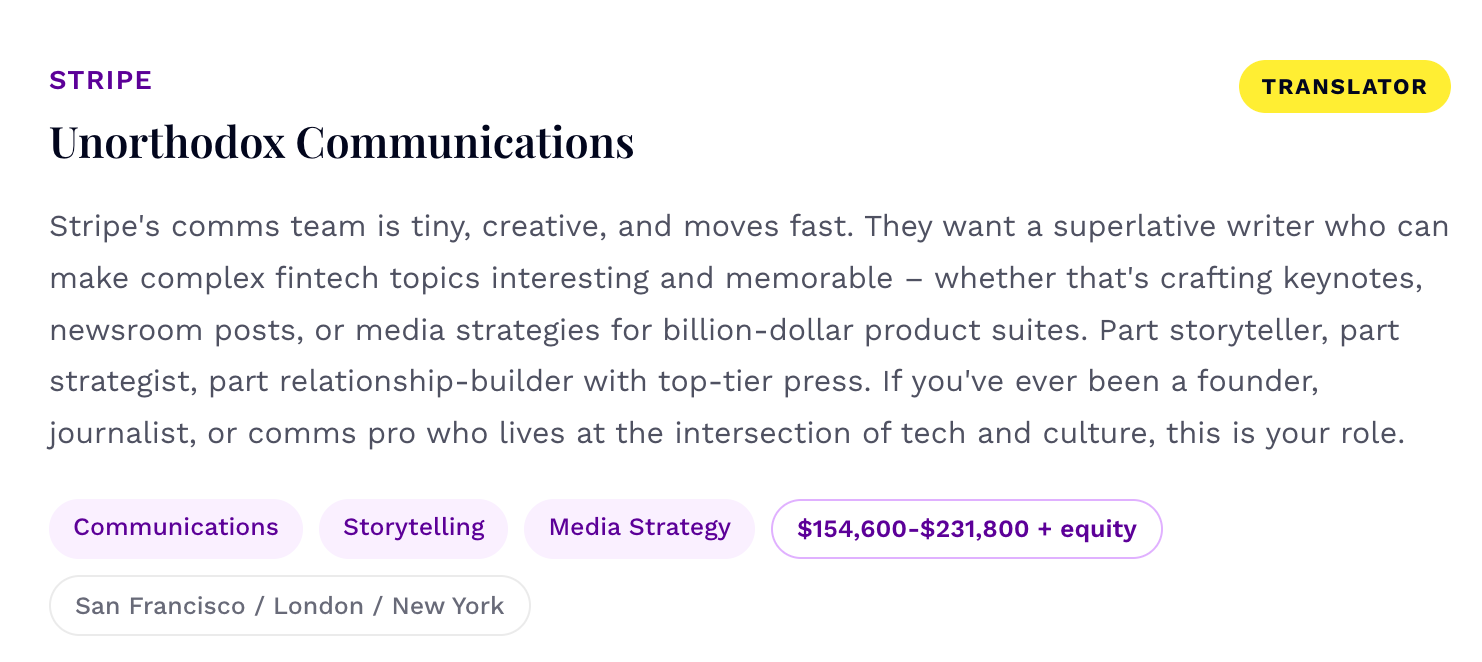
This role is a blend of content marketing and distrubution plus buiness development at real world events. I would imagine this weird role is occuring becuase in person events are increasing again becuase digital is getting more competitive due to everyon making content now. Additionally, at the same time digital is still really important so they need someone who’s able to flex back and forth into these two new domains. If I were someone looking to start this new Weird Job trend, I would work this weird for like 9-12 months. Then, through my experience, I would learn what huge new hurdles for humans are available in the B-2-B fintech world and find new opportunities to consult the rest of the market on my own terms. So then I own more of my career rathering then just renting my career forever at a job that’s making me be a generalist without any other ability.
Again, I would just be searching Genrealist Jobs as a brainstorming method at this stage.
Start identifying the projects
Then take your resume and put it into something like ChatGPT or Claude and start asking:
Based on my experience, what types of generalist or hybrid roles could I move into?
You can even feed it job descriptions from those boards so it understands the context.
The goal here is not to get one perfect answer with a job title, but instead to start seeing how your experience can be reframed.
Because the opportunity is taking what you already know how to do and repositioning it into something that’s actually valued in the market.
And from there, you can start moving toward work that looks less like a single job and more like:
retainer clients
project-based work
or hybrid roles that pay for outcomes, not just presence
Additionally, if this entire breakdown clicked for you and you’re realizing you’re already doing multiple jobs but only getting paid for one, this is acutally exactly what my new course is built for.
I’m going to show you how to:
break down what you’re actually doing at your job (not your title, the real work)
turn that into clear, outcome-based projects you can point to and sell
reposition your “generalist” skillset into something the market will actually pay for
identify which of those projects can become retainers or repeatable income
and start moving out of being paid for a role → to being paid for results
This course is not about quitting your job overnight or becoming some full-time entrepreneur tomorrow. So if that’s what’s most important to you, this course will not work for you. The Safe Exit Roadmap is about learning how to take the work you’re already doing and turn it into leverage.
If you want to be early to this shift before it becomes obvious to everyone else, join the waitlist for my course.
No posts
Comments
Nothing yet. Say the first thing.
Sign in to join the conversation.