
One of the joys of literature is that it is so easy to get top grades.
This is also a joy because what makes it easy is understanding the author’s ideas. These ideas are a kind of conversation, with you, the reader. If you just think of the text as a bunch of characters, telling a story, well, you aren’t studying literature. You’re watching a film. Only, it’s a film that takes ages. Maybe you prefer it because of the description, and because you get to know the characters better. That makes you a reader.
But you don’t become a student of literature unless you start to think about the author and their ideas. You become a great student of literature when you ask yourself this: what did the author think about the ideas in society at the time? How was the author in conversation with readers in their own time?
That’s now two separate conversations - one with you, and one with contemporary readers. Now you have shifting perspectives, likes and dislikes, arguments and counterarguments. Now you have strong opinions, or tentative opinions, and completely new ways of looking at life.
Now, you are a true student of English literature.
How easy is it to look at literature this way? Very easy. It is through vocabulary choice. Learn the right vocabulary which forces you to understand the author’s ideas.
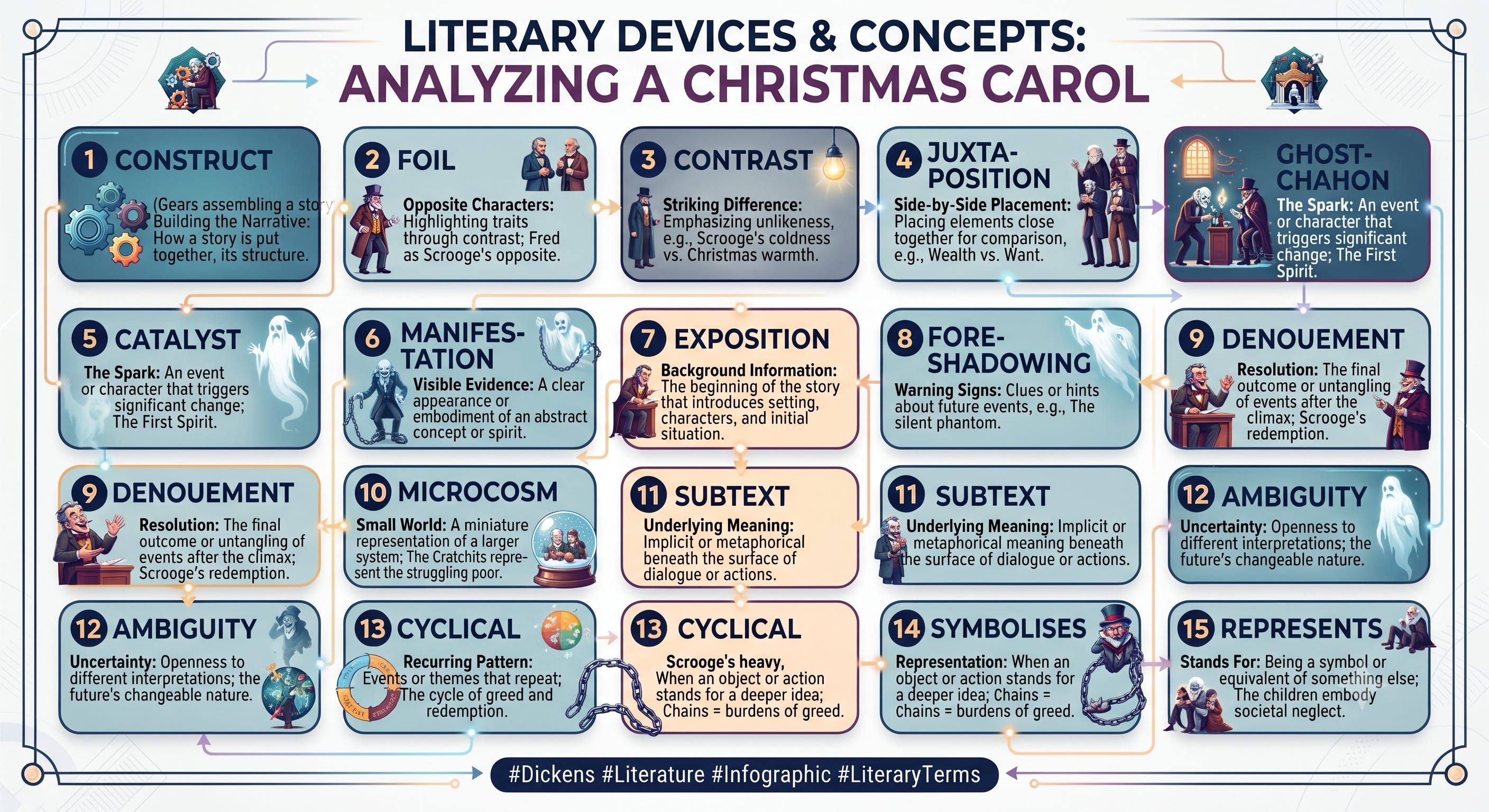
Here is a list:
Construct
Foil
Contrast
Juxtaposition
Catalyst
Manifestation
Exposition
Foreshadowing
Denoument
Microcosm
Subtext
Ambiguity
Cyclical
Symbolises
Represents
The character is not real; they are a tool used to represent an idea.
An Inspector Calls: “Inspector Goole is less a literal police officer and more a construct representing the collective conscience and socialist responsibility.”
Animal Farm: “Orwell uses Boxer not just as a horse, but as a construct for the exploited working class who are betrayed by the leaders they trust.”
Macbeth: “The Witches serve as constructs of the chaos and disorder that threaten the stability of the state.”
A character who contrasts with the main character to highlight specific traits.
Romeo & Juliet: “Mercutio’s cynical, bawdy view of love acts as a foil to Romeo’s intense, spiritual devotion, highlighting Romeo’s naivety.”
Dr Jekyll & Mr Hyde: “Dr. Lanyon, with his rational and orthodox approach to science, serves as a foil to Jekyll, emphasizing just how dangerous and mystical Jekyll’s experiments are.”
A Christmas Carol: “Scrooge’s nephew, Fred, is a foil to Scrooge; his warmth and generosity in Stave 1 accentuate Scrooge’s cold isolation.”
Banquo is the perfect foil because he is nearly identical to Macbeth at the start of the play. They are both brave Scottish generals; they both fight for the King; they both stand and listen to the Witches together.
The Contrast: When the Witches offer them a future, Macbeth becomes obsessed and secretive (“Stars hide your fires”). Banquo, however, remains skeptical and asks God to help him keep his allegiance clear (“In the great hand of God I stand”).
Analysis Sentence: “Shakespeare presents Banquo as a moral foil to Macbeth; because Banquo rejects the Witches’ temptation despite being promised a line of kings, he proves that Macbeth’s fall was a choice, not an inevitability.”
An Inspector Calls: Sheila vs. Mrs. Birling. Priestley uses the daughter to highlight the stubbornness of the mother.
The Contrast: Both women are confronted with their cruelty toward Eva Smith. Sheila instantly accepts the blame and shows remorse (“I know I’m to blame - and I’m desperately sorry”). Mrs. Birling, conversely, builds a wall of denial (“I accept no blame for it at all”).
Analysis Sentence: “Sheila serves as a foil to Mrs. Birling; her immediate capacity for guilt highlights the older generation’s callous refusal to accept their social responsibility.”
The thing that sparks that action or event.
An Inspector Calls: “The arrival of the Inspector acts as the catalyst that shatters the Birlings’ comfortable, complacent bubble.”
Lord of the Flies: “The discovery of the conch is the catalyst for the establishment of democracy on the island.”
Macbeth: “The Witches’ prophecy operates as the catalyst for Macbeth’s ambition, transforming a loyal soldier into a traitor.”
An abstract idea turning into a physical object or event.
Macbeth: “The floating dagger is a physical manifestation of Macbeth’s guilt and his fevered psychological state before the murder.”
A Christmas Carol: “The children ‘Ignorance and Want’ are the grotesque manifestations of society’s neglect of the poor.”
Dr Jekyll & Mr Hyde: “Hyde is not a separate person, but the physical manifestation of the repressed desires that Jekyll has hidden away.”
Thanks for reading Mr Salles Teaches English! This post is public so feel free to share it with someone who wants top grades.
The backstory or setting the scene.
Romeo & Juliet: “In the exposition (the Prologue), Shakespeare reveals the ending immediately, ensuring the audience focuses on the ‘how’ rather than the ‘what’.”
An Inspector Calls: “Priestley uses the exposition to establish Mr. Birling’s ignorance, having him confidently predict that the Titanic is ‘unsinkable’ and war is impossible.”
Animal Farm: “Old Major’s speech in the exposition lays out the theoretical utopia that will later be corrupted by Napoleon.”
✅ Paid subscribers get the vocabulary in the rest of the list, with examples.
✅ They also get a grade 9 essay using all this vocabulary. It is on A Christmas Carol and will answer 70% of every question you can possibly be asked on the novel.
✅ Paid subscribers get a grade 9 answer with my comments every week except the summer holidays, and access to the over 350+ already published. 🎓
✅ Substack thinks this is so good, that you can sample them free for a week. 👏
Placing two opposing things side by side for contrast.
Lord of the Flies: “Golding uses the juxtaposition of the beautiful, natural island against the ugly, violent actions of the boys to comment on the inherent darkness of man.”
A Christmas Carol: “Dickens employs juxtaposition by placing the warmth of Fezziwig’s party directly alongside the coldness of Scrooge’s counting house.”
Romeo & Juliet: “The play is built on the juxtaposition of love and violence, best seen when Romeo and Juliet marry while Tybalt and Mercutio prepare to kill each other.”
“Shakespeare uses juxtaposition to heighten dramatic irony, contrasting Duncan’s observation that the castle has a ‘pleasant seat’ and ‘delicate’ air against the audience’s knowledge of Lady Macbeth’s earlier demand to be filled with ‘direst cruelty’ inside those very walls.”
“Priestley shatters the family’s complacency through juxtaposition, clashing the ‘pink and intimate’ lighting of their celebratory dinner against the Inspector’s grotesque description of Eva Smith lying in the infirmary with her ‘burnt-out inside on a slab.’”
“Stevenson employs juxtaposition to manifest the duality of London, contrasting the ‘florid charms’ and ‘coquetry’ of the respectable street against the ‘blistered and distained’ door that breaks the pattern of wealth.”
“The novel’s tragic conclusion relies on visual juxtaposition; as the animals look from ‘pig to man, and from man to pig,’ the realization that it is ‘impossible to say which was which’ confirms the total corruption of their revolutionary ideals.”
Hints of what is to come.
An Inspector Calls: “Sheila’s half-playful warning to Gerald about him being absent (’you were distant last summer’) is foreshadowing the revelation of his affair.”
Macbeth: “The chaotic weather and the Witches’ chant ‘Fair is foul’ act as foreshadowing for the moral inversion that will plague Scotland.”
Animal Farm: “The pigs stealing the milk and apples early in the novella is clear foreshadowing that equality on the farm is a lie.”
The final resolution or unraveling.
Romeo & Juliet: “In the denouement, the Montague and Capulet parents build statues of their children, symbolizing that peace has been achieved but only through death.”
An Inspector Calls: “The play has a twist denouement: just as the family believes they are safe, the phone rings again, restarting the cycle of guilt.”
A Christmas Carol: “The denouement sees Scrooge not only buying the prize turkey but integrating himself into the Cratchit family, completing his redemption.”
A small version of the whole world.
Lord of the Flies: “The island is a microcosm of the wider world, which is also engaged in a nuclear war; the boys’ savagery mirrors the adults’ destruction.”
Animal Farm: “Manor Farm functions as a microcosm of Soviet Russia, with each animal representing a specific sector of society.”
An Inspector Calls: “ The Birling dining room is a microcosm of the Edwardian class system, sealed off from the harsh realities of the outside world.”
The hidden meaning underneath the dialogue.
Dr Jekyll & Mr Hyde: “The subtext of the conversation between Utterson and Enfield regarding the ‘Blackmail House’ hints at the Victorian fear of scandal and hidden vices.”
Macbeth: “When Lady Macbeth tells Macbeth to ‘leave all the rest to me,’ the subtext is that she questions his masculinity and ability to commit the crime.”
An Inspector Calls: “Mrs. Birling’s refusal to help Eva Smith contains a subtext of deep class prejudice; she judges the girl’s morals based entirely on her poverty.”
Open to more than one interpretation.
An Inspector Calls: “Priestley leaves the nature of the Inspector in ambiguity—is he a ghost, a time traveller, a representative of God, or a collective hallucination? It forces the audience to focus on the message, not the man.”
The previous example focused on the potion, but the real ambiguity is in Jekyll’s past. Stevenson never tells us exactly what Jekyll did that was so bad. He just calls them “undignified pleasures.”
The Ambiguity: Did he visit prostitutes? Gamble? Opium dens? Homosexuality? By leaving it blank, Stevenson makes the text a mirror for the reader’s own guilty conscience.
Analysis Sentence: “Stevenson maintains ambiguity regarding the specific nature of Jekyll’s ‘undignified pleasures,’ forcing the Victorian reader to project their own hidden sins onto the character rather than dismissing him as a specific type of criminal.”
2. Lord of the Flies: The “Rescue”
The previous example focused on the Beast, but the ending is the strongest example of structural ambiguity.
The Ambiguity: The boys are saved by a naval officer. On the surface, it’s a happy ending. However, the officer is driving a warship to fight in a global nuclear war. The boys are saved from their “microcosm” of violence only to be taken back to the “macrocosm” of violence. Are they actually safe?
Analysis Sentence: “Golding creates a crushing ambiguity in the final scene; while the boys are technically ‘rescued,’ the naval officer represents a world of nuclear war, suggesting they are simply trading a small island of savagery for a larger one.”
3. Macbeth: The Witches’ Power (Fate vs. Choice)
The Ambiguity: Do the Witches cause the future, or do they just see it? If they cause it, Macbeth is a victim. If they just see it, Macbeth is a villain who chose to make it happen. Shakespeare never confirms which is true.
Analysis Sentence: “Shakespeare uses ambiguity regarding the Witches’ actual power—whether they control fate or merely predict it—to prevent the audience from absolving Macbeth of his own ‘black and deep desires.’”
4. An Inspector Calls: The Inspector’s Nature
The Ambiguity: Is Inspector Goole a real police officer, a collective hallucination, or a supernatural “ghoul” (ghost)? The play provides evidence for all three but confirms none.
Analysis Sentence: “Priestley shrouds the Inspector’s true nature in ambiguity, ensuring that the Birlings (and the audience) cannot dismiss his message just because the man himself might be a fraud.”
5. A Christmas Carol: Dream vs. Reality
The Ambiguity: In Stave 1, Scrooge argues the ghost is just “a fragment of an underdone potato”—a hallucination caused by food poisoning. Dickens never explicitly proves the ghosts are “real” in the physical world.
Analysis Sentence: “Dickens utilizes ambiguity regarding the supernatural events—hinting they could be a dream caused by ‘indigestion’—to suggest that redemption is a psychological transformation as much as a spiritual one.”
6. Romeo & Juliet: The Source of the Feud
The Ambiguity: We are never told why the Capulets and Montagues are fighting. It is just an “ancient grudge.”
Analysis Sentence: “By treating the origin of the conflict with total ambiguity, Shakespeare removes any moral justification for the violence, presenting the feud as a mindless, self-perpetuating cycle of hate.”
7. Animal Farm: The Destruction of the Windmill
The Ambiguity: When the windmill falls down the first time, Napoleon says Snowball sabotaged it. The text hints it was just a storm. The animals are confused, and the reader is forced to see how easily history can be manipulated.
Analysis Sentence: “Orwell uses the ambiguity surrounding the windmill’s destruction to demonstrate how totalitarian regimes exploit uncertainty, replacing objective truth with convenient propaganda.”
Ending where it began; a repeating circle.
Animal Farm: “The structure of the novel is cyclic; the animals overthrow a tyrant (Jones) only to end up with a new tyrant (Napoleon) who wears clothes and walks on two legs.”
Macbeth: “The play is cyclic in its violence; it begins with a battle against a traitor (Thane of Cawdor) and ends with a battle against a traitor (Macbeth).”
An Inspector Calls: “The ending creates a cyclic structure; because the Birlings (mostly) failed to learn their lesson, the Inspector must return to interrogate them again.”
Although Dickens writes the novel as an entertainment, he wants the story of Scrooge’s moral awakening to MANIFEST as a CATALYST to “haunt” the reader, and so lead to a change in how his readers think about the poor. This essay will examine how Dickens SYMBOLISES his opposition to the Poor Laws, how he uses JUXTAPOSITION to CONTRAST the poor with the wealthy, and how the DENOUEMENT serves as a MICROCOSM for the redemption of society.
Dickens shows his opposition to The Poor Laws, which created “workhouses”, by making Scrooge support them: “Are they still in operation?”. Scrooge also supports the criminalisation of the poor, “Are there no prisons?” and believes these are necessary to “decrease the surplus population”. The SUBTEXT of these words refers to Thomas Malthus’s economic theory and the cruelty of social policy. Then, Dickens creates Tiny Tim as a FOIL to show us what “the surplus population” looks like. Dickens uses the AMBIGUITY of Tim’s impending death to transform Scrooge’s view.
Because only male property holders could vote, Dickens targets his book at them, pricing it at an expensive five shillings. Dickens invites these readers, who would employ domestic servants, into the warmth of the Cratchits’ family Christmas, so that they too can understand the social effects of low wages. On the way, Scrooge challenges the ghost for shutting bakers on a Sunday, which actually attacks the poor, and “deprive[s] them of their means of dining every seventh day”. Dickens uses CONTRAST between the harshness of society and the “hard and sharp as flint” Scrooge to point out that the miser is actually more generous than the reader who votes for such laws.
Cratchit’s daughter Martha, a domestic servant, has still had to “clear up” on Christmas morning for her thoughtless employers. Mrs Cratchit has tried to make old dresses appear more festive with “ribbons”; Peter wears a ridiculously out of fashion, second hand shirt, whose collar is so big it gets “into his mouth”. Only Bob and Tiny Tim have been to church, presumably because the rest of the family lack suitable clothing. Bob himself has no “greatcoat” and his best clothes are “threadbare”. Although this is a comic portrait, it is also a clue that the winter is a threat to health and a threat to their Christianity. Dickens FORESHADOWING here suggests that poverty is a threat to the family.
Dickens italicises the children’s excitement at the feast: “there’s such a goose,” and contrasts this with the goose’s meagre size. The starving family even eat the bones, so there is only an “atom of a bone” left. After witnessing this, Scrooge asks the Ghost “if Tiny Tim will live”. He won’t. So, Dickens challenges his readers to realise that the going rate of pay creates the working poor. Scrooge, like the reader, has simply supposed the poor are “idle people” who choose poverty because of defective character.
Scrooge’s transformation can happen right here, in Stave Three, where Scrooge decides he needs to save Tiny Tim. Dickens points this out when Scrooge becomes a “second father” to Tiny Tim. Dickens uses the final ghost to show the reader how wider society is affected by their poor pay. Those who earn less than Bob live in slums, where Dickens now takes us: “the whole quarter reeked with crime, with filth, and misery”.
Here we meet tradespeople Scrooge has employed. They have all stolen from the dead man’s room. They have “all three met here without meaning it!” because they are embarrassed at their crimes. They are surprisingly polite to each other, acting with “gallantry” to suggest that criminals are not evil, but driven to crime by poverty. Dickens’ lesson is that a significant amount of crime is caused by middle class indifference to the consequence of low wages. Even Fred has a live-in housekeeper who is still working on Christmas day. Dickens expects the reader to identify with the morally good “master” Fred and perhaps now to question their indifference.
This political message also explains the EXPOSITION of “Ignorance” and “Want”. Like the reader, Scrooge cannot see them, until he has started to transform. Dickens PERSONIFIES them as a boy and a girl. The Ghost of Christmas Present delivers Dickens’ warning, “but most of all beware this boy, for on his brow I see that written which is Doom, unless the writing be erased.” “Ignorance” REPRESENTS the poor being refused. This will result in unqualified, low paid workers, or unemployment, which will cause “doom”.
Therefore, Dickens ends with Scrooge raising Bob’s “salary”. So, this action becomes a clear signal to the reader to increase what they pay their employees. The final line, ending with “God bless us” is partly ironic. God isn’t going to help the poor, so we, like Scrooge, have to.
Comments
Nothing yet. Say the first thing.
Sign in to join the conversation.