
In this post I showed you how to write about the effect on the reader. I wrote the post for students who were taking my course Master Your English Language GCSE.

The student who wrote this piece kept getting stuck at 16/20 (which is still a grade 9). After reading my explanation, she scored 20/20 on her next question 4. That is today’s post.
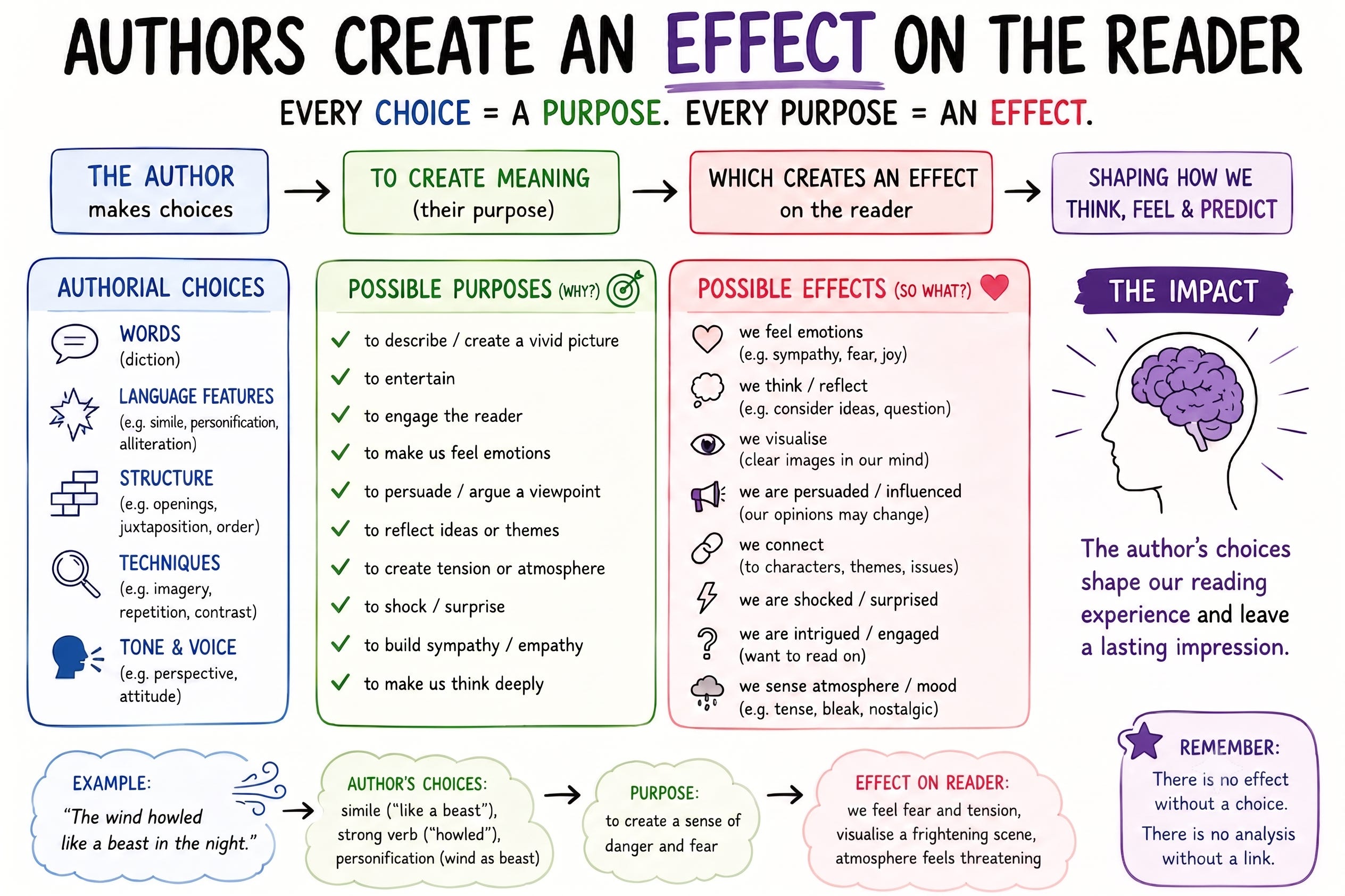
To get the most out of this post, read the student’s answer. For each numbered point, work out of there is an explanation of what the reader thinks, feels, or predicts.
Give each of those explanations 1 mark.
I strongly agree that the writer clearly presents the letters as significant. However, I partly disagree that the writer makes it predictable that Roland will steal the letters.
Through the complex sentence ‘half-looking, half reading’, the writer cleverly suggests that Roland is hesitant and unenthusiastic about carrying out the research involving this book for his employer, Professor Blackadder.
This immediately creates the impression that Roland may be idle and that the book fails to capture his attention. Consequently, his decision to steal the letters is rather unexpected for both the reader and Roland himself, as he has previously displayed considerable indifference towards the task.
The repetition of ‘half’, beginning with ‘half-there’, implies that Roland rarely commits fully to anything, highlighting his poor dedication and suggesting that he is more likely to abandon the task or leave it only partially completed rather than steal the letters.
Nevertheless, the letters are evidently important to Roland because he later ‘reads the letter again’, implying that the contents have awakened a genuine interest within him and that he is rereading it to gain a deeper understanding.
As a consequence, readers are led to believe that the letters must be remarkable because someone who is normally detached and uninterested in this type of work undergoes a noticeable transformation after discovering them.
I strongly agree that the writer clearly presents the letters as significant. However, I partly disagree that the writer makes it predictable that Roland will steal the letters. (Necessary introduction. Not an explanation).
Through the complex sentence ‘half-looking, half reading’, the writer cleverly suggests that Roland is hesitant and unenthusiastic about carrying out the research involving this book for his employer, Professor Blackadder. (1 mark) - feel
This immediately creates the impression that Roland may be idle and that the book fails to capture his attention. (1 mark) Consequently, his decision to steal the letters is rather unexpected for both the reader and Roland himself, as he has previously displayed considerable indifference towards the task. (1 mark) - predict
The repetition of ‘half’, beginning with ‘half-there’, implies that Roland rarely commits fully to anything, highlighting his poor dedication (1 mark) and suggesting that he is more likely to abandon the task or leave it only partially completed rather than steal the letters. (1 mark) - predict
Nevertheless, the letters are evidently important to Roland because he later ‘reads the letter again’, implying that the contents have awakened a genuine interest within him and that he is rereading it to gain a deeper understanding. (1 mark) - feel
As a consequence, readers are led to believe that the letters must be remarkable because someone who is normally detached and uninterested in this type of work undergoes a noticeable transformation after discovering them. (1 mark) - predict
Thanks for reading Mr Salles Teaches English! This post is public so feel free to share it with friends who want top grades.
There are a few things to pay attention to in the Points Make Prizes method.
The mark scheme does not specify 1 mark for each explanation. Instead it says this:
Shows perceptive and detailed evaluation:
Develops a convincing and critical understanding of ideas
Shows perceptive understanding of writer’s methods
Evaluates critically and in detail the impact of the writer’s ideas and methods on the reader
Selects a range of judicious textual detail
Every single word in bold is a judgement call. There are zero definitions of any of them in the mark scheme. Examiners are not given specific ways to decide on any of them. This is why 50% of English exam answers are given the wrong grade, according to Ofqual.
But there are two ways we can work out what is going on inside the examiner’s head as they mark. To find out how they make their gut reactions, I’ve done these two things:
I’ve read every single answer AQA has published from a senior examiner. They all conform to this pattern - the number of valid explanations is the number of marks given to the answer.
I’ve sat the exam twice and got remarked twice. Then I appealed any reading question where I scored less than 100%. The senior examiner’s written replies can be summarised like this: we do not agree with this explanation. This particular explanation is not a valid explanation. We don’t think you can infer that, we don’t like the explanation. You have made an inference from your knowledge of context, rather than from the language, so it is not a valid explanation. You get the idea. Every reason they had for not awarding a mark was about whether they agreed with an explanation. In other words, the examiner completely ignored the fact that explanations are not mentioned in the mark scheme.
Why? Because it is the number of valid explanations you write which helps the examiner decide if you are perceptive, if you have a range of references, if you are detailed, if you are convincing.
Sometimes you want to give more than one explanation for the same quote. Look at point 6 in the student’s answer - this is a second explanation for the quote in point 5. Many teachers believe this is the only kind of explanation that creates a detailed and perceptive response. It isn’t. Detailed means lots of explanations.
That said, if all your explanations are one quote/one explanation, your answer won’t be considered perceptive. So some of your explanations zoom in on individual words, to offer a second explanation for the same longer quote. Or, as in 6, you simply write a second explanation about the effect of the longer quote.
Out of the 20 explanations this student wrote, only 4 explanations were a second explanation for the same quote. That’s why I say ‘some’ need to be like this, not all.
✅ Paid subscribers get the rest of the answer with my comments.
✅ Paid subscribers get a grade 9 answer with my comments every week except the summer holidays, and access to the over 350+ already published. 🎓
✅ Substack thinks this is so good, that you can sample them free for a week. 👏
Conversely, the writer does make it seem less surprising that Roland will steal the letters when the extract states, “He enjoyed possessing this knowledge on his own.” This suggests to readers that Roland is selfish and that this possessive tendency will later be reflected in his theft. (1 mark) - think and predict.
Roland’s reluctance to inform Professor Blackadder about his discovery indicates that he is not motivated entirely by professional responsibilities but is also driven by personal ambitions. (1 mark) - think.
This encourages the reader to believe that Roland will steal the letters because he appears to be pursuing a hidden and potentially more important purpose, making his later actions seem more understandable and foreseeable. (1 mark) - think.
In contrast, the writer effectively shifts attention around Roland: “The clock ticked, specks of dust danced in sunlight, Roland meditated.” The movement from the clock to the dust and then to Roland suggests that he is so disengaged from the book that his attention drifts towards other thoughts and trivial details such as a ‘speck of dust’. (1 mark) - feel.
Alongside his wandering focus, readers may also feel that Roland is involved in a ‘bewitching’ and dangerous journey through the ‘tiresome endlessness of the quest for knowledge’. (0 marks) No think, feel or predict, no explanation.
This makes his later decision to steal the letters more surprising because of the dramatic change in attitude from aimlessly observing the room to being consumed by questions fuelled by curiosity. (1 mark) - think and feel.
Furthermore, when Roland opens the letter ‘delicately’, he examines it with great care, noticing the handwriting, describing it as ‘flowing’, and observing the address. The adverb ‘delicately’ highlights the depth of Roland’s fascination. (1 mark) - feel. The letters have captured his attention because they appear to contain something valuable, as shown by the care with which he handles them compared with his earlier ‘haphazardly’ approach. (1 mark) - feel and predict.
Through the repeated use of rhetorical questions, the writer makes it unmistakably clear that the letters have sparked Roland’s curiosity because he now wishes to broaden his knowledge rather than merely continue the original search. (1 mark) - think and feel.
Therefore, readers become convinced that Roland has uncovered something extraordinary within the letters because he is eager to continue what was previously described as a ‘bewitching’ pursuit. (1 mark) - think and feel.
When Roland is ‘seized’ by an impulse, the use of this forceful verb foreshadows the later moment when Roland ‘slips’ the letters away. (1 mark) - think and predict. Alternatively, the aggressive verb suggests that stealing the letters has become unavoidable, as though he has been trapped by the temptation. (1 mark) - feel.
The hunger Roland had previously noticed — “faint constriction of his belly” — disappears after reading the letters; “He had forgotten about his lunch”. This implies that the letters are almost supernatural in their power, captivating Roland so completely that even someone portrayed as ‘greedy’ forgets about food. (1 mark) - feel
Therefore, the reader is encouraged to view the letters as highly significant, meaning that Roland’s decision to steal them becomes less surprising. (1 mark) - think and predict.
In conclusion, after considering both sides of the statement, I strongly agree that the letters are special and disagree to some extent that the writer makes it surprising that Roland later steals the letters.
20 marks.
You’ll notice she numbered her explanations to try to get to 20.
The examiner did not mark her down for this, but did comment that it was strange, and suggested that she did not do this in the actual exam.
I numbered my explanations like this when I sat the exam in June 2025. This annoyed the examiners, who marked me down.
When I sat the exam in November 2025, I still wrote exactly like this - writing as many explanations as I could. But I didn’t put them on separate lines or number them, which meant I couldn’t be sure how many I had written. The examiner loved this. I got very high marks on each question, even though I didn’t write enough explanations (because I didn’t have time to reread my answers and count them).
But my marks were never higher than the number of explanations I wrote. Points Make Prizes.
I strongly agree that the writer clearly presents the letters as significant. However, I partly disagree that the writer makes it predictable that Roland will steal the letters. (Necessary introduction. Not an explanation).
Through the complex sentence ‘half-looking, half reading’, the writer cleverly suggests that Roland is hesitant and unenthusiastic about carrying out the research involving this book for his employer, Professor Blackadder. (1 mark) - feel
This immediately creates the impression that Roland may be idle and that the book fails to capture his attention. (1 mark) Consequently, his decision to steal the letters is rather unexpected for both the reader and Roland himself, as he has previously displayed considerable indifference towards the task. (1 mark) - predict
The repetition of ‘half’, beginning with ‘half-there’, implies that Roland rarely commits fully to anything, highlighting his poor dedication (1 mark) and suggesting that he is more likely to abandon the task or leave it only partially completed rather than steal the letters. (1 mark) - predict
Nevertheless, the letters are evidently important to Roland because he later ‘reads the letter again’, implying that the contents have awakened a genuine interest within him and that he is rereading it to gain a deeper understanding. (1 mark) - feel
As a consequence, readers are led to believe that the letters must be remarkable because someone who is normally detached and uninterested in this type of work undergoes a noticeable transformation after discovering them. (1 mark) - predict
Conversely, the writer does make it seem less surprising that Roland will steal the letters when the extract states, “He enjoyed possessing this knowledge on his own.” This suggests to readers that Roland is selfish and that this possessive tendency will later be reflected in his theft. (1 mark) - predict
Roland’s reluctance to inform Professor Blackadder about his discovery indicates that he is not motivated entirely by professional responsibilities but is also driven by personal ambitions. (1 mark) - think
This encourages the reader to believe that Roland will steal the letters because he appears to be pursuing a hidden and potentially more important purpose, making his later actions seem more understandable and foreseeable. (1 mark) - predict
In contrast, the writer effectively shifts attention around Roland: “The clock ticked, specks of dust danced in sunlight, Roland meditated.” The movement from the clock to the dust and then to Roland suggests that he is so disengaged from the book that his attention drifts towards other thoughts and trivial details such as a ‘speck of dust’. (1 mark) - feel
Alongside his wandering focus, readers may also feel that Roland is involved in a ‘bewitching’ and dangerous journey through the ‘tiresome endlessness of the quest for knowledge’.
This makes his later decision to steal the letters more surprising because of the dramatic change in attitude from aimlessly observing the room to being consumed by questions fuelled by curiosity. (1 mark) - think
Furthermore, when Roland opens the letter ‘delicately’, he examines it with great care, noticing the handwriting, describing it as ‘flowing’, and observing the address. The adverb ‘delicately’ highlights the depth of Roland’s fascination. (1 mark) The letters have captured his attention because they appear to contain something valuable, as shown by the care with which he handles them compared with his earlier ‘haphazardly’ approach. (1 mark) - think
Through the repeated use of rhetorical questions, the writer makes it unmistakably clear that the letters have sparked Roland’s curiosity because he now wishes to broaden his knowledge rather than merely continue the original search. (1 mark) - think
Therefore, readers become convinced that Roland has uncovered something extraordinary within the letters because he is eager to continue what was previously described as a ‘bewitching’ pursuit. (1 mark) - predict
When Roland is ‘seized’ by an impulse, the use of this forceful verb foreshadows the later moment when Roland ‘slips’ the letters away. Alternatively, the aggressive verb suggests that stealing the letters has become unavoidable, as though he has been trapped by the temptation. (1 mark) - think
The hunger Roland had previously noticed — “faint constriction of his belly” — disappears after reading the letters; “He had forgotten about his lunch”. This implies that the letters are almost supernatural in their power, captivating Roland so completely that even someone portrayed as ‘greedy’ forgets about food. (1 mark) - feel
Therefore, the reader is encouraged to view the letters as highly significant, meaning that Roland’s decision to steal them becomes less surprising. (1 mark) - think
In conclusion, after considering both sides of the statement, I strongly agree that the letters are special and disagree to some extent that the writer makes it surprising that Roland later steals the letters. (A necessary conclusion, but not a new explanation).
I count 19 explanations, so the Points Make Prizes method would give this 19 marks.
A one mark difference with the senior examiner is pretty damn accurate. Remember, examiners give an answer the wrong grade 50% of the time.
Three further takeaways:
Notice that each explanation is what we think, feel, or predict. And notice how often this student makes a prediction.
The Senior Examiner asked this student not to number her points like this, and to write in normal paragraphs. She thought examiners might find this layout too strange. This is exactly what I had to do when I took the exam in November.
The first 4 marks are earned by looking at a longer quote and then zooming in on individual words. This is the only time that happens. Students are taught that most of their analysis has to look like that to get top grades. As you can see, that is not true. You have to do it one or two times. For the rest of the time you can just write one explanation about one quote. If you can add more than one, do. But if you can’t, move on to the next quote.
Comments
Nothing yet. Say the first thing.
Sign in to join the conversation.