
Text within this block will maintain its original spacing when published
        Kelly was relaxing when she heard someone turning the doorknob.
        “Who’s there?” Kelly asked nervously.
        “It’s someone with a name spelled M-O-M,” said the person at the door. “And maybe to be helpful, you could open the door. My hands are full.”
        Kelly nodded to herself and opened the door.
        When her mother came in, she set down a large bag.
        “What did you bring us?”
        “Well,” said her mother, “a brand new color TV.”
        Kelly glanced at her old TV. It seemed really old compared to the new one.
        “Mom, will you set it up?” asked Kelly.
        “O.K., Kelly. Tomorrow,” her mom told her.
        The next day after school, her friend Stacy came over.
        “Wanna see my new TV?” asked Kelly.
        “Sure,” said Stacy.
        “My mom set it up last night,” Kelly told her.
        “Well, time to turn it on!” cried Stacy happily.
        “O.K. I’ll…” Kelly said.
        “Wait,” said Stacy. “Shouldn’t you read the directions?”
        “Nah,” said Kelly. “It’s just a simple TV.” She turned on the TV. Nothing happened.
        “Try a different channel!” said a voice.
        Kelly turned around. It was her older sister, Marti.
        “Try channel 78!” said Marti. “Or else I’ll pound you!”
        “O.K.” said Kelly. She hit the channel changers. Channel 78 was a 12-year-old’s channel. Just what Marti needed. A whole channel all to tell her how to pound younger sisters.
        Marti sat down and stared.
        Stacy tried changing the channel, but the remote control didn’t work. Kelly sighed. She’d never get to watch the TV.
        Kelly and Stacy waited and waited until they couldn’t stand it anymore.
        “Marti, if you don’t let us watch, I’ll tell Mom!” said Kelly. She looked at Marti.
        “Uh, Kelly? Marti doesn’t seem to be living. I think she’s dead,” cried Stacy.
        She looked at the TV. It had teeth, and the antennae had eyes. It almost looked like Marti.
        “Where are those instructions?” asked Stacy. She looked in Marti’s hands. The directions were ripped all up.
        “What do we do now?” asked Kelly.
        “Maybe become my lunch!” laughed the TV. “Kelly, Stacy, did you learn your lesson?”
        “What lesson?” asked Kelly.
        “You mean there was a lesson to learn?” asked Stacy.
        “Not to let someone boss you around?” the TV laughed wickedly. The TV’s arms were plugs. He pulled Stacy over and swallowed her whole. Stacy appeared on the TV screen. She was pounding.
        “Two down, one to go,” said the TV.
        Kelly glared at the torn instructions. She saw a pretty big piece. She picked it up. It read: TO STOP DEMON USE STOPPED PAST. Kelly didn’t understand.
        “Now,” said the demon, “to send you and Stacy back in time!” He zapped them with one of his arms. First, Stacy disappeared out of the TV. Then Kelly disappeared.
        Kelly saw it was the night before, when her mother brought the TV home. Kelly and Stacy saw many different scenes from the past. Suddenly, they stopped.
        “Kelly, where are we?” asked Stacy. Then there was a rustling sound. Kelly saw a bird.
        “This looks like a Dodo bird,” said Kelly.
        “Then we must be in Madagascar in the 1800s!” they both cried shakily.
        “That Dodo’s been dead for almost 200 years,” said Stacy, shaking her head.
        “Yep,” said Kelly.
        “If this is Madagascar, then that means there are lemurs, eek!” said Stacy. She was afraid of lemurs.
        Kelly continued to pet the Dodo.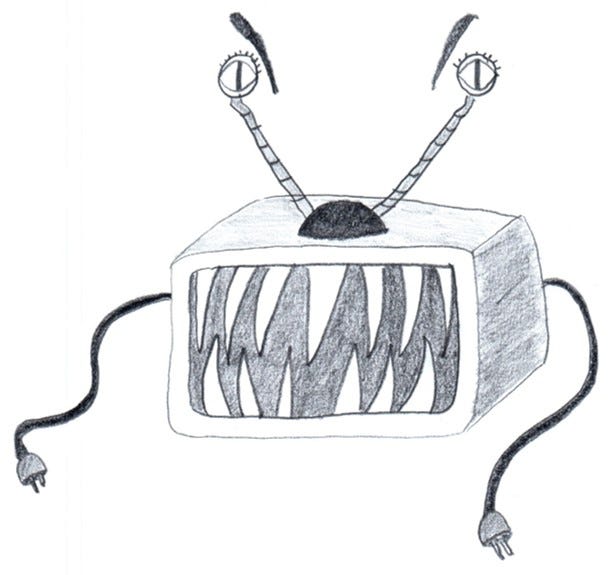
Please accept my sincerest apologies for leaving you hanging there. How—or, should I say, whether—Kelly and Stacy survive from there will have to be a mystery.
It wasn’t a mystery to the real Kelly who sat next to the author of that passage in Miss Viglione’s third-grade class. The writer behind that straightforward prose and realistic dialogue had a crush on the real Kelly, and in his nine-year-old brain, the path into her one-month-older heart was to write her an original story.
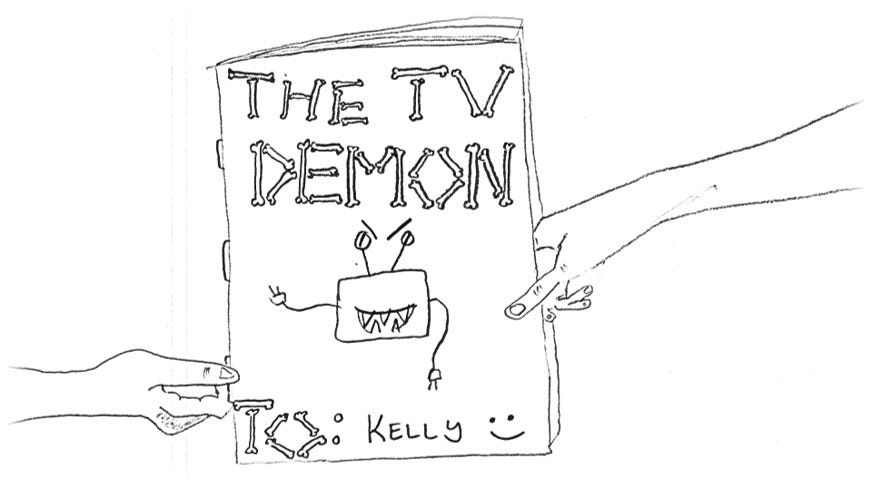
“The TV Demon” was the result of two weeks’ feverish crafting. The story began as a pencil-produced rough draft on tri-lined paper. Drawing on all the eclectic things he knew—obscure animals, YA mystery novels, his and Kelly’s elementary school classmates—he wrote a stirring story that raced through epochs, fandoms, and settings to engineer *SPOILERS* the titular heroine’s heroic escape. After finishing that draft, he carefully proofread it, typed it up on the new family computer his father had installed to keep up with work on weekends, and then pressed print. With his mother’s help, he stapled it together, drew a very menacing monster on the cover, and handed it to the object of his pint-sized desire.
After two weeks of blunt hype for “The TV Demon”, there was no chance it could match anyone’s expectations. Kelly received it graciously and called it “Fun”, downplaying what was assuredly life-affirming validation to have centered such a profound work of fiction, but you’ll be surprised to learn that she didn’t marry the author like you might have thought. He was at her wedding, though, and they both became math teachers who completed their credential program together, which is basically just as good.
Did “The TV Demon” facilitate that connection? Probably not. Much as that nine-year-old’s heart wanted it to be the sort of gift to end up on a mantle someday, such was not to be. Perhaps if he had considered writing it about Kelly’s interests instead of his own, it could have kindled adolescent affection, but alas, he was an early believer in the “write what you know” maxim. His goofy proto-fan fiction merely amused his crush. So it goes.
While the story became no catalyst for romance, it did inspire other projects following similar formulas. For someone’s birthday—probably Matt’s—the young author typed out an abridged encyclopedia of important dinosaurs. Despite his chosen 18-point font extending to dozens of pages, the author insisted on printing it out and wrapping it up for delivery by the relevant birthday party, so that Matt could thoroughly grow his awareness of dead giant lizards.
Perhaps his greatest achievement, though, was a short story collection written at ten. Modeled after the special edition Tales to Give You Goosebumps anthologies he loved so much, the young writer penned the not-at-all-derivative Ten Tales to Freak You Out that featured eight original stories alongside two classics: a remastered edition of “The TV Demon” and “Who’s Been Writing This?”, his award-winning story from a school contest.
The influence of said collection can be seen throughout popular culture in the decades that followed. Eleven years before Studio Ghibli produced Ponyo, our young author had one narrator, Kirsten, turn into a shark to hunt victims at a water park, and another, Travese, victimized by an aquatic curse to become a goldfish. And where else might you have seen a story in which the apparent protagonists turn out to be…GASP…the monsters? I mean, if you ignore The Twilight Zone, Goosebumps, and a few notable films, nobody else was that daring. Nobody. The kid was a pioneer.
But, like his previous works, Ten Tales to Freak You Out would not be confined to the Corel WordPerfect application in which he typed it. Much to the chagrin of his paper-and-ink-buying parents, the precocious writer printed copies of his anthology as gifts for his friends. Although the originals surely found their way—accidentally, I’m sure—into recycle bins and community shreds, one copy of that collection remains. Preventing it from becoming priceless lost media is a single, one-sided version bound inside a defunct Campbell’s Soup Salaried Employee Handbook binder.
Opening that thing up, the lucky reader will find the original cover art reproduced in crisp black-and-white. Between the author’s name and the collection’s title in a creepy font consisting of bones, there sits a pair of globes with two distinct ghost designs affixed in the foreground. The professional polish of that layered clip art reinforces how proud the young author was of having written those stories.
Hard though it might be to believe, what makes those stories special isn’t the stories themselves. Sure, they’ve aged well—there’s even a content advisory on page one warning readers that the book “WILL FREAK YOU OUT!”—but their author would later develop sharper skills to tell trickier tales that didn’t end with obligatory twists. What makes them special is how inextricable they are from their purpose: giving them away. The young writer we spotlight disdained fan service, but he did fill those stories with the names of the people he wrote them for. His old friends star in earlier works, while newfound SoCal chums populate the later entries.
From the very start, he wrote to hand his writing off. Although the sheer thrill of storytelling thoroughly motivated him, his objective was to pass them in physical form to the special people in his life. While he wanted Kelly to like him, the others carried no ulterior motive. They were homemade gifts straight from his creative, horror-adjacent heart.
There was no thrill greater than turning his projects into homemade gifts for someone he loved.
*****
Revelation forthcoming. I advise you to sit down for this.
That young author was me.
I’m a regular M. Night Shyamalan, I know. You couldn’t possibly have seen that coming. An early master of the twist ending never loses his touch, let me tell you.
But the funny thing is…he kinda did, which is to say, I did. Although I was still conjuring stories and brainstorming book titles into middle school, I stopped writing in eighth grade. During seventh-grade Humanities, I wrote a horror story that culminated in a twist about—no joke—the California governor’s race…and then I stopped writing for pleasure entirely. School and baseball took over my free time, and then I got a job, which filled in all the rest. Given downtime, I played video games, which I had for years before, but never at the expense of website building or story crafting. Something was bound to get squeezed out, though, and that something was extracurricular creativity.
Another thing got squeezed out, too: friendships. Sure, there were countless people I could and did talk to during school, some dating back to kindergarten and others to more recent courses, but when school ended, there were fewer. Matt and I attended different schools, pausing our closeness, and what had once been bi-weekly hangouts with Joey became quarterly. High school was a time when I saw and knew a lot of people, but I spent almost no time with them beyond the bells. In the moment, I would have insisted I had tons of friends, but by modern, mature definitions, I could argue I had almost none.
On Tuesday, July 8, 2003, that began to change. Cristina, a classmate from school, invited me to join an online writing platform she belonged to. Excited to be included in anything, I joined immediately, and one night later, I made my first public post.
Within weeks, writing became a central pillar of life again. I wasn’t writing creatively there at all, but I was writing, and almost every day. But the magical part was the sense of community that accompanied that writing. When I wrote something, people responded. People I knew and worked on projects with in school, as well as many others I barely knew beyond their names on a class roster.
I’ve written better pieces about the friendships that grew out of Cristina’s platform, so I won’t repeat myself, but the change in me was profound. I felt connected to these people because they knew a different, truer side of me than I showed at school—and I knew the same about them. When I wrote, I thought of it as them receiving my words with a similar excitement to what I’d felt as a kid with my wannabe Goosebumps stories. I didn’t understand how to get people to like me out loud, in the real world, but with words on a screen, it just happened. Magically.
In theory, this was a salve to the rash of loneliness I’d been scratching at for years. Knowing that they were out there, receiving my words, felt like proof of a meaningful connection. The comments they left, the AIM conversations they started—those were digital artifacts, but they were weighty objects in my heart. I believed in them.
Others in my life did not. To them, online interaction was more like a video game than genuine friendship. And I wanted to argue with them, but I’ve always been prone to doubting myself, and all signs pointed to me being in the wrong. As the years passed, those people faded further and further away, abandoning the platforms I continued to haunt. It made sense because their real lives demanded too much time to indulge in writing online, which insisted to me that the very world that had sparked my heart was little more than fiction.
I stopped writing in the fall of 2017.
Writing meant little when it was all in my head.
*****
Over dinner last night, I watched two videos.
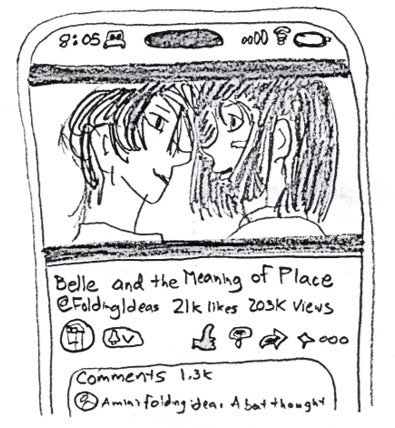
One was a baseball trivia show, the likes of which I regularly use to pass the time. The other was a short slice of film criticism by Dan Olson of the channel Folding Ideas.
Olson’s video focused on a 2021 film, Belle, which I haven’t seen at writing. His video orbited the concept of place as it pertains to fiction, and it moved me to tears. That an essay about a movie I’ve never heard of can stoke such feeling is a testament to Olson’s skill, but also a lovely reminder that something intensely specific to one person’s life—in this case, Belle and Olson’s trip to Japan—can resonate with others.
Set that aside, though. My favorite part of the video comes in its final minute. Because Belle bounces between hyper-real Kochi and an imagined visualization of the Internet, Olson concludes his essay by discussing realness as it pertains to him as an online creator and community member.
“YouTube is fake,” Olson says. “You can’t actually go to YouTube in the way that you can go to the Joker stairs. But it is real in that there are people on the other end of the tube, and those interactions are as potent and meaningful as the ones that happen between people who just happen to be in the same room.”
A part of me heard Olson’s words and felt his heart leap. Olson’s assertion validated what I’d felt long ago: that the friendships I developed online were real. Seeing video of the narrator hanging out with his peers provided a persuasive subtext: these were buddies he knew well enough through a digital platform to roar with laughter together on the other side of the world.
Despite that injection of warmth, the other part of me scoffed. How easy it was for Olson to claim realness from the cozy confines of cabin-bound camaraderie! There’s no insecurity for him when he’s got video evidence of his friendships’ authenticity. It’s trivial to be certain you’ve shut the garage door when you’re staring at it, completely closed, from inches away. There’s no doubt.
Through my begrudging tears, I found myself a little peeved at Olson. Before that point, I was deep into an essay about the intersection of a Taylor Swift song and the 2002 horror movie The Ring, a piece that was, ultimately, about ignoring the cries of my childhood self. After three days of writing, I had arrived at a profound sadness because, in the terrifying silence of summer, I felt incredibly alone.
As luck would have it, though, while reflecting on Olson’s video, I passed an envelope sitting on my sofa.
The night before, I had walked out to my mailbox well after my intended bedtime. All the lights in my house were off, and I was in my pajamas, a sheet already pulled up to my chin, but I threw all that aside to slide into flip flops and shuffle across a road still stained by firework scorch marks because I remembered that identical envelopes had been arriving elsewhere from Australia.
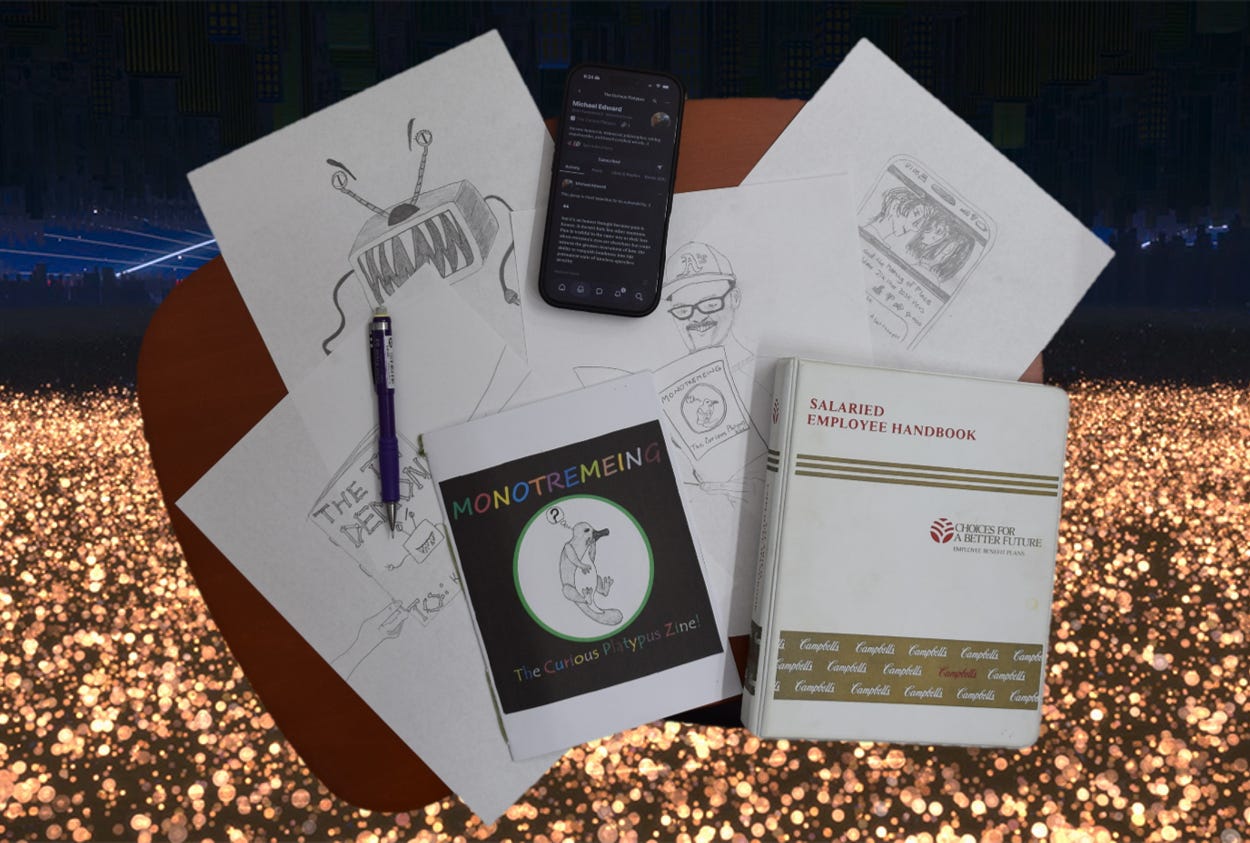
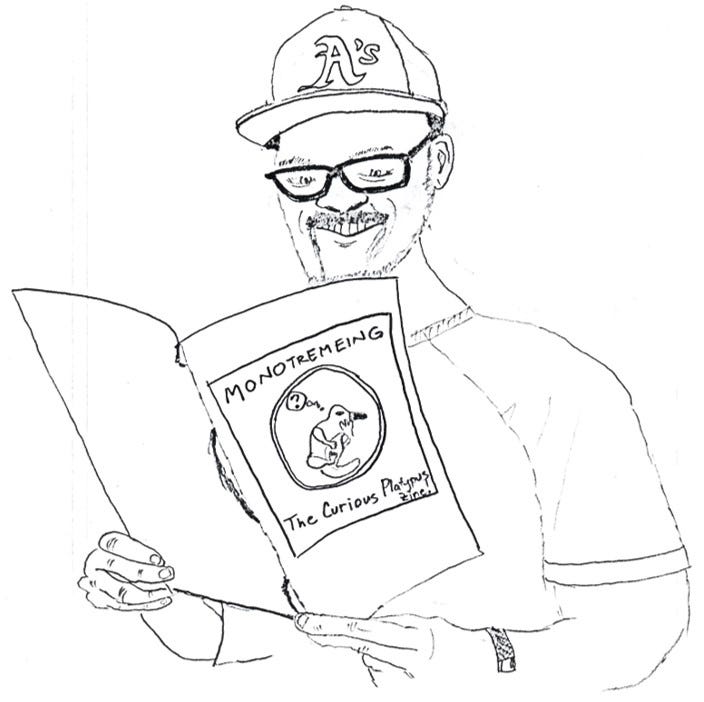
In that envelope was a zine produced by Michael Edward, aka The Curious Platypus. Hand-bound and packed with illustrations, jokes, and an original piece about an inspiring alien from The Simpsons, the zine beckoned, but I made myself wait until the next morning to read it. My one concession: I read the handwritten card from Michael that fell out with the booklet and some stickers.
“He writes in all caps, too!” I texted a friend, with the card still in my hand. I was that excited to hold what Michael had produced and sent from halfway across the globe.
When I first read through his zine, I’d been delighted, obviously, but I hadn’t processed why. Michael’s essay is whimsical and optimistic, his illustrations packed with personality, and his hopes for those stickers playful. I love the “Vintage Jeans” aesthetic of homemade things, so the hand-tied spine put a smile on my face, and the entire project felt lovingly crafted. The thing was an instant spirit lifter, an energy drink for my emotions.
Still, it took me an embarrassingly long time to connect the dots between my thoughts. The first thing that came to mind was how Michael’s zine reminded me of “The TV Demon” and its contemporaries. Even though Michael’s essay “Twirling Towards Freedom” narrowly1 bests “Invasion of the Lungpires from Atlantis” on literary merit, there’s the same generous spirit behind them. The zine oozes thoughtfulness and heart, as everything Michael writes does, but I could hold the thing in my hands and touch the ink on his card. It hits different when something’s actually there. My writing at nine couldn’t resonate the way Michael’s does now, but I felt special receiving something tangible he had made, in the same way I’d hoped miniature Kellys, Matts, and Julias in 1995 and 1996 felt receiving something made for them by me.
But the other reason that zine landed so warmly with me wasn’t about a kid’s creative exploits but what that booklet represented. Michael is someone I know exclusively online. I know his words from Substack and his voice from YouTube; I’ve seen his face in a photo or two, but—and this is true—I picture him as his platypus mascot far more than a dude glimpsed in a JPEG.
At the same time, Michael’s a guy I admire and look up to. Because he reads what I write, he knows me better than most of the people in my life ever will. He’s someone I consider a friend. At times, that feels like a cosmic gift, but at others, it can feel like yet another figment of my imagination. When I think of him that way, I do so defensively because those online interactions aren’t real. I’ve been told too often that digital doesn’t count.
The zine begs to differ. The magic of Michael sending a physical object across the Pacific Ocean is that it places in my hands physical proof of connection that transcends the online medium through which he and I communicate. While Olson can hark back to his in-person hangouts with YouTuber pals, I can pick up The Curious Platypus Zine and know that an actual person assembled it, wrote me a card, and mailed it to my house. A real person did that.
His zine couldn’t have arrived at a better time.
*****
One of the arguments levied against physical media is the space it takes up.
I understand this concern. I’ve invested in boxes for photos and baseball cards, and my books sprawl across three rooms. Bobbleheads require shelves, as do records, Blu-rays, and video games.
In truth, almost all of this stuff is replaceable. Would it suck to stare at the smoldering ash of my one-of-a-kind basketball card collection after a house fire? Yes, it would. It’s taken years to acquire those cards. Despite their relative worthlessness to others, they mean something to me. I’d hate to see them go.
The infinitely greater loss, though, would be from a different assemblage. Within the dresser next to my bed, inside the middle drawer, I keep a collection of letters. The earliest inclusions date back to 2010, but far more of them originated much later.
Somewhere in the stacks is a pair of letters from the author Will Leitch. At the end of every newsletter, he encourages readers to write to him, and I did twice in 2019. He and his podcast partner, Tim, are unbelievably generous about responding to emails, but it’s especially meaningful to hold the card and understand that someone as busy as him would make time to write back. That his pen pressed into that card while my words held his thoughts disarms me.
There’s also a stack of letters from this year. I responded to thirty of them in my first postal correspondence in more than a decade. Every one made me think, consider, and weigh my own words before letting my hand guide a pencil across paper.
The vast majority, though, came from students. I get more digital messages than physical ones these days, but that hasn’t always been true. Even this year, I received a letter with words that I’ll never forget. The writer didn’t sign their letter, but I don’t need their name to recall who authored it and what happened to inspire what they shared.
Flipping through this drawer and running my fingers across a letter from Mando or a postcard from Megan, I’m reminded of Olson’s words, albeit from a different direction. A potent and meaningful connection can transcend digital origins, but it can also overcome a relegation to the past. Connections that were once real inevitably become relics, and—for me at least—that helps time erode the credibility of even strong relationships that were, by design, ephemeral. But the letters strike back. They certify the realness of those now-defunct short-term engagements. They make something abstract concrete. These letters, cards, and messages matter to me still because their writers definitely did.
I’m keeping Michael’s zine out for the time being. I like that I pass it every time I move through the living room, offering me a fresh reminder of an ocean-spanning connection, but its ultimate destination will most likely be that drawer. Every time I open it up, I will see his platypus logo and think about everything we’ve written here.
But there’s an additional magic to Michael’s zine beyond the emotional component. Seeing that booklet sparks a flame of inspiration in me as well. I’ve gotten away from writing messages these last few years, particularly this year after damaging my wrist, but I’d like to do more of it. I’d like to find opportunities to handwrite letters to more than the one person I did. My wrist isn’t what it once was, but it’s certainly better than it was back in September. I should take advantage.
Even more persuasively, his zine urges me to make something. Not every project needs to be a 100,000-word novel or employ B&N Press services. I love those tools, and I’ve already teamed up with an artist on one such project, but Michael’s zine feels personal and powerful because it relies on human hands in the same way “The TV Demon” once did to a nine-year-old with a crush. It’s an elevated creation by a brilliant mind that twirls with a child’s joyous freedom.
As one of so many working creatively in a purely online space, I love the idea of turning something that could have been digital into a tangible and tactile totem.
I love the idea of sending that creation to people I care about even more.
That part has never changed
Sometimes, the universe seems cruel and uncaring. Other times, it seems like a thoughtfully executed play scripted by a divine show runner. The chasm between this piece and the one I wrote before is wider than the Grand Canyon.
As I texted Michelle after finishing a few hours of sketching, drawing is really, really hard. But it was fun to do some artwork with my hands. Score that one more positive outcome from reading Michael’s zine.
No posts
Comments
Nothing yet. Say the first thing.
Sign in to join the conversation.