
You think about love.
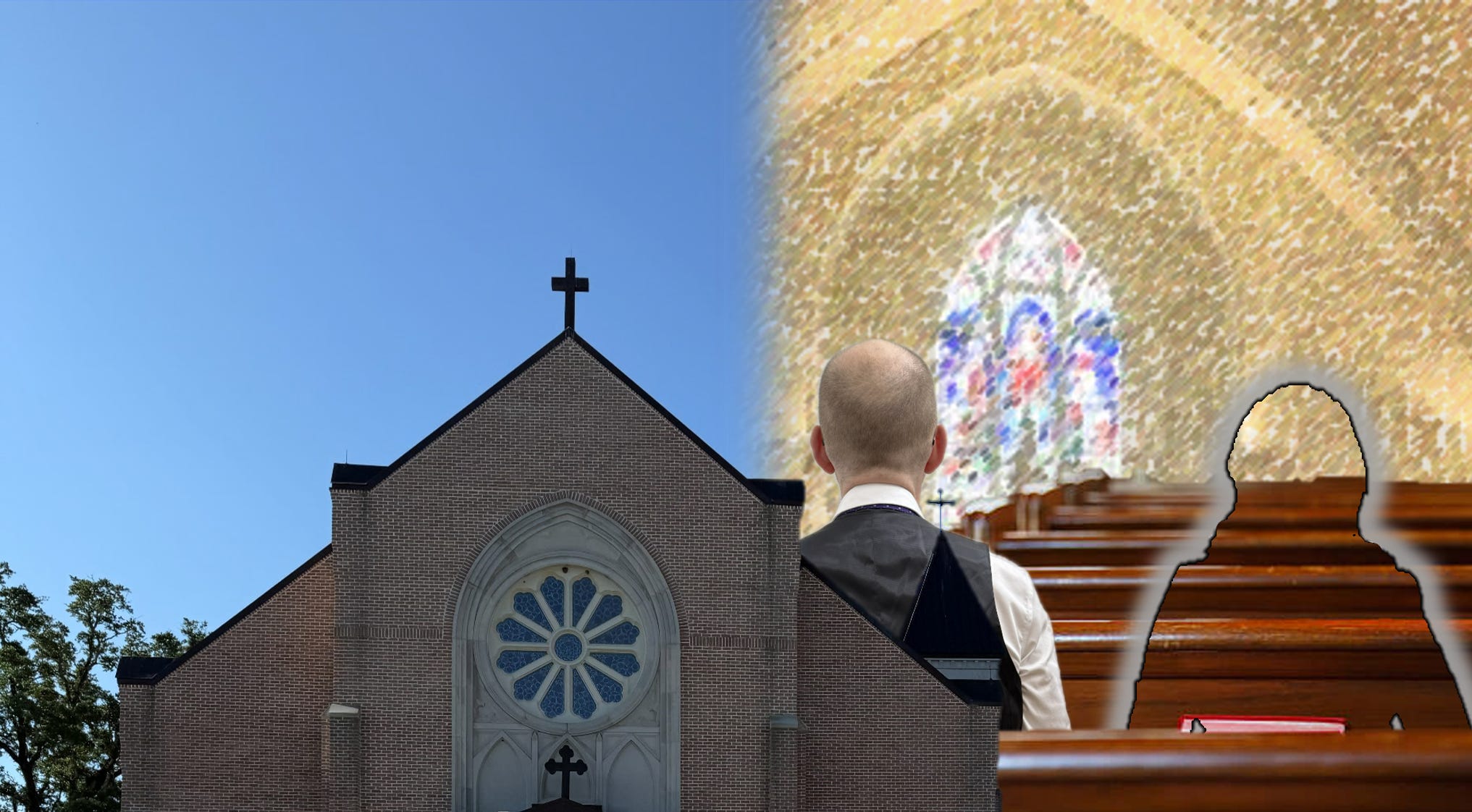
What else are you supposed to do when you’re alone at a wedding? You’ve got an entire pew to yourself because nobody on the groom’s side joined the row headed by you, so instead of making small talk with strangers, you think about love.
Of course, you’d rather not think about love. Even though you know that love’s kinda the name of the game at a wedding, love is a treacherous subject. Any subject would be better. Naturally, in a church, you can distract yourself by contemplating religion, and the church you’re seated in does its darnedest to oblige with stunning grandiosity. You gape at the ornate decorations because even the fixtures in the corners, in spots that serve no religious purpose, are exquisite and perfectly white, and the stained-glass windows gleam like someone polished them for this occasion, as if the clergy wanted those in attendance to remark on how immaculately pristine every square inch of this would-be dusty institution is so that it might reinforce the grandeur of the occasion for which you are gathered here today in celebration of the love—
Ah. Here you are again. Back on love. So it goes when illuminated by the glow of holy twenty-minutes-from-now matrimony.
Your last wedding saw you running the show, which will be funny to think about after watching the formalism of a practiced Catholic wedding mass, but that’s where your brain begins. You think about a person you love beaming at the man she has loved for years, and then beaming with them both atop the highest, if not legalest, cliff overlooking his hometown. You think about the one before that next, seeing one of your oldest friends who used to wield his chaotic goodness like a four-year-old riding a tiger channel his big cat toward a woman and her son, and then you dance your way through the others, too, and that’s a sound strategy to keep it memory-based rather than feeling-based. Remember is a safe verb; feel outlines the danger zone.
The organ music, stately and liturgical, squashes your member berries, and you’re left with sticky-sweet juice oozing all over your heart. If you could pull out your phone, you could clean yourself up, but you went through younger photos of the groom while waiting in the parking lot, and you turned your phone off out of respect for the joint institutions of the church and marriage, so all that’s left is you. Literally. Just. You. You’re surrounded by people buzzing with anticipation of seeing the two you have all gathered here today to bless in union, but you feel so darkly, pathologically, terminally alone in your pew that it’s like the rest of the witnesses are the elegant stained glass and you the black lines dividing it into sections, the narrow negative space that articulates the actual art, the functional other than separates those who know—
The slow, labored entrances of the grandparents rip you out of your seclusion. Instead of thinking yourself a drill and fracking your fragile warmth into fissures of despair, you compose yourself into performance mode. As others crane their necks, you exercise patience, waiting until each steady escort appears in your peripheral vision. You look on with similar awe to that which you earlier ceded to the stained glass, marveling that these time-worn warriors made decisions once upon a time that moved the first pawns toward the checkmate of today’s bride and groom. Their loves, whatever their mysterious-to-you natures, begat this love, passing along gene after gene until reaching these two. Love is a punnet square.
You dutifully watch each groomsman and bridesmaid march in, the former exuding a practiced stoicism that you wonder around the source of. Is it the sacred, soaring ceilings of the church or the adoring but heavy eyes in an audience of hundreds or the pretty woman on each one’s arm they may or may not know well or a performance of seriousness not unlike your own? It doesn’t matter, though, because where other eyes train and the peer pressure urges you to also look, you ignore. You fix your eyes elsewhere.
You watch him at the front.
You enjoyed officiating, and you’ll cherish the chance again next April, but this is now, and you have no role here except anonymous extra in this production, so you leverage your silent stillness to watch him watch for her. Perhaps if you knew her, you’d look for her and grin as she turned the corner on the arm of her father, but you only know him, and he is waiting for the same thing as everyone else, only with infinitely more anticipation because it’s his love turning the corner.
He’s so composed that you wouldn’t be able to tell when she appeared if not for everyone else reacting. But there’s a flicker in his eyes, this momentary flash, and the tiniest twitch at the corner of his lips, the briefest glimpse of that grin at Jack’s Urban Eats when he told you in a booth about her and proposing to her and being so excited to marry her, and you realized that although he’s always been so doggedly happy by default that you took for granted that there was another gear to it, a Backrooms-happy he could clip into when he met the right someone and she clipped into his heart, and you’re not alone, even though you are, because you remember how eager he was to tell you about her, how he couldn’t even wait to bring it up, and it reminds you you’re there for the man whose eyes light up for her.
It’s funny how thinking of him at Jack’s does it, isn’t it? It’s the story of your entire trip. One moment, you feel painfully solitary, vacant, and hollow, and then SNAP something reminds you of someone who isn’t there. You have the list in your notes, all the Acuff-and-Joaquins and Biloxi-because-Laylas, and you have the receipts from your trip to Five Guys when you spent half of your meal texting some of those this new place reminded you of, too, but it’s less about the list than the magic of association. That distant loves bombard you while you huddle apart from everyone else is a treasure, a gift, a marker that love is a many-splendored thing with textures that the priest won’t mention in his intricate ceremony, and it’s enough to right your ship while others sail through mumbled prayers to calls-and-responses you vaguely recognize. It’s enough to grant you safe passage into the heart of the ceremony.
You’re impressed when the priest talks about his music, a personal touch for a man he couldn’t possibly know, which means you now know how much the priest cares about this specific ceremony, or possibly every ceremony, but you suspect it’s really is for this wedding in particular because otherwise he’s just put other presiding priests to shame because he works the reference into his sermon masterfully but without stealing the spotlight. It’s an inviting gesture, the kind you make when you understand your own relationship imbalance so you go out of your way to be kind and accommodating so that both parties believe how much you want this to work for them, so that your words can be more than rote words. You laugh along with the cleverness, not because it’s funny per se, but because you recognize he’s your polar opposite—you know him not her, while he the reverse—and you’d like to think you’ll do the same thing the first time you buy them dinner, reading one of her poems or pieces beforehand to praise. But it’s a nifty touch, straight out of Ancient Rome but dusted before crown molding that glistens from all corners of the church, so the laugh is your way of saying Amen because you’ll be silent for all the official ones he solicits on this day.
But the truth of that lovely little speech, and of the Biblical readings and hymns and organ solos, is that they usher the bride and groom over to a little bench off to stage left so they, too, can watch the bits of the ceremony about them that don’t require them.
The others’ eyes remain on the priest, riveted by his delivery of His words or to the speakers sharing passages of scripture chosen for this occasion, but yours are on the couple, alone on stage and temporarily outside the spotlight while others soliloquize. You’re not supposed to watch them—the microphone is the spotlight—but you watch them anyway because this is your only window into the actual love you are gathered here today to observe and christen and cheer onward, and you find there’s something magical about understanding even a sliver of the source of this special occasion.
He’s so composed, still and dutiful, the once-outsider newly welcomed inside, listening as intently as he listened to every word of instruction you presented to him for years, but that lets you watch her and sneak a peek at the counterpoint to his giddiness when he told you about getting married. Sometimes, her eyes trace what your eyes have traced the entire ceremony as she observes his composure, watching his face like an artist regarding a piece they sculpted in a haze. You can’t see her eyes—and you wouldn’t know her expression even if you could, because you don’t know her—but you imagine her asking herself Is this real? or Is he real? in the same way you asked yourself dozens of times across the years when his kindness exceeded the bounds of even uncommon decency, except the stakes are infinitely higher because her love for him entwines with her life in a way that will become defining, til death do them part and so forth, but still you marvel because her curious disbelief is so familiar, meaning she understands the fundamental goodness of this man who inhabits the center of your shared Venn diagram with her, which renders you unbelievably happy.
And then, when his eyes stay locked on the priest, playing the perfect guest the same way he did when he stayed until 2:00 am hoping that perhaps he could be the one to beat Megan at ping pong (although, alas, he wasn’t), she lets her gaze drift downward to their newly ringed hands. His cups hers, their fingers entwined, a chaste-in-church gesture of affection, but her eyes linger on their hands, together, in this place she knows so well but he doesn’t yet but will from now on remember until the day he dies, and she gets this tiny smile. In a few hours time, her cheeks will ache with fatigue from all the mugging and posing and thanking a wedding reception requires of a bride, but right now, her facial muscles are fresh, and unlike later, there’s no performance, no gritting out authentic emotion through exhaustion, because her smile is just for herself, an involuntary reaction, an instinctual one, a tender slip up from the ceremonial formalism into authentic emotion where her feelings leap off her face, and you understand her disbelief at what has transpired to lead to this moment of joy in tethering herself to this man for the foreseeable future under the watchful eyes of our Lord in heaven, hallowed by thy name, thy kingdom come, thy will be done, on earth as it is in heaven.
You didn’t think it could get any better than that moment when you beheld her beholding the ring on her newly-minted husband’s finger, but you were wrong because he drops his relaxed, reflective regard for every word and note spoken for a moment. Everyone’s listening to stage right, but you are a laser-guided missile the other way when he leans over to her and whispers. She leans her head toward him, their eyes meet, and they laugh a soundless laugh in unison before adjusting on their bench, his hand squeezing hers with an added dash of fondness, and her cheeks ever so slightly flush, the smile only hinted at before at risk of full blossom before the distracted eyes of a side-heavy congregation keen to toast her future woven into his. They inch closer then, whether metaphorically or physically, and you feel a warm seed of joy bloom in your chest from having witnessed the radiant intimacy between the newlyweds.
Alas, while the Lord giveth, the Lord also taketh away, and witnessing such a polished pearl of young love casts an iridescent shadow over your empty pew. There’s a hurt inside you rendered by their happy display on their bench, and its gentle warmth grows shockingly hot and burns you from the inside, not fatally, but sufficiently to leave a mark.
It’s been years since you wanted a wedding, since you attended while planning an occasion of your own with an unnamed bride who looked remarkably like Michelle Trachtenberg, but that time-distance hasn’t erased the feeling of disappointment you’ve felt at nearly every wedding you’ve attended. What began as disappointment that you might never stand where he stood and wait with a thumping heart for your first glimpse of some miraculous her has morphed into something that others would call jealousy, but his wedding, a celebration of the love belonging to someone you love, is no time for jealousy, which is why you know it as a sorrow separate from the him, her, and them of it all.
What sets that burn ablaze is their intimacy. When he leans toward her to make an observation or remark on how hard it is to listen and not look at her or that he’s sorry his hand’s sweating on hers but he just can’t get over the feeling of the ring or whatever he said to her in front of everyone but also no one except perhaps defiant you, you see the part of the wedding you want. It’s why the pew for one thunders at you, threatening to eclipse your joy for them and their future and diminishes the invitation to be there to christen it, because what you want is someone at your side to lean over to and whisper something. You want to make knowing eye contact for a moment, exchange wordless sentiments with the untamable fluidity of intimates, and then return your eyes to the front with renewed jubilance because he has her and you have her. You don’t want to hold hands—you don’t need that part—but what you crave, in the automatic existential way that cradles your heart like he cradles his betrothed’s hand, is knowing she is there, knowing that your pew cannot be empty because you have someone there with you who can assure you that the love in your life is enough.
It’s a selfish thought, as all such thoughts of personal desire are at your loved ones’ weddings, but it’s an honest thought because pain is honest. It doesn’t hide like other emotions. Pain is truthful in the same way as their love when everyone’s eyes are elsewhere but yours witness the greatest instrument of love: the ability to vanquish loneliness into this permanent state of timeless, spaceless security. You are happy for them, so happy that you feel full before the communion you decline has concluded, but you are also bleeding, which is fine because you’ll have to dry clean your vest and pants anyway from the humidity, but still, it stings.
While your hollow sorrow crescendoes into a hurricane in your chest, screaming into your solo house on an empty beach, the organ drenches the assemblage like a cleansing cloud and a talented tenor erupts like a healing volcano, you hold your gaze on the two at the front, paraded together in a shot that will hang on the walls of several homes until all present pass away, and you regain the abiding wavelength of joy. Right then, they remind you of your parents, grinning in wedding photos as if they can’t believe this happened, your perpetually stoic father almost laughing with disbelief that she’s marrying him next to your mom’s practiced smile because they’re in her family’s church, and the whole universe becomes this beautiful writhing ball of love, everything connected, the fibers of being tangled between weddings fifty years and one week apart, and your whole thought is crazy, but you feel the fundamental gravity of love pulling from all directions, inward, upward, southward, forward, ever forward, and you wade into the surf aware of the vicious sharks in your orbit but willing to brave their bites to certify this moment for him, and her, and them, and for all of us, really, and you inhale a sigh of salty air into your lungs, and even though it’s not air but water and you are drowning, you relish the way the liquid puts you at equilibrium with the ocean of everyone else who comes naturally by their embrace of love without your pain, and you gurgle with joy when they kiss as a part of you marvels because he looks so natural doing it because he grew up a coast away, and you applaud with kelp stuffed in your trachea because you can still breathe through the discomfort. And then, when the cold front of your lonesomeness and the warm front of their I now pronounce you collide and risk a vicious storm ravaging your heart, the entire cell dissipates, and you are left with a perfect coastal sunset of shocking pastels as he laughs and she beams and all is right with the world.
There’s still a wound in you, a wound that the strings of seaweed can’t bandage and the saltwater can’t cleanse, but the seeping blood has slowed to a trickle. You see them posing at the front of the church as so many eager others with reciprocal affection for them as you rush to capture their own POV of it, and you chuckle. In thirty seconds, you’ll turn around and not be remotely alone again for the rest of the evening and reception in the most rewarding way possible, and that will be a lasting memory of your trip, that feeling of going from haunting a single pew to being absorbed into old connections and friendly faces that began with his. What a joy it will be to turn around and see those faces and understand that you were alone in that church but you are truly not alone because there’s always someone hidden behind you in a different row who cares.
But even before that, before generous joy becomes personal, you will discover a moment of calm in your solitude. Moments before turning around, with a smile for him etched across your face, you’ll glance to your right at the empty plank of gorgeously carved wood beside you, and you will imagine leaning over, catching her friendly eye, and nodding toward to newlyweds. You can see her looking, then returning your look, and smiling, knowingly, because she knows you and therefore knows what you’re seeing. And then you can see yourself turning back to the ceremony, secure, because you know that your pew is not empty because she is there, too.
It doesn’t change the empty pew when you imagine her there. Not in the slightest. Nobody sat with you. Your only company was your love for them and your thoughts. But it somehow salves the wound. It does.
Because you didn’t imagine a theoretical someone beside you on the pew.
Because you imagined a specific someone sitting beside you on the pew.
Because you know you didn’t wish someone was there but that she was there.
Celebrating love is better with someone you love. Always.
Amen.
This is the first piece I’ve ever written on here while stationary. Part was written at the Pensacola airport’s lobby, part while waiting in the terminal, and the bulk while on a flight from Florida to Colorado. I decided to forsake heavy revisions to let it exist in its more-or-less original form. I believe it’s better for its chaos.

No posts
Comments
Nothing yet. Say the first thing.
Sign in to join the conversation.