

Jonathan Haidt’s worries about political polarization seem quaint and nostalgic now, well over a decade after The Righteous Mind was first published. The book was written in and for an America I remember and grew up in, where the two political parties didn’t really seem that different, and weren’t yet openly playing what has become a zero sum game. Its apparent and explicit message is “guys, can’t we all just try to get along?”
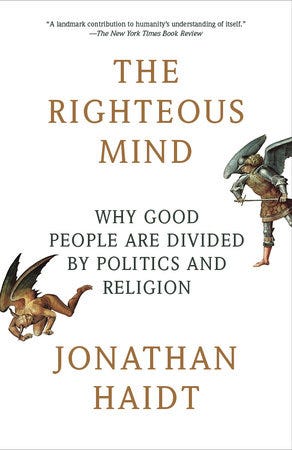
But I didn’t read The Righteous Mind to find out how to “get along” with “liberals” in that version of America where it didn’t matter much, day-to-day, whether Bill Clinton or George Bush was president. When this book was published, even Barack Obama was against gay marriage and illegal immigration.
I came across Haidt’s research because I’m writing a book about virtue, and I wanted to know who had followed up on Donald Brown’s research on human universals—which are essentially themes that all human communities have in common. I’ve long argued that if you’re going to develop moral systems that work for humans, they need to work in harmony with what is known about human nature.
Packed inside this book that does a pretty good job trying to explain 2012 conservatives to 2012 Democrats, there’s also impressive psychological research, philosophical argumentation, and an attempt to present a universal model of human morality. The insights that Haidt and his colleagues presented are worth examining outside the context of a book that, as a friend remarked, appears at first glance to be “airport book slop.”
So, here are some of the key ideas, though the book actually is very well written and persuasive and I do recommend that you read it for yourself.
The first big idea Haidt unpacks is that most of our moralizing as humans is emotional and based on intuition. The way he describes intuition sounds a lot like stereotyping, which is often presented as a bad thing, but obviously a survival mechanism. We see or read vibes and get a feeling about a situation, which he calls “the elephant” and then use reason, which he calls “the rider” to support our feelings so that we can justify them to others.
This is the way I’ve always seen any kind of apologetics. People decide they believe a thing and then come up with reasons to convince others why they are right to believe it, when those reasons usually have nothing to do with why they started believing it in the first place.
Humans can reason their way to new beliefs and positions, and sometimes they do, but that’s not the default. Haidt believes that a lot of our capacity for moral reasoning evolved to influence members of our groups to think well of us and manage our reputations.
Here’s a provocative quote:
Anyone who values truth should stop worshipping reason. We all need to take a cold hard look at the evidence and see reasoning for what it is. The French cognitive scientists Hugo Mercier and Dan Sperber recently reviewed the vast research literature on motivated reasoning (in social psychology) and on the biases and errors of reasoning (in cognitive psychology). They concluded that most of the bizarre and depressing research findings make perfect sense once you see reasoning as having evolved not to help us find truth but to help us engage in arguments, persuasion, and manipulation in the context of discussions with other people.
Haidt didn’t come up with it, but he uses the acronym WEIRD to identify the uniqueness of Western civilization. WEIRD stands for Western, educated, industrialized, rich, and democratic. WEIRD people tend to value individual autonomy above a wider range of human moral concerns. Our emphasis on autonomy is still seen as strange to many others in the world today, and even among Westerners, that emphasis varies. Libertarians would value autonomy above all other concerns, followed by liberals, and then less so among conservatives.
I’d add here that while I think this was still true in the early 2010s, the viral Marxism of hive-minded wokeness and the absolute partisan obedience of so-called liberals during the lockdowns, masking, and coerced injections of the early 2020 wiped out any meaningful association between Democrats and “liberty” or “autonomy.” Haidt and I grew up with a myth of the Democratic Party that portrayed them as advocates of individual freedom and that once seemed to be the case, but it no longer is.
A very specific set of socially subversive hedonisms are actively promoted by the left, but autonomy of the body, education, and even the right to defend one’s own life are all right-coded now. The “liberty” of the left has become “you can do drugs and sodomize each other in furry costumes, but you have to get the shots, learn our litanies in our schools, and if anyone other than a white man rapes or murders you, that’s unfortunate but acceptable.”
A lot of the guys who were brought up believing in the “freedom myth” of the Democratic Party have a hard time letting go of it for reasons Haidt actually explains elsewhere in the book. It’s part of their identity to be part of that team, and because people hate traitors more than enemies, the social cost of switching teams is extremely high. Say goodbye to writing for or being written about favorably in The New York Times.
Haidt showed that David Hume’s idea that morality was based in the sentiments or feelings was closer to what research now shows, but this idea was buried in favor of systematizers who wanted to reduce all human morality down to one or two basic principles that could govern all decisions.
Hume wrote that:
Morality is nothing in the abstract Nature of Things, but is entirely relative to the Sentiment or mental Taste of each particular Being; in the same Manner as the Distinctions of sweet and bitter, hot and cold, arise from the particular feeling of each Sense or Organ. Moral Perceptions therefore, ought not to be class’d with the Operations of the Understanding, but with the Tastes or Sentiments.
Hume, David. An Enquiry Concerning Human Understanding. Early editions (1748/1750).*
However, Jeremy Bentham came along and attempted to reduce human morality down to promoting pleasure and reducing harm. Immanuel Kant then introduced his categorical imperative, saying that you shouldn’t do anything you wouldn’t want to make a universal law. Both of these ideas reduced morality to making decisions that reduced harm to the individual. Haidt suggests that both of these men were probably somewhere on the autism spectrum, and didn’t understand other people very well.
The idea that there was more to morality than harm and fairness led to the development of a broader human “taste palette” for morality, which Haidt and his colleagues called Moral Foundations Theory.
Moral Foundations Theory as explained in the The Righteous Mind proposes five moral “foundations” which Haidt and others believed to be innate moral intuitions in humans. The idea is that cultures then build on these foundational elements in different ways and emphasize some elements more than others. These are:
Care/Harm
Fairness/Cheating
Loyalty/Betrayal
Authority/Subversion
Sanctity/Degradation
However, in 2023, Haidt and his colleagues updated their list of foundations, which you can find on their web site at
Care — Intuitions about avoiding emotional and physical damage to another individual (kindness, nurturance, preventing suffering).
Equality — Intuitions about equal treatment and equal outcomes for individuals.
Proportionality — Intuitions about individuals getting rewarded in proportion to their merit or contribution (this captures the “fairness as merit/deservingness” intuition that was previously bundled into Fairness).
Loyalty — Intuitions about cooperating with ingroups and competing with outgroups (patriotism, self-sacrifice for the group).
Authority — Intuitions about deference toward legitimate authorities and defense of traditions (providing stability).
Purity — Intuitions about avoiding bodily and spiritual contamination and degradation (body as temple, self-discipline, naturalness, spirituality).
In The Righteous Mind, Haidt attempted to explain to the COEXIST bumper sticker liberals of the early 2010s that they were only speaking to the Care and Equality moral intuitions, while conservatives seemed to be addressing most or all of the moral intuitions, which was giving them an edge. Unfortunately, because these types are globalist, anti-nationalist, and anti-tribal, while human beings are and always have been extremely tribal, they will refuse to understand this, or pretend to.
This month’s outrage over Nolan’s DEI Odyssey film comes to mind here. There’s a saying on X: “liberals pretending not to understand things.” It means that liberals/democrats know they are trying to desecrate something—in this case, one of the literary foundations of Western culture—but pretend to be unable to understand why anyone would be upset. They do this, and then repost reviews that applaud the film for being “subversive,’ indicating that they knew exactly why others found elements of the film offensive, and were happy they were offended. Those arguing on behalf of a more faithful and reverent treatment of Homer’s epic are, in the language of MFT, demonstrating loyalty, defending a tradition, and taking offense to the intentional degradation of something they hold as sacred.
One of the ideas from The Righteous Mind that stuck with me was that, from an evolutionary perspective, the most successful cultures aren’t just successful at war, they are also successful at “procuring food and turning it into children.” It’s obvious, but notably an area in which WEIRD cultures are failing. Mike Judge’s 2006 film Idiocracy famously pointed this out, as it comically portrayed well-off liberals waiting to have one or two children as their idiot counterparts had many.
Haidt wrote about Rubicons in the book, and as a liberal toying with conservative ideas, he probably knew that adding any criticism of feminism or the mainstreaming of homosexuality to the book would be…well…let’s just say “distracting” for his intended audience. However, these major features of WEIRD “progress” are obviously and directly at odds with the goal of “turning food into babies.” Western nations that embrace these forms of “progress” all have population replacement problems. And the pushback against these ideas tends to come primarily from religious people, because most successful religions have patriarchy and proscriptions against homosexuality coded into them. If you look at one of the most successful “new” religions, Mormonism, you’ll also notice that the Mormons have a great reputation for promoting patriarchal structures, discouraging homosexuality, and turning food into babies.
Haidt argued in The Righteous Mind that we rarely reason our way to opinions as individuals, and that most of our reasoning tends to be rationalization for emotional responses. Many of our “gut responses” to things are not necessarily innate in themselves (though some may be). Many of these responses probably, and I think Haidt would agree with this, become emotionally embedded through cultural programming that works in harmony with his moral foundations. He more or less explains this when he writes about his experiences in India and people’s emotional reactions to different behaviors.
But one thing The Righteous Mind brought to mind for me was the idea of cultural reasoning. It seems obvious to me, though I don’t know how you’d prove it scientifically, that cultures reason at a level beyond individuals. When the Mormons encourage members of their tribe to have a lot of kids, they’re just repeating themes from the Old Testament.
“And God blessed them, and God said unto them, Be fruitful, and multiply, and replenish the earth, and subdue it...” (Genesis 1:28).
But where did that idea come from?
Christians would answer “God, moron. God said it, it’s right there.”
But, as a non-believer, I see that as the encoded collective wisdom of a tribal culture that figured out that they’d be better off if they encouraged their members to have more babies, and discouraged behaviors that prevent them from having babies. I think cultures learn and reason. People try out different ideas, and find out they don’t work.
One of the major responses that conservatives (and I) have to communism or even entertaining communist ideas is that we can point to all of the times in our lifetimes and recent memory that communism has been tried and resulted in mass murder, poverty, and corruption.
There is a pushback on feminism and homosexuality right now in America, notably among a lot of young men, because Boomers tried out open homosexuality and feminism and there have been a lot of negative effects on normal people. The worst of which was probably the progression from feminism and homosexuality into widespread gender confusion, pronoun confusion, and the coerced sterilization and mutilation of children and young adults. Over the last few generations, people gave these things a try, and then people assessed the foreseen and unforeseen results.
Western governments tried to solve the declining birth rates these innovations produced with third world immigration. This has allowed some members of the political class to manipulate electorates and consolidate power. But for the average person, the net result has been turning high trust societies into low-trust societies.
Basically, my theory is that cultures do science, and then they encode the results of their experiments into myth and religion. Myth and religion are emotional technologies that produce intuitive responses that, among other things, encourage people to turn food into babies. Cultures reason and then convert reason into intuition.
Many scientific writers like Haidt seem willing to admit this when they look at rules about cleanliness and food handling in Leviticus, but are more likely to dismiss other religiously encoded behavioral models as superstition.
This doesn’t mean that every encoded morality of every religion or culture is equally right or good or that the negative effects of a given experiment couldn’t have been mitigated in a different way and with different coding. Some of the encoded moralities might also be dysfunctional alone, but functional in packages. But does suggest how many cultures developed similar, in the words of Kipling, “
One of the more satisfying parts of The Righteous Mind was Haidt’s dismissal of the tedious arguments of the New Atheists, who insisted that religion was the worst thing that ever happened to mankind. You still hear this from people who gobbled up these ideas during their formative years in the 2000s, or as responses from people who have been traumatized in some way by a religious group—which is something that absolutely happens. (Religious people are just people, and people sometimes treat each other very poorly.) If you would have asked me in my early twenties, I would have agreed that “religion is stupid and bad.”
The reality though, is that religion actually has a lot of positive effects—which is part of the reason why I started my own.
Rituals that seem “silly” to outsiders have a unifying effect on groups, and initiate a phenomenon that Haidt calls “The Hive Switch.” He describes humans as “90% chimp and 10% bee” and says that humans survived and thrived in part because they can get on the same page and act collectively. Religions create group experiences that encourage a sense of oneness using human technologies that you can also find in military exercises, sporting events, and rave culture.
The New Atheists claimed that non-religious people were better people, but studies have shown that to be false. Religious people tend to be happier, make better neighbors and help people around them, often even people outside their groups—at least until there is a religious conflict and the hive switch flips them into crusade/jihad mode. The New Atheists argued that was the bad part, and it can be, but generally speaking, religious cultures do better and their people have a sense of purpose and fulfillment and connection that non-religious people struggle to create without the technology of religion.
Haidt makes some suggestions about how corporations could make use of the hive switch, but over the past few decades, many have tried to implement these kinds of suggestions to create corporate tribalism. However, in a culture of free agents and at-will employment, everyone knows that they could get a new job or be laid off at any time, so this kind of corporate culture ends up seeming nauseatingly fake and gay. A major feature of tribalism is also a sense of shared fate, which can be whipped up easily, but it only lasts to the effect that the individuals feel that they actually share and benefit from the fate of what Haidt acknowledges elsewhere is merely a legal entity that exists primarily for its own perpetuation and expansion, not necessarily to benefit humans or the members of its “hive.”
The Righteous Mind ends on the “can’t we all just get along” note that seems less relevant (or realistic) in today’s political climate.
Like Haidt, I started out as a liberal, and reality challenged a lot of my own ideas. Anyone reading this review will see evidence of my own political tribalism. I do think you need to pick a team and decide what you believe is best for society as a whole. And I don’t think you have to see direct benefit for yourself to do that.
But, looking past the political framing, The Righteous Mind is a solid companion to The Way of Men and even Fire in the Dark. The post 2020 world saw a massive drop in trust concerning “science,” research, and academia. For very good reasons. But it also created a lot of woo and wishful thinking about human nature. I believe, and I think Haidt would agree, that if we’re going to create new proscriptions for how humans SHOULD behave, it would be best to begin from descriptive observations about how they DO behave.
And then the big circus trick is to take suggestions derived from those conclusions and turn riders into elephants.
*The same analogy appears in the final (1777) edition, sec. XII, pt. 3: “Morals and criticism are not so properly objects of the understanding as of taste and sentiment. Beauty, whether moral or natural, is felt, more properly than perceived.” A readable text of the final edition is at https://www.gutenberg.org/files/4320/4320-h/4320-h.htm.
Comments
Nothing yet. Say the first thing.
Sign in to join the conversation.