
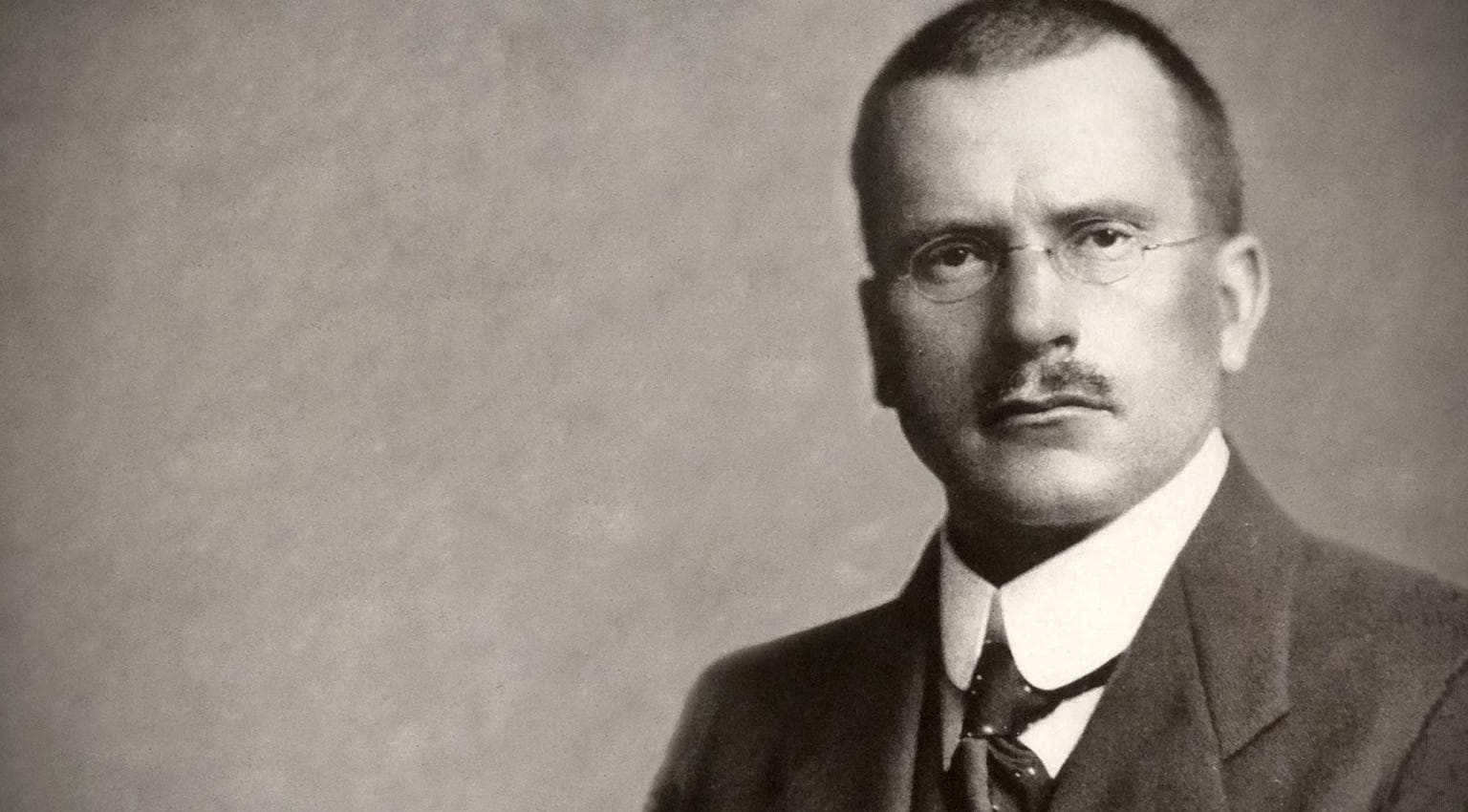
In the past two days, I’ve been “corrected” by two different Jungians on two different platforms.
I wasn’t writing or speaking about Jung directly. But many Jungians seem to feel a powerful sense of ownership over any terms or concepts introduced by or even used in Jungian thought.
Like certain Christians, Jungians will jump into your comments out of nowhere and give you their version of “ya’ll motherfuckers need Jesus.”
And there’s a reason for that.
For most of us, Jung was a Swiss psychiatrist who, as one of the pioneers of depth psychology, made many insightful observations about the human condition. Jung’s work has influenced the world—one might even say “the collective unconscious”—in many profound ways. Some of his influence has probably been consistent with his vision, and some seems to have spawned unintended reactions or popular reinterpretations that were unintended. I pointed out what I believe has been a negative impact of his use of the Latin word animus recently that probably has very little to do with what he was actually trying to convey in his work.
The ideas—the memes—that we put out there live lives of their own. And, like children, they don’t always do what we had hoped they would do.
For most of us, Jung is one thinker to read among many.
For others, Jung was a prophet.
That’s why Jungians rush to defend a man who has been dead for over 65 years.
For them, he was not A man, but THE man.
For me, and maybe for you, Jung presented some models and frames that help us understand human thought and behavior. He classified some extremely esoteric aspects of culture in interesting ways.
For Jungians, Jung presented a complete worldview and the key to understanding human life.
Jungianism is essentially a religion. And when you understand it in this way, the behavior of Jungians makes a lot more sense.
Freud doesn’t seem to command the same kind of loyalty. I think you’d be hard-pressed to find another psychiatrist or psychologist who does.
I suspect this is because Jung’s work had a very well-developed spiritual and esoteric dimension. Jung wasn’t some dispassionate scientist, content to conduct experiments and publish studies. He wrote volumes on alchemy and religious symbolism and the occult. He produced beautiful and mysterious illuminated dream journals like the Red Book. One can spend an entire lifetime reading his works and interpreting them and arguing with other Jungians about what Jung meant vs. what Jung really, really meant.
And people do.
There are several academic and accrediting organizations for professional Jungian therapists and Jungian scholars. And there are more accessible public organizations like the International Association for Jungian Studies (IAJS) that you can join to attend Jungian seminars and webinars and purchase journals produced by the top contemporary Jungian thinkers. I checked out their web site, and you can pick up award-winning books there like Jung’s Studies in Astrology.
Beyond the world of accredited professional Jungian therapists and scholars, there are also all kinds of Jungian thinkers and life coaches driving their Jungian gypsy wagons all over the Internet, promising “initiation” and “deep shadow work.” To be fair to the professionals, these are probably the Jungians who I am most likely to come into contact with in my line of work. But there seems to be a good bit of “woo” on the professional side, too.
As a naturally suspicious man, I admit that I immediately distrust anyone whose aim is to tell me my unconscious motivations. Since I don’t “know” them, that’s just a blank slate they can write anything on. There’s a massive opportunity there for manipulation and abuse. And, to the extent that we believe in the concept of unconscious motivations, even a Jungian “guide” who has the best intentions may also be acting on unconscious motivations that are less noble. It’s a very murky realm.
The same could be said of priests or coaches of any kind. So I’m not claiming that Jungians are distinctively wicked or suspicious—only that they are human.
I write about myth and archetypes and symbols, so I have many interests in common with Jungians.
As a man who started his own religion, I’m certainly not saying that it’s wrong for Jungians to be so religious. People need some kind of cohesive worldview and naturally seek out and create communities for people with the same or compatible worldviews. It’s just helpful to understand who you’re talking to and how they understand the world.
When you deal with Jungians, they’re going to refer back to his works like Muslims citing the Quran. They’re going to attempt to reconcile every issue they encounter and every experience they have with Jung’s framing, just like Catholics trying to reconcile their views with 2000 years of church doctrine.
What would Jung think of this? What Would Jung Do?
Within the context of any religion or worldview, words develop specific meanings that are unknown, incomprehensible, or (most often) irrelevant to outsiders. And that’s normal. That’s part of the process of constructing deep meaning.
I spoke about this briefly in a video I produced yesterday for The Order of Fire, introducing people to our “semiotic engineering project.”
In it, I referred to an argument I made in 2025 in a Substack piece about the runes. When I saw the way that words and even types of trees took on new esoteric meanings within a religious context, it helped me to understand the concept of meaning in general and also presented creative opportunities for the development of new narratives and symbols.
In the Order of Fire, we have made up or appropriated words and names and symbols that mean very specific things to our members that they do NOT mean to outsiders.
I was having a conversation with CB Robertson this morning about SOMA. He was making connections between our concept of SOMA (as a sacred beverage related to the production and offering of excellence) and his interpretations of scenes from the works of Homer. It was interesting to us, but it would have sounded like complete nonsense to almost any Hindu.
Yesterday, I had a Jungian slip into my DMs to lecture me about how I was “lost” and was using the words “differentiation” and “non-differentiation” improperly.
I have access to many dictionaries.
I meant exactly what I said, and was using the words in the ways I’ve used them countless times before, in the context of a very specific narrative and argument.
But he’d slipped out of self awareness. He didn’t realize he was evaluating a non-Jungian from within a Jungian frame.
Words have general and culturally specific meanings.
This is why it is important to define terms when you’re making an argument.
But people become so immersed in their own worldview that they forget that outside of that worldview or area of expertise, nothing they’re saying makes any sense.
This is something to think about when you’re dealing with different groups of people.
Are they speaking to you as if you are in their esoteric group?
If so, do they know they are doing it?
And, what about you?
Are you doing it, too?
Stay Solar.
Comments
Nothing yet. Say the first thing.
Sign in to join the conversation.