
Product management is a challenging career, and it can be an especially lonely one if you're the only PM in the company. As a PM, you are often expected to make critical decisions about the product or feature ideas that can significantly impact the business. In many cases, you are trapped in sink-or-swim situations where you have to rely on your instincts and experience to make the best possible decisions.
Having a personal sounding board can help you thrive even in the most difficult situations. It is a group of people you can bounce ideas with and get honest feedback. While having a peer/mentor group to validate product or feature ideas may be the first idea that comes to mind, having a personal sounding board goes much deeper. As a PM, you are constantly facing problems that span across strategic and tactical stuff. It is essential to have people you can rely on to provide thoughtful advice and help you navigate these challenges.
In this post, I'll share some of the lessons I've learned in my career as a PM that can help you accelerate the process of becoming a better PM. I'll also talk about how to ask for advice effectively, and how to assemble a personal sounding board.
First, let's define what a personal sounding board is:
A person or group whose reactions to suggested ideas are used as a test of their validity or likely success before they are made public.
In other words, a personal sounding board is a group of people with whom you can share ideas to receive honest feedback. As a PM, you might first think of having a peer/mentor group to validate product or feature ideas. However, a personal sounding board can be much more valuable, as we are constantly facing problems that span strategic and tactical areas.
Here is a non-exhaustive list of topics that I usually cover with my personal sounding board:
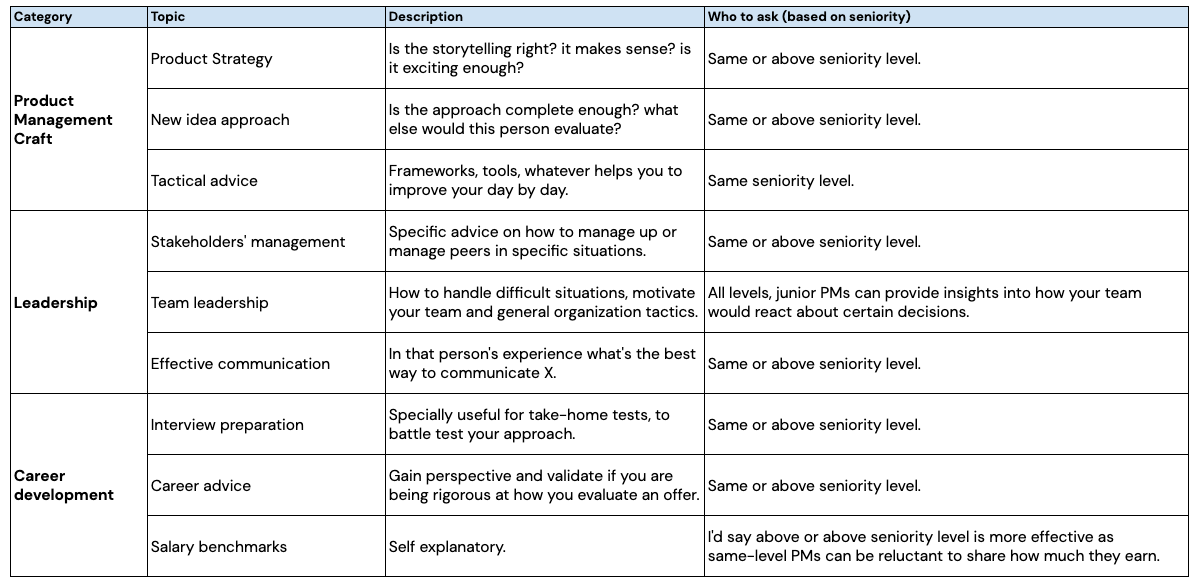
While it's always good to have people with domain expertise or specific knowledge by your side as a PM, I believe that as PMs we are trained to solve almost any problem in any industry, or at least rely on first principles to give thoughtful advice. In my experience, this hasn't been a problem.
I've found that questions like "Do you have a framework for X?" or "What do you think about this idea?" are the most common and at the same time the most ineffective. These questions add friction to the other person, who may lack the context and knowledge that you have. To ask more effective questions, double-check how you are asking and validate if it passes these filters:
Is this an answer I could find on Google, Communities, etc.? or do I need a person's take?
What's at stake? Do I really need to bother someone with this?
Does my question include basic context?
Am I mentioning the approach I'm prone to follow?
Here's an example of how to ask a more effective question regarding a new feature idea:
Hi
‘name’, as you know I'm a Product Manager at‘company’and I'm currently focused on improving'metric'which is the company most important bet for the current quarter.Based on user interviews and user behavior data, I found that they are experiencing pain in
'process', which is tightly related to'metric'because of'reason 1'and'reason 2.'That's why I thought of'feature idea', which is'feature description'.Do you have any thoughts about this approach? Maybe something I'm missing?
This approach is much better than simply asking "What do you think about building 'feature'?" as it includes all the necessary context and shows that you've thought through the problem.
Unfortunately, there is no quick way to build a personal sounding board, as it requires a certain personality fit with those individuals and the most popular path is to just tap into your network of former co-workers or school/college friends. However, in recent years, many communities and platforms have emerged, making it possible to find interesting people for mentoring or exchanging ideas.
Regarding communities, some of them have a recurring matching cadence between members, so be sure to explore that feature and meet new people. I have found a handful of interesting people in similar communities with whom I try to maintain close communication.
If you are interested in having me as a product mentor or coach, hit me up for a free consultation call. Let's talk about how we can team up and tackle your challenges together!
Thank you for reading! here’s a list of my most popular articles if you want to keep reading.
Comments
Nothing yet. Say the first thing.
Sign in to join the conversation.