
On Sunday evening, hours before Ulchi Freedom Shield began in South Korea, Donald Trump ordered Pete Hegseth to “substantially reduce” American participation in the exercise. In his Truth Social post, Trump praised his “very good relationship” with the monstrous dictator Kim Jong Un, described nuclear-armed North Korea, who currently provide millions of artillery rounds and thousands of soldiers to Russia for their war in Ukraine, as “unthreatening and respectful”, and added on Truth Social: “While somewhat unrelated (?), I recently asked the President of South Korea if they would like to join us in the Denuclearization of the Islamic Republic of Iran, and they said, ‘No thanks!’”.
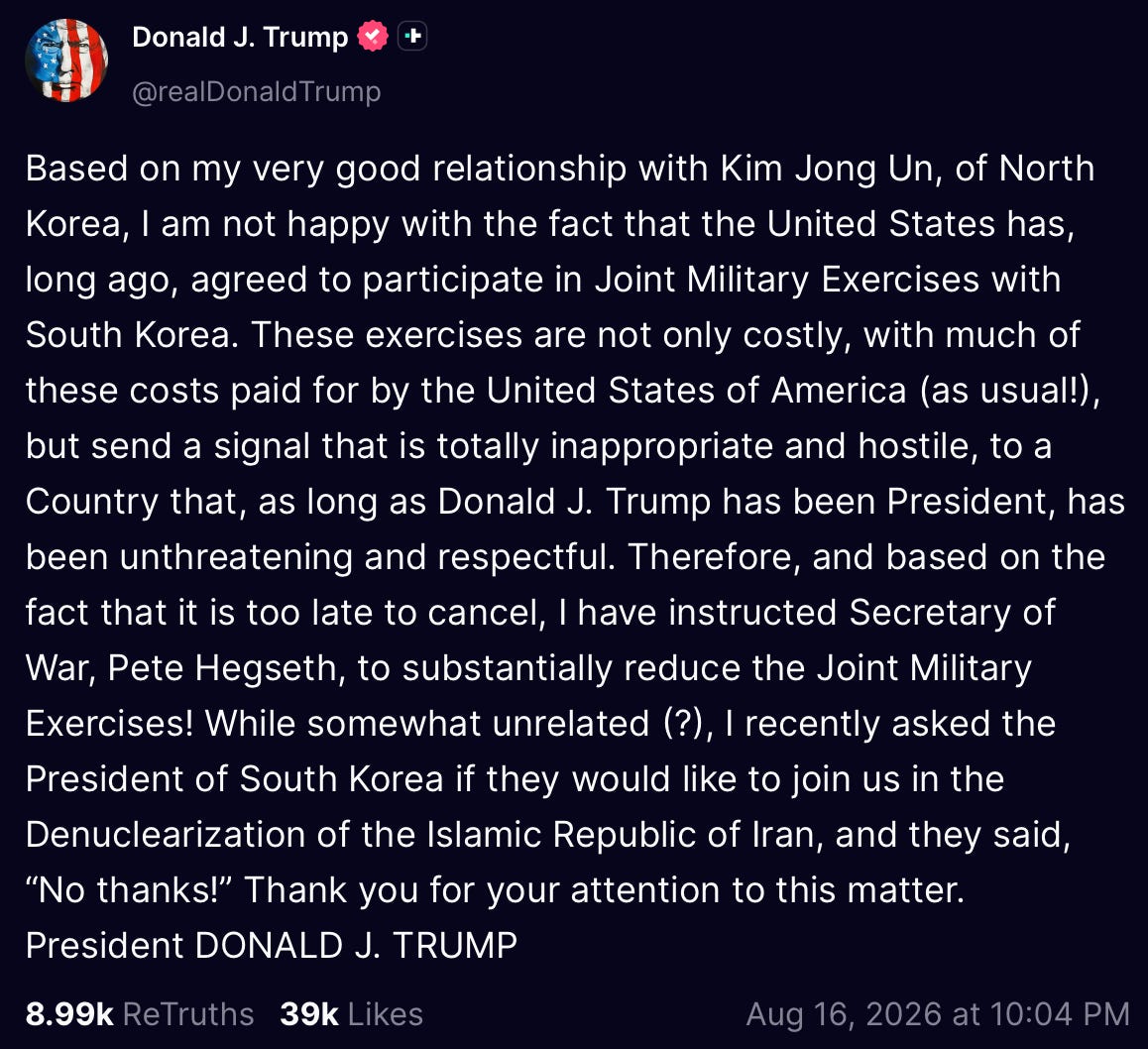
Trump’s parenthetical question mark was the only hesitation in the post. He ordered a reduction in an exercise designed to keep American and South Korean forces capable of fighting together against Kim, then placed Seoul’s refusal to join the Iran war alongside his complaints about its cost and hostility. The drills were intended to incorporate lessons from the more than 14,000 North Korean troops sent to fight for Russia, including the use of drones, GPS disruption and cyberattacks. Trump disclosed no return from Pyongyang for the concession. Seoul received a public rebuke over a different war.
South Korea said the exercise would proceed as scheduled, so the immediate operational reduction remains unclear. The political signal was clearer. On Monday, Trump inflated the size of the American garrison, from about 28,500 to 39,000 personnel, claimed that Seoul had once agreed to pay nearly $3 billion a year for protection, and asked why Washington remained involved in helping it. He then supplied the answer in the language of a protection racketeer: “We can’t go around and protect all of these countries, especially when they’re not there to help us.” His deflection of blame for his defeat in Iran continues.
South Korea can shoulder more of the conventional burden, and large-scale exercises can impede diplomacy. Washington suspended major drills after the 2018 Singapore summit, but the Pentagon described that decision as coordinated with Seoul and conditional on productive negotiations with Pyongyang. Trump’s present order arrived hours before training, with no reciprocal North Korean concession in the public account, and expressly punished Seoul over an unrelated war. His own White House had praised South Korean plans to spend 3.5 per cent of GDP on defence, buy $25 billion in American weapons and provide $33 billion in support for US Forces Korea. The timing made a mockery of any claim to serious burden redistribution.
A Trump loyalist acquaintance, formerly a dear and much-loved friend, now tragically deep in the MAGA cult, recently offered me the creed that excuses this behaviour: “The stock market is through the roof, petrol is cheaper than under Biden, Washington dominates the Western Hemisphere, Venezuela’s oil is under American control, China has been driven from the Panama Canal, and conservative presidents are winning elections across Latin America.” Europe, he concluded, simply does not affect Americans. His list confused the dashboard with the engine beneath it. Wealth matters, but a share index says little about whether the United States can project power globally, secure access and overflight, sustain combat operations, replenish precision weapons, or persuade another government to accept political risk on its behalf.
Even his cited dashboard is less impressive than the Trump cult imagines. Regular petrol averaged $4.079 per gallon on 3 August 2026, higher than during most of Joe Biden’s presidency outside the shock after Russia’s invasion of Ukraine. China never controlled the Panama Canal; a Panamanian authority did, while a Hong Kong company operated two terminals until Panama’s Supreme Court annulled its concession. Washington now exercises commanding leverage over Venezuelan oil sales and holds the revenue, although the White House itself acknowledges that the money remains Venezuelan property. Trump’s supporters have mistaken this paltry collection of local gains for global command.
The serious defence of Trump is that allies have free-rode for years, American pressure has contributed to higher defence spending, and US firepower remains unequalled. Much of that is true. Europe is rearming, South Korea has assumed greater responsibility for its defence, and American forces inflicted severe but non-decisive damage on Iran’s navy, missile force and military infrastructure. Operation Epic Fury demonstrated a combined scale of long-range strike, air defence and aerial refuelling that no rival has yet replicated in combat. Those inherited advantages remain immense. Their strategic value still depends on allied governments granting access and accepting the risks of a common campaign.
Burden-sharing strengthens the United States when allies become more capable without becoming less willing to operate with it. The opposite is currently true. Trump’s own 2026 National Defense Strategy calls the alliance network a “defensive perimeter around Eurasia” whose geography and wealth are essential to balancing simultaneous threats. In April, Hegseth called South Korea a “model ally” because it had increased spending and accepted primary responsibility against the North. Four months later, Trump penalised that same ally for declining his demand over Iran. As with his relations with Europe, he reduced burden-sharing to an obligation to obey him.
Europe has spent two years receiving the same treatment. Trump imposed tariffs after declaring that the European Union had been created to “screw the United States”. His administration joined Russia in voting against a European-backed UN resolution on Ukraine, opened talks with Moscow that excluded Kyiv and Europe, shamefully berated Volodymyr Zelensky in the Oval Office, and suspended aid and intelligence. Trump threatened tariffs on eight European allies unless Denmark accepted a “Complete and Total purchase” of Greenland, despite the military access Washington already enjoyed under the 1951 defence agreement. He later told Copenhagen: “You can say no and we will remember.” At a March Senate hearing, committee chairman Roger Wicker described the access, bases, overflight, refuelling and logistics supplied from Europe as “enormous military advantages”; General Alexus Grynkewich separately called the continent a platform for projecting the joint force. Governments Trump routinely abused still supplied the infrastructure for his war.
Trump extended the abuse to the allies’ war dead. He claimed America had never needed NATO and said allied forces in Afghanistan stayed “a little off the front lines”. Britain lost 457 service personnel there (13 of whom were my own close friends or colleagues); Canada lost 158, France 90 and Denmark 43. Trump later praised British service and said he had been misunderstood. His correction did not alter what allied governments and their citizens had heard: service beside the United States no longer guaranteed that the United States would remember or appreciate the cost.
Operation Epic Fury exposed the same gap between American firepower and political outcomes. The strikes achieved genuine tactical effects, yet the regime survived, and the nuclear problem did not disappear. After nearly a year without sufficient access for verification, the IAEA still cannot establish the current size or location of Iran’s last recorded stock of 440.9 kilograms of uranium enriched to 60 per cent. The administration’s declared aims had included eliminating Iran’s missile and naval power and ensuring that it never obtained a nuclear weapon.
Battle damage assessment is not strategy. Epic Fury destroyed targets and degraded Iranian military capacity. Its operational test was the restoration of normal shipping; its policy test was the nuclear outcome Washington had declared. Shipping remained throttled, and no enforceable nuclear settlement has followed. Failure.
Hormuz supplies the operational measure. In the week ending 2 August, traffic recovered to 84 transits, down from more than 700 in a normal week, while 70 ships, including 29 tankers, remained trapped. Iran demanded reparations, influence over passage through the strait and American troop withdrawal as talks stalled. The 60-day deadline for a memorandum expired without agreement, while Trump oscillated between demanding Iran’s “white flag” and privately signalling that he might end the war if Hormuz reopened without a nuclear deal. After five months of tactical damage, Washington was still negotiating for access to a waterway that was open before the war.
Allied reluctance to join Trump’s Hormuz force does not alone prove that American hegemony has vanished. Governments could reasonably object to the war’s legality, the risk of escalation, and shifting objectives. In March Trump said he had “demanded” warships from about seven countries; none had committed. They did not abandon freedom of navigation. Britain, France, Germany, Italy, the Netherlands and Japan declared themselves ready to act, while France later explored a strictly defensive mission outside American command. Several European states supplied inherited access and logistics whilst refusing political ownership of the campaign. The shared interest in navigation produced no common campaign under American command, because Trump had laid none of the diplomatic groundwork needed to build an alliance. In fact, every move he made had alienated potential allies and guaranteed their disengagement.
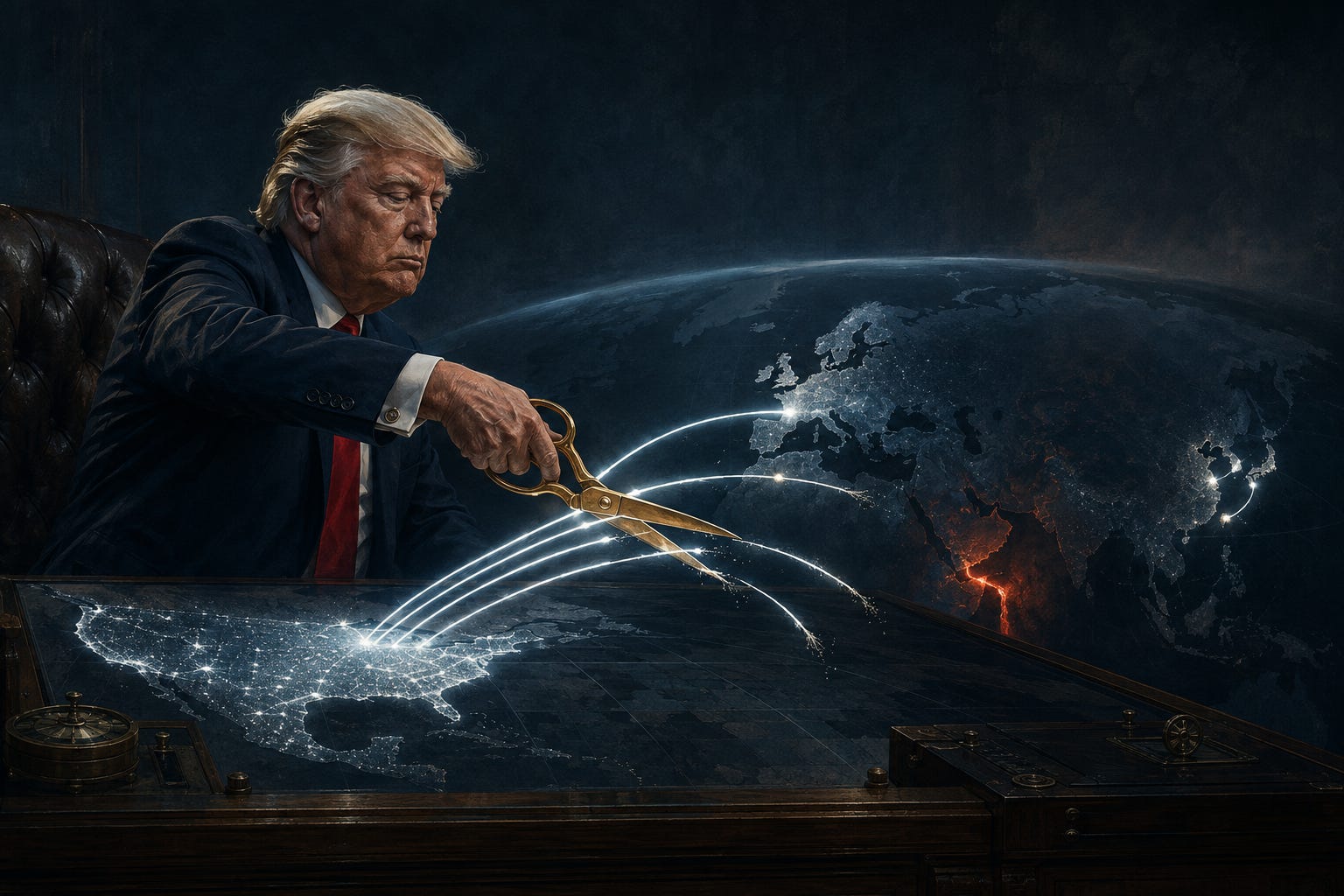
Epic Fury also depleted stocks relevant to other theatres. At least 18 American service personnel died, and hundreds were wounded. A CSIS estimate placed direct military costs at roughly $34 billion to $42 billion, while its munitions analysis found that depleted stocks of Tomahawk, Patriot, and THAAD created a window of vulnerability in the Western Pacific. The great unspoken is that China controls 90% of the rare earth minerals needed to replace these munitions. It will take 40-50 months to rearm, even if China agrees to supply the required raw material. Trump has now ordered training reduced with a central Indo-Pacific ally, citing in the same post Seoul’s refusal to join the Iran war.
Political distance becomes difficult to reverse once it reaches the defence procurement stage. Spain shelved the F-35 in favour of European options; Denmark selected the Franco-Italian SAMP/T system over Patriot; and Canada has continued to review its F-35 purchase. Cost, delivery schedules and European industrial policy all influenced those decisions, and the trend towards autonomy predates the Iran war. Trump has now added yet another reason to look elsewhere: dependence on American export controls and presidential judgement carries an obvious political risk. The European Union’s SAFE programme offers up to €150 billion in loans for joint procurement to strengthen Europe’s industrial base.
Once made, those choices outlast future, more sensible US presidencies because maintenance depots, training pipelines, software architecture and munitions production bind a military to its suppliers for decades. Saudi Arabia, Turkey and nuclear-armed Pakistan have now signed a mutual-defence agreement amid the regional upheaval. Their security relationships and talks predated the war, and the pact’s provisions remain untested. Its signatories say it complements existing alliances, but it is another piece of insurance being written outside Washington.
Trump’s admirers cite Panama and Venezuelan oil as proof that American primacy has returned. Both episodes involved weaker states within Washington’s own hemisphere. Hormuz demanded a durable coalition, while South Korea demanded disciplined alliance management; Trump failed at each of the harder tasks. No share price refills a launcher or grants overflight rights.
Trump inherited a priceless alliance system, unique in modern history, that turned American strength into global hegemony. He is leaving his successor with depleted magazines and partners who have learnt that American guarantees can be repriced by presidential whim. The United States will still possess extraordinary power when he leaves office, but less of it will be usable, and rebuilding what he squandered will take decades longer than destroying it did. He calls that MAGA and America First. The proper name is hegemonic suicide.
You can now follow me on your social media of choice:
Or visit my homepage at www.andrewfox.online
Comments
Nothing yet. Say the first thing.
Sign in to join the conversation.