
Author’s Note: Grief has forced me to slow down. I intended to start posting 6 months ago, but instead, I have spent the first half of the year remembering that writing is refreshing. It’s even better when I take time to reflect on voice, theme, my own growth in the craft, and what gets shared with the public. I hope you enjoy this series as much as I have enjoyed writing it, and that it offers you space to connect with your power.
This was not poetry class, and yet, an elderly white man sat directly next to me and decided to make an example out of Maya Angelou. I observed him closely upon his arrival, but chose to maintain my distance even if it hurt his ego or amplified my not-so-secret problems with the racial makeup of our MFA program.
“Maya Angelou is kind of gimmicky,” he said confidently. “Gimmicky” in contrast to whoever had captured his devotion for their technical prowess at that time. Knowing this writer, the prototype did not share much with Angelou and was of no interest to me.
I looked up, likely unable to hide the shock on my face, and scanned the seminar style table as every single person including the instructor nodded in agreement. For years, I did not understand why I froze in that moment. Perhaps I was tired of arguing, tired of being perceived as a “race writer,” or tired of making white people uncomfortable in places where they were the overwhelmingly majority. Perhaps I was hurt. Underneath the silence, I was changing — not breaking — binding like butter, egg, and flour. There were no words then, but there are now.
By the 5th grade, it was clear that I performed best in my English classes. One evening as a latch key kid, my mother came home early. To my surprise, she handed me a copy of Maya Angelou’s Complete Collected Poems. I ran my hands over the shiny gold and quilted cover. When I looked up at her she was smiling over me — still wearing the bulk of the commute and the downtown musk of the day. Through her exhaustion, she seemed proud. This is one of the last sweet memories I have of my mother, and one of the few that feels genuinely pure.

It is difficult to recall what she said about Maya in that moment, but the memory nows feels like a first threshold. The Complete Collected poems were a tool, a guide, and a vote of confidence for the journey ahead. From that moment on, Maya has consistently astounded me with her her capacity to transform. She was the first strong Black woman in my life whose strength wasn’t just survival, but her tight grip on joy and her commitment to vulnerability. I have yet to come across anything as bold or beautiful as her laughter.
I cite Toni Morrison often as a literary mother because reading the Bluest Eye shifted me into becoming a writer, but Maya is the reason I started (and kept) using my voice at all.
Even when I did not know that I needed her, Maya was there. I purchased Mom & Me & Mom, a memoir, without hesitation in a secondhand bookstore as a mid-20-something. Luckily, it was the audio book version on CD. Maya admits that her mother was plain terrible to her as a small child, but that her mother became the best person she ever knew as an adult. Maya's brave honesty sank into me. It tugged at the part of my spirit that wanted to forgive my mother despite everything that had fractured the potential of our relationship. From that moment on, with Maya & Mom & Me, I would begin chiseling away at the violence of this woman who lived inside of my body, and start empathizing with the human that still walked the waking world.
By the time I went to graduate school in 2017, I had already come out as queer, been marked by my family for doing so, and left California. Upon completion in 2019-2020, my mother and I were on opposite sides of the country, but we still spoke on the phone. I had just completed the task that she cared about most and spoke consistently over my life: You will go to school, and you will get a Master’s degree. As a young adult who had already fulfilled their life’s purpose, I was left sorting through many confusions about what it meant to be happy, what it meant to live in my body, and the future of my creative practice. I did not call my mother to talk about these things. I called my mother because I knew she was not ok. A lifetime of taking care of her, of sitting with her in doctor’s appointments and emergency rooms, of seeking alternative pain remedies, and of listening to her lament had built its own internal alarm system within my gut. One night in 2020 on the phone with a college friend from California, I said, “I think my mother is going to lose her memory very soon. I am not ready.” I tried to help her build a long term care plan, but she either didn’t like her options or she was too stubborn to sacrifice the independence she had left. Her reluctance to long-term care planning would anger me at the time, but in the end, it helped me understand her better.
In 2021, I moved back to California primarily due to concern about both of my parent’s health as they were experiencing major declines and hospitalizations. I was 25 and prideful enough to think that I would be able to navigate the landscape of home without feeling like a helpless child. I thought all the self work would spring into effect. Above all, I was dumb enough to think anyone had changed. Instead, I came back to find both of them stuck in the same places and patterns. My mother, angry at the system, at her body, and at her family. My father, angry at my mother, and angry at himself. Both of them, angry at me. I thought I had enough tools to handle running back and forth between these two. Instead, I quickly found out that the work of healing had only just begun.
From 2022-2023, I struggled to find my footing in all areas of life. The job market in Los Angeles was competitive, and I was scraping by with contract work. Each day living closer to my father revealed a new horror about the reality of men and the impact of generational fatherlessness. My mother’s family was the primary problem Their love of gaslighting constantly triggered memories of abuse and trauma that I had long buried for survival. They still treated her like a burden, and me like a queer outcast. No matter how hard I tried to sweep things under the rug as instructed, or sacrifice myself in order to exist around them, it never stuck. I could no longer tolerate their control in order to maintain the lie. Suddenly, I found myself pushing thirty and begging to be seen by family as a full human, only to be reminded that I was remembered best and loved most before I learned to speak. To them I had become uncontrollable. To me, I was becoming an adult with my own identity, will, and boundaries — relentlessly in pursuit of self love and hope. I had tasted freedom and self-respect. It was never destined to work out the way they all hoped, but I still tried.
By the beginning of 2024, my mother was first diagnosed with a major neurocognitive disorder, then mild Alzheimer’s. Without question, I began shifting my entire schedule and foregoing working opportunities to contribute to her care. Predictably, my family who had now obtained full control over her affairs began to shut me out of her life. They berated me constantly. I was expected to help but chastised for my contributions. They even began treating me like a criminal who needed to be supervised at every turn. I stopped getting the opportunity to take my mom to doctor’s appointments — even after volunteering to foot the bill for the 4 hour minimum round trip. When I tried to pick my mother up for a ride, to visit with other family members, to grab some ice cream, or go to yoga class I was denied. Until finally, I began receiving lengthy, fully coherent, and sharp-toned text messages from my mother’s phone about how she didn’t want me around at all. True to the push and pull nature of it all, these “messages from my mother” were of course followed by calls from other demanding I come by to help, and text messages stating that I was no longer wanted in the family. I was exhausted by the dysfunction. I felt guilty because I could not figure out a way to satisfy their demands and expectations while keeping myself alive. I had worked so hard on healing and I had demonstrated progress, but any form of contact with them sent me backsliding into the role of the punching bag. My nervous system was shredded.
By 2025, I had been through intensive therapy to soothe the grief and distress of being exiled by family — again. I spent the first half of the year tending to my father after he had another near-death stint in the hospital, and praying. Praying for help. Praying for relief. Praying that my mother could end her life with dignity, and that we could spend time together without the noise of a family who was dead set on treating me like the new her.
By the end of that summer, my mother’s friends showed up on my doorstep to inform me that in my absence she had gone through hell. I wasn’t surprised her family treated her like a prisoner. Watching my mother routinely fall apart as a result of their dynamic, and watching my grandparents abuse disabled or grieving family members were core parts of my childhood. I was, however, speechless when presented with evidence that I was right all along. I was not making everything up as I was made to believe. When I arrived at the emergency room to see her, I could do nothing but weep. I spent the whole night by her side, feeding her, helping her to the bathroom, and holding her when she said she felt cold. The only reason I left the emergency room, despite the nurses refusing to give me any information, is because I got the call that my great uncle was on his actual deathbed. I pounded coffee on the drive from Kaiser to Kaiser, only to arrive 10 minutes after he took his last breath.
Life gives us so many opportunities to change. Sometimes it’s an inch of opportunity. Sometimes it is tragedy that knocks you off of your feet, so that you have no choice but to reflect. I have grown accustomed to life’s piling on. It’s random and Saturnian behavior that reminds us that the laws of nature rule this world, not the laws or the preventative efforts of man. What I cannot grow accustomed to, is human stubbornness and lack of remorse. When humans grow through their half-century decades, and refuse so much as an apology for the lives they’ve crushed, the people they’ve taken advantage of, and for making other’s responsible for their own unhappiness, I cannot make sense of it. Surely, the laws of nature have knocked them down by this point. Surely someone they’ve bullied, stolen from, abused, or lied about would have cursed them by now.
It is not just the survival of evil that grinds at me. Evil loves it’s patterns after all. It loves to return more insidiously each time with a tighter grip and a better disguise, but it does not change at its core. No, it is our acquiescence when faced with evil disguised as plain and normal that pisses me off. How quickly we forget, and how quickly we question ourselves knowing that evil is as evil does — whether it’s performing middle class excellence, it’s just trying to help, it has a nice car, the right membership into the right clubs, or it wears a church hat with a matching suit every Sunday. Evil rewrites the impressions of the first mind, and most times, we let it.
By the beginning of 2026, I had wasted years internalizing the guilt of not being strong enough to fight the evil in my mother’s life. A month away from turning 30, I was now heavy with my own bittersweetness, but noticeably stronger, happier, clearer, and more self assured than any other iteration. I sat in front of my ancestral altar watching the flame glow, and asked silently for strength.
The most beautiful thing about chosen silence is that it speaks in memories. Nourishing the seeds of revelation can grow into purpose and clarity. In the middle of my meditation, a detail of the suffering my mother had endured the past year landed in my gut. Two witnesses shared that my mother’s family would demand she ate the same food everyday — typically cereal or grits — while they had whatever they wanted right in front of her. Naturally, my mother refused. They would say “if you don’t eat this, you won’t get anything else for the rest of the day.” When she complained of hunger, they would set the old plate of food down in front of her and yell until she did what they asked. One time, my mother tried turn the grits and bread on her plate into a sandwich. She was berated for not eating it “properly.” My mom’s friend tried to bring food over, but learned quickly that if left unsupervised, the food would never make it into my mother’s mouth. Sadly, I knew none of these reports were lies because I know how these people are and I’ve seen them do it to other’s before. It also explained why my mother was so frail and delirious when I saw her at the hospital.
I hung my head in my hands and wept. To know my mother is to know that food is one of the greatest joys of her life. To deny her food as she is dying is to hate her. This is why I always try to make sure she has something tasty to eat whether I am near or not. When I was out of state I would place pick up orders so that she could having her favorite meal and feel special. When my family was still letting me in the house and my mother was anywhere near, I would buy groceries and cook dinner for everyone in the home. When I rushed to hospital to see her in 2025, I stopped first at Chili’s to grab her favorite appetizers. Even through the mental fog and jumbled language, she clapped, moaned, asked for more spoonfuls, said hallelujah! and smiled after every bite. I’ve never felt more like a child that when I read her body language. I forgot what it meant to have a relationship with someone that transcended the need for words. I knew she was not only grateful, but genuinely happy to taste something so good. The thought of my mother starving shattered my heart where it was already cracked.
At the center of my altar, sits a collection of items that represent the badass femmes who have rescued me. Towering over them all, is Maya Angelou’s Collected Poems. I cried until the pain formed a lump in my throat. Barely able to breath from the trapped words and screams, I asked Maya:
How did you become so strong? How did you keep going? You remained eloquent in that face of so much violence against your entire being. Did it ever feel like you finally got a break? Or that it all came to an end?
The end. That’s what I found truly terrifying. Archetypes can always be traced back to the systems that shaped their worlds — like western astrology built as a shrine to Roman ideals. The cycles cultivated over generations can become overwhelmingly rigid, but not impossible to grasp. Thankfully, I have plenty of mistakes and material to learn from. And thankfully, I see all of my predecessors as human even when I have to bite my tongue off to do so. We all have a choice in how we respond to the unfairness of life, but still, who is to say one is the villian and the other the savior when they are all just survivors? What if there is no way out? No end. Just an endless stretching of what our bodies can hold, a future full of baggage, and the ever increasing challenge of trying to process it all with as little resources as possible.
I grabbed my phone and googled Maya Angelou + food. Lo and behold, Maya published two cookbooks. The first is titled Hallelujah: The Welcome Table (2004). The year it was released, she told the LA Times that “Food is important not just as fuel for the body, but as devices for the growth of the soul.”
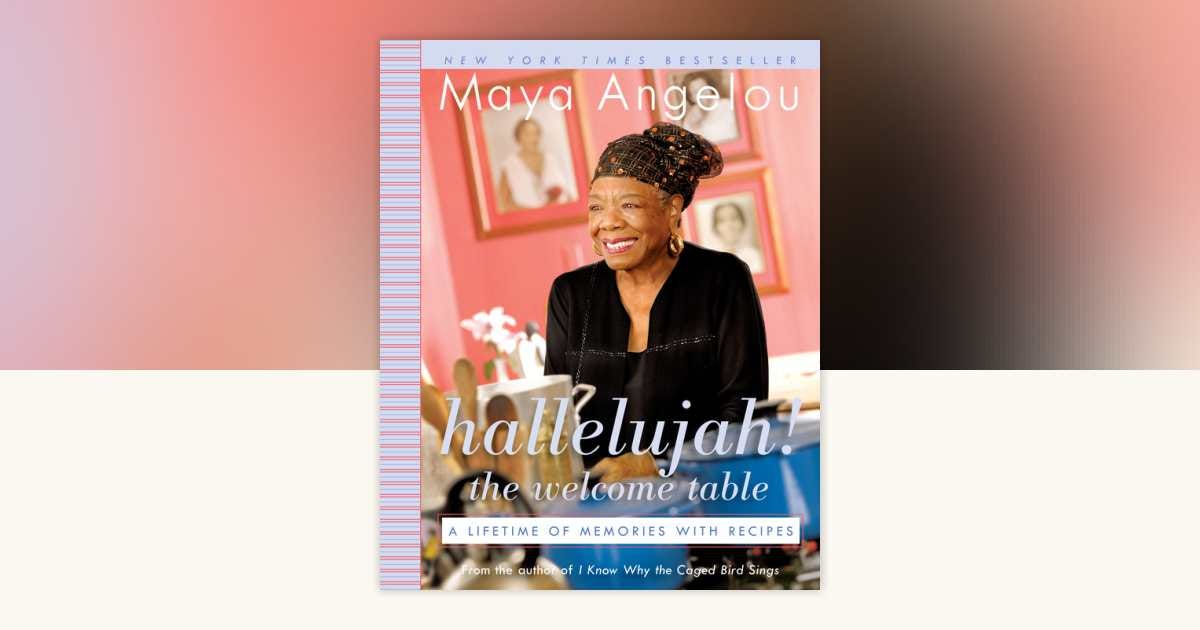
As someone who writes a food blog, I had placed my library hold within the hour. As a little black girl who has looked up to and relied on Maya for strength, I felt like she was giving me a big hug.
Hallelujah: The Welcome Table is a book of recipes told through anecdotal memories. There are 28 prose passages and 72 recipes. Categories are just as much shaped by experience and message as they are pies, essentials, meat, and veggies. Food speaks, and in Maya’s case, she made her way into who she was as a writer, daughter, and friend by honing her skills as a chef — from learning recipes to making them her own.
In Maya’s world, no one could have a slice of her grandmother’s Lemon Meringue Pie before listening to a story. Liver and Onions represented the sacrifice adults make in order to see you grow up healthy and strong because they love you. These experiences are not entirely Southern either. After all, Maya was a world traveler and she learned a lot about boundaries through her food experiences abroad. Surprisingly close to home, many transformational food memories and adopted recipes come from her time in California. She lies her way into a cooking job in San Fransisco, only to end up running a successful Creole kitchen. She learns the truth of love and lust. She repairs her relationship with her mother over red rice.
In Los Angeles during the mid-1960s, she’s temporarily staying with a friend, can’t find work, and is running out of money. She tells a social worker at an employment agency about her relevant experience as a blues singer in Hawaii, and an administrative assistant (with no typing skills) in Ghana. The social worker tells her that she’s unemployable, but thank God Maya could cook. Her friend sets up a scheme to lure an acquaintance over for Southern brunch. The acquaintance was a homesick Southern white man working at a PR agency for large corporations who “would break down and cry if you mentioned fried chicken.” Her friend was determined that if Maya cooked for him, she’d come out of that brunch with a job. She serves sausage made from scratch, eggs, spoon bread, fried apples, and homemade biscuits buffet-style. Maya watched him sit alone by the windowsill and disappear into him Alabama childhood with each bite. At the end of the night, the man walks straight up to Maya and says she can start her new job on Monday as long as she shares her recipes. “…if you can write half as good as you can cook,” he says, “you are going to be famous.”
Here I was, vulnerable, fragile, and defeated. In looking to Maya for answers, I had expected something of love, passion, joy, boldness, and courage. That is how it goes as a Black femme. One must be unbreakable and always rise above. One must persevere all disrespect, violence, and strife. If one is too overcome by emotion to be strong, or too fresh off the heels of unprovoked violence, one must hope that another Black femme has the time and energy reserves to stand in your place. One must hand over their rage so that another can pick it up and fight back. Maya stopped speaking due to being sexually abused as a child. This, we all know from her acclaimed memoir I Know Why the Caged Bird Sings. A teacher, who was so angered by the fact that Maya was not speaking, slapped her across the face. Maya ran home to to her grandmother whom she called Mama. Mama stopped what she was doing, went back to the school, and slapped the teacher across the face. This is the impetus that gives us Caramel Cake, a special occasion dish that reminded Maya how loved and precious she was even when the world gave her every reason to doubt it.
I expected Maya to be chock-full of resilience, but I did not expect food to be one of those building blocks. “With almost nothing,” she says in this story “if you care, you can make something. That’s the lesson of African American cuisine.”
I spend a lot of time these days thinking about the dishes that have the ability to transport my mother out of this reality into some sweet, wholesome memory. In the time that I’d been allowed to visit her she would tell me that the nursing home food was bland but better than nothing. I brought her the usual fast-food favorites because driving a minimum of 1.5 hours to visit with her necessitated ease of pickup and transport. She was always grateful and excited.
I made sure each visit consisted of “real food.” She ate four slices of “the best pizza ever” before falling asleep on our tour of the Christmas lights. I fed her lemon-pepper dusted filet o sole and french fries at a you-buy-we-fry fish market wher she said “oh wow, thank you” before every bite. I brought all of her favorite snacks — Doritos, cheetos, cookies, iced teas. I drove her down the street from her nursing home just so she could admire the bougainvilleas in the neighborhood. We stood in front of houses filled with people we’d never meet and stories we’d never know until loose guard dogs chased us away. On the way back from our flower excursion, she was delighted to learn that it was “burrito time” which she said while holding up rockstar handsigns — even as her head sank into her chest from being tired out by the walk. Every time she saw me, I made sure she felt the pleasure and relief of familiar flavor.
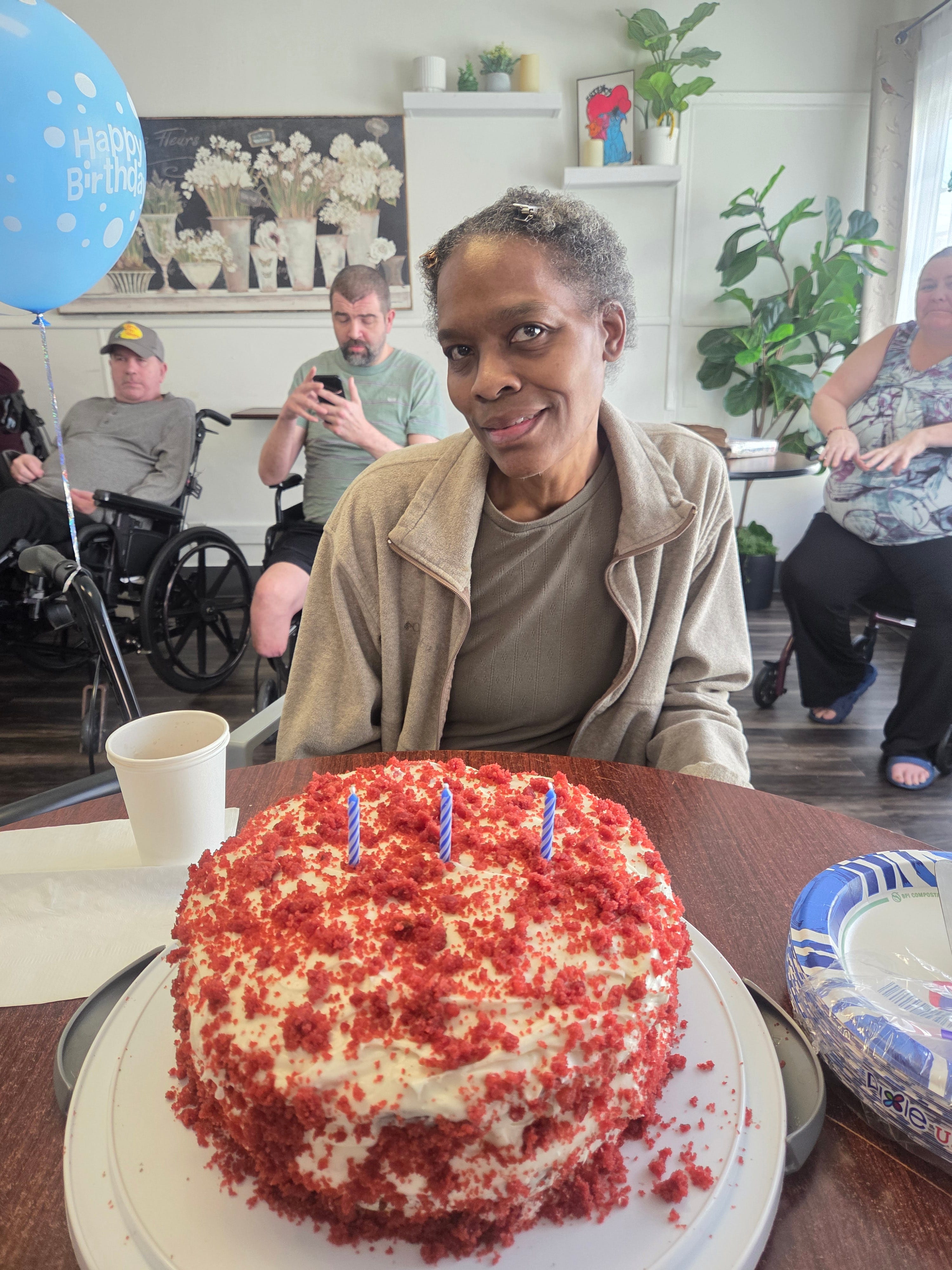
When preparing to make her birthday cake I presented her with a list of options.
You really don’t have to do that she said while patting my knee.
I want to. How about Caramel cake?
She shrugged as if she was willing to eat it, but it wasn’t what she truly wanted.
Pound cake? This was her specialty. She went through a phase where she made one whenever she got the chance.
My mother tilted her head side to side at the mention, but was more preoccupied with putting the right amount of mustard on her hamburger bun.
Coconut cake? Maya had a recipe I’d been dying to try, but I was unusually surrounded by coconut haters.
Hmm, not really. She said clearly before scanning her surroundings.
Red velvet?
Mother pointed her fingers at me and nodded slowly. She looked me directly in the eyes, and said that’s it. Finally, she went in for a bite of her lunch.
Still, I am not sure what dish would bring my mother to tears. I know what she liked, but much of it is processed or requires dining out. She had many different phases, and some of the restaurants she was loyal to have now gone out of business. The longer I wracked my brain for something she would want to eat slowly and savor with each bite, the more I realized how different our tastes had become. Over the past five years I have worked incredibly hard to ween myself off of eating out several times a week. Growing up, I observed food as an escape or as an easy alternative ot chronic exhaustion, not as a healing agent. This breeds addiction. I’ve also struggled with being overweight my whole life, like most people in my lineage. It wasn’t until I became the runner of my own kitchen that I realized I cook better and I feel more myself when I’m using whole foods. I genuinely enjoy prioritizing nutrients and vegetables over empty calories. I’ve also had life-changing experiences eating in different countries or dining in unfamiliar places, and now I like eating cuisines I did not grow up with. Buying all of her favorites was like a trip down memory lane that illuminated where the root of my issues with food came from, but it also deepened the grief that I might not be able to share my new way of cooking, eating, and enjoying food with her.
After reading Hallelujah Table, I couldn’t stop talking about Maya’s fried meat pie story. Her grandmother’s husband walked out on their family in 1903 after five years of marriage and left her with two sons — the older was Maya’s father, and the younger “Uncle Willie” was disabled after falling off the porch onto the ground as a baby. Maya’s grandmother, “Momma,” blamed herself for it all but she did not quit. As a single mother, she had no choice. Working as a maid was her lowest hanging fruit being a Black woman in the South at that time, but it would require her to leave her children unattended or in someone else’s care. She wanted to spend time with her children and make money, so she used the skills she was confident in and started a business. The cotton gin sat three miles away from the lumber mill. She spent evenings prepping meat and pastry, early mornings assembling the meat pies, and mid-morning making her commute. She set up her folding chair and cooking supplies at the “colored entrance” and rang her bell shortly after lunch. Hot meat pies were sold at 5 cents. Leftovers were wrapped up before she ran three miles over to the lumber mill. Warm, but still fresh pies were sold for 3 cents. She alternated her start between the cotton gin and the lumber mill to ensure fairness, and it won the respect of her customers — her delicious cooking didn’t hurt. Within a few years she had enough resources to build a hut between the two factories, and instead of running from one place to the next, the workers ran to her at lunchtime.
The last two paragraphs of Maya’s story read:
“ ‘Sister, the world might try to put you on a road that you don’t like. First stop and look behind you. If nothing back there makes you want to return, then look ahead. If nothing ahead beckons you enough to keep you going, then you have to step off that road and cut yourself a brand-new path.’
The hut became a store in which I grew up. It remained in use for over sixty years.”
The store she speaks of — Wm Johnson General Merchandise Store — is the central setting for Maya’s famed work I Know Why the Caged Bird Sings. Maya became a master at making her own way, and one of the most prolific teacher’s in the art of agency and resilience.
Though I’d long had my eyes on an onion tart recipe that comes later on in the cookbook, nothing felt as right as fried meat pies for Mother’s Day.
The chicken was quite easy. I never would’ve thought to pair cinnamon with red pepper flakes and caramelized onion. It was simple, but not at the cost of depth. The biscuit dough, on the other hand, was humbling. It’s funny, I was puzzled and worried about pulling off a buttermilk biscuit crust instead of using puff pastry. I even contemplated making a switch to store bought crust, but I was comforted by the idea of an old Southern recipe intended to hold over factory workers until dinner time. Therefore, it was more important to trust the process.
By the end of the process I had made the crust too thick and fried the first batch of pies too fast. My success rate on this first go around came out to 4 out of 8 perfectly golden pies. I wrapped two in foil and drove the 1.5 hours to see my mother — slightly anxious she might find them dry, undercooked, or that contrary to pizza they would be the worst thing ever. Still worried about the biscuit dough overwhelming the experience, I stopped for some Spinach & Artichoke flavored Bitchin’ sauce — something I know she’d appreciate drizzled on any meal. We arrived as she was already eating lunch, so I presented the plate to a nurse, adding that my mother was a late night snacker. Oh yeah, she replied, I have a pudding cup ready for her every night at 8pm. The nurse agreed to give her half a pie instead for the next few days.
Our Mother’s Day visit was frustrating. My mother zoned out often. I tried to introduce her to my partner, but she was uninterested. The conversation was less than surface level but she was still herself. She was served chicken piccata with mixed vegetables and soup. She asked me to pour the juice (aka the soup) over her chicken after she cut it up into small pieces. She tossed it in the sauce before taking a bite. “That’ll work,” she said before devouring her meal. Again, unsatisfied but doing what she had to do.
That evening, well after 8pm, I made my way from the dark corridors of my apartment to the fridge and cut the last surviving meat pie for a late night snack. Only after I experienced it myself did the recipe begin to click.
Rely on the salad plate for cutting out the initial shape, but roll out the edges again afterward for an even cook.
Buy some lard, seriously. As a friend said on a phone call, “Our stuff doesn’t taste the the way their’s did because we’re not using what they use.”
I would never doubt the power of Mama’s pot method, but I need the non stick for this one. Fry one pie at a time, not all at once.
Use more stuffing. Off center doesn’t mean completely away from center. It is as simple as it sounds.
Apart from the stories, the recipe pages within Hallelujah table are mostly made up of white space. Just like the tropes about learning Black American cuisine, Maya gives you the guardrails, but the rest is to taste. Sometimes when we witness the curtness and the resolve of a Black femme bustling through her kitchen, we may equate this with perfection or superiority — even magic.
The point of the white space on the recipe page is to observe, feel, and practice. Beyond obligation and gender expectation, the black femme’s presence in the kitchen can be about practical pleasure and spiritual embodiment. When I didn’t churn out a batch full of perfect meat pies on my first try, I thought my body and mind might be out of sync or that I was moving too fast. Now, I don’t think Maya would have expected me to get it right on the first try, being the cycle breaker that she was. I think she would have called it a delicious try, and asked me if I enjoyed myself. Then I believe she would said try again next week.
No posts
Comments
Nothing yet. Say the first thing.
Sign in to join the conversation.