
40 years ago, in 1986, Wheeler asked this question. It is a deep question, because it also asks why atoms exist, why particles exist, how life works, and why quantum mechanics is so weird.
The following image, showing the platinum atoms on a needle tip, captures the fascination of atoms making up a metal. We are also made of atoms - just different ones, many of them, and always moving around.
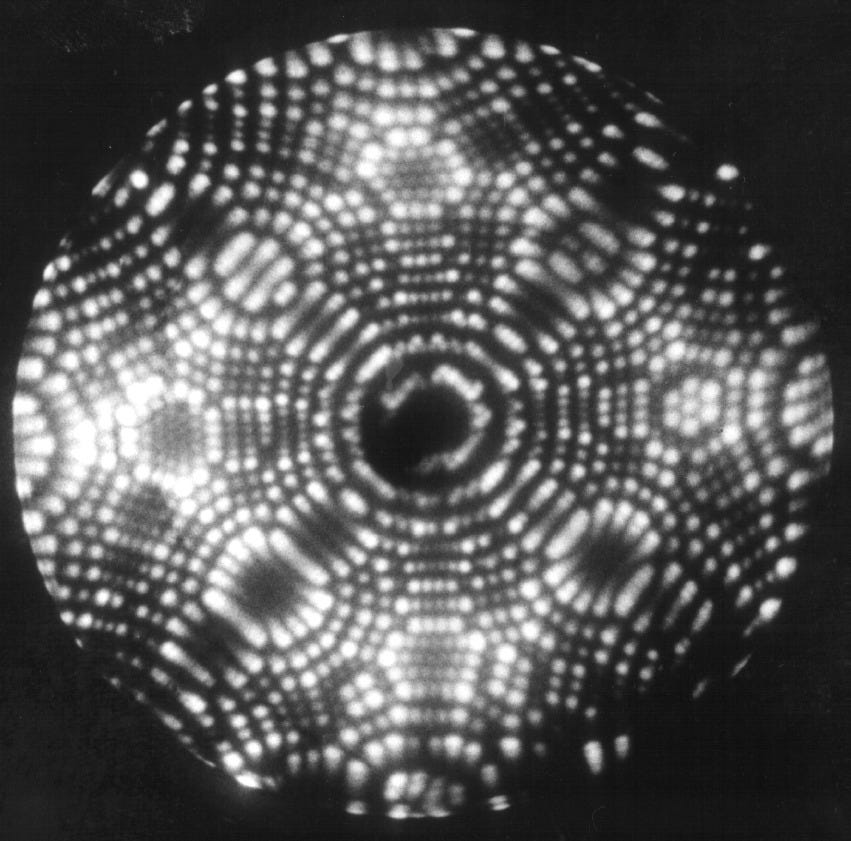
Tatsuo Iwata, via wikimedia
Why do atoms exist? The first answer you will learn at school is: atoms exist because of Planck’s quantum of action ħ. In my view, Planck’s discovery was one of the most influential ideas of modern science. But then we ask: where does the quantum of action come from? There was no answer for a long time. But finally, in 1987, Louis Kauffman provided the simple and fascinating answer: Planck’s quantum of action ħ is a topological effect.
This is the basis of the strand model of nature, in which particles are tangles of unobservable strands whose crossing switches ħ and are observable.
Why is this answer interesting? It enables everybody to understand and to visualize quantum theory. The definition allows everybody to visualize wave functions, to visualize spin, to visualize statistics, to visualize multi-particle states, to visualize superpositions and interference, to visualize wave function collapse, to visualize entanglement and to visualize measurements and probabilities.
Recently, Louis Kauffman and I wrote a text together that realizes this promise. The text is pedagogical, thus somewhat long, but you can start by just looking at the pictures.
By imagining nature - particles, vacuum, and horizons - as built of strands, it is possible to deduce, to visualize and to understand quantum theory. But it is also possible to deduce and to visualize the three gauge interactions, general relativity and the various elementary particles found in nature. The text dramatically simplifies our description of nature. I hope you enjoy it.
*
The full article is
How come the quantum? Testing the topological origin of Planck’s quantum of action, by L.H. Kauffman and C. Schiller, available at zenodo.org/records/19628907
When you look at it for the first time, only look at the pictures.
Then, only read the last paragraph of each section, which starts with “In short”.
Enjoy.
And as usual, every good remark about the text is rewarded with an invitation to dinner - or more.
* *
No posts
Comments
Nothing yet. Say the first thing.
Sign in to join the conversation.