
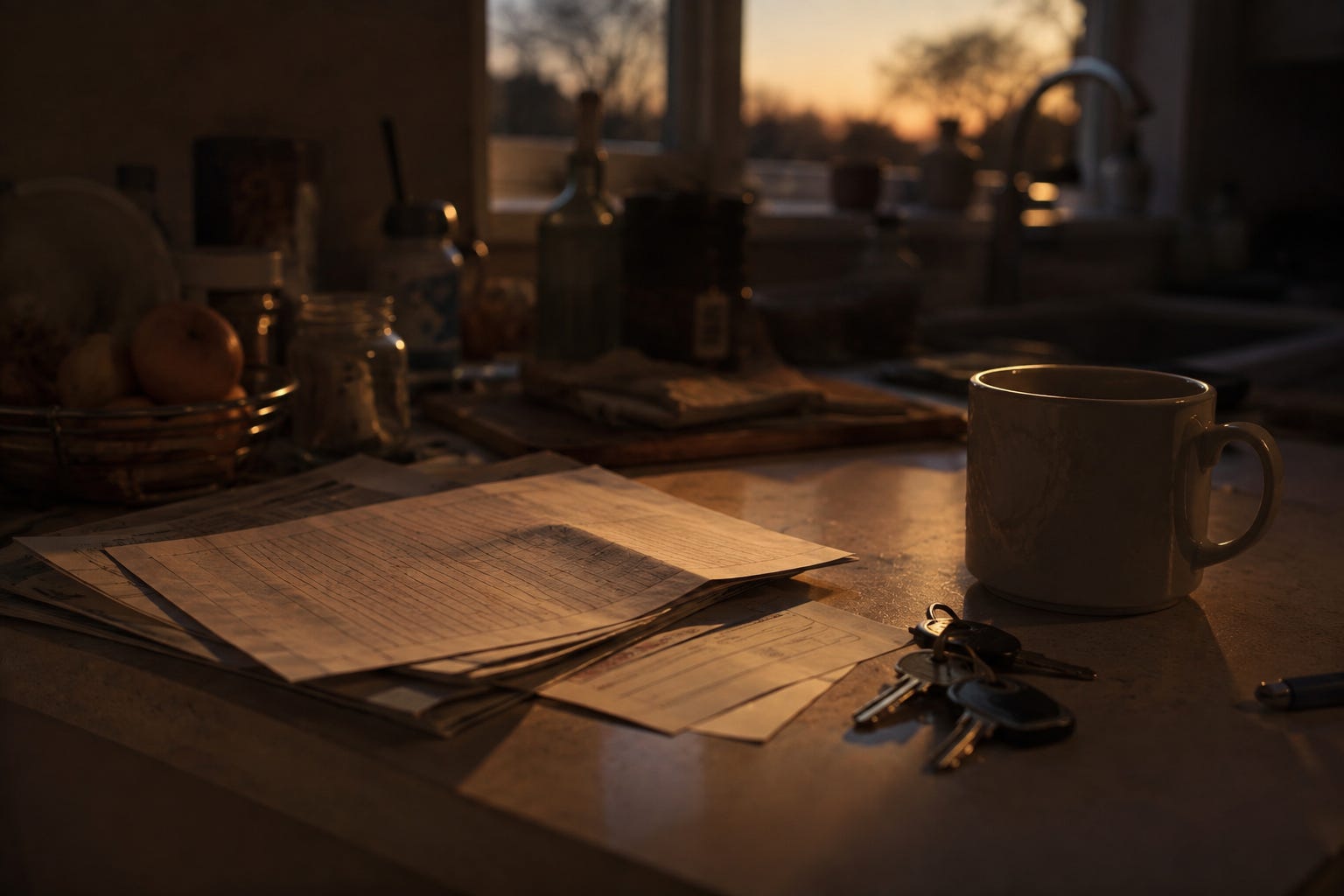
Try this. Go find someone in your house — a partner, a kid old enough to drive, whoever — and ask them what day the recycling goes out. Not trash. Recycling. The one that alternates. Watch the pause.
Now ask them which kid is allergic to what, and how bad. Ask them the pediatrician’s name, or where the birth certificates are, or the password to the school portal, or what time the tutor comes on Thursdays, or which of your children is currently not speaking to which other child and why.
They don’t know. And here’s the part that’ll get you: they don’t know because they’ve never had to. You’ve never been unavailable. Not once. Not in fifteen years.
You are not the manager of your household. You are its only copy.
We call this being organized. We call it being on top of things. When someone says I don’t know how she does it, that’s what they’re pointing at — this enormous, invisible, undocumented database that lives behind your eyes and nowhere else on earth. And you’ve probably felt a little proud of it. I know I have. There’s a specific kind of dignity in being the one who remembers.
But run the thought all the way to the end. What happens if you get the flu — not a manageable flu, a real one, the kind where you’re down for nine days? What happens if you have to go to the hospital? What happens if you just, one Tuesday, for no reason you could explain, could not get out of bed?
You already know the answer, because you’ve probably tested it. You got sick once and the whole thing lurched. Someone missed a practice. Someone ate cereal for dinner three nights running. Somebody’s field trip form never got signed. And you lay there with a fever, texting instructions, because it turned out the house couldn’t run for four days without pulling data directly out of your skull.
So you did what we all do. You concluded you needed to be better. Better systems. A shared calendar nobody looks at. A family binder you made in 2019 that’s now a museum of expired information. A whiteboard. An app. A label maker, God help us. And when those didn’t hold, you concluded — quietly, without ever quite saying it out loud — that the problem was you. That you weren’t disciplined enough. That a more competent woman would have this handled.
Mama, I need you to hear this clearly. You didn’t fail at a system. You are the system. And no system can document itself while it’s running at full capacity, every day, with no backup, for two decades.
Here’s the part I’ve been chewing on lately, and it’s bigger than laundry.
Most of us spend our lives trying to solve the constraint in front of us. Not enough hours, not enough help, not enough of me to go around. So we optimize. We wake up earlier, we meal-prep, we get efficient. But every constraint has a parent. Go up one level and ask why does this constraint exist in the first place — and the answer is almost never “because you’re bad at this.” The answer is almost always: because the structure was built assuming you’d always be there.
That’s it. That’s the whole thing. Nobody wrote it down because you were always available to be asked. Nobody built a backup because you never went offline. The house isn’t badly organized — the house is perfectly organized, around the assumption that you are permanent, infinitely available, and never, ever allowed to be a person who is unavailable.
You are not a scheduling problem. You are a single point of failure, and that is not a compliment. It’s the most dangerous position in any structure that matters.
I’ve been thinking about this because I’ve been living inside a version of it that I built myself, on purpose, like an idiot.
For eight years, every genuinely new question in my company has come to me. Not because my team is incapable — they’re extraordinary — but because the answer didn’t exist anywhere yet, and I was the only one who knew what this company is, and what it will never do. That knowledge had never been written down. It just sat in me. So the work would stop, turn around, and wait for a woman to be available.
I built a company whose entire mission is that mothers should not have to hold everything alone. And I made myself the single point of failure. You can laugh. I did.
So right now we’re building something we call the Brain — a living, breathing memory for the whole organization, where everything that used to live in my head gets written down where it can breathe: get amended, get corrected, get updated the second the truth changes. Not just what we decided, but why, and what it had to survive. Not a binder. Not a museum. Something alive, so that anyone on my team can walk in on a Tuesday and be fully caught up on any corner of this business without needing me to be conscious.
And the strangest thing has happened. I’m not less necessary. I’m finally necessary for the right things.
Because that’s what nobody tells you about being the only copy: it doesn’t make you indispensable, it makes you trapped. Every hour you spend being the family’s search engine is an hour you are not spending being a mother, or a person, or a woman with a Tuesday of her own. The irreplaceability you’ve been so quietly proud of is the exact thing that has never once let you rest.
You want to know what the real luxury is? It’s not a spa day. It’s not a weekend away. It’s being able to get sick without the whole thing falling down.
That’s the goal. Not doing more, not doing it better — building it so it doesn’t need you to be superhuman, so it can survive you being human. And you cannot get there by being more organized. You get there by refusing the assumption underneath the whole arrangement: that you’ll always be there.
So tonight, when you get in the tub — and I hope you get in the tub — I don’t want you to make a list. I want you to pick one thing. One single thing that only exists inside your head, that would break if you disappeared for a week.
And I want you to get it out of you. Say it out loud to someone, write it on the back of an envelope and stick it to the fridge. It does not need to be a system. It just needs to exist somewhere that isn’t you. That’s not delegating, and it’s not giving up control. That’s the first time in maybe twenty years that you’ve built yourself a way out.
Twenty minutes. One thing. Out of your head and into the world.
You’ve been carrying the whole map. It’s time somebody else learned to read it.
xoxo
If you want the mechanics of how we’re actually building this — the architecture, the guardrails, what we got wrong twice — I wrote the whole thing up over on the site: They're buying the ethos
Comments
Nothing yet. Say the first thing.
Sign in to join the conversation.