
I’ve started and stopped this newsletter plenty of times. Every thought has felt incomplete. Too much emotion and too little substance.
Recently in my journaling, I wrote that perhaps I am uncomfortable being perceived as dumb.
As soon as I wrote it down, I felt a deep ache. My whole childhood revolved around this fear of perceived intelligence (or lack of) and it has never fully diminished.
I felt it when I tried to make a joke that didn’t land and the AV teacher in fourth grade told me it was stupid. I felt it whenever a friend told me to stop asking questions in class or a teacher grew tired of my inability to listen without argument.
I tied my ability to consume information and write about it as the highest form of knowledge.
How many books can I read? How can I achieve the verbal feedback I need to be qualified as intelligent enough? How can I do this without being annoying to people who didn’t like being questioned?
The math I knew told me that academic achievement + following directions = success.
The reality of my undiagnosed ADHD made this feel impossible. I was smart enough to ace the tests but unable to complete homework. To quote a good teacher of mine after my ADHD assessment, “Chanel is the only honors C student I’ve ever had.”
I felt lazy because I was punished for my inability to meet my full potential. I accepted the punishment with relief: I’m thankful that people see me for the lazy garbage I am. Being grounded means I can finally have other people make decisions about what I should do next.
I had no idea that ADHD was why I felt like a walking contradiction. I just felt dumb. I didn’t have the language to describe how I had three monologues running through my head with a song on full blast. I knew that my head space felt loud and I couldn’t focus, therefore I needed to just focus.
Why can’t you just make something happen and get the good grade/ paycheck/ satisfaction of responsibility?
When we ask others why they can’t accomplish something, are we understanding their limitations? Are we asking why they can’t achieve something we feel is a normal standard with compassionate curiosity, or with judgment?
As an adult, I am currently having a hard season of accepting my brain and body limitations with compassion and curiosity.
When I tried a medication for ADHD at 18, I discovered the stimulant was a perfect recipe for an addictive personality like me. (I’ve recently been diagnosed with OCD as well and have read that these medications can enhance anxiety.) I chose during that point of my life to quit the meds and accept my brain as unworthy of help.
I’m just not trying hard enough. I will continue to work harder.
I’ve developed a lifestyle of high expectations and leaning into the hyper focus mania to operate. Not gonna lie, it’s resulted in excellent work.
I’m the person who can miraculously turn a four month campaign into a 48 hour launch. I’m the person who can create online summits for hundreds of guests with minimal help. I can dive into a new project or CRM and adapt to its environment after a couple days. I throw myself into things with a superpower that goes unmatched.
How does she do it? She’s crushing it. She’s thriving...She’s unable to remove herself from the computer and hasn’t eaten in six hours because time is either now or never.
She doesn’t go to the bathroom until a whole project is over, otherwise she’ll be seen as apathetic.
She collapses mentally and physically after working the better part of three days and feels like a failure.
That superpower has also resulted in periods of intense depression and physical pain/ fatigue.
The world has felt incredibly difficult to manage. My high capability to achieve things is not matched by my capacity. I am incredibly creative as a problem solver and writer but I feel the weight of my physical/mental disability (I find myself hating the word disability but here I am, unable to function) is crushing me over the years.
I want to pour all my energy into my family, creative work, and take care of my health. Where does maintaining income producing work land in that energy bank? How can I be productive while also caring for myself in the long-term?
I’ve spent so long forcing myself into the system that now I don’t know how to maintain it.
How does anyone maintain it?
As always, thank you to our financial supporters of Motherhood Minute!
» Financial supporters of Motherhood Minute (paid subscriptions to the online newsletter) contribute to the technology fees surrounding the Mental Health and Motherhood Virtual Summits, magazine production costs, and providing benefits to the contributing creators.
What I’ve been reading
ADHD 2.0 by Edward M. Hallowell M.D. and John J. Ratey M.D.
When I was 17 and randomly looking through the library psychology section, I came across a quiz in one of Dr. Hallowell’s books. It led me to a diagnosis and I’m revisiting the updated research him and Dr. Ratey have put together in this hope-filled bookMummy Man and Waffles: The Dire Deeds of Doctor Gargo by Steve Behling
(Author) and Robb Mommaerts (Illustrator) is the sequel to my daughter’s favorite spooky silly book. It’s a middle school tale about a boy (nickname Waffles), his friend Tanya, and his grandfather (who created props for scary movies). With the help of some magic slime, all the props come to life, including the heroic Mummy Man.
What I’ve been listening to
Jervis Campbell’s album “Good Grief”
Maggie Rogers’ album “Don’t Forget Me”

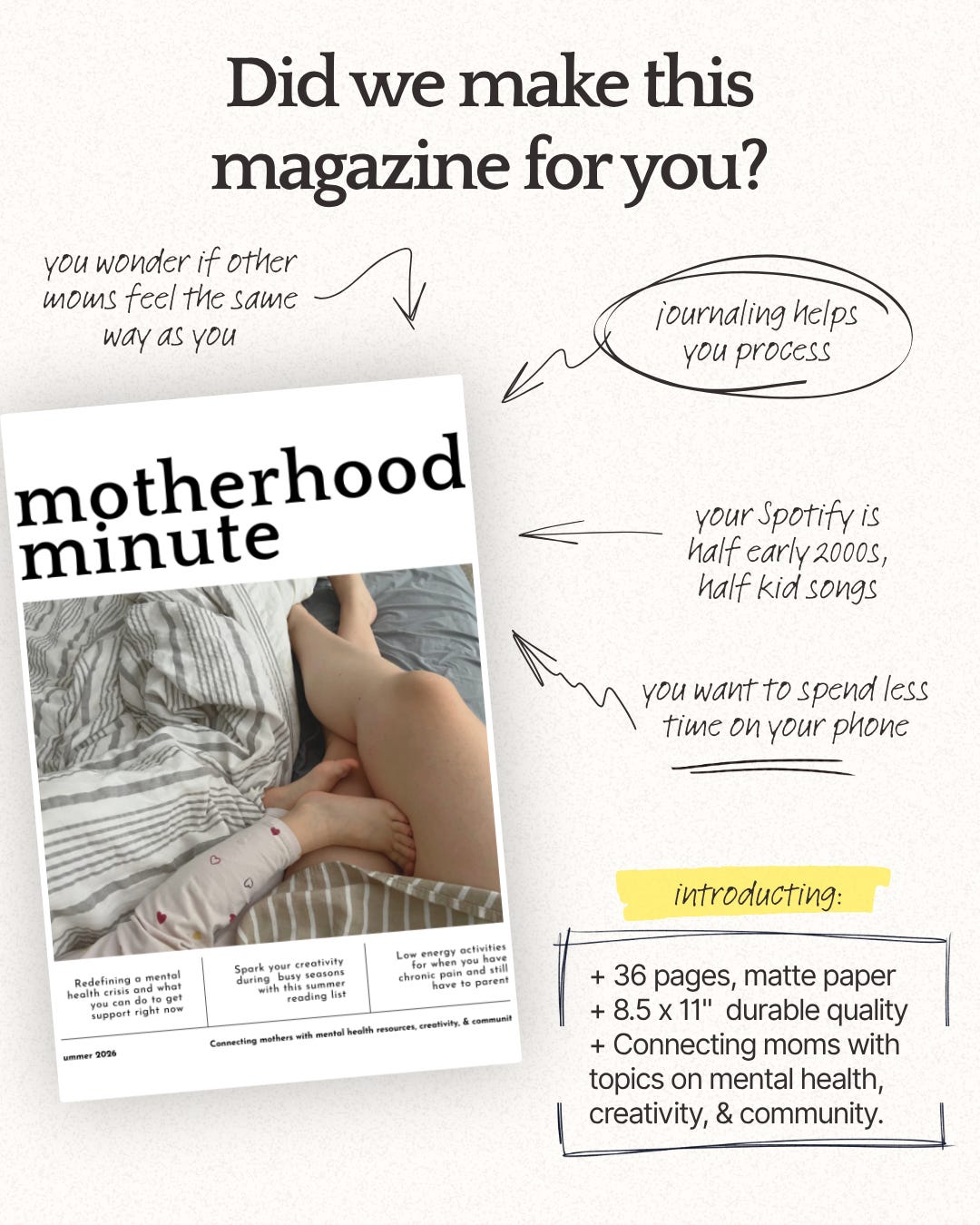
In case you haven’t gotten the summer edition of the Motherhood Minute magazine, you can save $5 by ordering before September 1, 2026. I hope your bags are stocked with snacks and good reading, while you figure out the first few weeks of school.
This issue contains topics on mental health, creativity, and community.
Comments
Nothing yet. Say the first thing.
Sign in to join the conversation.