
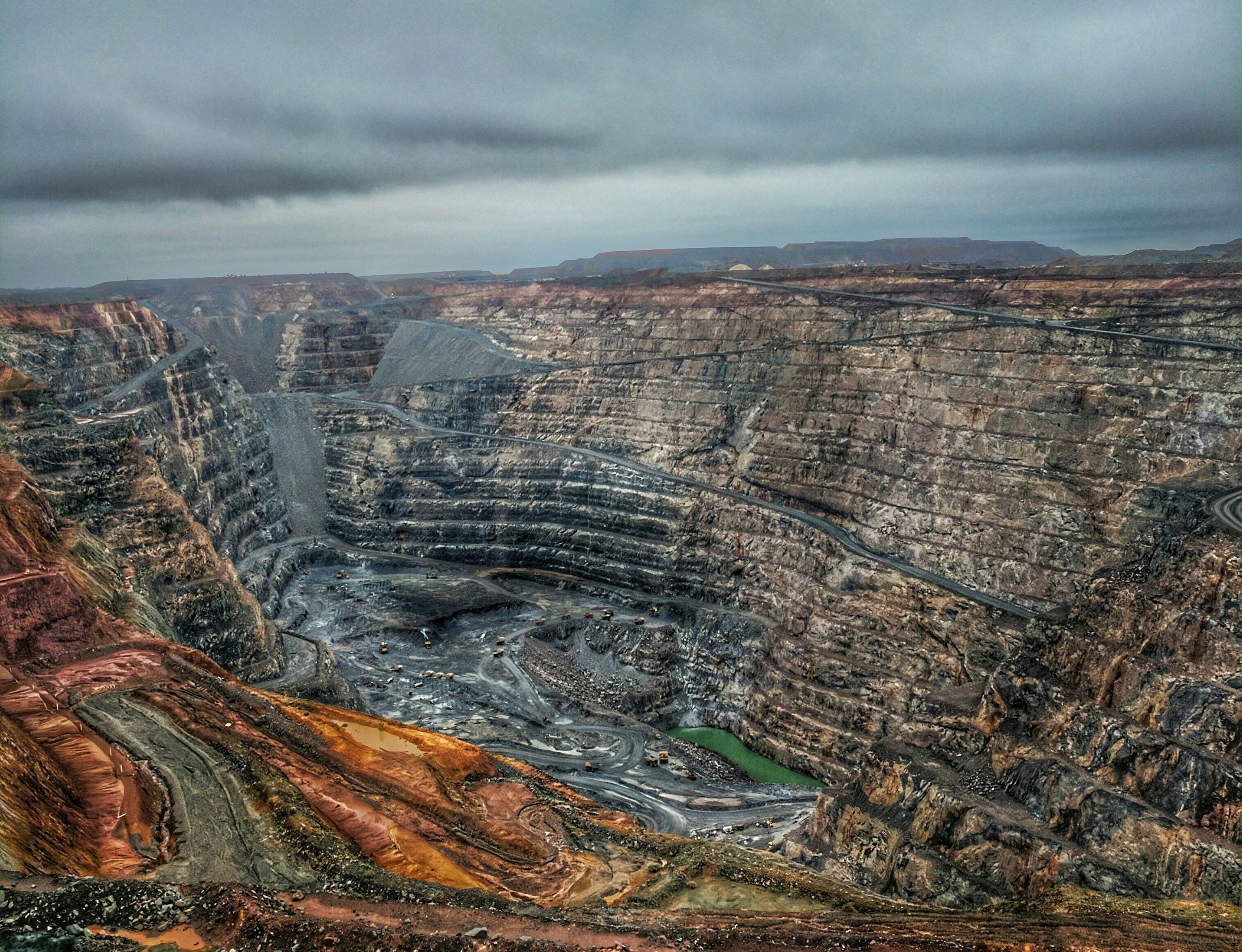
Being able to get things you need when you need them is important.
We learned this lesson during Covid, when countries scrambled to secure medical supplies and vaccines; during the ongoing US-China trade conflict, when China restricted exports of critical inputs into automotive supply chains; and most recently when tensions in the Gulf threatened the movement of oil and gas through the Strait of Hormuz.
Every time this happens the clamour for countries to “secure supply” grows.
Anyway, here is my crude hierarchy of options available to countries looking to secure access to stuff (more details HERE):
BEST: Have domestic access. Obviously.
But it can be easier said than done.
The word “access” here matters quite a lot. I’ve written before about stumbling across a protest in Serbia against a lithium mine that could reduce Europe’s dependency on China, which led me to produce this decision tree:
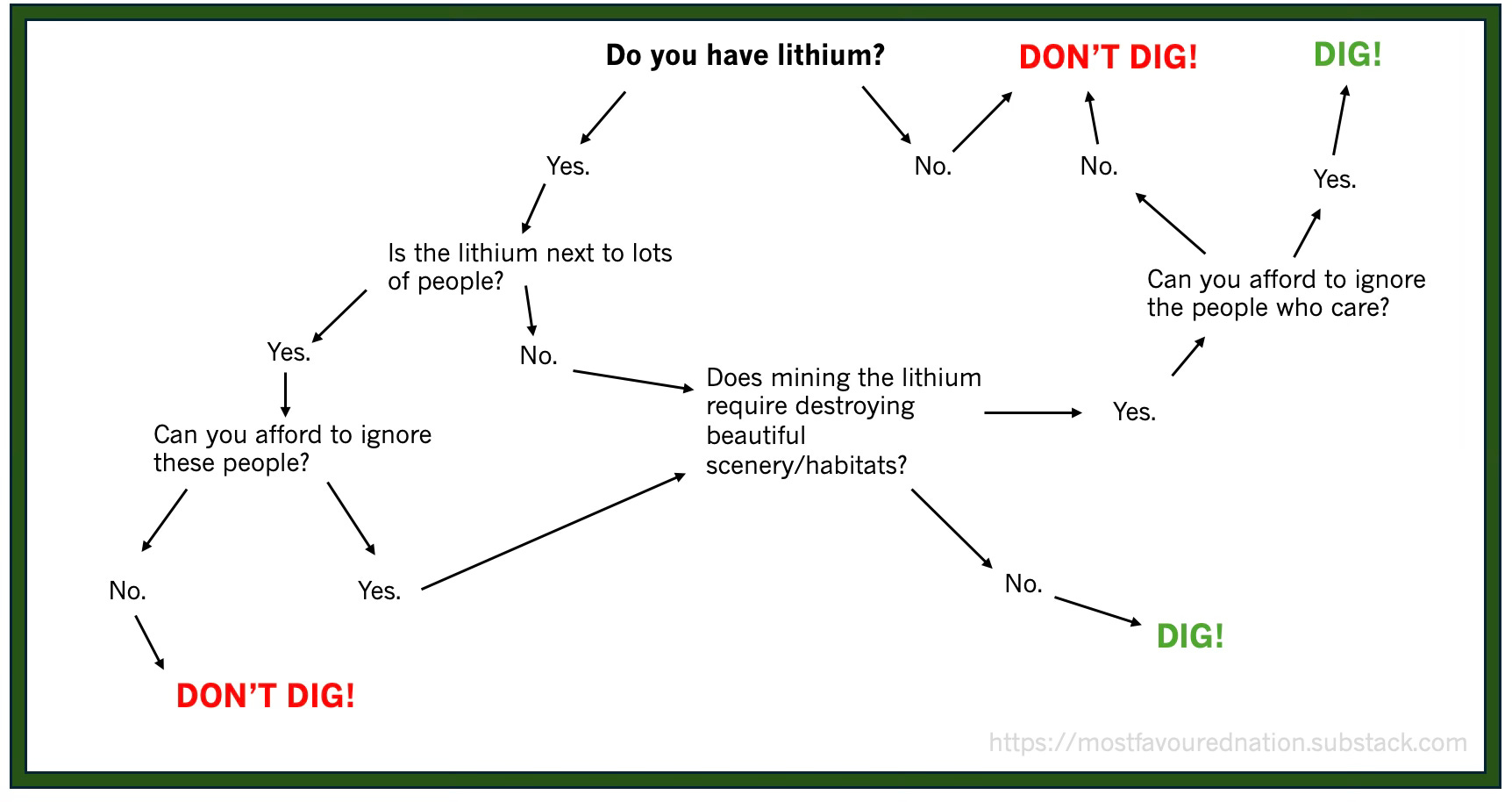
And while “have domestic access” can mean “have a lot of useful rocks under your soil”, or “have lots of fertile land to grow food”, it can also mean “have massive stockpiles of useful stuff”.
SECOND BEST: Get stuff from allies.
Obviously if you don’t have the stuff yourself, and aren’t willing to invade someone to get it (this is BAD … but, y’know, an option taken up by some) then the next place you look is your mates.
But there is, to my mind, a pretty big drop-off between “having the stuff yourself” and “getting it from someone else”.
This is because you will always be second fiddle. Or rather, if your mate and his family need the stuff too, they are always going to prioritise themselves over you.
The other issue is that your allies also have other allies. And some of those allies may be more important than you, or at least more scary.
This means that even if they have agreed to supply you during a crisis, they may also have made similar commitments to other countries.
In practice, the hierarchy often looks something like this:
Keep stuff for yourself
Give stuff to the US [maybe China]
Give stuff to other people
But what if you have an agreement saying that the other country will absolutely give stuff to you if you need it?
Even then, I’m slightly sceptical.
The fact that EU member states came close to imposing export controls on PPE moving to other member states during Covid is a pretty good example of this, given you can’t get a much stronger international agreement than “being in the EU”.
But this doesn’t mean you shouldn’t try.
To that effect, New Zealand and Singapore have signed what they describe as a “world first” agreement on trade in essential supplies.
First, I know what you’re thinking. It’s pretty easy to sign an agreement on trade in essential supplies when neither of you sell very much that feels obviously essential.
But it turns out New Zealand is particularly reliant on Singapore for refined fuels, while New Zealand, of course, produces a lot of food Singaporeans might want.
And New Zealand and Singapore have priors when it comes to signing agreements intended to normalise concepts that later get rolled out more widely. See, for example, digital trade agreements or, arguably, CPTPP.
But what is most interesting to me is that despite both countries being deeply reliant on trade, and explicitly wanting to set an example for others, even these two could not fully commit not to restrict trade in essential goods under all circumstances.
First, the list of goods covered is fairly narrow — although it can be expanded over time.
Second, the prohibition on restrictions is itself narrowly defined. Both countries give up their right to impose quantitative restrictions under GATT Article XI:2(a) [i.e. temporary restrictions to prevent or relieve critical shortages], but they still retain broad scope to restrict trade for other reasons, including national security.
Third, nearly every commitment is caveated with language along the lines of “to the extent possible”, “when available”, etc.
Anyway, there is a real chance this agreement represents something close to a high watermark for what is politically possible.
And to be fair, I suspect Singapore and New Zealand probably would try to honour it if push came to shove — it helps that the volumes involved in both directions would be relatively small.
But the uncomfortable reality is that international cooperation on essential supplies tends to work best precisely when it is not truly being tested.
Which is why, despite all the rhetoric around trusted partners and resilient supply chains, countries still tend to fall back on the same hierarchy in a crisis:
Have the stuff yourself.
Hope your allies still have enough left over.
And pray they like you more than everyone else asking.
Those of you who have children, or have given gifts to people who have children, have probably come across Sophie the giraffe. For those of you who haven’t, it’s a little French ahem rubber toy giraffe that toddlers seems to like chewing on. Or at least mine did.
Enter … the funniest trade story of the year so far [via the SCMP]:
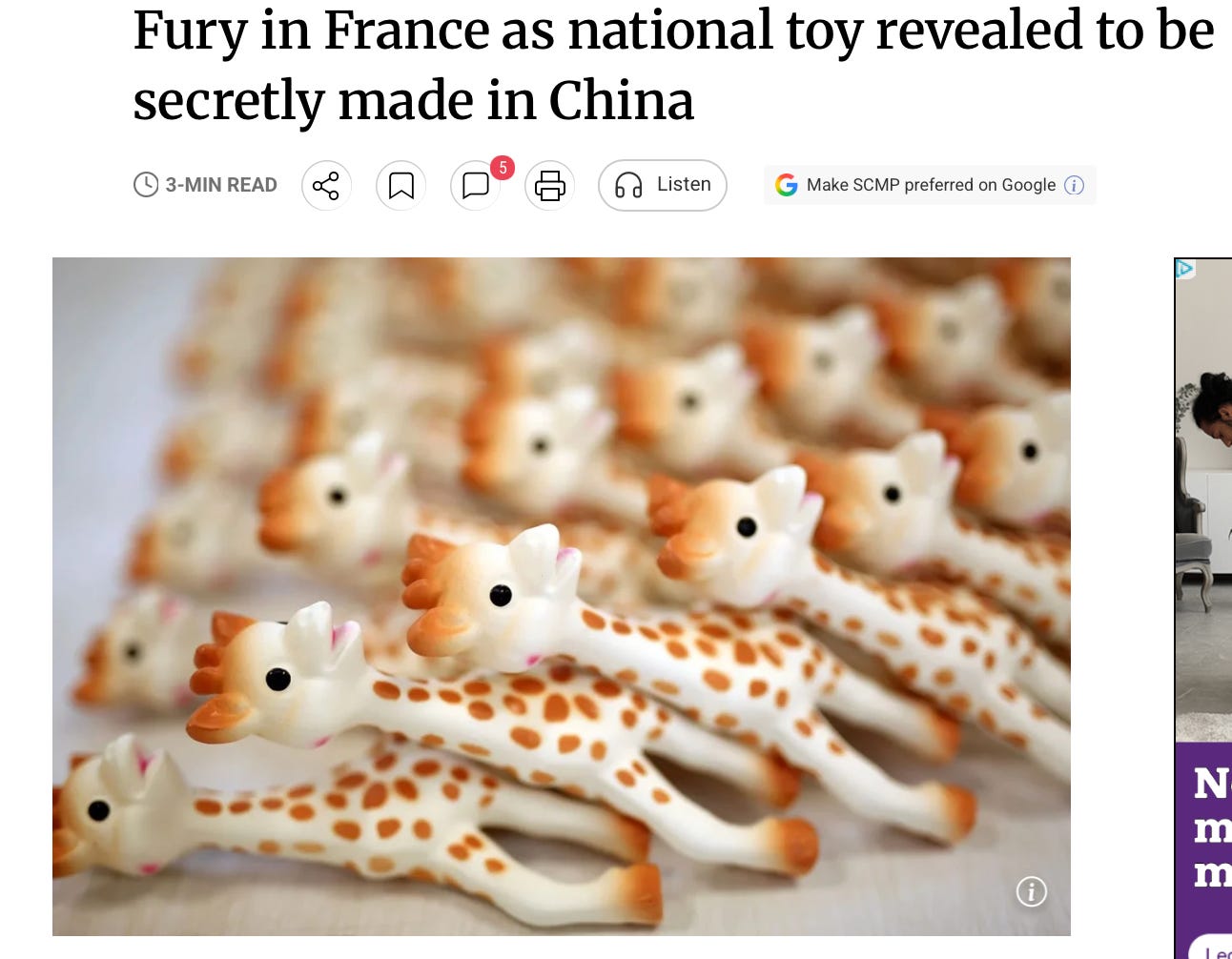
Sophie the giraffe … is actually Chinese!
Incredible scenes.
Highlights include:
Current and former workers told Mediapart they saw no one working in the factory and the production line would only spring to life when clients or journalists came to visit.
“We’d place four or five people in the workshop, the raw materials were expired. Everything was fake,” one manager said.
Last week the US President’s temporary tariff bridge — Section 122 — began to crumble as the Court of International Trade found that its use as a justification to apply a 10% tariff on everyone was ill founded.
This was expected, and in practical terms doesn’t change very much given these tariffs were only intended to last 150 days anyway.
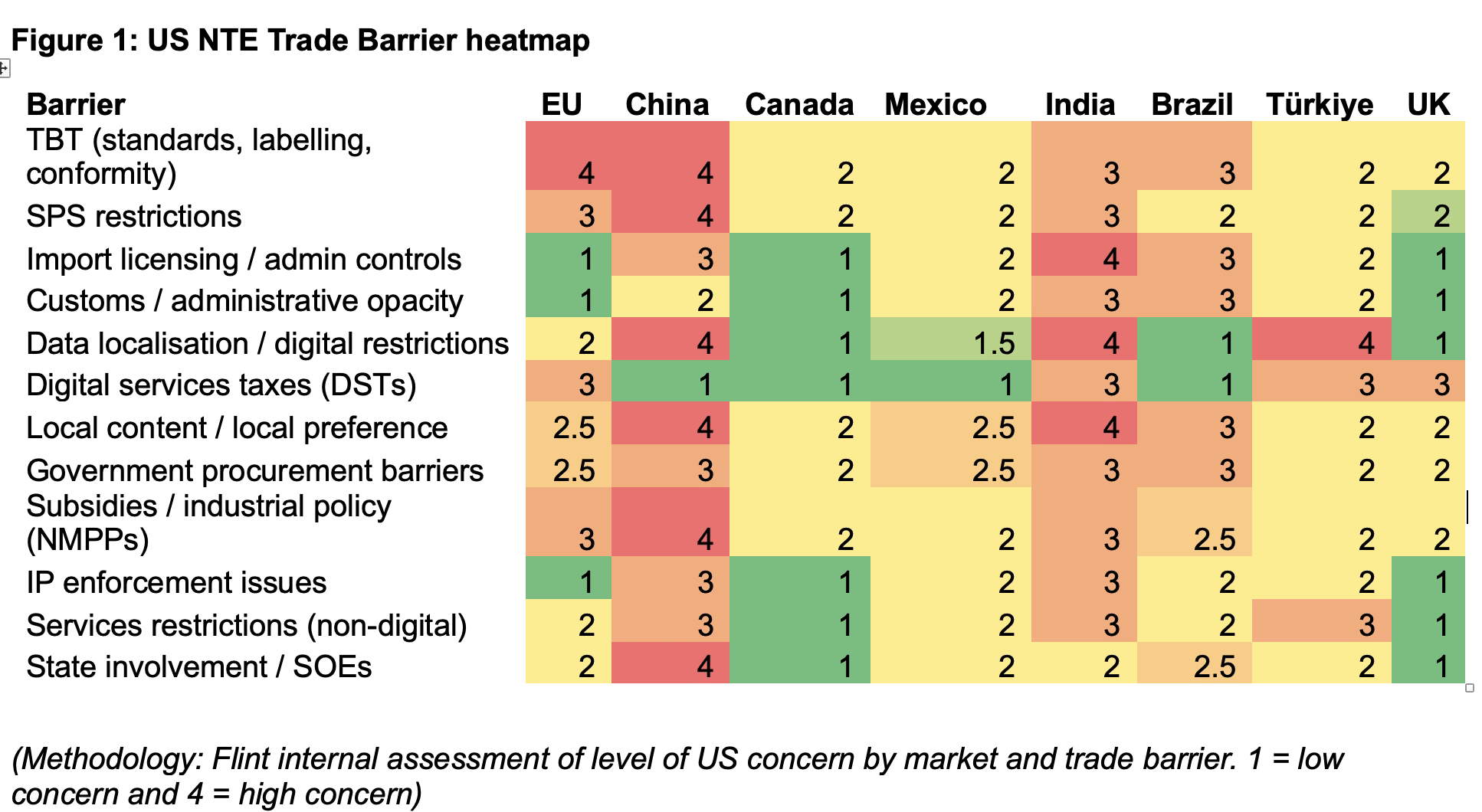
The big question is rather, what comes next. To that effect, my Flint Global colleagues Emilie Kerstens and Will Haworth have published a new piece looking at Section 301 tariffs, and what these could look like in practice.
Read it HERE.
They also created this jazzy heat map of US grievances against the rest of the world:
If you prefer your trade news in podcast form, I joined the CER’s Anton Spisak for a discussion of Trump’s deferred car-tariff threats, and the sustainability of the EU-US deal.
Check it out here:
And HERE.
Best,
Sam
No posts
Comments
Nothing yet. Say the first thing.
Sign in to join the conversation.