

One of my current concerns is that people are slightly too sanguine about the global economic impact of the Iran shock.
Similar to the early debate around Trump’s tariffs, many people appear to assume that higher costs feed almost immediately into consumer prices. In global goods trade, they usually don’t.
By which I mean, there is usually a lag between input costs going up, or in the case of Trump tariffs going up, and the price impact being felt in the real economy because firms first work through existing inventory and remain bound by existing contracts.
But this dynamic doesn’t last forever. And at some point, some consumer prices do indeed start going up.
Anyway, my rough model of the Iran shock, which is fundamentally an energy price shock (unlike, e.g., the Suez Canal blockage) is something like this:
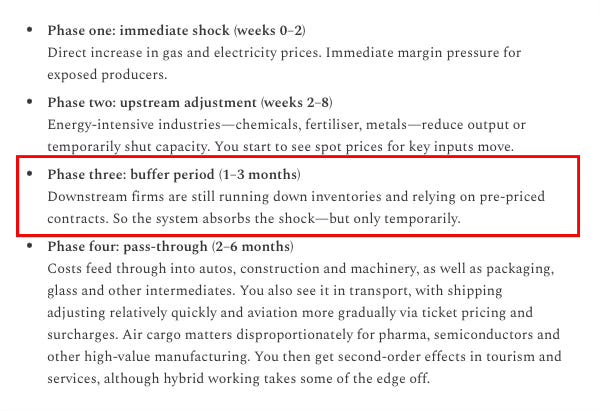
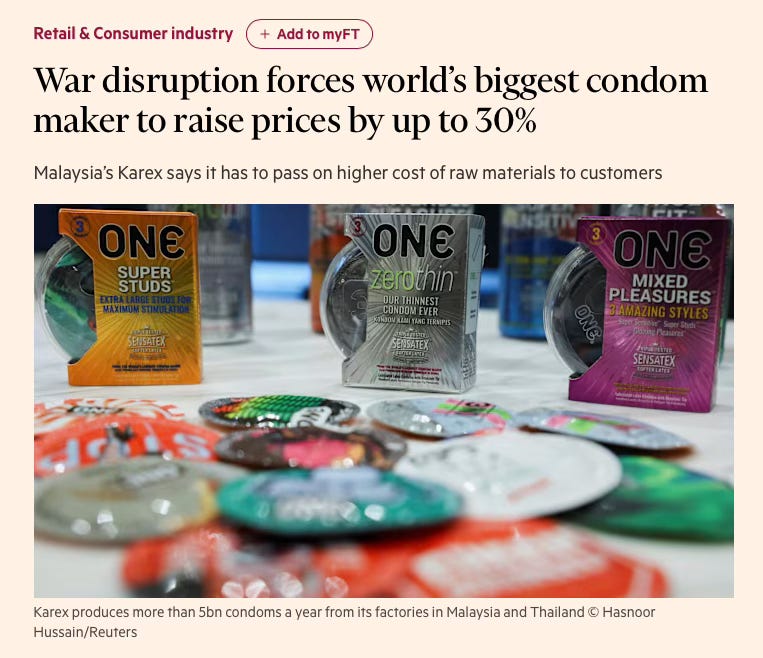
And if this is the case, we’re currently at the tail end of phase three, the buffer period, and in the coming weeks we’re going to see more and more stories such as this:
But even if you assume there is going to be a more acute price impact hitting soonish, you can’t necessarily assume that this price impact will be regionally homogenous.
Global Trade Alert’s Simon Evenett has published a very helpful piece of analysis looking at the historic long run (19 month) impact of energy price shocks on regional export performance.
As ever *adopts serious voice* past performance is not necessarily indicative of future events … but interestingly he finds that the it is not necessarily the price of energy going up that has the biggest negative impact on a regions export performance, rather the volatility of prices. If anything, for some regions, higher energy prices can be good for exports in some instances, offsetting the drag of price volatility. Also, some countries/regions tend to get over an energy price shock quicker than others.
This is his table capturing all these elements:
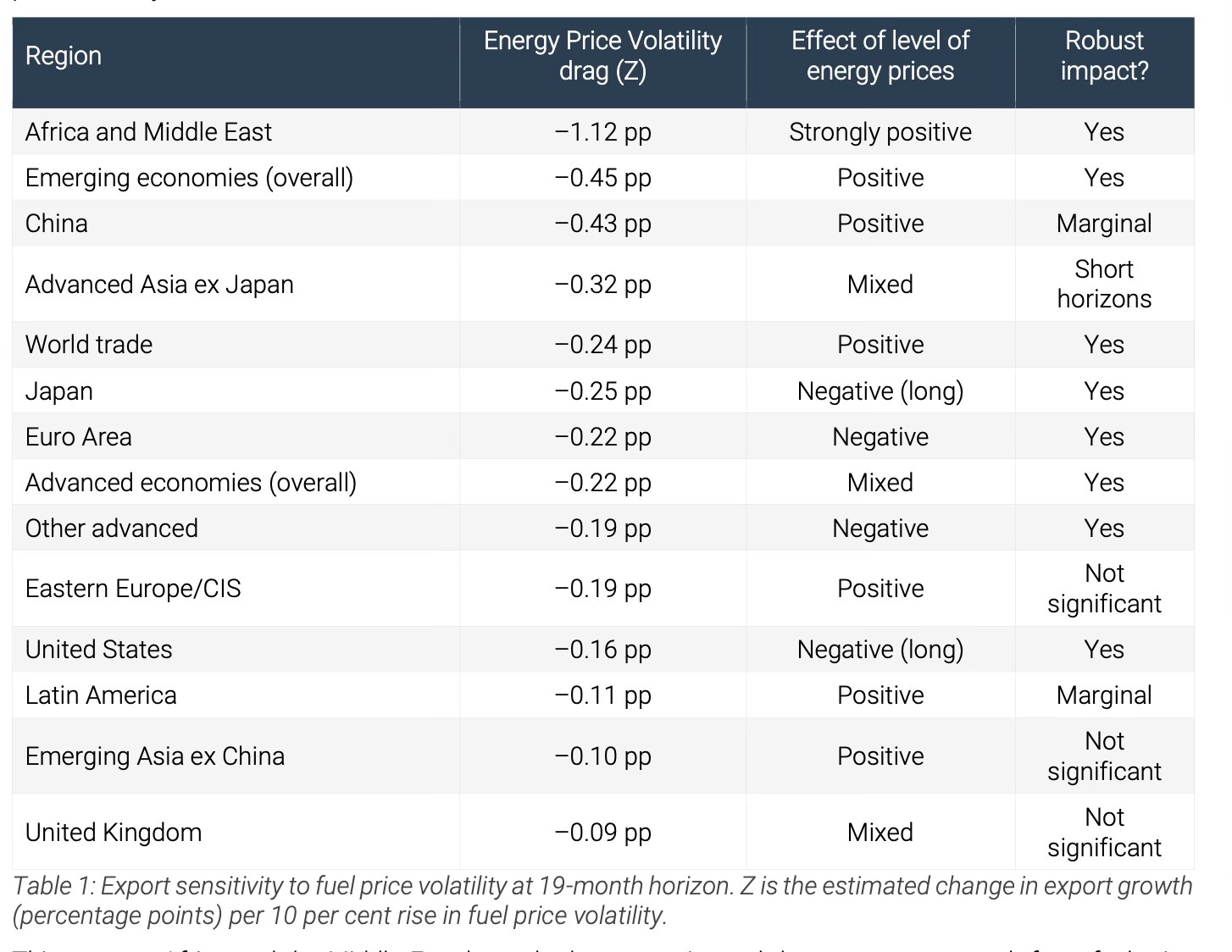
So, if the long-run impact of this energy price shock is similar to that of previous ones, you might expect export performance of …
Africa and the Middle East to suffer from volatility, but with much of the drag offset by higher energy prices
China to take a hit from volatility, partially offset by higher prices, though with effects that dissipate relatively quickly
The Euro Area to suffer the double hit of volatility and higher energy costs, with effects that linger
The US to see a relatively small negative effect [Though the scale of the recent US LNG ramp-up may not yet be fully captured in the historical data]
The UK to … mostly muddle through
Well … there we go.
On the subject of whether governments can meaningfully shape trade flows …
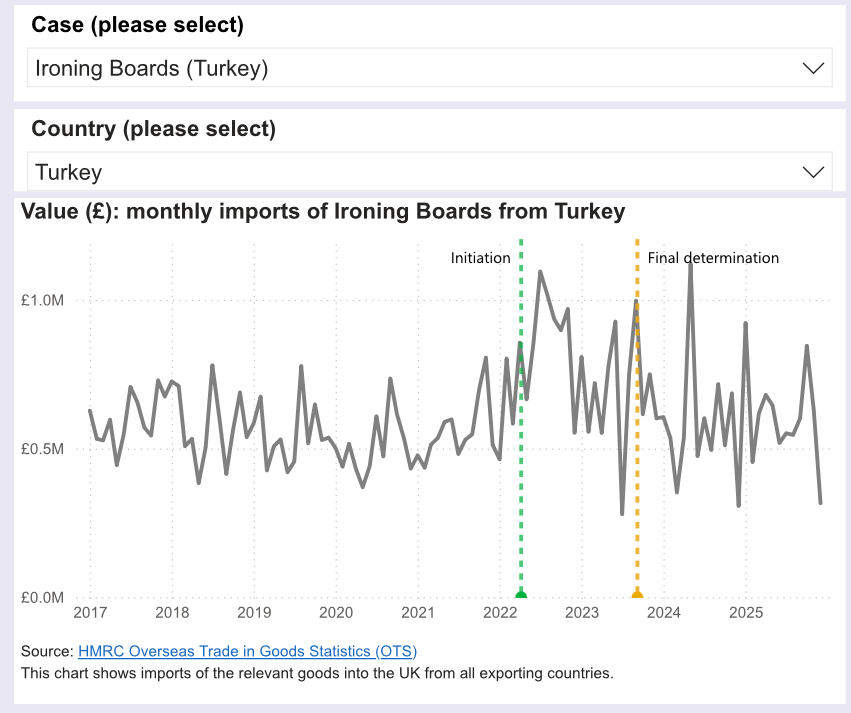
The UK’s Trade Remedies Authority (h/t Simon Lester) has produced a new dashboard where you can look at whether a specific intervention has had an impact on trade flows.
Play around with it HERE.
For example, I’m going to go out on a limb and say that the trade defence tariffs on Chinese electric bikes don’t appear to have worked …
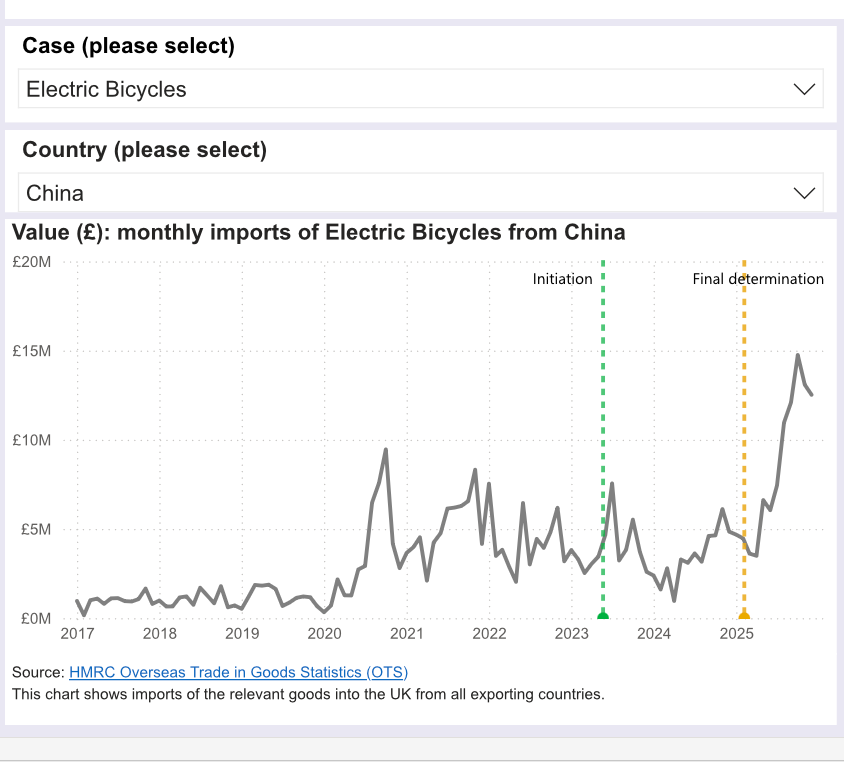
(And yes, before anyone shouts at me, I do understand that the counterfactual needs to account for the possibility that without the tariffs imports could have grown even faster.)
Whereas, tariffs on ironing boards from Turkey … maybe?
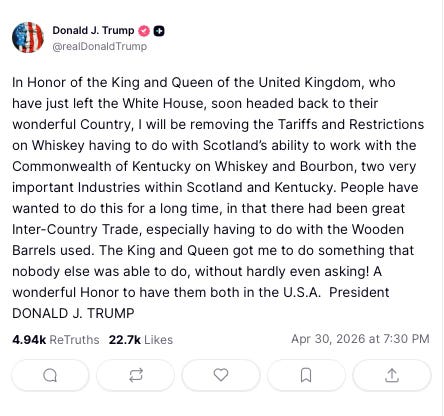
Get yourself a King who can do this …
Best,
Sam
No posts
Comments
Nothing yet. Say the first thing.
Sign in to join the conversation.