
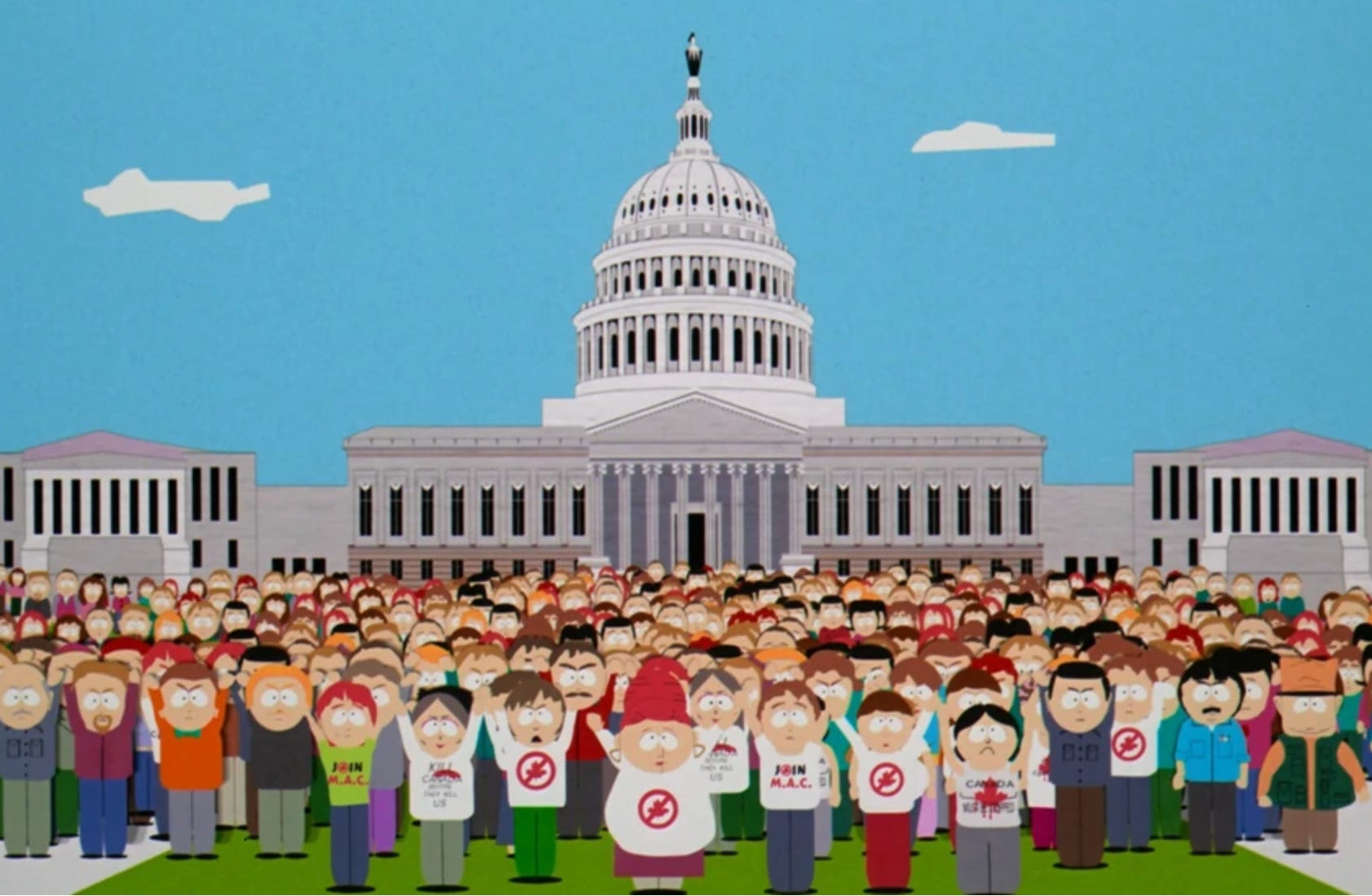
One of the things to know about Canadian trade negotiators is, contrary to much public assumption, they are the absolute worst. [Note: I mean this as a compliment.]
As in, they will push and push and push, storm out of negotiations at the last minute, and hold up deals until they get what they want.
To give an example, I remember bumping into an apoplectic UK official as I was walking across St James’s Park just after Canada had refused to roll over its post-Brexit trade agreement with the UK.
Canada’s reason?
The UK had just announced a new “no deal tariff schedule” that would have removed UK tariffs on nearly everything. Why on earth would Canada pay for something (via a reciprocal free trade agreement) that the UK was giving everyone else free?
Anyway, once the UK official found out I was, coincidentally, on my way to visit the Canadian High Commission, he asked me to [politely] tell them to get their act together.
This didn’t work.
And while the UK-Canada deal did eventually get rolled over, it was one of the few where the UK ended up with worse terms than it had as an EU member, specifically for dairy.
Canada also refused to back down a couple of years later, when in April 2024 it allowed a temporary rules of origin accommodation facilitating tariff-free UK car exports to Canada to expire.
And Canada was the country that posed the most problems when the UK was acceding to CPTPP.
All of this is to say that Canada is not even close to being a pushover, and its trade negotiators are very good at their job — which includes, for example, giving away as little as possible on dairy.
Anyway, hopefully this provides some context for my working hypothesis: Canada was looking for an excuse to walk out of the negotiations with Trump.
Even if you ignore some of the rumoured trickier US asks — such as restrictions on Canada’s ability to do trade deals with the rest of the world, or US control over Canadian critical mineral extraction and exports — there are plenty of more conventional US asks that Canada was absolutely not going to accept.
Major liberalisation of Canadian dairy markets. Restrictions on the power of provincial liquor boards. An end to Canadian cultural quotas.
And when you take into account the fact that, even under a deal, the US was still going to be applying loads of tariffs to Canadian exports … the walkout kinda makes sense.
So, stage a walkout. Deal with some short-term pain and escalation. Then start again with a different baseline to negotiate down from.
Obviously, the risk here is that Trump’s escalation ends in an invasion. Which would be bad.
My assumption, though, is that there will eventually be some sort of de-escalation which sees Canada give Trump some of what he wants — but, importantly, not the stuff it really doesn’t want to give — and get a tiny bit of what it wants in return.
But given we now have an end-of-year deadline for new 50% auto tariffs to kick in, we’re [or at least those of us whose job it is to advise on this sort of thing] all probably going to have to work on New Year’s Eve.
One of my least popular takes pre-Trump 2.0, and early in the Trump administration, was that
a) In a US context, you can’t just assume that tariffs are paid entirely by the importer [See HERE]; and
b) Tariffs were unlikely to lead to runaway inflation [See HERE, and HERE]
My basic argument is that imports, and goods imports in particular, just aren’t that large relative to the US economy, so therefore a general tariff hike has less of an inflationary impact than it would have in economies more reliant on trade. But the other thing that bugged me is that lots of the papers are presented as showing 100% passthrough of tariffs to consumers … don’t actually show that, when you read the small print.
Anyway, a new piece of research by Caroline Freund does exactly what I want it to do: confirm my priors!
In summary, Freund finds that [emphasis added]:
When the US imposed sweeping tariff increases in 2025, most economic forecasters predicted a sharp rise in consumer prices and significant import disruption. Instead, retail prices rose modestly and import-dependent sectors held up. This column uses data for the 50 largest US trading partners to show that foreign exporters absorbed roughly 40–50% of the 2025 US tariff increases through lower export prices – much more than earlier studies suggested. The absorption was highly unequal: dominant suppliers bore the bulk, while smaller ones passed the tariff on almost fully. The aggregate result vindicates optimal tariff theory. It does not mean the tariffs made America better off.
Why does she have a vastly different number to everyone else (other than me, but to be clear: I’m operating purely off vibes)?
Well, because everyone else was measuring it wrong:
Trade theory offers an explanation. When a large importer like the US imposes a tariff, foreign exporters can respond by lowering their prices to limit the loss in sales. Part of the tariff burden then falls on the exporter, not the consumer – the classic ‘terms-of-trade effect’ that has been central to trade theory.
The pattern shows up clearly in individual cases. Chinese exporters of toys and dolls saw tariffs rise by 28 percentage points while cutting export prices by 22%, absorbing roughly 80% of the shock. South Korean automakers faced a 22 percentage point tariff increase and lowered export prices by 12%, absorbing about half. Indian cotton bedsheet producers saw a 28 percentage point tariff increase and reduced export prices by 16%, also absorbing roughly half. In each case, exporters with large market shares and limited US substitutes had both the incentive and the room to absorb rather than pass through the tariff.
Yet the recent empirical literature on both the 2018–19 and 2025 tariff shocks finds near-complete pass-through to importers, with Amiti et al. (2026), Hinz et al. (2026), and Fajgelbaum and Khandelwal (2026) all reporting US incidence above 90% for the 2025 shock.
In this column, I argue those estimates do not tell the full story because they treat all product-country trade relationships symmetrically, giving equal weight to a tiny textile code with $300 in annual imports as to passenger vehicles accounting for $82 billion. They also don’t account for differences across countries, where the top exporter of a specific good typically represents half of product imports. Once the country-product trade flows are weighted by economic importance – or restricted to the dominant exporters of the most significant products – a very different picture emerges.
Read the full piece HERE.
Anyway, why does this matter?
Because the political consequences of a tariff where 100% of the cost is absorbed in the US are quite different to one where 50% of the cost is absorbed abroad.
If Freund is right, it could help explain why the political backlash against Trump’s tariffs has so far been less severe than lots of people expected. And it gives us a better sense of whether elevated US tariffs are politically sustainable — including beyond Trump [disclaimer: I think they are].
It also matters when thinking about how high tariffs can go. A 25% tariff where foreign exporters absorb half the cost is a very different proposition for US consumers and importers from a 25% tariff where they absorb none of it. The incidence matters for the ceiling.
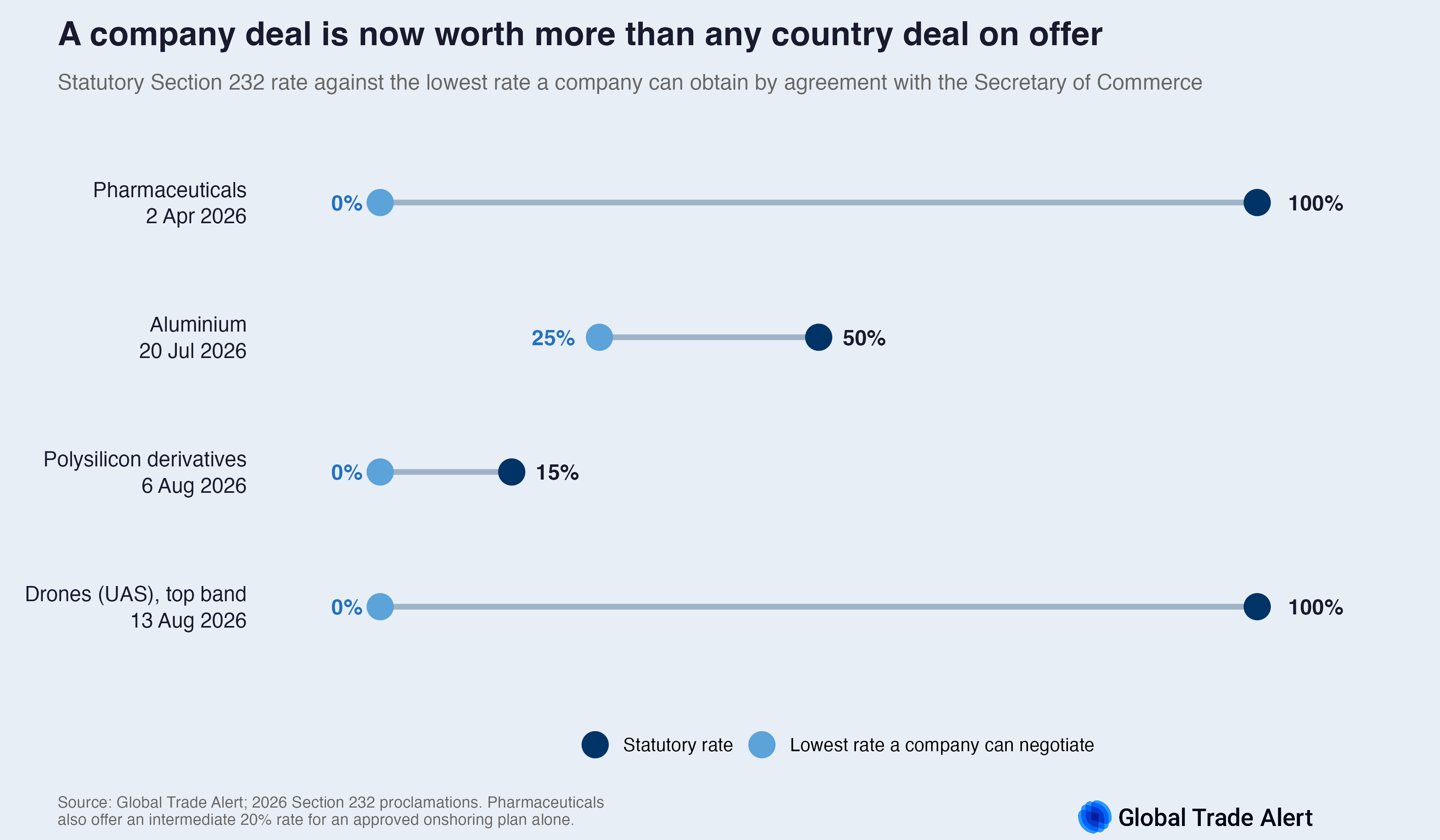
From Global Trade Alert’s analysis of company-specific deals:
My clever trade modelling colleagues at Flint have created a new THING, which allows companies to assess the impact of future shocks on the attractiveness of different markets.
For example, this shows how an abundance of robots could change the relative competitiveness of countries competing to be leaders in semiconductor assembly.
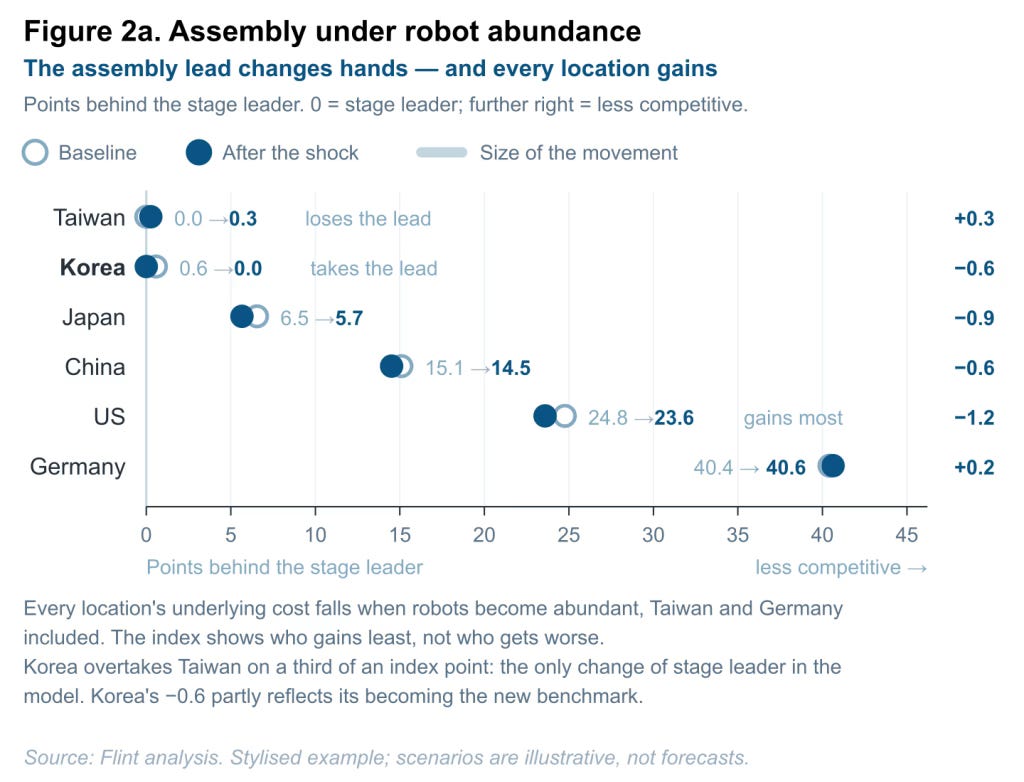
Find out more HERE.
Best,
Sam
No posts
Comments
Nothing yet. Say the first thing.
Sign in to join the conversation.