

Last month, a Wall Street Journal piece by Meghan Bobrowsky on Meta’s big layoffs illustrated what AI anxiety looks like at scale. Let’s talk about two big anxiety triggers, and how they could have been mitigated.
According to the Journal article and previous reporting by Reuters, on April 23, Meta announced that on May 20, it would lay off roughly 8,000 people — about 10% of its workforce. Meta’s chief people officer acknowledged in a memo that announcing layoffs a month before notifying affected employees was “incredibly unsettling.” For a month, workers would have to show up wondering if they’d be one of the 10%.
When humans are faced with too much uncertainty or a loss of control, our body creates a threat response. Data goes to the amygdala, which then sends an alert to the hypothalamus. Sounding the alarm, the sympathetic nervous system hits the gas with adrenaline, cortisol, and norepinephrine flooding our system. We enter fight, flight, or freeze. That threat response commonly shows up at work as overworking, ill temper, micromanagement, or checking out. Even a poorly communicated AI rollout or casual announcement of layoffs can trigger the same biological cascade of fear as seeing a predator in the wild. We can all relate to the notion of receiving unsettling news in the middle of our work day and feeling worried and distracted.
It’s much worse when you have too much time to marinate in that fear. Our nervous systems are designed to meet a threat, respond, and then downshift once the threat passes. That’s why short-term stress can be beneficial and spur us into action, while long-term anxiety drains us. When you’re awaiting the potential loss of your livelihood for months, your threat response never downshifts, and that damages physical and emotional health.
When companies announce layoffs well into the future, they trigger chronic anxiety. During the pandemic, I spoke at a large multinational that announced its intention to lay off 5% of its staff six months before the cuts were to begin. Once the layoffs were to begin, they would happen in waves over time. Morale cratered. Showing up every day waiting for the next shoe to drop is a great way to slow productivity and stifle innovation.
Data is inconclusive whether it’s better for employee wellbeing to conduct layoffs suddenly or to give longer notice periods. Companies like to signal layoffs to Wall Street thus longer notice periods appeal, but the human cost is real. We can handle hard things better when we feel supported by community and we feel equipped with tools to manage through chaos. That’s why giving managers and teams tools to create psychosocial safety is essential right now. If AI is going to disrupt job security in major ways, companies must invest in supporting employees through hard transitions.
If companies care at all about the humans they employ, companies must invest in human wellbeing and psychosocial safety: the organizational, social, and job design factors that prevent mental and physical harm in the workplace. Whether or not they choose to do this is anyone’s guess.
According to the article, Meta has started grading employees in performance reviews on their AI use, while also expecting employees to use a new software tool that records their keystrokes, mouse movements, and click locations to teach “the next generation of our AI models to use computers.” In a separate memo, Meta’s technology chief Andrew Bosworth said the company is building toward a vision where AI agents primarily do the work. “Our role is to direct, review, and help them improve,” he said.
On the one hand, it sounds great to let machines “do the work.” On the other hand, WTF? Training a machine to do your craft doesn’t sound like a great way to ensure job security. Designing your own obsolescence threatens our identity and even our values.
After an internal memo outlining Meta’s new tracking software went viral, an anonymous Meta employee compared it to bossware. “What next? Implement chips in our brains to read our minds? How is this totally unrelated to the upcoming layoffs?” the user wrote.
AI triggers anxiety about an uncertain future, but for many of us, the thought of AI taking over also clashes with values we hold dear. Emotional flexibility — the ability to tolerate anxiety while still acting in alignment with our values — is the skill this moment requires. Pause, name the emotion, identify the value underneath it, and consider a constructive next step. If you feel anger at the thought of training an AI to do your job, ask what value is being threatened. Is it fairness? Trust? Craft? Agency? I imagine Meta’s moves undermined trust immensely. It may seem like a small thing, but emotional flexibility is the first step in setting us free and giving us agency.
Lee Gonzales, Director of AI Transformation at BetterUp, leads teams through exactly this work — discussing AI anxiety before asking teams to help design their roles alongside AI. “People have an attachment to their identity, and that is so deep that if you can’t lever into that first, the change will never, never, never actually persist or be deep enough,” he says. He challenges software engineers to examine their fundamental identity: is it that they write code, or that they solve problems? “We take them from passenger to pilot, and in that transition, we help them understand there’s so much power and capability” in the AI future. It starts with conversations that help people get in touch with their emotions around AI.
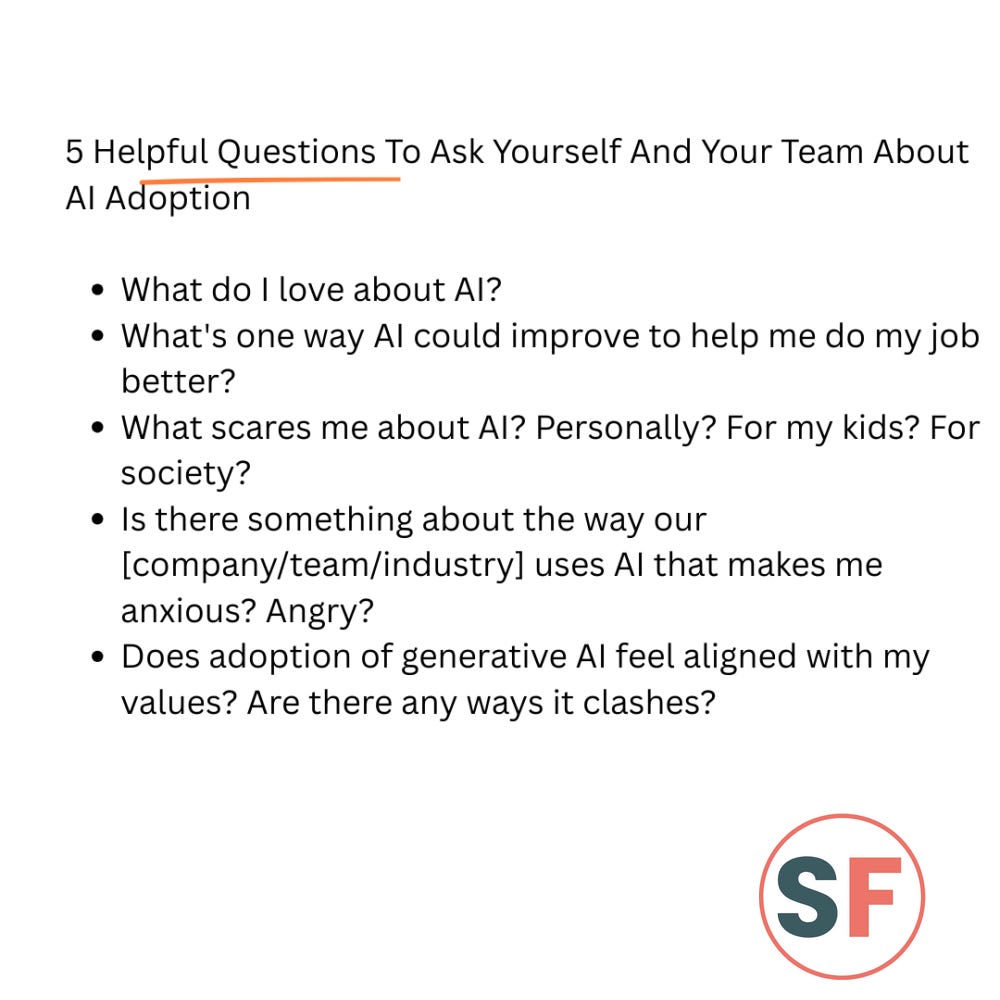
Rather than issuing a mandate that strips away agency with seemingly no explanation, could employees have had a say? Could they have been bought into a vision where investing in AI training preserves human agency? While it may be fantastical to promise that jobs are safe, when radical change is presented as a mandate with no upside, it’s hard to avoid not just anxiety, but anger. Leaked internal memos are probably the worst way people can learn about painful, disruptive change in which they feel they have no agency. Again, investing ins psychosocial safety would help here.
These answers aren’t easy and they require a new mindset. Most organizations respond to AI anxiety with surprise sweeping changes, forced positivity or silence. None of these works. What actually helps is giving people the language and the tools to understand what they’re feeling and why, and then figure out what to do with it. That’s what I’ll be talking about at Harvard Business School’s Leading with AI 2026 conference on May 19. The event is built around a premise I deeply agree with: many of us feel like AI is being done to us, not with us, even while we love using it day to day. The conference is a call to rebalance that — to bring the conversation back down to earth, to the people actually living through this change. It’s virtual and open to the public: https://d3.harvard.edu/events/leading-with-ai-2026/
With Feeling,
Morra
P.S.: Check out my interview with Lee Gonzales and the work he’s doing on managing AI anxiety at BetterUp:
Comments
Nothing yet. Say the first thing.
Sign in to join the conversation.