
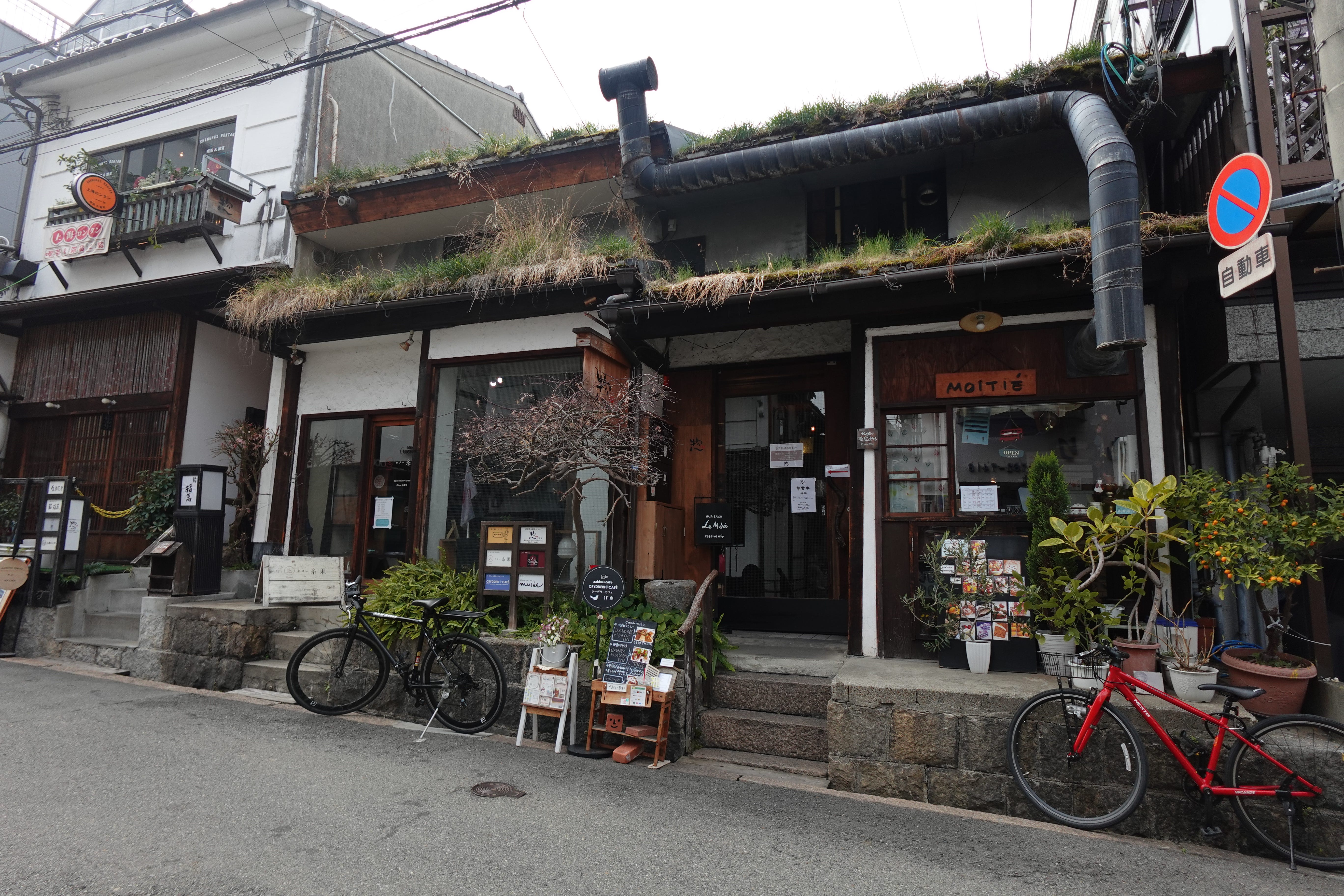
Last week, I finished my weaving piece and the first portion of my textile course here in Japan. After a short break, my next course began at a small kimono shop on a narrow traditional street in Osaka.
Since this studio is here in the city, as opposed to Kyoto, my daily commute is much shorter! (Down from 1 hour and 30 minutes in two trains and a bus to just 17 minutes and one station over.)
One recurring pattern I’ve noticed when learning new skills is that even things I feel semi-confident about often need to be re-learned. With a background in amateur sewing, I assumed I knew how to hold a needle. While maybe in western settings I do, here, that wasn’t the case.
Even something so simple as how the needle is held between the thumb and index finger is different, but what really threw me off was using the knuckle/back of the middle finger to push the needle forward. Because of this, my instructor had me hand make a leather thimble for my middle finger. It may seem like a small detail, but it completely threw me off.
While at first I was confused by this, and a little frustrated to have to start with something so basic, I quickly realized how fast and precise this technique could be when done correctly.
Similar to my weaving teacher, my current instructor (Ueda-san) had me practice a handful of stitches over and over for a few days before we moved on to the main project.
Yet another fundamental thing I’m learning to do differently is measurements.
When it came time to take all the necessary dimensions for my Yukata, a lightweight Kimono typically worn to summer festivals, Ueda-san pulled out an unfamiliar ruler. As she began to explain, I realized that everything in her kimono shop was made using the traditional Japanese measurement system.
This system was adopted from ancient China in 701 AD. Its primary unit, the shaku (尺), is divided into 10 tsun (寸) and further into 100 bu (分). One shaku measures roughly 30.3 centimeters.
Before any measuring could happen though, the fabric had to be prepared. With new fabrics, it’s standard to wash and dry them before starting construction, so they won’t shrink or distort after the fact. Kimono fabrics require a bit more in-depth care.
For my yukata, I unrolled the entire bolt (almost 40 feet of fabric!) and soaked it in warm water for 30 minutes. It was then hoisted up to dry only halfway before the entire length was ironed completely dry and rolled up tightly again.
Only after the preparation was finished could we return to measurements. Rather than converting units back and forth, everything was done directly in shaku and tsun. I briefly remember being taught this when attending school here in the past, but this was a good refresher. Once adjusted, I could take accurate dimensions and begin cutting.
Since coming back to Japan a couple months ago, I’ve made a point of paying close attention to any vocabulary I heard around me. Writing down words in public or mid-conversation felt awkward at first, but I quickly stopped worrying about it. It’s better to look silly in the moment for future progress than just to pretend I understand everything perfectly.
After self-studying two languages besides English, I’ve learned that speaking is the most effective way to improve. Whether it was with a cello teacher in Mexico, sailing instructors off the coast of Uruguay, or my driving instructor while getting my license, actively listening and responding did more for my fluency than anything else.
The same has proven true with Japanese. Meeting lots of new people, all with varying lifestyles and interests, each interaction has been a chance to pick up new vocabulary.
Aside from language learning, I completed the course ‘Understanding Japan: A Cultural History’ and began ‘WWII: The Pacific Theater’. I’ve already noticed this course is drenched in American heroism, so while I’ll take it all with a grain of salt, it’s still helpful for grounding the overall timeline and key events.
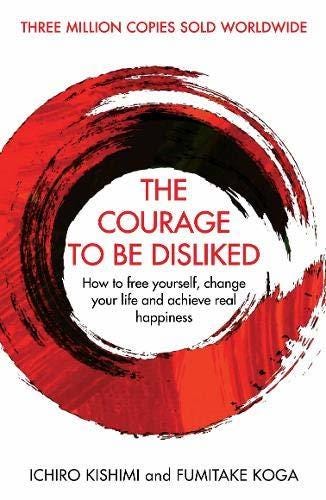
Finished ‘The Courage To Be Disliked’ by Ichiro Kishimi and Fumitake Koga
Started and finished ‘The Rape of Nanking’ by Iris Chang
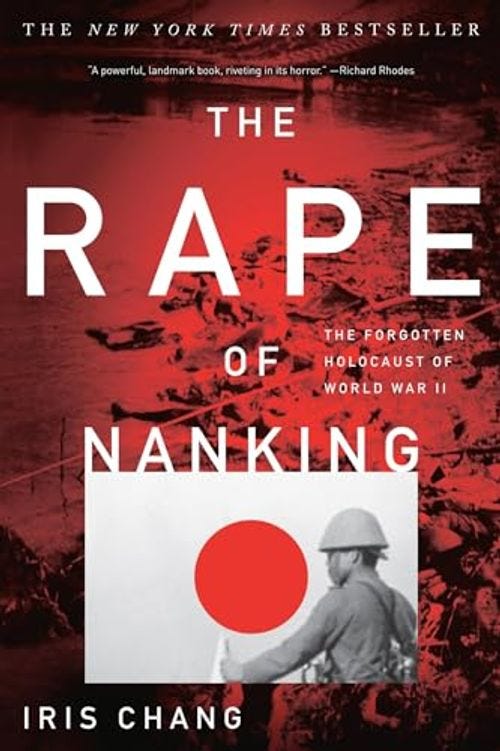
While Japan is generally well liked around the world today, I’ve often wondered about the lingering tensions between Japan, China, and Korea. I knew that events like the Sino-Japanese Wars and “comfort women” had played a role, but reading this book put the horror of 1930s Japan-occupied-China into perspective.
I’m generally an upbeat person, so learning about these gruesome, graphic, and deeply unsettling moments in history is difficult. Still, it’s necessary. Understanding the darkest chapters is part of understanding the whole picture.
This week, I made progress on sorting out the rest of my 2026 courses, while also taking time for things that keep me present. I took a Japanese cooking class on chocolate soufflé cakes and brought one home for my fiancé and me to share. I plan to do some hiking this upcoming weekend, with others and maybe solo!
Here’s to more progress next week! - Morgan Senna
Comments
Nothing yet. Say the first thing.
Sign in to join the conversation.