
Born fifteenth of seventeen children to a poor candle and soap maker in Boston, Benjamin Franklin came from humble beginnings.
He received only a couple of years of formal schooling before entering his older brother’s printing shop as an apprentice. Repeated clashes with this strict brother led Franklin to run away to Philadelphia at just seventeen. Not long afterward, he was sent on what proved to be a wild goose chase across the Atlantic to England. Despite being stranded there, he made the most of the situation. Constantly finding inventive ways to save money, he continued to broaden his knowledge of the printing trade and it’s latest techniques.
Eventually, Franklin returned home to open his own printing shop. There he worked diligently until his retirement, when he turned his attention to public affairs and international diplomacy.
Somehow, amid founding libraries, universities, and hospitals; inventing bifocals and the Franklin stove; conducting experiments with electricity; writing books and pamphlets; and helping shape the American Revolution, Franklin still managed to find time to devote himself to, what he called:
"the bold and arduous project of arriving at moral perfection."
Franklin recognized that becoming a better person was not a matter of good intentions alone. So, as for many things, he set about creating a plan.
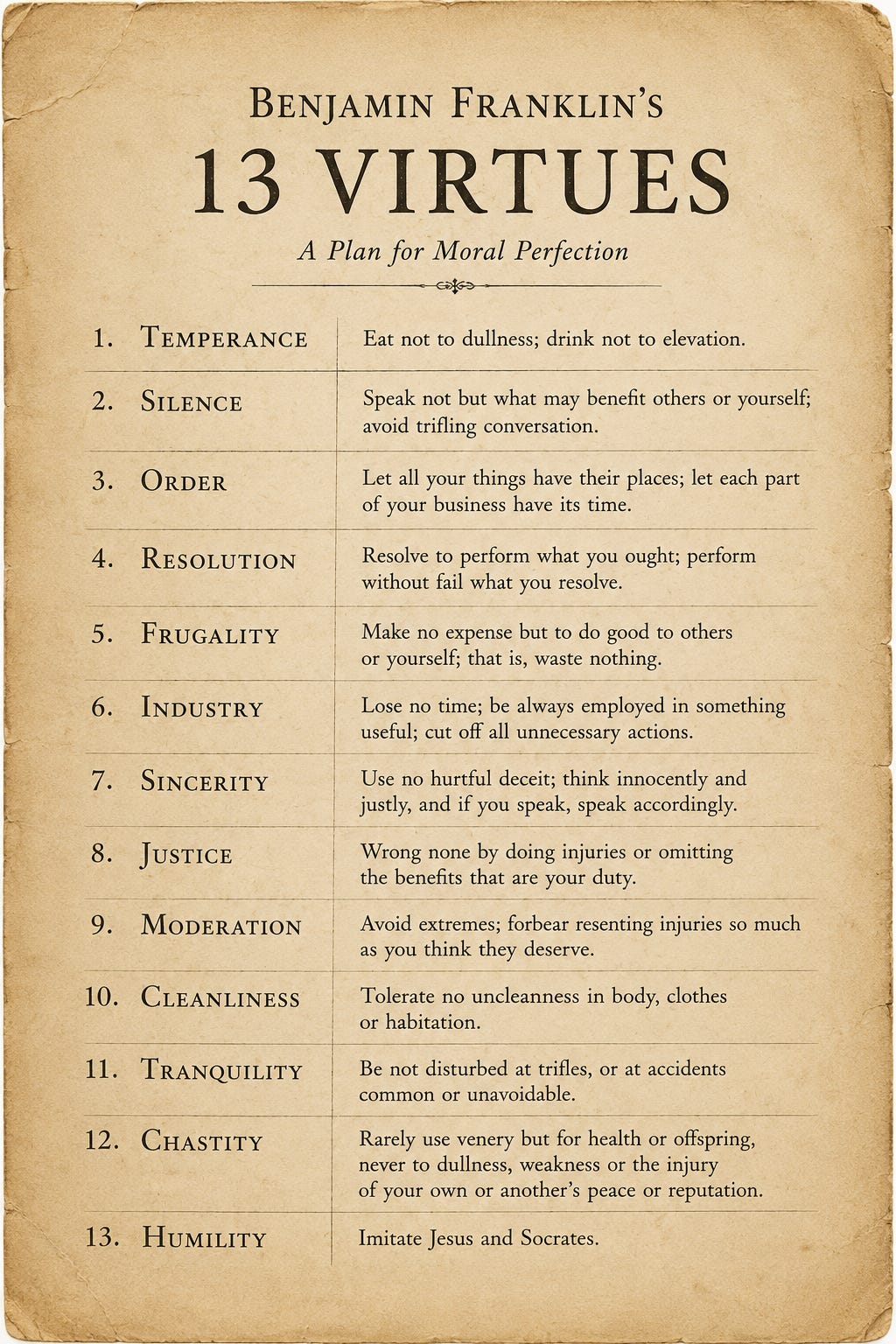
Temperance, Silence, Order, Resolution, Frugality, Industry, Sincerity, Justice, Moderation, Cleanliness, Tranquility, Chastity, and Humility
These were the virtues Benjamin Franklin believed addressed his personal shortcomings.
I’m unsure if New Years resolutions existed 300 years ago, but Franklin understood that taking on too many big changes at once often leads to no change at all. This is why Franklin chose thirteen virtues, one for each week in a thirteen week cycle repeated four times each year.
To execute this, he had a notebook with a table for each week. Every evening, he marked any failures with a dot. The aim was to focus strongly on achieving one primary virtue, while still observing the others.
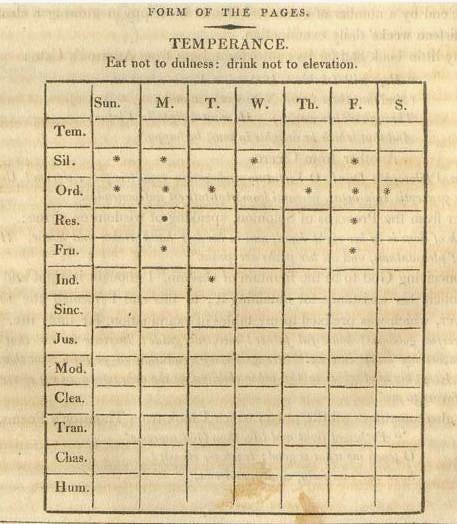
Franklin began developing this method at just 20 years old and returned to the cycle throughout his life, utilizing it through the Revolution and until his death in 1790. Humility, the final addition, was added at the behest of a friend who helped him recognize what he later deemed his greatest personal weakness. This adaptation gave me the idea to take his method and supplement virtues that combat my own personal weaknesses for my next cycle. But for now…
"Eat not to dullness; drink not to elevation.”
Historically, ancient greeks and stoics used the word sōphrosynē — the virtue of inner harmony and rightly ordered desire to describe temperance. Exercising control over your desire, emotions, and impulses rather than allowing them to lead you you.
This first virtue essentially sets the tone for the rest. Franklin believed that temperance allowed the mind and body to work at the optimal level, making the other virtues possible. For Franklin, it meant avoiding excess in eating and drinking, enjoying life's pleasures without becoming dependent on them.
As a young man in England, he noted that his colleagues spent much of their time going between work and the boarding house for meals, and much of their money on beer. Back then, it was commonly held by the English (and maybe still is…) that beer gave strength. Yet, Franklin’s simple diet of bread, fruit, and water often surprised them. Despite consuming far less, he found himself with greater clarity of mind, more time for productivity, more money, and the energy to outwork those around him.
During the first week, I tried something I had never consciously done before. Fasting. I’ve always been fortunate enough to be able to eat whenever I wanted and, for the most part, whatever I wanted without any issue. As the house cook and someone who sees food as more than just fuel, fasting was never something I had given much thought to.
The goal of this week was not necessarily to master fasting itself, but to become less preoccupied with food. I think many people unknowingly structure their days around their next meal, their lunch break, or a sweet treat at the end of the night. I for one, have a habit of using food as a form of procrastination or as a way to fill moments of boredom. As much as I love to cook and bake, the goal was simply to decenter food in my life, by redirecting that energy toward more productive and meaningful pursuits.
While Franklin focuses on appetite, practicing Temperance could include:
Limit digital media consumption
Control outbursts and strong emotions
Don’t overwork yourself
Small acts of restraint
"Speak not but what may benefit others or yourself; avoid trifling conversation.”
Unlike the definition of silence as the absence of sound, Franklin’s definition is simply about intentional speech. Speech should be meaningful, improving a situation or communicating something valuable.
Franklin was known to be curious, social, and to love conversation. John Adams visited both England and Paris after him and wrote:
"His name was familiar to government and people, to kings, courtiers, nobility, clergy, and philosophers, as well as plebeians, to such a degree that there was scarcely a peasant or citizen… who was not familiar with it.”
That being said, as a young man especially, he was known to love a good argument. In his childhood he read a book on rhetoric and the Socratic method, which he learned, and then utilized against the kids in his neighborhood.
Franklin admits to enjoying arguments and contradicting others. The Socratic method taught him that asking careful questions allowed people to discover flaws in their own reasoning. The change came from exercising it for the sake of understanding as opposed to winning an argument for the sake of victory.
For my part, I’m not the best debater and tend to avoid conflict, so this wasn’t my primary focus. Instead, it was on controlling my speech. Filler words (like, literally, um) make up the best part of much of my age demographic’s vocabulary, and I’m no exception.
Something interesting that Franklin implemented was the removal of speech like:
‘certainly’
‘undoubtedly’
‘you are wrong’
‘that is not so’
Replacing them with:
‘I conceive’
‘It appears to me’
‘If I’m not mistaken’
Not only did this save him from any embarrassment incase of mistake, but it also allowed him to always be of open mind and manner.
On top of this, I tried to implement pausing before responding or speaking. In social situations it’s easy to overshare or phrase something in a way that you would’ve changed (or not said at all) had you stopped to think before speaking. Groundbreaking, I’m sure…
Not only can intentional silence prevent regret, it can also open up conversation. I notice that if you take a pause before speaking, often times people continue to open up when you would’ve interjected. It’s easy to spend a conversation thinking about what you want to say next, instead of paying full attention to your partner and then having a more meaningful question to ask or insight to provide.
“Let every person be quick to hear, slow to speak, and slower to anger.” - James 1:19
More ways to practice Silence include:
Don’t interrupt or talking over others
Avoid gossip
Commute and exercise without music/audio
Stop swearing
“Let all your things have their places; let each part of your business have its time.”
Kosmos (order, arrangement, harmony) is an ancient Greek concept that viewed the universe as an ordered whole. To live virtuously was to reflect this within one’s life by bringing thoughts, desires, and actions into harmony with one another.
Disorder can initially feel like freedom from structure. Sometimes leaving things open and unplanned allows for greater flexibility and creativity. However that lack of structure often becomes its own limitation. A disorganized environment can create unnecessary friction, slowly draining your time and attention. Small problems left unattended easily become excuses to avoid larger and more important responsibilities.
Franklin created a very organized routine for himself.
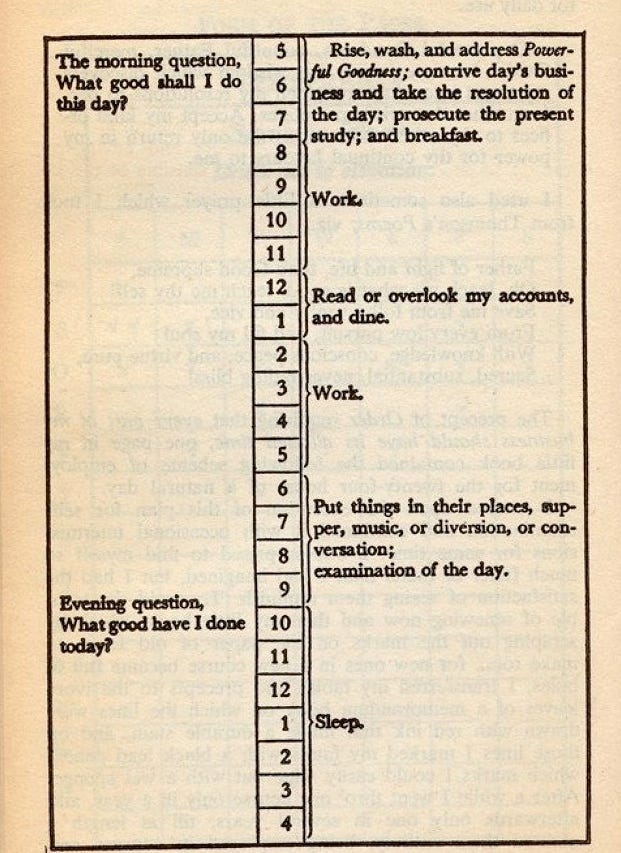
Following a schedule shouldn’t be restrictive, it should bring more freedom to daily life. By deciding beforehand how to use your time, you reduce decision fatigue and promote focus, productivity, and intentional action.
For months, I’ve experienced this through maintaining an organized planner. Each Sunday, I prepare my teaching topics for the week, organize equipment/notes for culinary classes, and map out the week’s events as clearly as possible. This practice allows me to begin each week with direction and reduces the mental clutter of constantly deciding what needs to be done next.
On top of this, during the week I organized anything that was cluttered and causing minor nuisances in my daily life. Anytime I had a minute to take care of a small task to save my future self time, I did.
Speaking of Order, I began to realize how each virtue supports the ones that follow. Temperance lays the foundation to focus on meaningful endeavors, Silence helps with clarity of mind, and Order provides the structure you need for the upcoming: Resolution.
Ways to practice Order:
Organize physical and digital spaces
Finish one thing before beginning another
Identify your main priority for the day
End the day with a mini reset
“Tho’ I never arrived at the perfection I had been so ambitious of obtaining, but fell far short of it, yet I was, by the endeavor, a better and a happier man than I otherwise should have been if I had not attempted it.”
Comments
Nothing yet. Say the first thing.
Sign in to join the conversation.