
Text within this block will maintain its original spacing when published
Me and the moon are wondering where you can be.
Me and the moon are lonely for your company.
I’ve asked the moon to find you somewhere behind the star.
I want him to remind you how dear to me you are
Me and the moon are gazing through a hazy light.
For all too soon, I lost you on a summer night.
I’m afraid of the dawn, cause you and the moon will both be gone.
There’s me and the moon, and pretty soon there’ll just be me.
- Hal Kemp, Me and the Moon (1936)
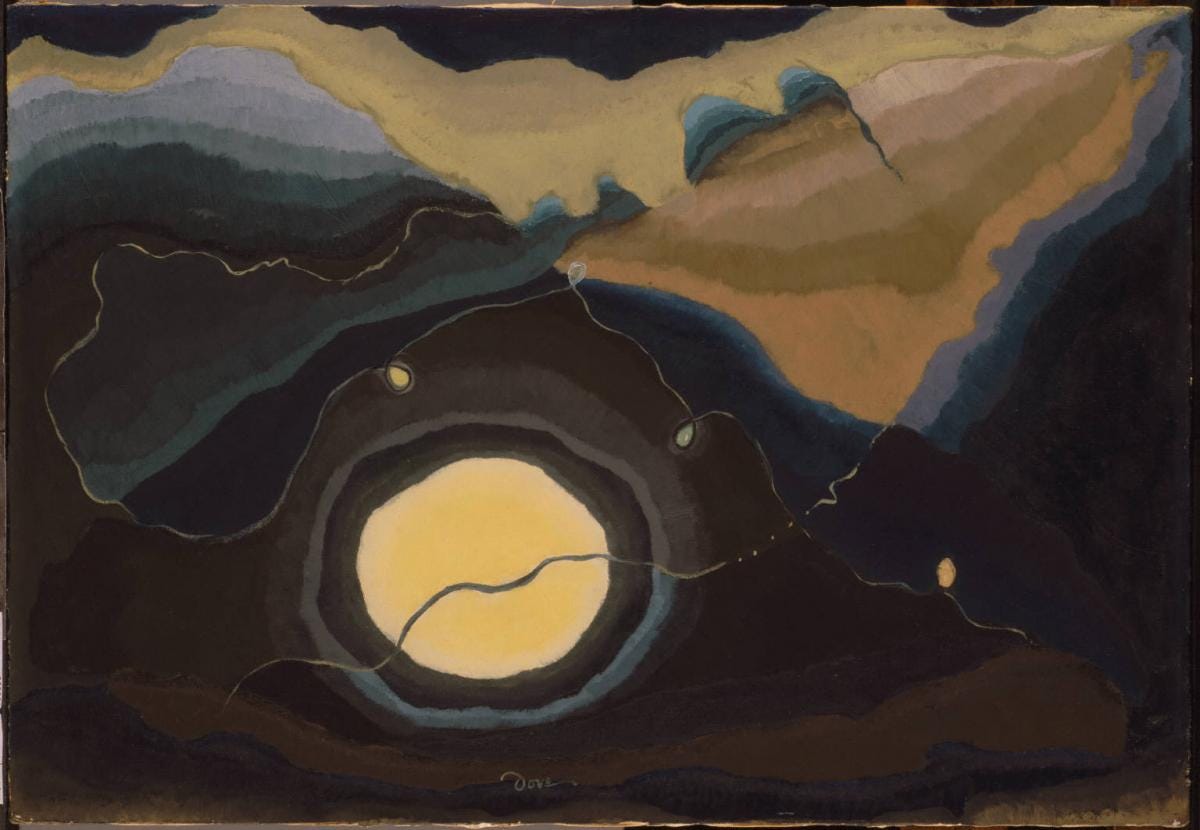
It’s 1936 and you live below the poverty line. Forget that, the poverty line won’t be drawn until 1963, by a bureaucrat at the Social Security Administration. For now, you live with your lover on a boat, very far away from where you’d like to be. You tried to earn your way as a farmer, sometimes as an artist. And while you continually fail to climb out of your poverty, the only thing that really gets you down is watching the world change. Materialism, industry, pollution, machines. However your life is guided by a sequence of appreciations, through daily recognitions of what you call “conditions of light.” So on your boat, with your lover and your radio and not much else, how lucky you are. How bogus the rest of all this is. Bogus that you died because you couldn’t afford to live. Lucky that a woman loved you so much that, as you died, she guided your weak hand across a canvas with colors you chose. She was such a painter, too. Really you both knew that a line is a gesture made permanent. My god what a line. Of course she loved you, how could she not? Like when she went away on a trip for a couple weeks, a song found you through the radio. Four four time. A melody as slow as syrup, sung as soft as silk. The song found you and it moved you. Because despite your poverty, you knew with your whole heart that appreciating art was your human right. You and the moon, on a journey to find someone who is lost. You delegate a task to the moon, to communicate with someone on your behalf and express your clear and simple dedication of love. Your lover has gone on a trip, the song on the radio tell you it’s possible she’s just behind a star. The moment is noetic. The moment of listening is already a work of art. It is an act of love that finds you translating the light, the moon, the star, the radio, into a painting. Yes, you have made a landscape painting. But there’s something so peculiar about it because it looks as if you are standing so deep within a valley that there’s no horizon line. You are essentially underground, surrounded on all sides by blue earth. In lieu of the horizon, you have painted a line in motion, like tracks of a dancer, or incomprehensible script. The lines curl and wiggle and break the dense earth in a silly way. If I were to ask you about this line, you’d tell me it was a synesthetic vision of radio waves. The radio waves that reached you and brought to you the song you loved. The lines travel out of frame, backwards and forwards across the big moon, presumably in the direction of someone else who may be listening. And when there’s a song, there’s often someone listening.
Hmmhmm hmmhmm. I sing the song in my mind now. It’s been more or less a hundred years. It’s been so long, you’d think I’d know better, but I keep mistaking the poverty line for the horizon line.
Honestly, though, it is confusing because there are so many different types of lines. There are the lines that Helen Torr aided by holding Arthur Dove’s hand. There’s the line of Dove’s curling, loving radio. There’s the lyrical lines that Dove heard written by Hal Kemp and Maxine Gray, it was a pop song. There are lines that are only partially delineated. Lines on a map that symbolize a paved road, and the pavement of the road itself is a line that symbolizes a treaded path that might naturally occur if there was somewhere we regularly needed to go. Then there is the line of the horizon which changes the length of your day depending on where you find yourself within the landscape. There is the horizon that exists as a peripheral daydream in your mind and the minds of others who work the land. There is the horizon and it is one possible explanation of where you are. When the horizon is a portrait of where you aren’t.
Well it seems that I have mistaken the poverty line for the horizon line because they are examples of lines that you, as a regular person, do not draw. They are externally determined. You find yourself against these lines, as if you were lost before.
Unlike a line of white snow falling on a bare tree branch. Unlike an afternoon shadow cast against a bathroom wall. Unlike a line of water from a faucet. None of these lines. Instead, the poverty line is a “drawing of the floor.” That’s how Michael Green explained Mollie Orshansky’s intention when creating the poverty line. It was a measure of income inadequacy, not adequacy. Green believes that the line is drastically too low and is actually a measurement for starvation. This, you know, is on a lot of people’s minds because SNAP was momentarily eliminated this October. It’s weird to explain this, but when you are living below the poverty line, if you are lucky and your papers are in order, you receive just enough benefits to not die. As if your body were pushed into some unnoticed corner of a bad dream. Out of sight, below the floor.
What gets to me about the poverty line is that it was drawn, pretty randomly at the time and extremely randomly now, by one person in the Social Security Administration like 60 years ago. It was drawn by one person but we live it as an innate truth. We spatially organize ourselves around this line, as if we were above or below the floor, in a building, surrounded by, if we are able to notice, the horizon.
In Arthur Dow’s 1899 textbook Composition, he writes: only through the appreciations does the composer recognize a harmony. In Dow’s worldview, recognizing harmony was almost a spiritual philosophy. Mass recognition of harmony requires mass composers. He revolutionized visual art education by applying words that were previously only used in the context of music. Specifically, in the context of listening to music. He hated formal schools of thought and mastery, and instead he empowered regular people to believe in their own capacity to draw lines that pleased them. One of these regular people was a girl named Georgia.
Georgia O’Keeffe went on to paint in the same circles as Arthur Dove and his wife Helen Torr. I believe by proximity, this group of artists adopted some of Dow’s pedagogy. In Dove’s painting Me and the Moon, named after Hal Kemp’s pop song by the same name, you can see the cross disciplinary osmosis of sound into visual form. And, so vividly, the appreciations.
There’s great intimacy in painting in close proximity with others, even if by necessity. Imagine Dove and Torr painting together on their boat. Maybe a wave comes and jolts their hands as they paint, so their paintings would share a similar line quality. A shared pictorial language. The language of appreciations so deep, one could contently spend the day looking at anything up close. Purple and green leaves. Hands moving. Appreciating the world so deeply, a pop song about the moon comes on the radio, and you paint the song, and the motion of the radio, because you love someone and you miss her.
-
I have often seen the world as a place where the painting already exists. Everything I can sense is already a work of art. If I were to make a record of what is already a work of art, it would only be for you. A gift for you. The lines I write are only here to show you that you can make lines too.
Martin Espada wrote:
but rebellion
is the circle of a lover’s hands,
that must keep moving
Take your hand now, draw a circular line in the air. Draw it slowly. The poverty line is not like this. You drew a circle in the air. You can draw it over and over if you like. I mean to say that you did not draw the poverty line. You wouldn’t want someone to live below the floor, why would you want that?
I met someone a few weeks ago who was studying how the poverty line is measured. I asked him if the purpose of the poverty line is to figure out whether or not one’s life is livable, depending on where they fall. Yes, he answered. Then I wanted to ask him but was too embarrassed, I wanted to ask him: shouldn’t we ask everyone this question? Couldn’t you ask anyone if their life, for them, is livable? And would their answer be dependent on whether they fell above or below the line? Or is livability a different thing than poverty?
The poverty line can and might kill me. Living below it is like living below the floor. I have a home but it is precarious and always has been. The stress of it wrecks my health and wellbeing. But my safety net is that I am a composer, in Dow’s sense, because I am a regular person. Gratitude is a composer’s education, and the reward is recognition of harmony.
-
In the basement, the staff members of the food pantry are cold and irritable. The basement is basically windowless. On the shelves there’s lasagna noodles, hazelnuts, applesauce, totally random things. When my bags are full of random things, I walk a straight line to the door. Then, in my troublesome car, I listen to a song on the radio. As I drive, I look at the division between the earth and the sky. That smooth, faraway place is blue.
No posts
Comments
Nothing yet. Say the first thing.
Sign in to join the conversation.