
By Denise Rivette
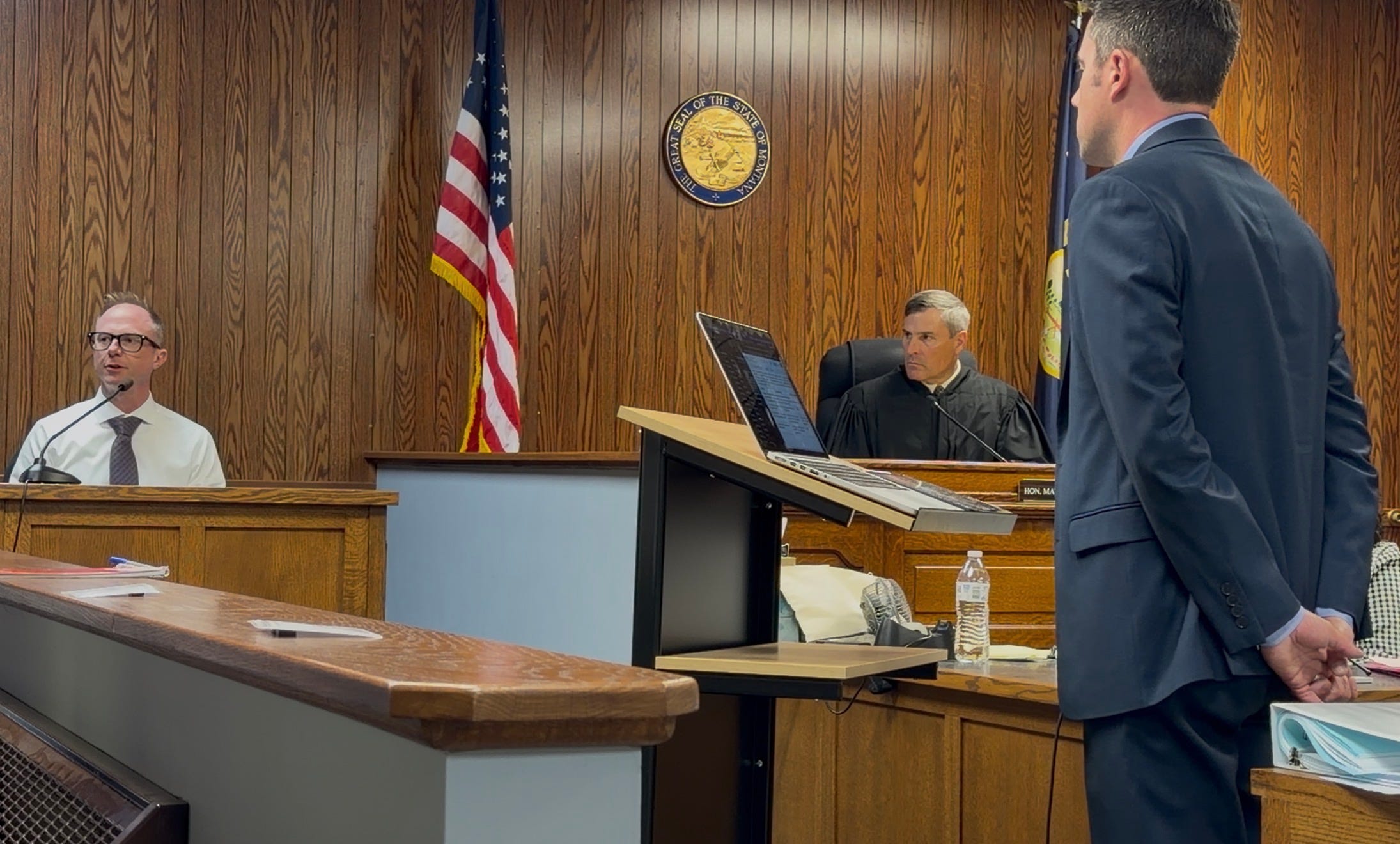
On August 14, a Carbon County District Court jury found Travis Morgan Sherrod not guilty of felony deliberate homicide in the shooting death of Rehn Peterson III that started as an argument over fantasy football. The verdict, returned before District Judge Matthew J. Wald, closes a case that began with the shooting in November 2023 and that had previously gone before a coroner’s jury. Carbon County Attorney Alex Nixon and Shannon Foley represented the State. Nick Brooke and Colin Stephens represented Sherrod.
Charges were first filed against Sherrod on Dec. 5, 2024. Sherrod pleaded not guilty and maintained from the start that the shooting was justified under Montana law. The case was dismissed without prejudice on Oct. 10, 2025, after Nixon and Brooke agreed to put the question of whether a crime had occurred to a coroner’s inquest.
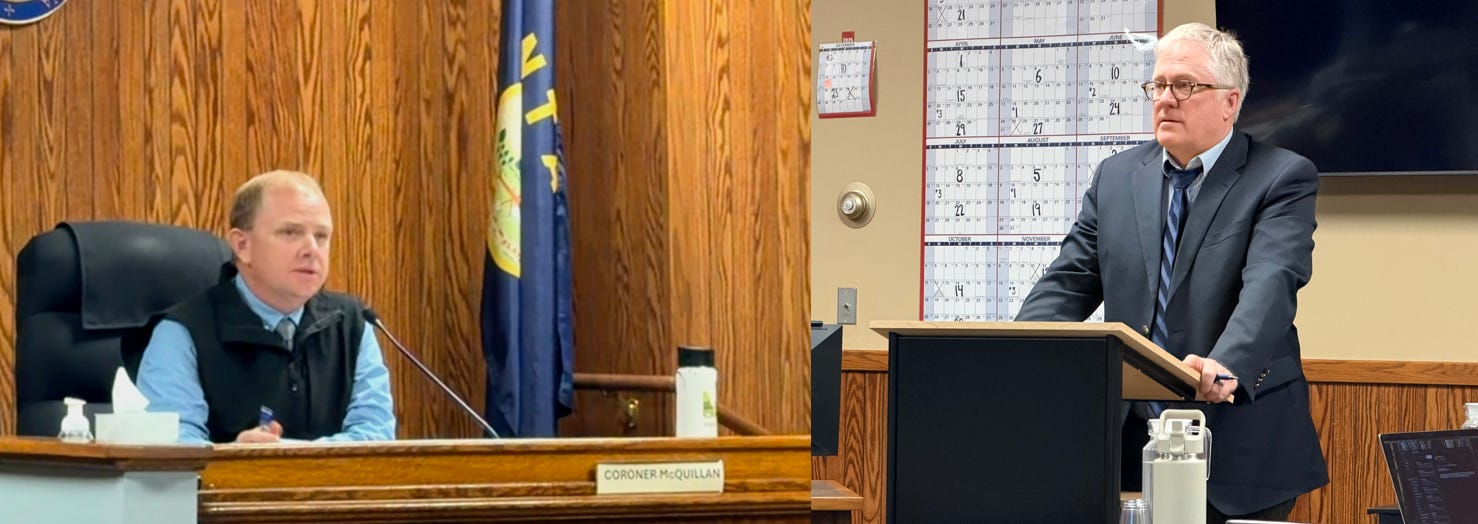
The inquest was held Dec. 8-9, 2025 — the first in the county in years that did not involve a law enforcement officer, and the first presided over by Sheriff and Coroner Josh McQuillan. A coroner’s inquest differs from a trial: the jury has nine members, jurors may question witnesses, and they are empaneled not to decide guilt or innocence but to answer specific questions. A unanimous vote is not required. This jury was unanimous, finding Peterson’s death a deliberate homicide by criminal means. But that finding came under a lower standard than a criminal trial demands. To convict in a criminal trial, the State had to prove Sherrod’s guilt beyond a reasonable doubt.
Because the jury found that a crime had occurred, the State filed new charges and Sherrod was arraigned for the second time in District Court on Dec. 10, 2025. He pleaded not guilty and was released on his own recognizance.
The shooting followed a dispute over a fantasy football league both men belonged to. Sherrod had expelled Peterson from the league over unpaid dues, and the two traded insults by text that evening. Peterson wrote, “Now you are not safe ... Let’s go.” Sherrod replied, “Lets go!!” and “Bring it.” Rather than call law enforcement, Sherrod retrieved a handgun, waited behind a car and chambered a round as Peterson approached, according to Sherrod’s testimony at trial. He told Peterson to leave and, by his own account, fired only when Peterson lunged for the gun. Sherrod fired five shots, and testing of Peterson’s clothing indicated at least one was fired at close range. About 45 seconds passed between Peterson’s last text and Sherrod’s 911 call. Law enforcement arrived within two minutes of the 911 call.
Forensic testing showed Peterson had a blood alcohol content of 0.313 and a THC level of 54 nanograms per milliliter. In Montana, a person is considered impaired at 0.08 blood alcohol content and at 5 nanograms of THC. Sherrod was sober.
Montana law allows a person to use force likely to cause death or serious bodily harm only when that person reasonably believes it necessary to prevent imminent death or serious bodily harm or a forcible felony (Montana Code Annotated 45-3-102, see grey block below for MCA sections quoted). The law imposes no duty to retreat on a person who is lawfully present and threatened (MCA 45-3-110), but it withholds that justification from an aggressor who provokes the use of force against himself (MCA 45-3-105). Self-defense is an affirmative defense (MCA 45-3-115). At the center of both the inquest and the trial was a single question Nixon put to jurors: not whether Sherrod shot Peterson — he admitted that — but whether it was reasonable for him to use deadly force. After three and a half days of testimony, the closing arguments focused on answering that question.
After Foley recapped the State’s evidence, Brooke opened his closing by defining the State’s burden. Because Sherrod had offered a defense of justifiable use of force, Brooke reminded jurors, the court had instructed that the State — not the defense — bore the burden of proving beyond a reasonable doubt that the shooting was not justified. He walked jurors through the phrase “beyond a reasonable doubt” word by word, using the 1982 Tylenol cyanide poisonings as an analogy: even a low-probability of danger, he argued, can provide reasonable doubt as to safety, and a single doubt grounded in logic and evidence requires acquittal.
Brooke’s central theme was that the State’s own witnesses had failed to contradict Sherrod’s account and, in places, corroborated it. He argued the pathologist’s testimony on the downward, front-to-back path of all five shots was consistent with Sherrod’s description of pulling the gun back as Peterson reached for it; that the gunshot-residue analyst placed at least one shot within 24 inches and could not disprove Sherrod’s claim that all shots occurred at close range; and that the location of shell casings — two near the car, three farther back — matched Sherrod’s testimony of firing two shots, backing up and firing three more. Brooke stressed that the physical evidence was generated after Sherrod gave his statements, so he could not have tailored his story to fit it. He also cited a state investigator, identified in testimony as Agent Tucker, who testified that Sherrod’s statements were consistent with one another and uncontradicted by the evidence.
Much of the argument was devoted to what Sherrod knew about Peterson. Brooke pointed to a jail phone call and text messages showing Peterson had a prior arrest involving an altercation with roommates and resisting arrest, and to text messages confirming the two had wrestled — countering the State’s suggestion that Sherrod invented a wrestling history. Brooke argued Sherrod knew he would lose a physical fight and lose control of the gun. He invoked Montana’s open-carry (MCA 45-3-111) and no-duty-to-retreat (MCA 45-3-110) statutes, arguing Sherrod was legally entitled to arm himself, to stand in his own driveway, to draw and present the weapon when threatened, and that he warned Peterson to leave three times before firing.
Brooke sought to reframe the “Bring it” and “Let’s go” texts — which the State cast as Sherrod inviting a fight — as a distraction. He read text messages Peterson had sent a third party over the month before the shooting, in which Peterson repeatedly said he intended to go to Sherrod’s house and beat him. Peterson, Brooke argued, had planned the confrontation; Sherrod’s mirrored replies were bluster he never took seriously. Addressing Peterson’s intoxication, Brooke said he took no pleasure in raising it before Peterson’s mother but could not let the State’s portrayal of Peterson as a harmless “playful drunk” stand uncorrected.
Brooke closed with an “alternate reality” in which Sherrod hesitated a second longer, lost the gun and died, and jurors instead sat in judgment of Peterson — asking whether, given the same text messages and intoxication, they would believe Peterson had not meant harm. Brooke said he believed his client was innocent but asked jurors only to find him not guilty. As all defendants are considered innocent unless proven guilty in a court of law, a jury can only determine if someone is guilty or not guilty of the specified crime.
Nixon, in the final closing for the State, began by disclosing recent events that made him think about the sanctity of life. Nixon conceded much of what Brooke had argued—Sherrod did not have to silence his phone, ignore the texts, stay indoors or call police, and that he had every right to carry a pistol. The single question that mattered, Nixon said, was whether it was ever reasonable for Sherrod to bring a gun out and point it at Peterson. Everything else was a distraction. He emphasized what was not in dispute: Peterson never struck Sherrod, never damaged his property, never harmed his animals, and was dead seconds after Sherrod first saw him. Nixon ended his remarks by returning to the shared value of human life and the principle that deadly force should be a last resort.
Nixon argued Sherrod spent roughly two hours trading insults with a man he knew was easily provoked when drunk — “pouring gasoline on a fire,” in his words — then tried to blame Peterson for the result. The “Bring it” exchange, he said, was a mutual invitation to fight, and Sherrod’s own decision to show the texts to law enforcement showed the words worried him. When Peterson arrived, Nixon argued, Sherrod did not warn him he was prepared to shoot or announce the gun from a distance; by Sherrod’s own account he was positioned behind a car and believed Peterson had not seen him, then confronted him with a drawn weapon. This, Nixon said, was a situation Sherrod created and controlled.
Nixon pressed that Sherrod deliberately kept everyone else out of the encounter — not telling his wife who was in the house that he feared trouble, not calling police who were two minutes away, not warning Peterson off — leaving only Sherrod’s own uncontested account, since the other man was dead. He questioned the plausibility of that account, noting testimony Peterson could barely walk earlier in the evening yet Sherrod claimed he was suddenly quick enough to charge. He asked jurors what example an acquittal would set, and called a fantasy football dispute perhaps the dumbest reason for anyone to die. He ended by asking jurors, as the reasonable people the law measures a defendant against, to consider how much value society places on life and how easy it should be to take one.
In the end, although the law allows room for community standards to play a pivotal role when interpreting Second Amendment protections, Stand Your Ground, Castle Doctrine, and Duty to Warn (drawing a weapon as a deterrent), the letter of the law is the guiding principle. While the laws are firmly encoded in state statutes, their execution depends entirely on how a local jury interprets “reasonableness.”
Excerpts from Montana Code Annoted
45-3-102. Use of force in defense of person.
A person is justified in the use of force or threat to use force against another when and to the extent that the person reasonably believes that the conduct is necessary for self-defense or the defense of another against the other person’s imminent use of unlawful force. However, the person is justified in the use of force likely to cause death or serious bodily harm only if the person reasonably believes that the force is necessary to prevent imminent death or serious bodily harm to the person or another or to prevent the commission of a forcible felony.
45-3-103. Use of force in defense of occupied structure.
A person is justified in the use of force or threat to use force against another when and to the extent that the person reasonably believes that the use of force is necessary to prevent or terminate the other person’s unlawful entry into or attack upon an occupied structure.
A person justified in the use of force pursuant to subsection (1) is justified in the use of force likely to cause death or serious bodily harm only if:
the entry is made or attempted and the person reasonably believes that the force is necessary to prevent an assault upon the person or another then in the occupied structure; or
the person reasonably believes that the force is necessary to prevent the commission of a forcible felony in the occupied structure.
45-3-104. Use of force in defense of other property.
A person is justified in the use of force or threat to use force against another when and to the extent that the person reasonably believes that the conduct is necessary to prevent or terminate the other person’s trespass on or other tortious or criminal interference with either real property, other than an occupied structure, or personal property lawfully in the person’s possession or in the possession of another who is a member of the person’s immediate family or household or of a person whose property the person has a legal duty to protect. However, the person is justified in the use of force likely to cause death or serious bodily harm only if the person reasonably believes that the force is necessary to prevent the commission of a forcible felony.
45-3-105. Use of force by aggressor.
The justification described in 45-3-102 through 45-3-104 is not available to a person who:
is attempting to commit, committing, or escaping after the commission of a forcible felony; or
purposely or knowingly provokes the use of force against the person, unless:
the force is so great that the person reasonably believes that the person is in imminent danger of death or serious bodily harm and that the person has exhausted every reasonable means to escape the danger other than the use of force that is likely to cause death or serious bodily harm to the assailant; or
in good faith, the person withdraws from physical contact with the assailant and indicates clearly to the assailant that the person desires to withdraw and terminate the use of force, but the assailant continues or resumes the use of force.
45-3-110. No duty to summon help or flee.
Except as provided in 45-3-105, a person who is lawfully in a place or location and who is threatened with bodily injury or loss of life has no duty to retreat from a threat or summon law enforcement assistance prior to using force. The provisions of this section apply to a person offering evidence of justifiable use of force under 45-3-102, 45-3-103, or 45-3-104.
45-3-111. Openly carrying weapon—display.
Any person who is not otherwise prohibited from doing so by federal or state law may openly carry a weapon and may communicate to another person the fact that the person has a weapon.
If a person reasonably believes that the person or another person is threatened with bodily harm, the person may warn or threaten the use of force, including deadly force, against the aggressor, including drawing or presenting a weapon.
45-3-112. Investigation of alleged offense involving claim of justifiable use of force.
When an investigation is conducted by a peace officer of an incident that appears to have or is alleged to have involved justifiable use of force, the investigation must be conducted so as to disclose all evidence, including testimony concerning the alleged offense and that might support the apparent or alleged justifiable use of force.
45-3-115. Affirmative defense.
A defense of justifiable use of force based on the provisions of this part is an affirmative defense.

Comments
Nothing yet. Say the first thing.
Sign in to join the conversation.