
By Denise Rivette
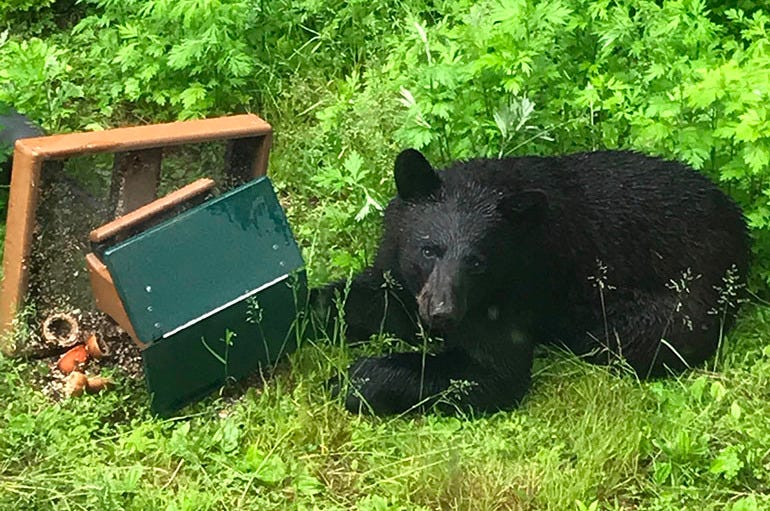
Bear conflicts across south-central Montana have more than doubled this year, and Red Lodge sits at the center of the problem, a state bear specialist told the City of Red Lodge Public Health and Safety Committee last week, warning that the town’s unsecured attractants — not the bears themselves — are driving the crisis. Attractants include trash, bird feeders, pet food and dirty barbeque grills.
Region 5 (consisting of Big Horn, Carbon, Fergus, Golden Valley, Meagher, Musselshell, Park, Petroleum, Stillwater, Sweet Grass, Treasure, Wheatland, and Yellowstone counties) has logged almost 400 bear conflicts so far in 2026, said Dan McHugh, a Montana Fish, Wildlife & Parks bear management specialist. The region recorded 150 for all of last year, he said.
Wildlife officers have euthanized eight bears (six black bears and two grizzlies) in Carbon County so far this year, seven bears within or near Red Lodge city limits, all for human-safety reasons — bears breaking into homes and vehicles or chasing people — not for raiding garbage, McHugh said. Rarely are bears relocated; however, two cubs were saved from euthanasia and relocated from the Red Lodge area this year when zoo space was found for them. Even so, he estimates three to four bears still move through Red Lodge on any given night.
Both grizzlies and black bears populate our area. McHugh said Red Lodge ranks among the worst communities in Montana for bear conflict — comparable, he said, to Jackson Hole in Wyoming and Durango in Colorado because citizens aren’t taking the precautions or developing the habits necessary to live safely in bear country.
Grizzly bears are no longer a rarity in the Red Lodge area or across Carbon County. McHugh says they have become a routine presence along the Beartooth Front, in town and out — and many residents still do not know it. “The Beartooth Front, and Red Lodge in particular, is grizzly bear country,” McHugh said. “There’s no ifs, ands or buts about that.” People need to recognize that “Red Lodge is on a bear highway” because the town is built along Rock Creek, providing the County’s prime bear habitat.
The bears, he said, are “pretty much ubiquitous now.” Few of them live in Carbon County alone. A grizzly’s home range is large enough that a single bear may spend part of a summer near Cooke City and part of it near Red Lodge. Along the Beartooth Front every drainage has recorded at least one grizzly sighting in the past 10 years.
He attributed a large part of this year’s surge in both bear species appearances in populated areas to poor natural food availability. Chokecherries are mediocre and huckleberries scarce, he said, leaving bears thinner and more willing to press into yards and alleys, particularly as they enter hyperphagia, the late-summer/early-fall feeding drive before hibernation.
McHugh’s central message is that residents, not the agency, hold the solution. Securing attractants inside a hard-sided building—in the case of trash until the morning of pickup—or in a working bear-resistant container would eliminate roughly 95% of the town’s bear problems, he said. He faulted noncompliance across the board, pushing back on the common assumption that short-term rentals are chiefly to blame. Full-time residents and businesses are just as often the source, he said, and alleys in some neighborhoods near downtown have become unsafe to walk at night, even with dogs.
Enforcement remains the gap. McHugh noted that he is not a law-enforcement officer and lacks the staff to respond to trash complaints, which he said must fall to the city. City officials said a compliance program is beginning, allowing officers to target problem alleys where open cans amount to “a buffet,” in one participant’s words.
Another problem is people regarding bears in populated areas as a wildlife sighting opportunity to be encouraged, photographed and shared on social media which habituates bears to humans, thereby signing their death warrant. Instead, it is recommended that if a bear is sighted making itself at home in a residential area that it be made uncomfortable with loud noises, paintball guns and bear spray. Bears are being spotted at all hours of the day and people are encouraged to carry bear spray in Red Lodge and while near any of the drainages, especially Rock Creek. Bears that are moseying through should be left alone.
Bird feeders were also pointed out as a major attractant and the success of bird feeding bans in decreasing conflicts in other states was discussed. It was agreed Montana communities have little reason to keep feeders out in summer. A bird feeder can hand a bear more fat, carbohydrates and protein than a garbage can does — a high-calorie reward with little to no work attached.
That reward teaches the wrong lesson. Bears learn to link homes, and then people, with an easy meal, no different from raiding garbage. Once a grizzly makes that connection, the specialist said, the stakes climb fast: a resident can step out the door to find a sow with cubs on the porch, a far more dangerous encounter than a black bear in the trash. He framed the long view simply: “A problem with a black bear now is a problem with a grizzly bear down the road.” Along the Beartooth Front, McHugh’s recommendation is direct: take bird feeders down from March 1 to Dec. 15, the months bears are active. If people want to attract birds to their yards during those months, the most beneficial way to do so for the birds, the environment and the bears is to plant vegetation that feeds them naturally.
Red Lodge is not the only community in Carbon County with issues. In communities such as Fromberg, Bridger and Roberts, where bear-resistant trash bins are scarce, bears work the full menu — garbage, pet food and feeders alike. The County now requires new subdivisions to require bear-resistant trash bins, but the remainder of the rural county is making their own provisions—or not.
Intentional feeding of deer, turkeys and other game animals is already illegal under state law, he said, though he noted that fines, generally starting around $100, do little to deter repeat offenders. Matt Heaton, the local game warden, has cited some residents more than once with little effect, McHugh said.
Residents worried about attractants on their own property can request a free site assessment from McHugh or the Region 5 bear technician. The visits, although they have to be worked in around his regular schedule, are the part of the job he likes best because it heads off trouble before a bear ever learns to come looking. You can contact him at dmchugh@mt.gov.
To learn more about living in bear country, specifically Red Lodge and Carbon County, please join FWP and City of Red Lodge at the Red Lodge Senior Center at 6:30 p.m. next Monday, August 24.

Comments
Nothing yet. Say the first thing.
Sign in to join the conversation.