
After nearly a decade of limited progress, RMB internationalisation appears to have re-accelerated since 2024. The context appears highly supportive of continued progress: the renminbi has been appreciating since last summer as China’s balance of payments has been persistently strong, and the renminbi might benefit at the margin as historical US allies are reconsidering their USD allocations. Moreover, the renminbi has already displaced the dollar as the dominant currency for Chinese trade credit in the span of a few years, as we have discussed in a previous note on this topic (see link and below chart).
In this note, we zoom in on three policy milestones in renminbi internationalisation since 2024. The official messaging points to a higher priority and has also become somewhat more specific. In a future note, we will discuss how onshore commentators conceptualise RMB internationalisation by reviewing 43 Chinese-language articles published since 2024.
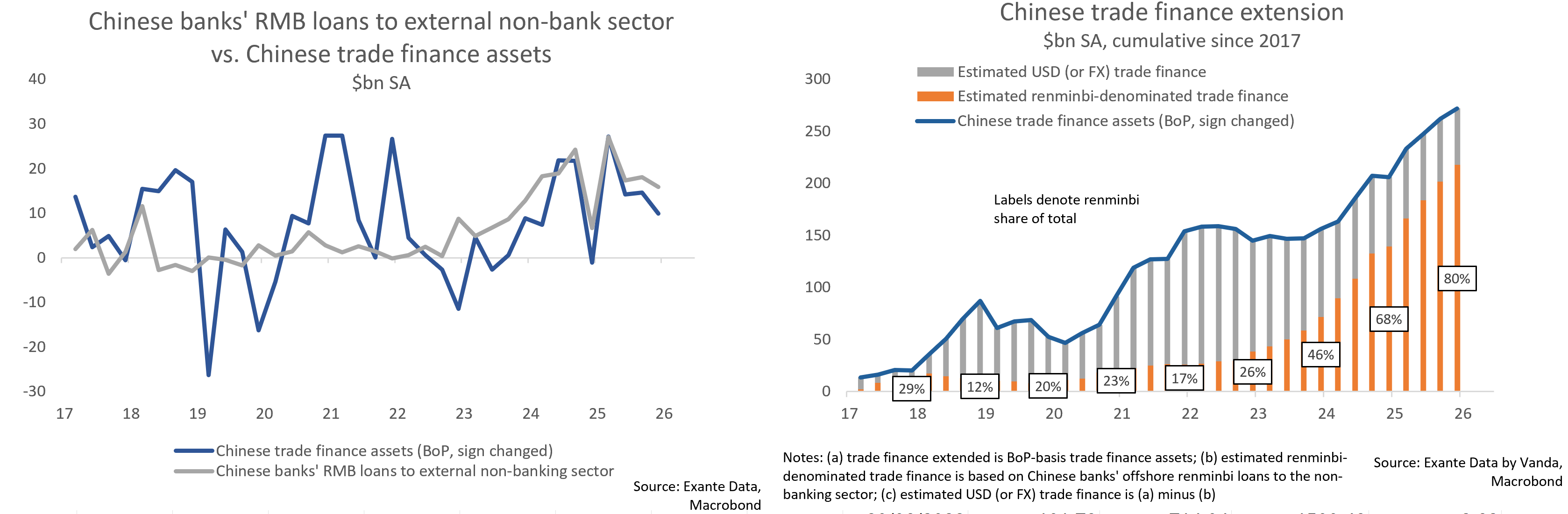
RMB internationalisation was a notable policy priority for Chinese authorities in the early 2010s, though the project slowed down from the mid-2010s amid capital outflow pressures. The theme has reemerged as a policy priority in China in recent years, particularly since 2024.
Renminbi internationalisation as a policy goal has grown in importance in the past few years, and thinking on the topic is becoming more concrete. Xi Jinping has begun to comment on the issue, and this is a strong signal and means that there is political backing for the project at the highest levels. The strong backing is also evident in the latest five-year plan, which gives RMB internationalisation greater prominence, and Xi Jinping’s January 2026 speech, which set out how RMB internationalisation will be measured.
1/ The current ‘wave’ of renminbi internationalisation began with a speech by Xi Jinping in January 2024. In the speech, Xi Jinping laid out how China should follow “the path of financial development with Chinese characteristics” to become a “strong financial country”. In the speech, Xi pointed out six components of this vision (”six strengths”), the first of which was a “strong currency”. More specifically, Xi argued that
A powerful sovereign currency is the cornerstone of financial strength. The RMB’s internationalisation has advanced steadily, rising to second place in global trade financing, and its international status continues to grow.
One way to frame the development here is that Xi frames the goal as moving from “a large financial nation” to a “strong financial nation”, and that having a strong currency is the first prerequisite for achieving this. The speech is, as is typical of high-level speeches, vague on what is actually meant by a “strong currency”.
2/ The next major policy signal came from the draft of the 15th Five-Year Plan, published in October 2025, a document that sets out the high-level goals for economic policy in the coming five years. We think the plan signals that the priority attached to RMB internationalisation has increased, and that the speed might increase.
A notable signal is that the section that mentions RMB internationalisation moved from the 11th to the 7th bullet; the listing of priorities is, in the world of Chinese political texts, a clear indicator of priority and means that authorities now view RMB internationalisation as more important than they did during the prior five-year plan period (2021-2025).
In terms of the specific comments, the plan mentions renminbi internationalisation only in the following sentence
“We should advance the internationalisation of the RMB, pursue greater openness of RMB capital accounts, and build a homegrown, risk-controllable cross-border RMB payment system”
The sentence is nearly identical to that in the 2021-2025 five-year plan, though the word “prudently [advance]” was dropped from the current plan. These texts are drafted with high political sensitivity, and we think the removal of “prudently” signals that authorities want the pace of renminbi internationalisation to increase.
It also seems clear that China wants to become less reliant on SWIFT, as the following was added: “build an independent and controllable RMB cross-border payment system”, which is more notable than the “Strengthen the construction of the RMB cross-border payment system” in the previous five-year plan.
We compared the final version of the current five-year plan, released on March 13th, 2026, and the prior five-year plan, and found that the differences between the two are similar to the differences between the draft versions.
3/ In January 2026, Xi Jinping argued in an important Communist Party journal that “a strong currency [should be] widely used in international trade, investment, and foreign exchange markets, with global reserve status” (link). That article has led to a revival in interest in renminbi internationalisation. While analysts have pointed to these dimensions following Xi’s 2022 speech, it is the first time that Xi has endorsed the operationalisation of what it means for a currency to be strong. As such, the article communicates a more specific goal than had been communicated before.
The article isn’t an unqualified call for internationalising the renminbi, and frames the goal of having a “strong currency” as one of six components of building a strong financial nation (the article is even titled “Follow the path of financial development with Chinese characteristics and build a strong financial nation”).
Looking ahead, we think ministries in Beijing and local governments are now operationalising the goals Xi set out in January: how to increase the role of the RMB in trade, investment, FX markets, and reserves. Historical experience suggests that, once such goals are set, officials will work hard to advance them. The easiest gains are likely to come in trade settlement and commodities where China plays a central role.
Yet while China’s bureaucracy is now likely working hard to execute on these top-level goals, the absence of a detailed blueprint makes the eventual outcome hard to anticipate. In a forthcoming note, we show that Chinese policy commentators are still in the process of defining what RMB internationalisation should mean operationally, and that multiple interpretations continue to coexist. RMB internationalisation may therefore be following China’s familiar gradualist-experimental policymaking model: the central leadership sets the broad direction, while officials experiment with and refine the practical details over time to suit local realities.
The above article is an excerpt of a longer note sent to clients of Exante Data. If you are interested in learning more about how Exante Data helps institutional investors generate alpha, get in touch with us at sales@vanda.com.
The content in this piece is partly based on proprietary analysis that Exante Data does for institutional clients as part of its full macro strategy and flow analytics services. The content offered here differs significantly from Exante Data’s full service and is less technical as it aims to provide a more medium-term policy relevant perspective. The opinions and analytics expressed in this piece are those of the author alone and may not be those of Exante Data Inc. or Exante Advisors LLC. The content of this piece and the opinions expressed herein are independent of any work Exante Data Inc. or Exante Advisors LLC does and communicates to its clients.
Exante Advisors, LLC & Exante Data, Inc. Disclaimer
Exante Data delivers proprietary data and innovative analytics to investors globally. The vision of exante data is to improve markets strategy via new technologies. We provide reasoned answers to the most difficult markets questions, before the consensus.
This communication is provided for your informational purposes only. In making any investment decision, you must rely on your own examination of the securities and the terms of the offering. The contents of this communication does not constitute legal, tax, investment or other advice, or a recommendation to purchase or sell any particular security. Exante Advisors, LLC, Exante Data, Inc. and their affiliates (together, “Exante”) do not warrant that information provided herein is correct, accurate, timely, error-free, or otherwise reliable. EXANTE HEREBY DISCLAIMS ANY WARRANTIES, EXPRESS OR IMPLIED.
Exante Data is a trading name of Vanda Research Limited which is an appointed representative of Messels Limited which is authorised and regulated by the Financial Conduct Authority.
No posts
Comments
Nothing yet. Say the first thing.
Sign in to join the conversation.